 Talmud Bavli
Bava Kamma 21b : Youtube
Daf TubeYoutube
2 video classes :
Bava Kamma Page 21b
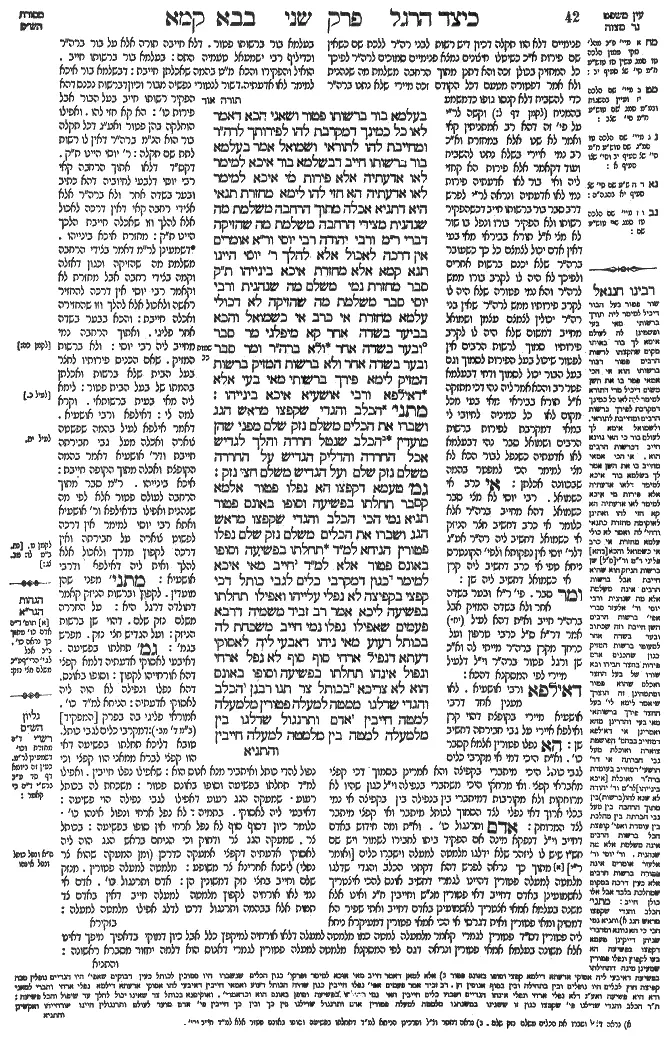
Bava Kamma 21b - Guemara
בעלמא בור ברשותו פטור ושאני הכא דאמר לאו כל כמינך דמקרבת להו לפירותך לרה"ר ומחייבת להו לתוראי ושמואל אמר בעלמא בור ברשותו חייב דבשלמא בור איכא למימר לאו אדעתיה אלא פירות מי איכא למימר לאו אדעתיה הא חזי להו לימא מחזרת תנאי היא דתניא אכלה מתוך הרחבה משלמת מה שנהנית מצידי הרחבה משלמת מה שהזיקה דברי ר"מ ורבי יהודה רבי יוסי ור"א אומרים אין דרכה לאכול אלא להלך ר' יוסי היינו תנא קמא אלא מחזרת איכא בינייהו ת"ק סבר מחזרת נמי משלם מה שנהנית ורבי יוסי סבר משלמת מה שהזיקה לא דכולי עלמא מחזרת אי כרב אי כשמואל והכא בביער בשדה אחר קא מיפלגי מר סבר (שמות כב, ד) ובער בשדה אחר ולא ברה"ר ומר סבר ובער בשדה אחר ולא ברשות המזיק ברשות המזיק לימא פירך ברשותי מאי בעי אלא דאילפא ורבי אושעיא איכא בינייהו:
מתני׳ הכלב והגדי שקפצו מראש הגג ושברו את הכלים משלם נזק שלם מפני שהן מועדין הכלב שנטל חררה והלך לגדיש אכל החררה והדליק הגדיש על החררה משלם נזק שלם ועל הגדיש משלם חצי נזק:
גמ׳ טעמא דקפצו הא נפלו פטור אלמא קסבר תחלתו בפשיעה וסופו באונס פטור תניא נמי הכי הכלב והגדי שקפצו מראש הגג ושברו את הכלים משלם נזק שלם נפלו פטורין הניחא למ"ד תחלתו בפשיעה וסופו באונס פטור אלא למ"ד חייב מאי איכא למימר כגון דמקרבי כלים לגבי כותל דכי קפצי בקפיצה לא נפלי עלייהו ואפילו תחלתו בפשיעה ליכא אמר רב זביד משמיה דרבא פעמים שאפילו נפלו נמי חייב משכחת לה בכותל רעוע מאי ניהו דאבעי ליה לאסוקי דעתא דנפיל ארחי סוף סוף לא נפל ארחי ונפול אינהו תחלתו בפשיעה וסופו באונס הוא לא צריכא בכותל צר תנו רבנן הכלב והגדי שדלגו ממטה למעלה פטורין מלמעלה למטה חייבין אדם ותרנגול שדלגו בין מלמעלה למטה בין מלמטה למעלה חייבין
Comments from Rashi on Masechet Bava Kamma Page 21b
בעלמא בור ברשותו פטור . דלא חייבה תורה אלא על בור ברה"ר וכדיליף רבי ישמעאל טעמיה התם: בעלמא בור ברשותו חייב . הואיל והפקירו והכא מ"ט בהמה שאכלתן חייבת: דבשלמא בור איכא למימר לאו אדעתיה . דשור לנטורי נפשיה מבור וכיון דברשות נכנס דהא הפקיר רשותו חייב בעל הבור אבל פירות כו': הא קא חזי להו . ואפילו הוחלקה בהן פטור ואע"ג דכל תקלה בור הוא הנ"מ ברה"ר דאין לו רשות לתת שם תקלה: ר' יוסי היינו ת"ק . דקס"ד דלאו אתוך הרחבה קאי רבי יוסי דלבעי לחיוביה דהא כתיב ובער בשדה אחר ולא ברה"ר אלא אצידי רחבה קאי דאין דרכה לאכול אלא להלך וזו שאכלה חייבת הלכך היינו ת"ק: מחזרת איכא בינייהו . דשמעינן לר"מ דאמר בצידי הרחבה משלמת מה שהזיקה וכגון דאזלה וקמה בצידי רחבה אבל מחזרת לא וקאמר רבי יוסי אין דרכה להחזיר ראשה ולאכול אלא להלך וזו שהחזירה ואכלה חייבת: איכא בינייהו . ר"מ סבר מתוך הרחבה לעולם פטור אלא לפי מה שנהנית ואפילו בדאילפא ור' אושעיא ואתא רבי יוסי למימר אין דרכה לפשוט צוארה על חבירתה ואין דרכה לקפוץ מדרך ולאכול אלא להלך ואית ליה דאילפא ודרבי אושעיא: והכא בבער בשדה אחר פליגי . ואתוך הרחבה נמי מחייב ליה רבי יוסי: ולא ברשות המזיק . שאם הכניס פירותיו לחצר בעל הבית שלא ברשות ואכלתן בהמתו של בעל הבית פטור: לימא ליה מאי בעית ברשותאי . וקרא למה לי: דאילפא ורבי אושעיא . דאמר אילפא לעיל בהמה שפשטה צוארה ואכלה מעל גבי חבירתה חייבת ודר' אושעיא דאמר בהמה הקופצת ואכלה מתוך הקופה חייבת: מתני' מפני שהן מועדין . לקפוץ וברשות הניזק קאמר דתולדה דרגל היא: על החררה משלם נזק שלם . דהוי שן ברשות הניזק: ועל הגדיש חצי נזק . מפרש בגמ': גמ' תחלתו בפשיעה . דאיבעי לאסוקי אדעתיה דלמא קפצי דהא אורחייהו לקפוץ: הניחא למ"ד כו' . אמוראי פליגי בה בפרק [המפקיד] (ב"מ ד' מב.): וסופו באונס . דהא נפלו ונפילה לא הוה ליה לאסוקי אדעתיה: דמקרבי כלים לגבי כותל . טובא דליכא תחלתו בפשיעה דאי הוו קפצי לברא ממאני הוו קפצי וכי נפול להדי כותל ואיתביר מנא אנוס הוא: שאפילו נפלו חייבין . ואפילו למ"ד תחלתו בפשיעה וסופו באונס פטור: משכחת לה בכותל רעוע . שמעקה הגג רעוע דאפילו לגבי נפילה הוי פשיעה: דאיבעי ליה לאסוקי . בתמיה: לא נפל ארחי ונפול אינהו כו' . כלומר כיון דסוף סוף לא נפל ארחי אין סופו בפשיעה: בכותל צר . שמעקה הגג צר ודחוק וכי הניחם בראש הגג הוה ליה לאסוקי אדעתיה דקפצי אמעקה כדרכן (ומן המעקה שהוא צר נפלי) לישנא אחרינא צר משופע: מלמטה למעלה פטורין . מנזק שלם וחייב בחצי נזק דמשונין הן: אדם ותרנגול כו' . אדם אי נמי לאו אורחיה לקפוץ מלמטה למעלה חייב דאין באדם צד תמות אלא בבהמה ותרנגול דרכו לדלג אפילו מלמטה למעלה:
Comments from Tosafot - Bava Kamma 21b
אי כרב אי כשמואל . רבי יוסי לא מצי סבר כשמואל דהא מחייב ברה"ר אלא כלומר אי כרב דחשיב חצר הניזק אי כשמואל דחשיב ליה רה"ר אע"ג דלר' יוסי אין נפקותא ולפי' הקונטרס ניחא טפי אי כרב דחשיב ליה קרן אי כשמואל דחשיב ליה שן: ומר סבר . פי' ר"א ובער בשדה אחר ולא בשדה המזיק אבל ברה"ר חייב וא"ת דהא לעיל (בבא קמא יח.) אמר דר"א ס"ל כרבי טרפון ועל כרחך מקרן ברה"ר מייתי לה וא"כ שן ורגל פטור ברה"ר וי"ל דלעיל מיירי לפי המסקנא דהכא: דאילפא ורבי אושעיא . לאו מענין אחד דרבי אושעיא מיירי בקופצת דהוי קרן ואילפא איירי על גבי חבירתה דחשיב שן: הא נפלו פטורין אלמא קסבר כו' . וא"ת היכי דמי אי מקרבי כלים לגבי כותל היכי מיתברי בקפיצה והא אמרינן בסמוך דכי קפצי מאבראי קפצי ואי מרחקי היכי משתברי בנפילה וי"ל כגון שהיו לא מרוחקות ולא מקורבות דמיתברי בין בנפילה בין בקפיצה אי נמי בכלי ארוך דאי נפלי לצד הסמוך לכותל מיתבר ואי קפצי מיתבר לצד המרוחק: אדם ותרנגול כו' . וא"ת ומה חידוש באדם דחייב וי"ל דנפקא מינה אם הפקיד ביתו לחבירו לשמור ויש שם חש"ו שיש לו ליזהר שלא ידלגו מלמטה למעלה וישברו כלים [ואומר ר"י] מתוך כך נראה לפרש דהא דקתני הכלב והגדי שדלגו מלמטה למעלה פטורין דהיינו לגמרי דחשיב אונס להכי איצטריך לאשמועינן באדם דחייב דאי פטורין מנ"ש וחייבין ח"נ ואינו אלא משנה בעלמא אמאי אצטריך לאשמועינן באדם דחייב ואתי שפיר הא דמסיק ומאי פטורין ואית דגרסי אי הכי אמאי פטורין דמעיקרא ניחא ליה פטורין דס"ד פטורין לגמרי קאמר מלמעלה למטה כמו מלמטה למעלה דלאו אורחיה למיקפץ כלל אבל כיון דמוקי בדאפיך מיפך דאינו אלא משונה בעלמא אמאי פטורין ונראה דגם לפי המסקנא מלמטה למעלה פטורין לגמרי דאנוס הוא דלמה יחזור מסברא ראשונה:
Bava Kamma 21b - Mishnah translated into english
that usually, if one digs a pit within his own property and he then declares his property to be ownerless, he is exempt, as he dug the pit when the property was his. But here it is different, because here the owner of the animal can say to the owner of the produce: It is not all in your power to bring your produce close to the public domain and to also hold my ox liable for eating it.
And Shmuel can say: Usually, if one digs a pit or creates an obstacle that can cause damage within his own property and he then declares his property to be ownerless, he is liable for any damage that is caused by the pit. As with regard to the pit, granted, it is possible to say that he was not aware, meaning the injured party was not thinking about the possibility that there may be a pit there that could cause him harm, and therefore the one who dug the pit is liable. But with regard to produce that is spread out over the ground, can it be said that the animal was not aware of it? It cannot be, because the animal sees the produce.
The Gemara suggests: Let us say that actually, the amoraic dispute about an animal that turns its head and eats produce at the side of the road is the subject of a dispute between tanna’im. As it is taught in a baraita: If an animal ate produce from the public square, the owner of the animal pays for the benefit that the animal derived; but if it ate from the sides of the public square, he pays for that which it damaged. This is the statement of Rabbi Meir and Rabbi Yehuda. But Rabbi Yosei and Rabbi Elazar say: It is not typical for an animal to eat in the public domain but only to walk there. Consequently, the owner is liable.
Initially, the Gemara understands Rabbi Yosei’s opinion as also referring to a situation in which the animal eats from the sides of the public square, and since this is so, it seems that the opinion of Rabbi Yosei is the same as that of the first tanna, Rabbi Meir, and the mishna presents their opinions as differing. Rather, it is clear that there is a difference between them with regard to a case in which the animal turns its head to eat. The first tanna holds that with regard to an animal that turns its head, the owner of the animal also pays for the benefit that the animal derived, while Rabbi Yosei holds that he pays for that which it damaged.
The Gemara rejects this: No, it is possible to say that everyone agrees about the halakha in the case of an animal that turns its head, either in accordance with the opinion of Rav or in accordance with the opinion of Shmuel. And here they disagree about the exemption inferred from the verse: “It consumed in the field of another” (Exodus 22:4), which renders the owner of an animal liable for damage classified as Eating. One Sage, Rabbi Meir, holds that only if it ate from private property is its owner liable, as the verse stating the owner’s liability means: “And it consumed in the field of another,” but not when it eats in the public domain. And one Sage, Rabbi Yosei, holds it means that even if it ate from the public domain its owner is liable, as the verse stating the owner’s liability means: “And it consumed in the field of another,” but not when it eats in the domain of the one responsible for the damage; only if the animal ate produce of another that was on the property of the animal’s owner, is its owner exempt.
The Gemara challenges this: But not when it eats in the domain of the one responsible for the damage? What is the novelty in this statement? Let the owner of the animal say to the owner of the produce: What is your produce doing on my property? The owner would certainly not be liable if the produce is damaged in that case. Rather, it must be that the difference between them is with regard to the dispute between Ilfa and Rabbi Oshaya concerning an animal that ate produce from the back of another animal or the like. Rabbi Meir holds that one is never liable for damage classified as Eating in the public domain, even if his animal ate from the back of another, and Rabbi Yosei holds that if it ate off the back of another animal, this is equivalent to Eating from the property of the injured party.
MISHNA: With regard to a dog or a goat that jumped from a rooftop and broke vessels while doing so, their owners must pay the full cost of the damage to the vessels because these animals are deemed forewarned concerning to jumping. With regard to a dog that took a cake that had been baked directly on hot coals, and went to a stack of grain to eat it, and it ate the cake and at the same time ignited the stack of grain with a coal that it had taken along with the cake, the owner of the dog must pay the full cost of the damage for the cake, and he must pay for half the cost of the damage to the stack of grain.
GEMARA: The Gemara infers from the mishna: The reason the owners must pay the full cost of the damage is because the animals jumped off the rooftop. This indicates that if they fell off the roof, they would be exempt from all liability despite his obligation to keep them from climbing onto the roof and jumping down from there. Apparently, the tanna holds that in an incident that begins with negligence, meaning carelessness or even an intention to cause damage, and ends in an accident, the one who caused the damage is exempt, as in this case the owner was careless in allowing the animals to go to the rooftop, but since they did not jump off the roof but rather fell accidentally, he is exempt.
The Gemara notes: This is also taught in a baraita: If a dog or a goat jumped from a rooftop and broke vessels while doing so, their owners must pay the full cost of the damage. If they fell from there, they are exempt from all liability. The Gemara asks: This works out well according to the one who says that if an incident begins with negligence and ends in an accident, the one who caused the damage is exempt, but according to the one who says that in such a case he is liable, what can be said? It seems that this baraita constitutes conclusive proof against that opinion.
The Gemara answers: The case in the baraita is a case where the vessels were brought close to the wall by their owners, so that when the animals jump off the rooftop in an ordinary leap they do not fall on top of them, and the vessels broke because the animal fell and didn’t jump. And since in an ordinary circumstance no damage should occur, this case does not even begin with negligence. Since the damage was caused by falling, the entire case is ruled an accident.
Rav Zevid said in the name of Rava: Sometimes one can be obligated to pay even in a case where the animals fell from the wall of their owner’s house. You find such a case where the wall was unstable, and the owner was negligent in allowing the animals to go up to the roof due to the danger of the wall collapsing. The Gemara asks: What is the reason for this? Is it because it should have occurred to him that bricks may fall from the wall and break the vessels? But ultimately, no bricks fell and instead the animals fell, so this is actually a case that begins with negligence and ends in an accident. The Gemara answers: No, it is necessary to state this halakha with regard to a case of a narrow wall, in which case it is clear that if they climb up there they will fall, and that is why he is liable for the damage they cause by falling.
The Sages taught in a baraita: If a dog or a goat jumped from below to something that was above them and thereby caused damage, their owners are exempt, as this is atypical behavior. But if they jumped from above to below, their owners are liable to pay the full cost of any damage they cause, as this is typical behavior. If a person or a chicken jumped and broke something, regardless of whether they jumped from above to below or from below to above, they are liable.
Traduction : The William Davidson digital edition of the Koren Noé Talmud, with commentary by Rabbi Adin Even-Israel Steinsaltz.
Bava Kamma 21b : Significance
Next step
Finished studying Bava Kamma 21b? Carry on with the rest of the tractate.
Study Bava Kamma 22aFrequently asked questions: Bava Kamma 21b
Where is Bava Kamma 21b in tractate Bava Kamma?
Bava Kamma 21b is page 40 of 236 in tractate Bava Kamma (Seder Nezikin).
When is daf 21 of Bava Kamma studied in Daf Yomi?
Daf Yomi covers one daf a day, both sides. Daf 21 of Bava Kamma will be studied on April 26, 2031.
Is there a video class on Bava Kamma 21b?
Yes, by Daf Tube, Rabbi Dr. Moshe Weisblum. These classes were published on YouTube by their authors and are gathered on this site.
What is tractate Bava Kamma about?
The Masechet Baba Kama is the first tractate of the Seder Nezikin. The Baba Kama gemara is the study of laws relating to the general aspects and specific orders of tort liability without criminal intent. As well as criminal damage, whether it be theft, violence or burglary The Baba Kama tractate is a gemara which contains 10 chapters.
Your study is also dedicated to them
- L'ilui Nishmat Yechayahou ben Moche
- L'ilui Nishmat Ledicia bat David Banoun
- L'ilui Nishmat Margalit bat Ledicia