 Talmud Bavli
Bava Kamma 20b : Youtube
Daf TubeYoutube
2 video classes :
Bava Kamma Page 20b
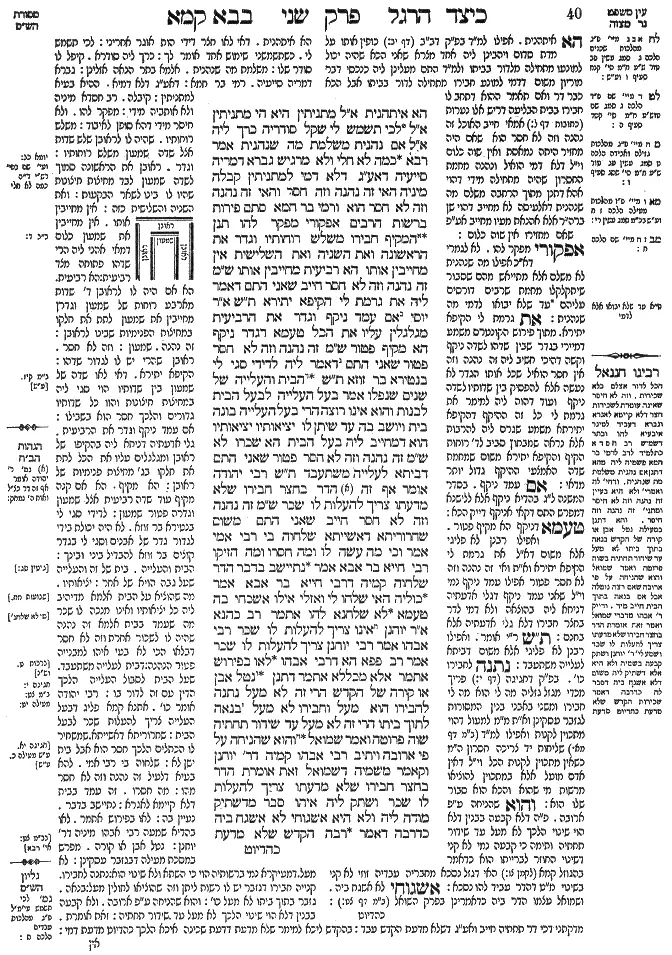
Bava Kamma 20b - Guemara
הא איתהנית א"ל מתניתין היא הי מתניתין א"ל לכי תשמש לי שקל סודריה כרך ליה א"ל אם נהנית משלמת מה שנהנית אמר רבא כמה לא חלי ולא מרגיש גברא דמריה סייעיה דאע"ג דלא דמי למתניתין קבלה מיניה האי זה נהנה וזה חסר והאי זה נהנה וזה לא חסר הוא ורמי בר חמא סתם פירות ברשות הרבים אפקורי מפקר להו תנן המקיף חבירו משלש רוחותיו וגדר את הראשונה ואת השניה ואת השלישית אין מחייבין אותו הא רביעית מחייבין אותו ש"מ זה נהנה וזה לא חסר חייב שאני התם דאמר ליה את גרמת לי הקיפא יתירא ת"ש א"ר יוסי אם עמד ניקף וגדר את הרביעית מגלגלין עליו את הכל טעמא דגדר ניקף הא מקיף פטור ש"מ זה נהנה וזה לא חסר פטור שאני התם דאמר ליה לדידי סגי לי בנטירא בר זוזא ת"ש הבית והעלייה של שנים שנפלו אמר בעל העלייה לבעל הבית לבנות והוא אינו רוצה הרי בעל העלייה בונה בית ויושב בה עד שיתן לו יציאותיו יציאותיו הוא דמחייב ליה בעל הבית הא שכרו לא ש"מ זה נהנה וזה לא חסר פטור שאני התם דביתא לעלייה משתעבד ת"ש רבי יהודה אומר אף זה הדר בחצר חבירו שלא מדעתו צריך להעלות לו שכר ש"מ זה נהנה וזה לא חסר חייב שאני התם משום שחרוריתא דאשייתא שלחוה בי רבי אמי אמר וכי מה עשה לו ומה חסרו ומה הזיקו רבי חייא בר אבא אמר נתיישב בדבר הדר שלחוה קמיה דרבי חייא בר אבא אמר כוליה האי שלחו לי ואזלי אילו אשכחי בה טעמא לא שלחנא להו אתמר רב כהנא א"ר יוחנן אינו צריך להעלות לו שכר רבי אבהו אמר רבי יוחנן צריך להעלות לו שכר אמר רב פפא הא דרבי אבהו לאו בפירוש אתמר אלא מכללא אתמר דתנן נטל אבן או קורה של הקדש הרי זה לא מעל נתנה לחבירו הוא מעל וחבירו לא מעל בנאה לתוך ביתו הרי זה לא מעל עד שידור תחתיה שוה פרוטה ואמר שמואל והוא שהניחה על פי ארובה ויתיב רבי אבהו קמיה דר' יוחנן וקאמר משמיה דשמואל זאת אומרת הדר בחצר חבירו שלא מדעתו צריך להעלות לו שכר ושתק ליה איהו סבר מדשתיק מודה ליה ולא היא אשגוחי לא אשגח ביה כדרבה דאמר רבה הקדש שלא מדעת
Comments from Rashi on Masechet Bava Kamma Page 20b
הא איתהנית . דאי לאו חצר דידי הות אוגר אחריני: לכי תשמש לי . כשתשמשני שימוש אחד אומר לך: כרך ליה סודרא . קיפל לו סודר שלו: משלמת מה שנהנית . אלמא בתר הנאה אזלינן: גברא דמריה סייעיה . רמי בר חמא: דאע"ג דלא דמיא . ההיא בעיא למתניתין: קיבלה . רב חסדא מיניה ולא אותביה מידי: מפקר להו . ולא חיסר מידי דהא סופן לאיבוד: משלש רוחותיו . שהיה לו לראובן שלש שדות אצל שדה שמעון משלש רוחותיו: וגדר . ראובן את הראשונה סמוך לשדה שמעון לבד מחיצות חיצונות שהיו לו בינו לשאר הבקעות: ואת השניה והשלישית כזה:  אין מחייבין אותו . אין מחייבין את שמעון כלום דמאי אהני ליה הרי שדהו פתוחה מצד רביעית: הא רביעית . הא אם היה לו לראובן ד' שדות מארבע רוחות של שמעון וגדרן מחייבין את שמעון לתת את חלקו במחיצות הפנימיות שבינו לראובן: זה נהנה . שמעון: וזה לא חסר . ראובן שהרי יש לו לגדור שדהו: הקיפא יתירא . דאי לאו שדה של שמעון בין שדותיו הוי סגי ליה במחיצות חיצונות והוו כל שדותיו גדורים והלכך חסר הוא בשבילו: אם עמד ניקף וגדר את הרביעית . גלי אדעתיה דניחא ליה בהקיפו של ראובן ומגלגלים עליו את הכל לתת את חלקו בג' מחיצות פנימיות של ראובן: הא מקיף . הא אם קנה מקיף עוד שדה רביעית אצל שמעון וגדרה פטור שמעון: לדידי סגי לי בנטירא בר זוזא . לא היה יכולת בידי לגדור גדר של אבנים וסגי לי בגדר קוצים בר זוזא להבדיל ביני ובינך: הבית והעלייה . בית של זה והעלייה שעל גבה הויא של אחר: יציאותיו . מה שהוציא על הבית אלמא מדיהיב ליה כל יציאותיו ואינו מנכה לו שכר מה שעמד בבית אלמא זה נהנה שהיה לו לשכור אחרת וזה לא חסר דבלאו הכי לא בעי איהו למבנייה פטור הנהנה: דבית לעלייה משתעבד . שעל הבית לסבול העלייה הלכך הדין עם זה לדור בו: רבי יהודה אומר כו' . אתנא קמא פליג דבעל העלייה צריך להעלות שכר לבעל הבית: שחרוריתא דאשייתא . שמשחיר לו הכתלים הלכך חסר הוא אבל בית ישן לא: שלחוה בי רבי אמי . להא בעיא דלעיל זה נהנה וזה לא חסר מהו: מה חסרו . זה עמד בבית דלא קיימא לאגרא: נתיישב בדבר . נעיין בה: לאו בפירוש אתמר . לאו בהדיא שמעה רבי אבהו מיניה דר' יוחנן: נטל אבן או קורה . מפרש במסכת מעילה דבגזבר עסקינן: לא מעל . דמעיקרא נמי ברשותיה הוי כי השתא ולא שינוי הוא: נתנה לחבירו . קנייה חבירו דגזבר יש לו רשות ליתן וזה שהוציאו לחולין מעל: בנאה . גזבר בתוך ביתו לא מעל כו': והוא שהניחה ע"פ ארובה . ולא קבעה בבנין דלא הוי שינוי הלכך לא מעל עד שידור תחתיה: זאת אומרת . מדקתני דכי דר תחתיה חייב ואע"ג דשלא מדעת הקדש עבד: בהקדש ליכא למימר שלא מדעת דדעת שכינה איכא הלכך כהדיוט מדעת דמי:
Comments from Tosafot - Bava Kamma 20b
הא איתהנית . אפילו למ"ד בפ"ק דב"ב (דף יב:) כופין אותו על מדת סדום ויהבינן ליה אחד מצרא שאני הכא שהיה יכול למונעו מתחילה מלדור בביתו ולמ"ד התם מעלינן ליה כנכסי דבר מוריון משום דדמי למונע חבירו מתחילה לדור בביתו אבל הכא כבר דר. ואם תאמר ההוא דתחב לו חבירו בבית הבליעה דריש אלו נערות (כתובות דף ל:) אמאי חייב האוכל זה נהנה וזה לא חסר הוא שאם היה מחזיר היתה נמאסת ואין שוה כלום וי"ל דלא דמי הואיל ונהנה מחמת החסרון שהיה מתחילה מידי דהוי אהא דתנן מתוך הרחבה משלם מה שנהנית דאלעיסה לא מחייב דהוי שן ברה"'ר אלא אהנאת מעיו מחייב אע"פ שאם מחזירו אין שוה כלום: אפקורי מפקר להו . לא לגמרי דא"כ אפילו מה שנהנית לא משלם אלא מתייאש מהם שסבור שיתקלקלו מחמת שרבים דורסים עליהם עד שלא יבואו לדמי מה שנהנית: את גרמת לי הקיפא יתירא . מתוך פירוש הקונטרס משמע דמיירי בגדר שבין שדהו לשדה ניקף וקשה דהיכי חשיב ליה זה נהנה וזה אין חסר הואיל שכל אותו הגדר לא נעשה אלא להפסיק בין שדותיו לשדה ניקף ועוד דהוה ליה למימר את גרמת לי כל זה ההיקף דהקיפא יתירתא משמע שגרם ליה להרבות אלא נראה שמבחוץ סביב לד. רוחות הקיף והקיפא יתירא משום שמחמת שדה האמצעי ההיקף גדול יותר מדאי: אם עמד ניקף . בסדר המשנה ל"ג בהדיא ניקף אלא ללישנא דמפרש התם דקאי אניקף דייק הכא: טעמא דניקף הא מקיף פטור . ואפילו רבנן לא פליגי אלא משום דא"ל את גרמת לי הקיפא יתירא וא"ת ואי זה נהנה וזה לא חסר פטור אפילו עמד ניקף נמי וי"ל שאני עמד ניקף דגלי אדעתיה דניחא ליה בהוצאה ולא דמי לדר בחצר חבירו דלא גלי אדעתיה אלא בחנם: ת"ש ר"י אומר . ואפילו רבנן לא פליגי אלא משום דביתא לעלייה משתעבד: נתנה לחבירו כו' . בפ"ק דחגיגה (דף י:) פריך מכדי מגזל גזליה מה לי הוא מה לי חבירו ומשני באבני בנין המסורות לגזבר עסקינן וא"ת מ"מ למעול דהוי מתכוין לקנות ואפילו למ"ד (ב"מ דף מא.) שליחות יד צריכה חסרון ה"מ כשאין מתכוין לקנות הכל וי"ל דאין אדם מועל אלא במתכוין להוציאו מרשות מי שהוא והכא הוא סבור שלו הוא: והוא שהניחה ע"פ ארובה . פ"ה דלא קבעה בבנין דלא הוי שינוי הלכך לא מעל עד שידור תחתיה ותימה כי קבעה נמי לא קני דשינוי החוזר לברייתו הוא כדאמר בהגוזל קמא (לקמן בבא קמא צו:) האי דגזל נסכא מחבריה עבדיה זוזי לא קני בשינוי מ"ט דהדר עביד להו נסכא: אשגוחי לא אשגח ביה . ושמואל עצמו הדר ביה כדאמרינן בפרק השואל (ב"מ דף צט:):
Bava Kamma 20b - Mishnah translated into english
You have derived benefit from my property, as by living there you saved the money you otherwise would have had to pay in order to rent out a different courtyard, and therefore you must pay me for the benefit you derived.
Rami bar Ḥama said to him: This dilemma is not new; rather, it is discussed in the mishna, and the mishna already provided a solution. Rav Ḥisda asked him: To which mishna are you referring? Rami bar Ḥama said to him: After you serve me, I will tell you. Rav Ḥisda took hold of Rami bar Ḥama’s scarf [suderei] and folded it, as an act of service. Rami bar Ḥama then said to him: This is the mishna: If the animal derives benefit, the owner of the animal pays for the benefit that the animal derived. This demonstrates that one who derives benefit must pay for the benefit he derives, even if the injured party is not entitled to payment for his loss.
Rava said: How little does a man who has the assistance of his Lord have to worry or be concerned about the possibility that his opinion may not be accepted, as even though the dilemma that was raised is in fact not similar to the case in the mishna quoted by Rami bar Ḥama, Rav Ḥisda nevertheless accepted it from him. This case in the mishna, about the animal eating produce in the public domain, is where this one derives benefit and that one suffers a loss, and that case of the squatter living in the courtyard, is where this one derives benefit and that one does not suffer a loss.
The Gemara asks: And what does Rami bar Ḥama think? Why does he equate the two cases? The Gemara explains: He holds that if produce is left in the public domain without specification with regard to its ownership, it is assumed that the owner has rendered it ownerless. The owner does not expect to derive benefit from the produce, and therefore when the animal ate it he suffered no loss. Consequently, it is a case where this one derives benefit and that one does not suffer a loss, and it is comparable to the case of the squatter in the courtyard.
The Gemara attempts to cite conclusive evidence from another case: We learned in a mishna (Bava Batra 4b): If one’s fields surround the fields of another on three sides, and he fenced in the first, the second, and the third field, thereby providing protection also to the other man’s field, the court does not obligate the owner of the inner field to share in the costs of the fence, as he can claim that he does not derive benefit from it, since his field remains exposed on the fourth side. The Gemara infers: But this indicates that if his fields surrounded the inner field on all four sides, and the owner of the outer fields fenced the field on the fourth side as well, the court does obligate the owner of the inner field to share in the expenses.
The Gemara suggests: Conclude from the mishna that where this one derives benefit and that one does not suffer a loss, the one who derives benefit is obligated to pay for that benefit. In this case, the owner of the inner field benefits from the fence while the owner of the outer field does not suffer a loss, because in any event he would have needed to build those fences, and the owner of the inner field is obligated to share in the expense. The Gemara rejects this: It is different there because the owner of the outer field can say to the owner of the inner field: Your field caused me to have to build the fence with a larger circumference than I would have otherwise needed to had your field not been there, and therefore your field caused me an additional expense. This case is therefore similar to those where this one derives benefit and that one suffers a loss.
The Gemara attempts another resolution: Come and hear a proof from the continuation of that mishna. Rabbi Yosei said: If the owner of the surrounded, i.e., inner, field arose and enclosed the fourth side on his own, the court imposes upon him the obligation to pay his share of all of it, as through his actions he demonstrated that he was interested in having the fence installed. The Gemara infers from this: The reason the court imposes upon him the obligation to pay his share of all of it is because the owner of the surrounded field arose and enclosed the fourth side himself. By inference, had the owner of the surrounding field built the fourth fence, the owner of the inner field would be exempt.
The Gemara suggests: Conclude from the mishna that where this one derives benefit and that one does not suffer a loss, the one who derives benefit is exempt. The Gemara rejects this: It is different there because the owner of the inner field can say to the owner of the surrounding fields: For me, the protection of a fence worth a dinar would have been sufficient; I did not wish to pay for such an expensive fence.
The Gemara attempts another resolution: Come and hear a proof from a mishna (Bava Metzia 117a): If a house and its upper story, which belonged to two separate people, collapsed, necessitating that the entire structure be rebuilt, and the owner of the upper story told the owner of the lower story of the house to build the lower story again so that he could rebuild the upper story, but the owner of the lower story does not want to do so, the owner of the upper story may build the lower story of the house and live in it until the owner of the lower story will pay him for his expenses, and only then will he be required to vacate the lower story of the house and build the upper story.
The Gemara infers: It is all of his expenses that the owner of the lower story of the house is obligated to pay him, and he does not subtract from the amount compensation for rent for the time that the owner of the upper story lived in the lower story of the house. Conclude from the mishna that where this one derives benefit and that one does not suffer a loss, the one who derives benefit is exempt, as the owner of the upper story derived benefit from living in the lower story, while the owner of the lower story did not suffer a loss, since he said he did not need it. The Gemara rejects this proof: It is different there because the lower story of the house is subjugated to the upper story, because it also serves as the foundation of the upper story, and therefore the owner of the lower story of the house is obligated to provide lodging to the owner of the upper story in the interim.
The Gemara attempts another resolution. Come and hear a proof from the continuation of the mishna, in which Rabbi Yehuda disagrees with the first tanna and holds that the owner of the upper story may not reside in the lower story of the house without payment. Rabbi Yehuda says: A proof that the owner of the upper story must pay rent is from the halakha that even this one who resides in another’s courtyard without his knowledge must pay him rent. Conclude from the mishna that when this one derives benefit and that one does not suffer a loss, the one who derives benefit is obligated to pay. The Gemara rejects this: It is different there, as there it is possible to claim that the owner of the lower story suffers a loss due to the blackening of the walls, as when a person lives in a home, the value of the house depreciates due to the use.
This dilemma was not successfully resolved so they sent it to the academy of Rabbi Ami to ask his opinion. Rabbi Ami said: And what did this squatter do to the owner? What loss did he cause him? How did he damage him? Rav Ami holds that if this one derives benefit and that one does not suffer a loss, no payment is necessary. When asked about this dilemma, Rabbi Ḥiyya bar Abba said: Let us consider the matter. After waiting and not receiving a response they sent the question to Rabbi Ḥiyya bar Abba again. He said: They keep sending me this dilemma; had I found a response to their question, would I not have sent them a reply? They should have realized that Rabbi Ḥiyya bar Abba did not have an answer for them.
It was stated that the amora’im discussed this matter: Rav Kahana says that Rabbi Yoḥanan says: He need not pay him rent, and Rabbi Abbahu says that Rabbi Yoḥanan says: He must pay him rent.
Rav Pappa said: This statement of Rabbi Abbahu, citing Rabbi Yoḥanan, was not stated explicitly; rather, it was stated from an inference that Rabbi Abbahu drew from something that Rabbi Yoḥanan said in a different context. As we learned in a mishna (Me’ila 5:4): If the treasurer of consecrated property took for himself a stone or a cross beam that had been consecrated, he has not violated the prohibition of misuse of consecrated property. This is because his act of taking the stone or the beam has not effectively removed it from within the jurisdiction of Temple property, as any item under his control is in the possession of the Temple treasury.
If the treasurer gave it to another as a gift, he has then misused consecrated property, as he removed it from the possession of the Temple and conveyed it into the possession of another. But the other man, who received the item, has not misused a consecrated item until he actually uses the item. If the treasurer himself built it into his house, he has not violated the prohibition of misuse of consecrated property until he has lived beneath it for an amount of time worth one peruta.
And Shmuel said: And this is the halakha provided that he placed it over the skylight, as were he to have built it into the actual structure of the house, he would have violated the prohibition of misuse with the very act of construction, as by doing so he effects a change in the stone itself. By contrast, when he places the stone in a place from which it is easy to remove it and give it back, then as long as he has not lived beneath it, he has not, as yet, misused consecrated property.
And Rabbi Abbahu sat before Rabbi Yoḥanan and was saying in the name of Shmuel: That is to say, one who resides in another’s courtyard without his knowledge must pay him rent, similar to the treasurer who resides beneath the consecrated beam without detracting from the value of the beam in any way but has nevertheless violated the prohibition of misuse since he has derived personal benefit from it. And Rabbi Yoḥanan remained silent and offered him no reply.
Rabbi Abbahu thought that since he was silent, this must mean he concedes to his conclusion, and therefore, from then on he would cite this opinion in the name of Rabbi Yoḥanan. But that is not so. The reason Rabbi Yoḥanan was silent was because he did not pay attention to Rabbi Abbahu and did not bother to contradict his opinion on the issue. In truth Rabbi Yoḥanan’s opinion is as was reported in his name by Rav Kahana, that a squatter living on someone else’s premises without his permission and without causing him any loss does not need to pay the owner any rent.
The Gemara explains the distinction between that case and the case of the consecrated stone or beam. The reason the treasurer of consecrated property is considered to have misused consecrated property by deriving benefit from it is in accordance with the statement of Rabba, as Rabba says: Consecrated property from which one derived benefit without the Temple treasury’s knowledge
Traduction : The William Davidson digital edition of the Koren Noé Talmud, with commentary by Rabbi Adin Even-Israel Steinsaltz.