 Talmud Bavli
The learning on the whole site is dedicated : L'ilui Nishmat Nissim ben Barukh Malka
The learning on the whole site is dedicated : L'ilui Nishmat Rav Chlomo Ben Jamilla
The learning on the whole site is dedicated : L'ilui Nishmat יוסף בן מושה
Bava Kamma 15b : Youtube
Daf TubeYoutube
2 video classes :
Bava Kamma Page 15b
Bava Kamma 15b - Guemara
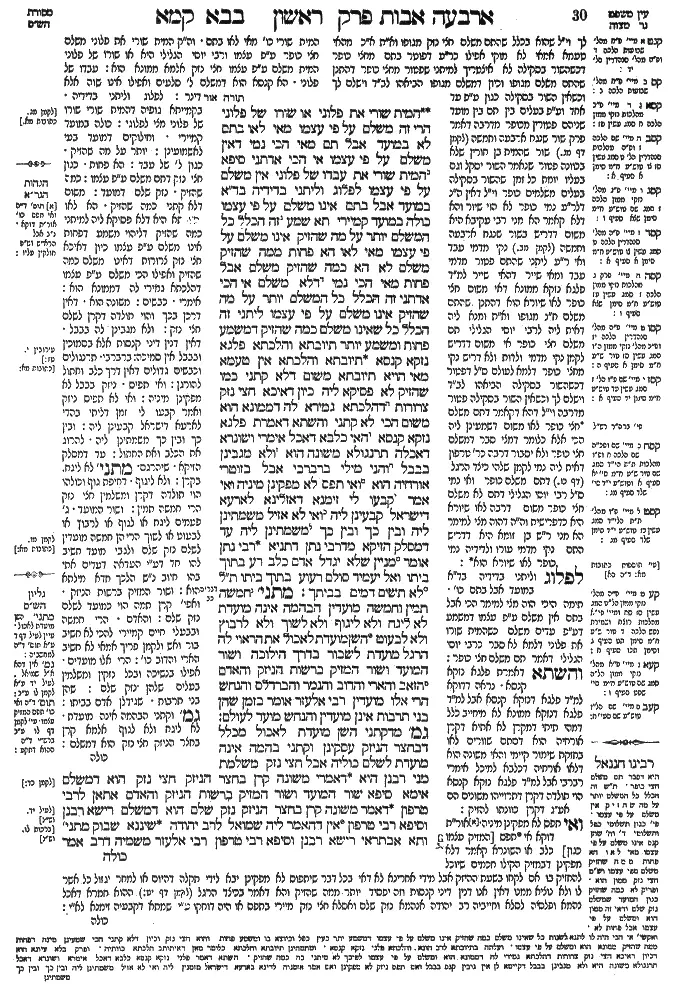
המית שורי את פלוני או שורו של פלוני הרי זה משלם על פי עצמו מאי לאו בתם לא במועד אבל תם מאי הכי נמי דאין משלם על פי עצמו אי הכי אדתני סיפא המית שורי את עבדו של פלוני אין משלם על פי עצמו לפלוג וליתני בדידיה בד"א במועד אבל בתם אינו משלם על פי עצמו כולה במועד קמיירי תא שמע זה הכלל כל המשלם יותר על מה שהזיק אינו משלם על פי עצמו מאי לאו הא פחות ממה שהזיק משלם לא הא כמה שהזיק משלם אבל פחות מאי הכי נמי דלא משלם אי הכי אדתני זה הכלל כל המשלם יותר על מה שהזיק אינו משלם על פי עצמו ליתני זה הכלל כל שאינו משלם כמה שהזיק דמשמע פחות ומשמע יותר תיובתא והלכתא פלגא נזקא קנסא תיובתא והלכתא אין טעמא מאי הויא תיובתא משום דלא קתני כמו שהזיק לא פסיקא ליה כיון דאיכא חצי נזק צרורות דהלכתא גמירא לה דממונא הוא משום הכי לא קתני והשתא דאמרת פלגא נזקא קנסא האי כלבא דאכל אימרי ושונרא דאכלה תרנגולא משונה הוא ולא מגבינן בבבל והני מילי ברברבי אבל בזוטרי אורחיה הוא ואי תפס לא מפקינן מיניה ואי אמר קבעו לי זימנא דאזלינא לארעא דישראל קבעינן ליה ואי לא אזיל משמתינן ליה ובין כך ובין כך משמתינן ליה עד דמסלק הזיקא מדרבי נתן דתניא רבי נתן אומר מניין שלא יגדל אדם כלב רע בתוך ביתו ואל יעמיד סולם רעוע בתוך ביתו ת"ל (דברים כב, ח) לא תשים דמים בביתך מתני׳ חמשה תמין וחמשה מועדין הבהמה אינה מועדת לא ליגח ולא ליגוף ולא לשוך ולא לרבוץ ולא לבעוט השן מועדת לאכול את הראוי לה הרגל מועדת לשבור בדרך הילוכה ושור המועד ושור המזיק ברשות הניזק והאדם הזאב והארי והדוב והנמר והברדלס והנחש הרי אלו מועדין רבי אלעזר אומר בזמן שהן בני תרבות אינן מועדין והנחש מועד לעולם גמ׳ מדקתני השן מועדת לאכול מכלל דבחצר הניזק עסקינן וקתני בהמה אינה מועדת לשלם כוליה אבל חצי נזק משלמת מני רבנן היא דאמרי משונה קרן בחצר הניזק חצי נזק הוא דמשלם אימא סיפא שור המועד ושור המזיק ברשות הניזק והאדם אתאן לרבי טרפון דאמר משונה קרן בחצר הניזק נזק שלם הוא דמשלם רישא רבנן וסיפא רבי טרפון אין דהאמר ליה שמואל לרב יהודה שיננא שבוק מתני' ותא אבתראי רישא רבנן וסיפא רבי טרפון רבי אלעזר משמיה דרב אמר
Comments from Rashi on Masechet Bava Kamma Page 15b
המית שורי כו' מאי לאו בתם . וה"ק המית שורי את פלוני משלם חצי כופר ע"פ עצמו ורבי יוסי הגלילי היא או שורו של פלוני המית משלם ע"פ עצמו חצי נזק אלמא ממונא הוא: עבדו של פלוני . הא קנסא הוא דמשלם ל' סלעים ואפילו אינו שוה אלא דינר: לפלוג וליתני בדידיה . בקמייתא גופיה דהמית שורי שורו של פלוני מצי לפלוגי: כולה במועד קמיירי . וחילוקים דמועד בעי לאשמועינן: יותר על מה שהזיק . כגון ל' של עבד: הא פחות . כגון חצי נזק דתם משלם ע"פ עצמו: כמה שהזיק . נזק שלם דמועד: משום דלא קתני כמה שהזיק . הא לאו תיובתא היא דלא פסיקא ליה למיתני כמה שהזיק דליהוי משמע דפחות אינו משלם ע"פ עצמו כיון דאיכא חצי נזק צרורות דאינו משלם כמה שהזיק ואפילו הכי משלם ע"פ עצמו דהלכתא גמירי לה דממונא הוא: אימרי . כבשים: משונה הוא . דאין דרכן בכך והוי תולדה דקרן לשלם חצי נזק: ולא מגבינן לה בבבל . דאין דנין דיני קנסות אלא בסמוכין ובבבל אין סמיכה: ברברבי . תרנגולים וכבשים גדולים דאין דרך כלב וחתול להורגן: ואי תפיס . ניזק בבבל לא מפקינן מיניה: ואי לא תפיס ניזק ואמר קבעו לי זמן דליתי בהדי לארעא דישראל קבעינן ליה: ובין כך ובין כך משמתינן ליה . להרוג את הכלב ואת החתול: עד דמסלק הזיקא . שיהרגם: מתני' לא ליגח . בקרן: ולא ליגוף . דחיפת גוף וכולהו הוי תולדה דקרן ומשלמין חצי נזק הרי חמשה תמין: ושור המועד . ג' פעמים ליגח או לגוף או לרבוץ או לבעוט או לשוך הרי הן חמשה מועדין לשלם נזק שלם ולגבי מועד חשיב להו חד דע"י העדאה דעדים אתי בהו חיוב נ"ש הלכך חדא מילתא הוא: ושור המזיק ברשות הניזק . ואפי' קרן תמה הוי כמועד לשלם נזק שלם: והאדם . הרי חמשה ובבעלי חיים קמיירי להכי לא חשיב בור ואש ולקמן פריך אמאי לא חשיב הארי והדוב כו': הרי אלו מועדים . אפילו בנשיכה ובכל. נזקין ומשלמין בעלים שלהן נזק שלם: שהן בני תרבות . שגידלן אדם בביתו: גמ' וקתני הבהמה אינה מועדת . לא ליגח ולא לגוף אלמא קרן בחצר הניזק חצי נזק הוא דמשלם:
Comments from Tosafot - Bava Kamma 15b
לפלוג וליתני בדידיה בד"א במועד אבל בתם כו' . תימה היכי הוה מצי למימר הכי אבל בתם אין משלם ע"פ עצמו דמשמע דע"פ עדים משלם כשהמית שורו את פלוני. דלמא לא סבר כרבי יוסי הגלילי דאמר תם משלם חצי כופר: והשתא דאמרת פלגא נזקא קנסא . נראה דדוקא למ"ד פלגא דנזקא קנסא אבל למ"ד פלגא דנזקא ממונא לא מיחייב כלל דמהי תיתי דמקרן לא אתיא דקרן אורחיה הוא דסתם שוורים לאו בחזקת שימור קיימי והאי משונה הוא דלאו אורחיה דכלבא למיכל אימרי רברבי אבל למ"ד פלגא נזקא קנסא הוי תולדה דקרן דתרוייהו משונים הם אע"ג דקרן כוונתו להזיק: ואי תפס לא מפקינן מיניה . אור"ת דוקא אי תפס [המזיק עצמו כגון] כלב או השונרא קאמר דלא מפקינן דבמזיק הקילו חכמים שיוכל להחזיק בו אם לקחו בשעת ההיזק אבל מידי אחרינא לא דאי בכל דבר שיתפוס לא מפקינן יבא לידי תקלה דהיום או למחר יגזול כל אשר לו ולא נוציא ממנו דאין אנו דנין דיני קנסות וזה יפסיד יותר ממה שהזיק והא דאמר בכיצד הרגל (לקמן בבא קמא דף יט:) ההוא חמרא דאכל נהמא ופלסיה לסלא וחייביה רב יהודה אנהמא נזק שלם ואסלא חצי נזק מיירי בתפס או היה דוחקו ע"י שמתא דקבעיה זימנא לא"י: והנחש הרי אלו מועדים. לאו בכל עניני היזק חשיבי מועדים אלא כל אחד במידי דאורחיה כגון שבא זאב וטרף ארי ודרס או טרף להניח אבל במידי דלאו אורחיה כגון ארי שטרף ואכל וכן שאר הזיקות דלאו אורחייהו לא הוו מועדים אלא משלמי' ח"נ ובמידי דאורחייהו דמשלם נ"ש היינו דוקא בחצר הניזק אבל ברה"ר פטור דהוי שן ברה"ר כדאמר שמואל בגמ' ארי ברה"ר דרס ואכל פטור ואפי' נחש שאין נהנה מנשיכתו כדאמרינן בפ"ק דתענית (דף ח.) שנתקבצו כל החיות אצל הנחש ואומרות לו מה הנאה יש לך מ"מ כיון דאורחיה בהכי הוי כמו רגל ופטור ברה"ר ולא הוי כמו קרן בתר דאייעד אע"פ דמתכוין להזיק מדחשיב ליה גבי אחריני: רבי אלעזר אומר בזמן שהן בני תרבות אינן מועדים . תימה דבריש פ"ק דסנהדרין (דף ב. ושם) תנן הארי והזאב והדוב כו' ר"א אומר כל הקודם להורגו זכה ומפרש ר' יוחנן בגמ' (שם טו:) אע"פ שלא המיתו דאין להם תרבות ואין להם בעלים ואור"י דהכא גרסינן ר' אלעזר שהוא אחר ר' מאיר והתם גרסינן ר' אליעזר שהוא קודם ר' עקיבא דקתני בתריה ר' עקיבא אומר מיהו אכתי קשה דהתנן והנחש מועד לעולם אליבא דכ"ע והתם מפרש ריש לקיש והוא שהמיתו אבל לא המיתו לא קסבר יש להם תרבות ויש להם בעלים אפי' אנחש ואומר ר"ת דהתם בקשורים בשלשלאות כגון ארי בגוהרקי שלו דבענין זה יש להם תרבות [ואין להם להרגם אא"כ המיתו ותרבות דהכא היינו שגידלם בביתו] ועוד יש לחלק דוקא לענין זה יש להם תרבות שאין להם להרגם כל הקודם אא"כ המיתו אבל לענין אם הזיקו לשלם נזק שלם או לא בהא לא איירי מידי אם חשיב תרבות שלהם תרבות:
Bava Kamma 15b - Mishnah translated into english
If one admits: My ox killed so-and-so, or my ox killed so-and-so’s ox, then this person pays based on his own admission.
The Gemara analyzes the mishna: What, is the halakha of the mishna not stated with regard to an innocuous ox? If so, this mishna proves that one is required to pay for half the cost of the damage even based on one’s own admission, which demonstrates that the payment is monetary restitution and not a fine.
The Gemara rejects the proof: No, the halakha of the mishna is stated with regard to a forewarned ox. The Gemara asks: But according to this explanation, if it had been an innocuous ox that gored, what would be the halakha? Would one say that indeed, he does not pay based on his own admission? But if so, rather than teaching in the latter clause of the mishna in Ketubot: If one admits: My ox killed so-and-so’s Canaanite slave, he does not pay based on his own admission, let the mishna differentiate and teach the distinction with regard to the case raised in the first clause itself. The reason for the distinction between the cases when one’s ox kills a Jew or a Canaanite slave is that in the first one pays monetary restitution, while in the second one pays a fine. If the mishna wishes to demonstrate the difference between a fine and monetary restitution with regard to admission, then instead of introducing a new case, the mishna would have modified the case of the previous clause.
The mishna would have continued: In what case is this statement in the first clause said? It is said with regard to a forewarned ox, but with regard to an admission that one’s innocuous ox gored, he does not pay based on his own admission. The fact that the mishna does not do so suggests that in fact one is required to pay for half the cost of the damage based on one’s own admission that his innocuous ox gored. Evidently, the payment is considered to be monetary restitution.
The Gemara rejects this: The reason the mishna did not raise the distinction between an innocuous and a forewarned ox is not because that distinction is not a valid one, but because the entire mishna speaks only of cases of a forewarned ox. Accordingly, no proof can be adduced from the mishna.
The Gemara suggests further: Come and hear a proof from the concluding clause of the mishna just cited: This is the principle: Anyone who pays more than the cost of that which he damaged does not pay based on his own admission. The Gemara infers: What, is it not that were he liable to pay less than the cost of that which he damaged, he would pay based on his own admission? Since when an innocuous ox gores, its owner is liable to pay more than the cost of the damage, the payment is clearly not monetary restitution, and this is why it is not payable based on one’s own admission.
The Gemara rejects the inference: No, one should infer only that were he liable to pay as much as the cost of that which he damaged, he pays based on his own admission. If the sum to be paid is more or less than the cost of that which he damaged, he would not pay based on his own admission.
The Gemara asks. But according to that opinion, where one is liable to pay less than the cost of the damage, what would be the halakha? Would one say that, indeed, he does not pay based on his own admission? If so, instead of teaching: This is the principle: Anyone who pays more than the cost of that which he damaged does not pay based on his own admission, let the mishna teach instead: This is the principle: Anyone who does not pay as much as the cost of that which he damaged does not pay based on his own admission. As that statement indicates cases where one is liable to pay more than the cost of that which he damaged and it also indicates cases where one is liable to pay less than the cost of that which he damaged. Evidently, the mishna holds that where one’s liability is for less than the cost of the damage, it is payable based on one’s own admission. This therefore provides a conclusive refutation of the opinion that the payment for half the cost of the damage is a fine.
The Gemara adds: And the halakha is that the payment for half the cost of the damage is a fine.
The Gemara notes the obvious inconsistency: How can it be that the Gemara offers a conclusive refutation of the opinion that the payment for half the cost of the damage is a fine and then state that the halakha is in accordance with that opinion?
The Gemara explains: Yes, the halakha may be in accordance with that opinion because of the following resolution of the refutation. What is the reason that the Gemara held that there is a conclusive refutation of the opinion that the payment for half the cost of the damage is a fine? Because the mishna does not teach: Anyone who does not pay as much as the cost of that which he damaged does not pay based on his own admission. This is not, in fact, a conclusive refutation, as even if one holds that the payment of half the cost of the damage for an innocuous ox is considered monetary restitution, one can still explain why the mishna doesn’t discuss cases where one is liable for less than the cost of the damage.
This is because the tanna cannot make an absolute statement about such cases, that one never pays based on one’s own admission. Since there is an obligation for one to pay for half the cost of the damage resulting from pebbles inadvertently propelled by the foot of a walking animal, which, through tradition it is learned that this payment is monetary restitution, and it is due to that reason that the mishna does not teach cases where one’s liability is valued at less than the cost of the damage.
The Gemara considers the ramifications of this halakha: And now that you have said that the halakha is that the payment of half the cost of the damage is a fine, with regard to this innocuous dog that ate lambs or this innocuous cat that ate a chicken, which is atypical behavior for dogs and cats, we do not collect the payment for these acts in the courts in Babylonia. Since it is not common for these animals to eat those animals, these acts are classified as Goring, irrespective of the fact that the animal gained pleasure from the damage, for which it would normally be classified in the category of Eating. Therefore, in cases where these animals had not performed this act of damaging before, and were therefore considered innocuous, the owner is liable for only half the cost of the damage, which is a fine. Since the collection of fines may be imposed only by judges who have been ordained, and ordination is given only in Eretz Yisrael, these payments are not collected in Babylonia.
The Gemara adds: And this matter applies only where they attacked large animals, as it is atypical behavior for them; but where they attacked small animals, since that is their typical manner of behavior, it is classified as Eating, for which the owner pays the full cost of the damage, which is certainly considered monetary restitution. Accordingly, the payment is collected by the courts in Babylonia.
And even in a case where the payment is considered a fine, if the injured party seized the property of the owner of the belligerent animal in order to cover his loss, we do not reclaim it from him since he is entitled to it.
And also, if the injured party said to the court: Fix a time for me to go to Eretz Yisrael to present the case before ordained judges, we fix a time for him and require the owner of the belligerent animal to go to the court in Eretz Yisrael at that time. And if he does not go, we excommunicate him for disobeying the orders of the court.
And either way, we excommunicate the owner of the belligerent animal until he removes the danger, e.g., by killing the animal or otherwise neutralizing the danger.
The justification for this is from the ruling of Rabbi Natan, as it is taught in a baraita: Rabbi Natan says: From where is it derived that one may not raise a vicious dog in his house, and one may not set up an unstable ladder in his house? The verse states: “You shall not bring blood into your house” (Deuteronomy 22:8), i.e., one may not allow a hazardous situation or item to remain in one’s house. As long as the hazard remains, the owner is in violation of this verse and therefore the court may excommunicate him for failing to remove the danger.
MISHNA: There are five damage-causing acts that an animal can perform twice and remain innocuous even when its owner was warned each time to prevent it from doing so. After the third time, the animal is rendered forewarned. In such cases, the owner is liable to pay only half of the damages. And there are five damage-causing acts for which an animal is considered forewarned, at times even if it had never caused damage in that manner. In such cases the owner is liable to pay the full cost of the damage.
An animal is not considered forewarned with regard to Goring, i.e., not for goring with its horns, nor for pushing with its body, nor for biting, nor for crouching upon items in order to damage them, nor for kicking. In these cases the animal is considered to be innocuous and its owner is liable for only half of the damages.
Concerning acts of damage performed with the tooth, the animal is considered forewarned with regard to eating that which is fitting for it to eat. Concerning acts of damage performed with the foot, the animal is considered forewarned with regard to breaking items while walking. And there is a forewarned ox, which gored three times and each time his owner was warned to safeguard his ox from doing so. And there is an ox that causes damage to the property of the injured party while on the property of the injured party. And there is the person, i.e., any damage done by a person. In all of these cases the one who caused the damage is considered to be forewarned, resulting in the obligation to pay the full cost of the damage.
The mishna presents the halakha for wild animals: The wolf; the lion; the bear; the leopard; the bardelas, the meaning of which the Gemara will discuss; and the snake. These are considered forewarned even if they had never previously caused damage. Rabbi Elazar says: When these animals are domesticated they are not considered forewarned. But the snake is always considered forewarned.
GEMARA: From the fact that the mishna teaches in its latter clause: Concerning acts of damage performed with the tooth, the animal is considered forewarned with regard to eating that which is fitting for it to eat, we learn, by inference, that we are dealing throughout the mishna with cases of damage done in the courtyard of the injured party, as one is exempt from liability for acts of damage classified as Eating if they occur in the public domain. And yet the first clause teaches: An animal is not considered forewarned with regard to Goring. Stating that it is not forewarned indicates that the liability of its owner is limited only with regard to paying the full cost of the damage, but the owner pays half the cost of the damage.
The Gemara asks: Who is it that holds that when damage classified as Goring is done within the property of the injured party the owner of the belligerent animal is liable for only half of the damages? It is the Rabbis, who say: The halakha of cases of Goring performed by an innocuous animal, which is atypical behavior, done in the courtyard of the injured party, is that the owner of the ox pays half the cost of the damage.
But then say, and try to explain accordingly, the next part of the latter clause of the mishna: And there is a forewarned ox that gored three times, and each time his owner was warned to safeguard his ox from doing so. And there is an ox that causes damage to the property of the injured party while on the property of the injured party. And there is the person. In these cases, the responsible party pays full damages. With this clause we arrive at the opinion of Rabbi Tarfon, who says: The halakha of cases of Goring performed by an innocuous animal, which is atypical, done in the courtyard of the injured party, is that the owner of the ox pays the full cost of the damage even if the ox is innocuous.
The Gemara asks: Could it be that the first part of the latter clause of the mishna is in accordance with the opinion of the Rabbis and the next part of the latter clause is in accordance with the opinion of Rabbi Tarfon?
The Gemara answers: Yes, as Shmuel said to Rav Yehuda: Large-toothed one, leave the mishna and follow after me and my interpretation that the first part of the latter clause of the mishna is in accordance with the opinion of the Rabbis and the next part of the latter clause is in accordance with the opinion of Rabbi Tarfon.
The Gemara presents a different interpretation of the mishna: Rabbi Elazar said in the name of Rav:
Traduction : The William Davidson digital edition of the Koren Noé Talmud, with commentary by Rabbi Adin Even-Israel Steinsaltz.