 Talmud Bavli
Yevamot 17b : Youtube
Daf TubeYoutube
2 video classes :
Yevamot Page 17b
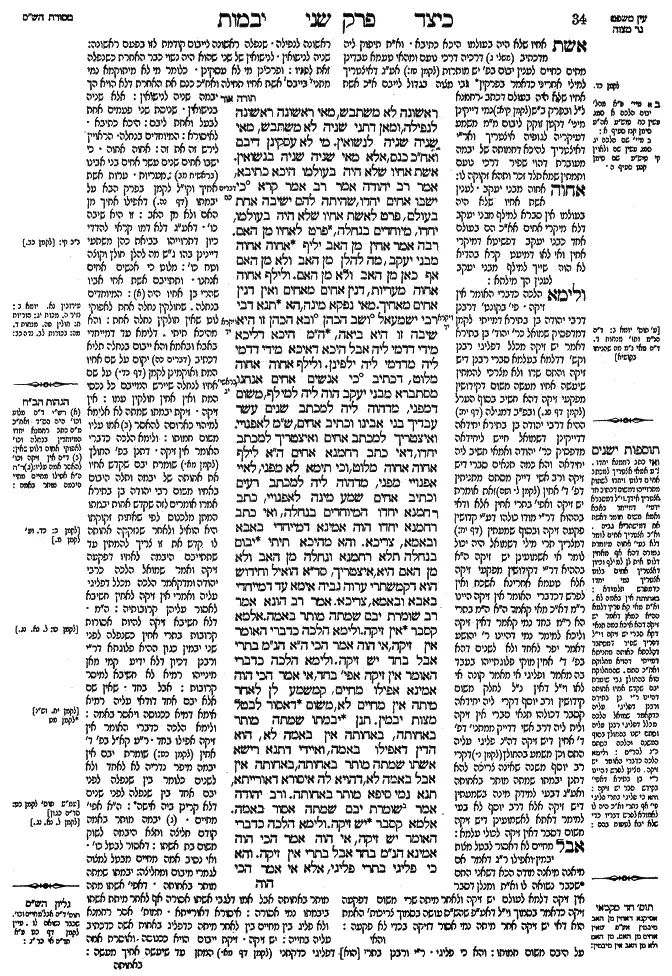
Yevamot 17b - Guemara
ראשונה לא משתבש מאי ראשונה ראשונה לנפילה ומאן דתני שניה לא משתבש מאי שניה שניה לנשואין מי לא עסקינן דיבם ואח"כ כנס אלא מאי שניה שניה בנשואין אשת אחיו שלא היה בעולמו היכא כתיבא אמר רב יהודה אמר רב אמר קרא (דברים כה, ה) כי ישבו אחים יחדו שהיתה להם ישיבה אחת בעולם פרט לאשת אחיו שלא היה בעולמו יחדו מיוחדים בנחלה פרט לאחיו מן האם רבה אמר אחין מן האב יליף אחוה אחוה מבני יעקב מה להלן מן האב ולא מן האם אף כאן מן האב ולא מן האם ולילף אחוה אחוה מעריות דנין אחים מאחים ואין דנין אחים מאחיך מאי נפקא מינה הא תנא דבי רבי ישמעאל (ויקרא יד, לט) ושב הכהן (ויקרא יד, מד) ובא הכהן זו היא שיבה זו היא ביאה ה"מ היכא דליכא מידי דדמי ליה אבל היכא דאיכא מידי דדמי ליה מדדמי ליה ילפינן ולילף אחוה אחוה מלוט דכתיב (בראשית יג, ח) כי אנשים אחים אנחנו מסתברא מבני יעקב הוה ליה למילף משום דמפני מדהוה ליה למכתב שנים עשר עבדיך בני אבינו וכתיב אחים ש"מ לאפנויי ואיצטריך למכתב אחים ואיצטריך למכתב יחדו דאי כתב רחמנא אחים ה"א לילף אחוה אחוה מלוט וכי תימא לא מפני לאיי אפנויי מפני מדהוה ליה למכתב רעים וכתיב אחים שמע מינה לאפנויי כתב רחמנא יחדו המיוחדים בנחלה ואי כתב רחמנא יחדו הוה אמינא דמייחדי באבא ובאמא צריכא והא מהיכא תיתי יבום בנחלה תלא רחמנא ונחלה מן האב ולא מן האם היא איצטריך סד"א הואיל וחידוש הוא דקמשתרי ערוה גביה אימא עד דמייחדי באבא ובאמא צריכא אמר רב הונא אמר רב שומרת יבם שמתה מותר באמה אלמא קסבר אין זיקה ולימא הלכה כדברי האומר אין זיקה אי הוה אמר הכי ה"א הנ"מ בתרי אבל בחד יש זיקה ולימא הלכה כדברי האומר אין זיקה אפי' בחד אי אמר הכי הוה אמינא אפילו מחיים קמשמע לן לאחר מיתה אין מחיים לא משום דאסור לבטל מצות יבמין תנן יבמתו שמתה מותר באחותה באחותה אין באמה לא הוא הדין דאפילו באמה ואיידי דתנא רישא אשתו שמתה מותר באחותה באחותה אין אבל באמה לא דהויא לה איסורא דאורייתא תנא נמי סיפא מותר באחותה ורב יהודה אמר שומרת יבם שמתה אסור באמה אלמא קסבר יש זיקה ולימא הלכה כדברי האומר יש זיקה אי הוה אמר הכי הוה אמינא הנ"מ בחד אבל בתרי אין זיקה והא כי פליגי בתרי פליגי אלא אי אמר הכי
Comments from Rashi on Masechet Yevamot Page 17b
ראשונה לנפילה . שנפלה ראשונה לייבום קודמת לזו בפעם ראשונה: שניה לנישואין . לנישואין של שני שהוא היה נשוי כבר האחרת כשנפלה זאת לפניו: ופרכינן מי לא עסקינן . כלומר מי לא מיתוקמא נמי מתני' בייבם אשת אחיו תחילה ואח"כ כנס את האחרת דלא הויא הך יבמה שניה לנישואין: אלא שניה בנישואין . שניסת שני פעמים אחת לבעל ואחת ליבם: היכא כתיבא . לאיסורא: המיוחדים בנחלה . הראויין לירש זה את זה: אחוה אחוה . כי ישבו אחים שנים עשר אחים בני אבינו (בראשית מב): מעריות . ערות אשת אחיך וקי"ל לקמן בפרק הבא על יבמתו (יבמות דף נה.) דאפילו אחיך מן האם ולא מן האב: זו היא שיבה כו' . דאע"ג דלא דמו קראי להדדי כיון דתרוייהו בביאת כהן משתעי דיינינן בהו ג"ש מה להלן חולץ וקוצה וטח כו': מלוט כי אנשים אחים אנחנו . ותתייבם אשת אחי אביו שהרי בן אחיו היה: המיוחדים בנחלה . שחולקין נחלה אחת לאפוקי לוט שאין חולקין נחלה אחת: והא מהיכא תיתי . דלימא עד דמייחדי באבא ובאמא והא ייבום בנחלה תליא דכתיב (דברים כה) יקום על שם אחיו המת ואוקמינן לקמן (יבמות דף כד.) על שם אחיו לנחלה שיירש המייבם כל נכסי המת ואין אחין חולקין עמו: אין זיקה . זיקת יבמתו שמתה לא אלימא למיהוי כארוסה להאסר אמו עליו משום חמותו: ולימא הלכה כדברי האומר אין זיקה . דתנן בפ' החולץ (לקמן יבמות מא.) שומרת יבם שקדש אחיו את אחותה של יבמה ותלה היבום באחיו משום רבי יהודה בן בתירא אמרו אומרים לזה שקדש אחות יבמתו המתן מלכנוס לפי שאחות זקוקתו היא הואיל ולאחר שנזקקה אחותה לו קדש את זו צריך להמתין עד שתתייבם היבמה לאחיו דפקעה זיקה ואמר שמואל הלכה כרבי יהודה ומדקאמר הלכה מכלל דפליגי עליה ואמרי אין זיקה לאחין חשיבא לאסור עליהן קרובותיה: ה"מ . דלא חשיבא זיקה להיות אסורות קרובות בתרי אחין כשנפלה לפני שני יבמין כגון ההיא פלוגתא דר"י ורבנן דכיון דלא ידיע קמי מאן מינייהו רמיא לא חשיבא למיסר קרובות: אבל בחד . שאין שם אלא יבם אחד דודאי עליה רמיא אימא דמיא ככנוסה ויאסר באמה: ולימא הלכה כדברי האומר אין זיקה אפילו בחד . ר"ע קא"ל בפ' ד' אחין (לקמן יבמות כט:) שומרת יבם אין יבמה מיפר נדריה לא לאחד ולא לשנים כלומר בין שנפלה לפני יבם אחד בין שנפלה לפני שנים דלא קרינן ביה אישה: ה"א אפי' מחיים . יבמה מותר באמה קודם חליצה ותצא היבמה לשוק משום בת אשתו: דאסור לבטל כו' . ואי נסיב אמה מחיים מבטל למצוה לגמרי מיבום ומחליצה: יבמתו שמתה מותר באחותה . דאפי' אשתו מתה מותר באחותה אבל אמה דלגבי אשתו אסורה אף לאחר מיתת אשתו ביבמתו נמי אסורה: איסורא דאורייתא . חמות' אסר רחמנא ולא פליג בין מחיים בין לאחר מיתה כדפליג באחות אשה כדכתיב עליה בחייה: יש זיקה . זיקת ייבום הויא ככנוסה ואוסרת אמה על היבם משום חמותו: והא כי פליגי . ר"י ורבנן בתרי [הוא] דפליגי כדקתני (לקמן יבמות דף מא.) המתן עד שיעשה אחיך מעשה:
Comments from Tosafot - Yevamot 17b
אשת אחיו שלא היה בעולמו היכא כתיבא . וא"ת תיפוק ליה מדכתיב (משלי ג) דרכיה דרכי נועם ומהאי טעמא עבדינן מתים כחיים לענין יבום בפ' יש מותרות (לקמן יבמות פז:) אע"ג דאיצטריך למילי אחריני כדאמר בפרקין גבי מצוה בגדול לייבם א"כ אשת אחיו שלא היה בעולם דכתב רחמנא ל"ל ובפרק ב"ש (לקמן יבמות קיא:) נמי דייקינן מיני' דקטן זוקק ליבום מ"מ משמע דעיקריה לגופיה איצטריך ואר"י דאיצטריך להיכא דחמותה של יבמה מעוברת דהוי שפיר דרכי נועם ותמתין שמא תלד זכר ותהא זקוקה לו: אחוה אחוה מבני יעקב . לענין אשת אחיו שלא היה בעולמו אין סברא למילף מבני יעקב דלא מיקרי אחים אא"כ הם בעולם אחד כבני יעקב דפשיטא דמיקרי אחין ואי לאו דמיעט קרא בהדיא לא הוה שייך למילף מבני יעקב לענין הך מילתא: ולימא הלכה כדברי האומר אין זיקה . פי' בקונט' דרבנן דרבי יהודה בן בתירא דמייתי לקמן דמדפסיק שמואל כר' יהוד' בן בתירא דאמר יש זיקה מכלל דפליגי רבנן וקש' דדלמא בעלמא סברי רבנן דיש זיקה והתם שרו ולא מצרכי להמתין שיעשה אחיו מעשה משום דקידושין מפקעי זיקה דהא חשיב בסוף הערל (לקמן יבמות דף פג.) ובפ"ב דמגילה (דף יח:) ההיא דרבי יהודה בן בתירא יחידאה דדייקינן דשמואל חייש ליחידאה מדפסיק כר' יהודה ואמאי חשיב ליה יחידאה והא כמה תנאים סברי דיש זיקה ורב אשי דייק מסתם מתניתין דפ' ד' אחין (לקמן יבמות ל. ושם) זאת אומרת יש זיקה ואפי' בתרי אחין אלא ודאי בההוא דר"י מודו כולהו דע"י קדושין פקעה זיקה ובסוף שמעתין (דף יח:) דמצריך תרי מילי דשמואל היה יכול לומר אי אשמועינן יש זיקה ה"א בההיא דר"י דקידושין מפקעי זיקה אלא טעמא אחרינא אשכח ואין לפרש דכדברי האומר אין זיקה היינו ר"מ דא"כ מאי קאמר ה"א ה"מ בתרי הא ר"מ בחד נמי קאמר דאין זיקה וליכא למימר נמי דהיינו ר' יהושע דאמר יפר לאחד ולא לשנים דהא בפ' ד' אחין מוקי פלוגתייהו בעבד בה מאמר ופליגי אי מאמר קונה אי לאו וי"ל דאין נ"ל לחלק משום קידושין ורב יוסף דקרי ליה יחידאה קסבר דכולהו תנאי סברי אין זיקה ולית ליה דרב אשי דדייק ממתני' דפ' ד' אחין דיש זיקה דה"נ פליגי עליה התם וכן משמע בהחולץ (לקמן יבמות נ.) דקרי רב יוסף משנה שאינה צריכה להא דתנן יבמתו שמתה מותר באחותה ואע"ג דבעי למידק מינה בשמעתין דיש זיקה אלא דרב יוסף לא בעי למימר דאתא לאשמועינן דיש זיקה משום דסבר דאין זיקה לכולי עלמא: אבל מחיים לא דאסור לבטל מצות יבמין . ואפילו ר"ג דאמר אם מיאנה מיאנה מודה הכא דשאני התם שכבר נשואה לו וא"ת ומנלן דסבר אין זיקה דלמא לעולם יש זיקה ולאחר מיתה שרי משום דפקעה זיקה כדאמר בסמוך וי"ל דאע"פ שהש"ס עושה בסמוך צריכות' האמת הוא דאי יש זיקה אחר מיתה נמי אסור דזיקה בכדי לא פקעה:
Yevamot 17b - Mishnah translated into english
The first, is not mistaken, as what is the meaning of first? It means the first to fall before her yavam for levirate marriage. And he who taught referring to her as the second is not mistaken either, as what is the meaning of second? It means the second to enter marriage. Since the second deceased brother was already married to one woman, this yevama whom he took in levirate marriage was his second wife. The Gemara wonders: Is this the necessary order of events? Are we not also dealing with a scenario in which the second brother took the wife of the first brother in levirate marriage and then later took another wife? Would such a situation not merit the same ruling? Rather, what is the meaning of calling the wife of the first brother the second? It means she who had been married for a second time. She had already been married twice, whereas the wife of the second brother had been married only once.
§ The Gemara turns from a review of the language used in the mishna to a discussion of the halakhot of a wife of a brother with whom one did not coexist. Where is it written that the mitzva of levirate marriage does not apply in the case of the wife of a brother with whom he did not coexist? Rav Yehuda said that Rav said: The verse states “If brothers dwell together and one of them dies” (Deuteronomy 25:5), meaning that they had a common dwelling together in the world. This excludes the wife of a brother with whom he did not coexist. Furthermore, it is derived: “Together” means that they were united together in an inheritance; i.e., they are united in that they inherit together. In other words, since property is inherited by sons from their father, it can be inferred that the verse is speaking specifically of brothers from the same father. This excludes his maternal half brother, with whom he is not united by inheritance, since only brothers who share the same father inherit from each other.
Rabba said: One learns the ruling that levirate marriage applies only to brothers from the same father by the verbal analogy between the term brotherhood used in the context of levirate marriage and the term brotherhood from the children of Jacob. Just as there, with regard to the children of Jacob, they are all brothers from the father and not from the mother, since they were from four different mothers, so too, here, in the case of levirate marriage, it is referring specifically to brothers from the father and not from the mother.
The Gemara raises an objection: Why should we learn from the children of Jacob? Let it derive the meaning of the term brotherhood by verbal analogy to the term brotherhood from the verses discussing those with whom relations are forbidden. In the halakhot of forbidden relations, both paternal and maternal half brothers are considered brothers, and are thereby subject to such prohibitions as those against relations with a brother’s wife. The Gemara answers: The first analogy is preferable, as we infer “brothers” from “brothers.” The word “brothers” is stated both with regard to the children of Jacob and with regard to the halakhot of levirate marriage, whereas with regard to forbidden relations it says “your brother,” and one cannot make an inference to “brothers” from “your brother.”
The Gemara objects: What difference does it make if there is a minor difference between the words being compared? As the school of Rabbi Yishmael taught a verbal analogy with regard to leprosy of houses between the verse “and the priest shall return [veshav]” (Leviticus 14:39) and the verse “and the priest shall come [uva]” (Leviticus 14:44), from which it is derived that this is the halakha with regard to returning, i.e., it is after seven days, and this is the same halakha with regard to coming, that it is after seven days. Consequently, a less pronounced difference of one letter between the Hebrew words for “brothers” and “your brother” should certainly not prevent the teaching of a verbal analogy. The Gemara responds: This applies when nothing else was more similar, but where there is something similar we infer from that which is more similar. In such situations, it is preferable to learn from the word that bears greater similarity.
The Gemara objects on another count: Let the halakha derive the meaning of the term brotherhood from the term brotherhood from Lot, as it is written that Abraham said to Lot: “For we are brothers” (Genesis 13:8). From here one could conclude that the word brothers means relatives and not necessarily brothers. The Gemara rejects this: It is more reasonable to derive from the children of Jacob, due to the fact that the word “brothers” is free in its context and is therefore available to be used in a verbal analogy: Since it could have written: We your servants are twelve children of our father, but instead it writes: “Twelve brothers, the children of one man” (Genesis 42:13), learn from here that this comes to render the word “brothers” free so that it may be allocated to another matter, i.e., the definition of brothers.
The Gemara comments: And although Rav Yehuda and Rabba learned the same ruling from two different passages, according to both it was necessary to write “brothers” and it was necessary to write “together” in the verses discussing levirate marriage, as, if the Merciful One had written only “brothers,” I would say that one should infer the meaning of the term “brothers” from the term “brothers” from Lot. And if you would say it is not free there in the same way that the word “brothers” is free in the passage concerning the children of Jacob, this is not so; in fact, it is free. With regard to Lot it could have written: Friends, as they were not actual brothers but relatives, and yet “brothers” is written. One might learn from here that this is free to be allocated elsewhere and teach that such relatives are called brothers even for levirate marriage. Therefore, the Torah wrote “together” to teach that this applies specifically to those brothers who are united in an inheritance.
And if the Merciful One had written “together” alone and not added “brothers,” I would say that they must have both the same father and mother together, and that otherwise the mitzva of levirate marriage would not apply. Therefore, “brothers” is written to compare this to the children of Jacob, who were brothers from the same father but not the same mother. It is for this reason, then, that it is necessary to write both.
The Gemara asks about the last supposition: But from where would it be derived that perhaps levirate marriage would apply only if they are full brothers, sharing both a father and mother? Why should one assume that maternal brotherhood is also of import here? Doesn’t the Merciful One make levirate marriage dependent upon inheritance? The Torah states that the yavam who performs the levirate marriage will establish the name of his deceased brother, meaning that he inherits from him, and inheritance comes from the father and not from the mother. Nevertheless, this was necessary, as it could enter your mind to say that since this halakha of levirate marriage is a novelty in that a woman who was a forbidden relation to him as a brother’s wife is now rendered permitted, say that this permissibility will be limited only to cases of brothers with the same father and same mother together. It is due to this possibility that the verbal analogy to the brothers who were the children of Jacob is necessary.
§ Rav Huna said that Rav said: In the case of a widow whose husband had died childless and who is waiting for her yavam to perform levirate marriage or set her free with ḥalitza, who then died before her yavam could take her in levirate marriage, the yavam is permitted to marry her mother. The levirate obligation does not create a familial relation between them. Apparently, Rav Huna says that Rav holds that the levirate bond [zikka] is not substantial. In other words, the bond formed between the yevama and her yavam requiring levirate marriage does not create a halakhic connection between the two. The Gemara asks: Then let him say explicitly: The halakha is in accordance with the statement of he who says that the levirate bond is not substantial, as this issue is in fact a matter of dispute between tanna’im. Why did he not simply conclude that the halakha is in accordance with the opinion of the tanna who held that the levirate bond is not substantial?
The Gemara answers: If he had said that, I would say: This statement that the levirate bond is not substantial applies only in reference to two brothers, each of whom has the possibility to take her in levirate marriage. In such cases the levirate bond between either one of the brothers and the yevama is not absolute, as it is always possible for the other brother to marry her instead. But in cases of one brother, then since the obligation to the yevama is exclusively his, I would say that the levirate bond is substantial.
The Gemara asks: Then let him say: The halakha is in accordance with the statement of the one who says that the levirate bond is not substantial, even in the case of one brother. The Gemara answers: If he had said that, I would say: Even if his yevama were alive and required levirate marriage with him, he would be allowed to take her mother in marriage. Therefore, this comes to teach us that after death, yes, he is permitted to marry her mother; but while she is alive, he is not. Why not? This is because it is prohibited to nullify the mitzva of levirate marriage. Were he to marry her mother, he would no longer be able to take the daughter in levirate marriage because his wife’s daughter is forbidden to him. As a result of his marriage, he would cancel the mitzva of levirate marriage so that it could no longer apply to him.
The Gemara raises an objection to the statement of Rav Huna: We learned in a mishna (49a): If his yevama dies, he is permitted to marry her sister. A precise reading of this phrase leads to the implication that with regard to her sister, yes, it is permitted, as even if it had been his wife who had died he would be permitted to marry her sister. But with regard to her mother, no, it is not permitted.
The Gemara rejects this: No evidence can be derived from here, as it is possible to say that the same is true even for her mother, that she too is permitted. But since it taught in the first clause of this mishna: If his wife dies he is permitted to take her sister, and there the language is precise and implies: Her sister, yes, but her mother, no, as she is forbidden by Torah law because it is prohibited for a man to marry both a woman and her daughter even after one of them dies, therefore he used the same language when he taught the latter clause of the same mishna that he is permitted to take her sister. However, in the latter clause it is not an exact reading, and in actuality one is allowed to marry any of her relatives. This completes the Gemara’s explanation of Rav Huna’s opinion.
And Rav Yehuda said: In the case of a widow who dies while waiting for her brother-in-law to perform ḥalitza or levirate marriage, he is prohibited from marrying her mother. The Gemara comments: Apparently Rav Yehuda holds that the levirate bond is substantial; this would mean that the attachment between the yevama and the yavam is like that of marriage and that the yavam is therefore prohibited from marrying her relatives. But it must be asked: Why does Rav Yehuda say it in such a way? Let him say: The halakha is in accordance with the statement of the one who says that the levirate bond is substantial.
The Gemara responds: If he would have said that, I would say that with regard to the levirate bond, this applies in the case of one brother, but if there were two brothers then the levirate bond is not substantial. The Gemara objects: But when the tanna’im disagree, they disagree in a case of two brothers, so how could one think that Rav Yehuda is speaking only in the case of a single brother? Rather, one must say: If he were to say that the conclusive halakhic ruling is that the bond is substantial,
Traduction : The William Davidson digital edition of the Koren Noé Talmud, with commentary by Rabbi Adin Even-Israel Steinsaltz.