 Talmud Bavli
The learning on the whole site is dedicated : L'ilui Nishmat Ledicia bat David Banoun
The learning on the whole site is dedicated : L'ilui Nishmat Reuven ben Rivka SEBBAG
The learning on the whole site is dedicated : L'ilui Nishmat Rav Chlomo Ben Jamilla
Bava Kamma 93b : Youtube
Daf TubeYoutube
2 video classes :
Bava Kamma Page 93b
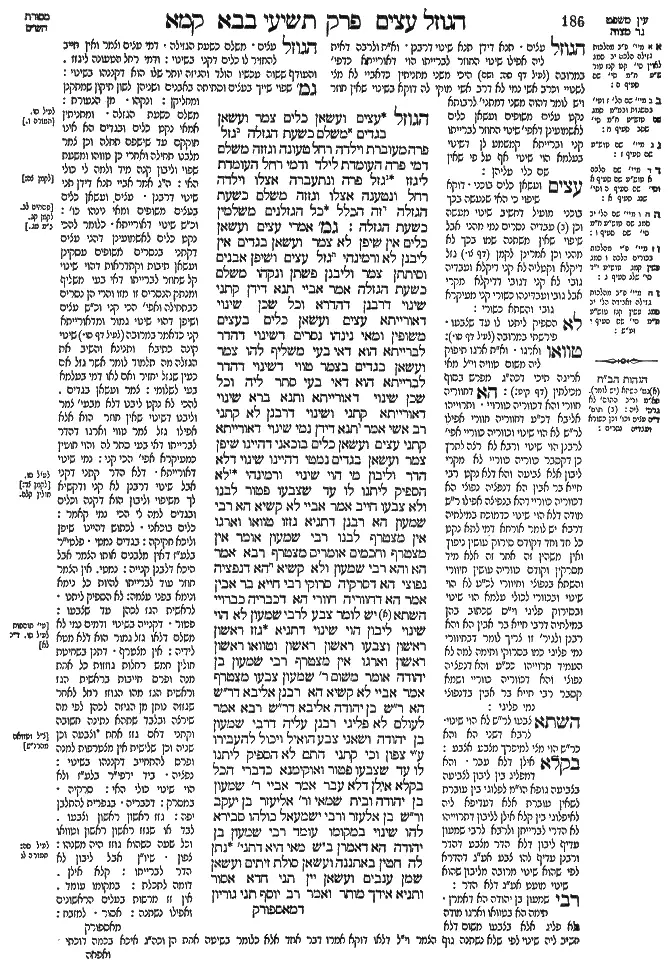
Bava Kamma 93b - Guemara
מתני׳ הגוזל עצים ועשאן כלים צמר ועשאן בגדים משלם כשעת הגזלה גזל פרה מעוברת וילדה רחל טעונה וגזזה משלם דמי פרה העומדת לילד ודמי רחל העומדת ליגזז גזל פרה ונתעברה אצלו וילדה רחל ונטענה אצלו וגזזה משלם כשעת הגזלה זה הכלל כל הגזלנים משלמין כשעת הגזלה:
גמ׳ אמרי עצים ועשאן כלים אין שיפן לא צמר ועשאן בגדים אין ליבנן לא ורמינהי גזל עצים ושיפן אבנים וסיתתן צמר וליבנן פשתן ונקהו משלם כשעת הגזלה אמר אביי תנא דידן קתני שינוי דרבנן דהדרא וכל שכן שינוי דאורייתא עצים ועשאן כלים בעצים משופין ומאי נינהו נסרים דשינוי דהדר לברייתא הוא דאי בעי משליף להו צמר ועשאן בגדים בצמר טווי דשינוי דהדר לברייתא הוא דאי בעי סתר ליה וכל שכן שינוי דאורייתא ותנא ברא שינוי דאורייתא קתני ושינוי דרבנן לא קתני רב אשי אמר תנא דידן נמי שינוי דאורייתא קתני עצים ועשאן כלים בוכאני דהיינו שיפן צמר ועשאן בגדים נמטי דהיינו שינוי דלא הדר וליבון מי הוי שינוי ורמינהי לא הספיק ליתנו לו עד שצבעו פטור לבנו ולא צבעו חייב אמר אביי לא קשיא הא רבי שמעון הא רבנן דתניא גזזו טוואו וארגו אין מצטרף לבנו רבי שמעון אומר אין מצטרף וחכמים אומרים מצטרף רבא אמר הא והא רבי שמעון ולא קשיא הא דנפציה נפוצי הא דסרקיה סרוקי רבי חייא בר אבין אמר הא דחווריה חוורי הא דכבריה כברויי השתא יש לומר צבע לרבי שמעון לא הוי שינוי ליבון הוי שינוי דתניא גזז ראשון ראשון וצבעו ראשון ראשון וטוואו ראשון ראשון וארגו אין מצטרף רבי שמעון בן יהודה אומר משום ר' שמעון צבעו מצטרף אמר אביי לא קשיא הא רבנן אליבא דר"ש הא ר"ש בן יהודה אליבא דר"ש רבא אמר לעולם לא פליגי רבנן עליה דרבי שמעון בן יהודה ושאני צבע הואיל ויכול להעבירו ע"י צפון וכי קתני התם לא הספיק ליתנו לו עד שצבעו פטור ואוקימנא כדברי הכל בקלא אילן דלא עבר אמר אביי ר' שמעון בן יהודה ובית שמאי ור' אליעזר בן יעקב ור"ש בן אלעזר ורבי ישמעאל כולהו סבירא להו שינוי במקומו עומד רבי שמעון בן יהודה הא דאמרן ב"ש מאי היא דתני' נתן לה חטין באתננה ועשאן סולת זיתים ועשאן שמן ענבים ועשאן יין תני חדא אסור ותניא אידך מותר ואמר רב יוסף תני גוריון
Comments from Rashi on Masechet Bava Kamma Page 93b
מתני' הגוזל עצים . משלם כשעת הגזילה. דמי עצים וצמר ואין חייב להחזיר לו כלים דקני בשינוי: ודמי רחל הטעונה ליגזז . והעודף ששוה עכשיו הולד והגיזה יותר שלו הוא דקננהו בשינוי: גמ' שפוי שייך בעצים וסתיתה באבנים ושניהן לשון תיקון שמתקנן ומחליקן: ונקהו . מן הנעורת: משלם כשעת הגזלה . ומתניתין אמאי נקט כלים ובגדים הא אינו חוקקם עד שישפם תחלה וכן צמר מלבנו תחילה ואחרי כן טווהו ומשעת שפוי וליבון קנה מיד ולמה לי כולי האי: ה"ג אמר אביי תנא דידן תני שינוי דרבנן . עצים ועשאן כלים בעצים משופים ומאי נינהו כו': וכ"ש שינוי דאורייתא . כלומר להכי נקט כלים לאשמועינן דהני עצים דקתני בנסרים משופים עסקינן ועשאן תיבות וקתדראות דהוי שינוי קל שחוזר לברייתו דאי בעי משליף ומנתק הנסרים זו מזו והרי הן נסרים כבתחילה ואפי' הכי קני וכ"ש עצים ושיפן דהוי שינוי גמור ומדאורייתא קני כדאמר במרובה (לעיל בבא קמא דף סו.) שינוי קונה כתיבא ותנינא והשיב את הגזלה מה תלמוד לומר אשר גזל אם כעין שגזל יחזיר ואם לאו דמי בעלמא בעי לשלומי: צמר ועשאן בגדים . להכי לא נקט ליבנו דלא מבעי' צמר וליבנו דשינוי שאין חוזר הוא אלא אפילו גזל צמר טווי וארגו דהדר לברייתו דאי בעי סתר לה והוי חוטין כמעיקרא אפי' הכי קני: נמי שינוי דאורייתא . דלא הדר קתני דקני אבל שינוי דרבנן לא קני ודקשיא לך משיפוי וליבון הוא דקנה וכלים ובגדים למה לי הכי נמי קאמר: כלים בוכאני . לכתוש דהיינו שיפן וליכא חקיקה: בגדים נמטי . פלטי"ר בלע"ז דאין מלבנים אותו הצמר אבל היכא דלבנן קנייה: נמטי . אין הצמר חוזר עוד לברייתו להיות כל נימא ונימא בפני עצמה: לא הספיק ליתנו . לראשית הגז לכהן עד שבצעו: פטור . דקנייה בשינוי ודמים נמי לא משלם דלאו גזל גמור הוא דלא מטא לידיה: אין מצטרף . דתנן בשחיטת חולין חמש רחלות גוזזות כל אחת מנה ופרס חייבות בראשית הגז וראשית הגז מהו הגוזז רחל לאחר שגזזה נותן מן הגיזה לכהן לפי מה שירצה ובלבד שתהא נתינה חשובה וקתני דאם גזז אחת וצבעה וכן שניה וכן שלישית אין מצטרפות למנה ופרס להתחייב דקננהו בשינוי: נפציה . ביד ירפי"ר בלע"ז ולא הוי שינוי כולי האי: סרקיה . במסרק: דכבריה . בגפרית להתלבן יפה: גזז ראשון ראשון וצבעו . לבד או שגזז ראשון ראשון וטוואו וכל שעה כשהוא גוזז היה משנהו: צפון . שיו"ן אבל ליבון לא הדר לברייתו: קלא אילן . דומה לתכלת: במקומו עומד . אין זז מרשות בעלים הראשונים ואפילו נשתנה: אסור . למזבח:
Comments from Tosafot - Bava Kamma 93b
מתני' הגוזל עצים. תנא דידן תנא שינוי דרבנן. וא"ת ולרבה דאית ליה אפילו שינוי החוזר לברייתו הוי דאורייתא כדפי' במרובה (לעיל בבא קמא דף סה: ושם) היכי משני מתניתין כדאביי לא מצי לשנויי וכרב אשי נמי לא דרב אשי מוקי לה דוקא בשינוי שאין חוזר ויש לומר דהוה משני דמתני' לרבותא נקט עצים משופים ועשאן כלים לאשמועינן דאפי' שינוי החוזר לברייתו קני וברייתא קמשמע לן דשינוי בעלמא הוי שינוי אף על פי שאין שם כלי עליהן: משלם דמי פרה העומדת לילד. וכל שבח שמשעת גזלה עד שתלד לגזלן: עצים ועשאן כלים בוכני . דוקא שיפוי כי האי שנעשה בכך בוכני מועיל דחשיב שינוי מעשה וכן עבדיה נסרים נמי מהני אבל שיפוי שאין משתנה שמו בכך לא מהני וכן אמרינן לקמן (בבא קמא דף צו.) גזל דיקלא וקטליה לא קני דיקלא ועבדיה גובי לא קני דגובי דדיקלא מקרי אבל גובי ועבדינהו כשורי קני מעיקרא גובי והשתא כשורי: לא הספיק ליתנו לו עד שצבעו . פירשתי במרובה (לעיל בבא קמא דף סו.): טוואו וארגו . וא"ת ארגו תיפוק ליה משום טוויה וי"ל מאי אריגה תיכי דכה"ג מפרש בסוף מכילתין (דף קיט:): הא דחווריה חוורי והא דכווריה כוורויי . ותרוייהו אליבא דכ"ע דחווריה חוורי אפילו לר"ש לא הוי שינוי וכווריה כווריי אפי' לרבנן הוי שינוי ורבא לא רצה לתרץ כן דקסבר כווריה כווריי לא מקרי ליבון אלא צביעה והא דלא נקט רבי חייא בר אבין הא דנפציה נפוצי הא דכווריה כווריי דהא בנפיצה אפילו ר"ש מודה דלא הוי שינוי כדמוכח במילתיה דרבא יש לומר אורחא דמי לתא נקט כל חד וחד דקודם סירוק עושין ניפוץ ואין משהין זה אחר זה אלא מיד מסרקין וקודם כווריה עושין חיוורי והשתא בנפוצי וחיוורי לכ"ע לא הוי שינוי ובכוורי לכולי עלמא הוי שינוי ובסירוק פליגי וי"ס שכתוב בהן במילתיה דרבי חייא בר אבין הא והא רבנן ולגיר' זו צריך לומר דבחיוורי נמי פליגי כמו בסרוקי ותימה למה לא העמיד תרוייהו ככ"ע והא דנפציה נפוצי והא דכווריה כווריי ושמא קסבר רבי חייא בר אבין בדנפוצי נמי פליגי: השתא צבעו לר"ש לא הוי שינוי . לרבא דשני הא והא כר"ש הוי מצי למיפרך מצבע אצבע: בקלא אילן דלא עבר . והא דמפליג בין ליבון לצביעה בצביעה גופא הו"מ לפלוגי בין עוברת לשאין עוברת אלא דעדיפא ליה לאיפלוגי בין קלא אילן לליבון דתרוייהו לא הדרי לברייתן ולרבא לרבי שמעון עדיף ליבון דלא הדר מצבע דהדר ורבנן עדיף להו צבע אע"ג דהדרא לפי שהוא שינוי מרובה מליבון שהוא שינוי מועט אע"ג דלא הדר: רבי שמעון בן יהודה הא דאמרן . תימה הא בטוואו וארגו מודה ולא פליג אלא בצבעו משום דלא חשיב ליה שינוי לפי שלא נשתנה גוף הצמר וי"ל דלאו דוקא אמרו דבר אחד אלא כלומר בשיטה אחת הן וכה"ג איכא בכמה דוכתי:
Bava Kamma 93b - Mishnah translated into english
MISHNA: In the case of one who robs another of wood and fashions it into vessels, or one who robs another of wool and fashions it into garments, he pays the robbery victim according to the value of the goods at the time of the robbery, but he need not return the vessels or garments. He has acquired the stolen items because they had undergone a change.
If one robbed another of a pregnant cow and it then gave birth while in his possession, or if one robbed another of a ewe that was laden with wool and the robber then sheared it, the robber pays the value of a cow that is ready to give birth or the value of a ewe that is ready to be shorn. He pays the value of the animal at the time of the robbery, and the calf or the wool remains his.
If one robbed another of a cow, and it became pregnant in his possession, and it then gave birth; or if one robbed another of a ewe, and it became laden with wool in his possession, and he then sheared it, then the robber pays according to the value of the animal at the time of the robbery. This is the principle: All robbers pay according to the value of the stolen item at the time of the robbery.
GEMARA: The Sages say: It can be inferred from the mishna that if one robbed another of wood and fashioned it into vessels, yes, the robber acquires the wood due to the change. If he merely sanded it, no, the robber does not acquire it, as this is not a significant change. Similarly, if one robbed another of wool and fashioned it into garments, yes, he has acquired the wool due to the change. If he merely washed it, no, he has not acquired it.
And the Gemara raises a contradiction from a baraita: If one robbed another of wood and sanded it, or stones and smoothed them, or wool and washed it, or flax and cleaned it, he pays according to the value of the stolen item at the time of the robbery. This baraita teaches that even a change such as sanding wood is regarded as a significant change.
Abaye said: This does not contradict the mishna. The tanna of our mishna teaches the halakha with regard to a change deemed significant by rabbinic law, which is not deemed significant by Torah law, as it is reversible. And all the more so, if the robber effects a change deemed significant by Torah law, i.e., an irreversible change, he acquires the stolen item due to the change.
The Gemara explains: Accordingly, it must be that the case in the mishna, where the change is reversible, where one robbed another of wood and fashioned it into vessels, is stated with regard to one who robbed another of sanded wood. And what are they? Boards that the robber used to construct a vessel, which is a change in which the item can revert to its original state, as, if the robber desires, he can disassemble them. Similarly, the case of one who robbed another of wool and fashioned it into garments refers to wool that was already spun, as fashioning them into garments is a change in which the item can revert to its original state, as, if the robber desires, he can unravel them. The mishna teaches that the robber acquires the stolen item by making these changes, and all the more so the robber acquires the stolen item through a change deemed significant by Torah law.
Abaye continues his explanation: And the tanna of the baraita teaches the halakha with regard to a change deemed significant by Torah law, but he does not teach the halakha with regard to a change deemed significant by rabbinic law. It is possible that he maintains that the robber does not acquire the stolen item due to such a change.
Rav Ashi stated another answer: The tanna of our mishna is also teaching the halakha with regard to a change deemed significant by Torah law. The case in the mishna of one who robbed another of wood and fashioned it into vessels is referring to one who constructed pestles [bukhanei], which is analogous to the case mentioned in the baraita where one sanded them, since a pestle is formed by trimming the wood in an irreversible manner. Similarly, the case in the mishna of one who robbed another of wool and fashioned it into garments is referring to one who fashioned the wool into pieces of felt [namtei], which is an irreversible change.
The Gemara asks a question with regard to the baraita: But does washing effect a significant change, so that one who robs another of wool and washes it acquires the wool and pays its value at the time of robbery? And the Gemara raises a contradiction from a mishna that discusses the halakhot of the first of the sheared wool, which one must give to a priest (Ḥullin 135a): If the owner of the sheep did not manage to give the sheared wool to the priest before he dyed it, he is exempt from giving it to the priest, as the obligation is in effect only with regard to wool remaining in its original state. By contrast, if he washed it but did not dye it, he is obligated to give it to the priest. This indicates that washing does not effect a significant change.
Abaye said: It is not difficult. This baraita is in accordance with the opinion of Rabbi Shimon, whereas that mishna is in accordance with the opinion of the Rabbis, as it is taught in a baraita with regard to the first of the sheared wool: If one sheared it, spun it, and wove it, the sheared wool does not combine with the wool from other sheep to constitute the minimum quantity of wool for which one is obligated to give the first of the sheared wool to the priest. If one washed it, then Rabbi Shimon says that it does not combine with the wool of other sheep, as washing effects a significant change, and the Rabbis say that it combines with the wool of other sheep, as washing does not effect a significant change. Their opinions correspond to the opinions in the baraita and mishna previously quoted.
Rava stated another answer: This and that, i.e., both the mishna and the baraita, are in accordance with the opinion of Rabbi Shimon, and it is not difficult. This mishna is referring to a case where one untangled the strands of wool by hand before washing it. In this case, the washing is not fully effective, and does not effect a significant change. That baraita is referring to a case where one combed it before washing it. The washing is more effective and consequently effects a significant change.
Rabbi Ḥiyya bar Avin stated another answer: This mishna is referring to a case where one merely whitened it, which is not a significant change. That baraita is referring to a case where one bleached it with sulfur, which is a significant change.
Having demonstrated that, according to Rabbi Shimon, washing effects a significant change, the Gemara asks: Now that it can be said that, according to Rabbi Shimon, dye does not effect a significant change, as the Gemara will prove, can it be said that washing effects a significant change? As it is taught in a baraita: If he sheared sheep one by one and dyed the wool of each sheep before shearing the next sheep, or sheared them one by one and spun the wool, or sheared them one by one and wove the wool, then the wool sheared from the different sheep does not combine to constitute the minimum quantity of wool for which one is obligated to give the first of the sheared wool to the priest. Rabbi Shimon ben Yehuda says in the name of Rabbi Shimon: Even if he dyed it, it combines with the other wool. This indicates that, according to Rabbi Shimon, even dyeing the wool is not a significant change, so how could he maintain that washing it is?
Abaye said: This is not difficult. This statement, that washed wool does not combine with other wool, is the opinion of the Rabbis in accordance with the opinion of Rabbi Shimon, while that statement, that even dyed wool combines with other wool, is the opinion of Rabbi Shimon ben Yehuda in accordance with the opinion of Rabbi Shimon. There is a dispute as to what Rabbi Shimon rules with regard to this issue.
Rava said: Actually, the Rabbis do not disagree with Rabbi Shimon ben Yehuda, and they are also of the opinion that Rabbi Shimon holds that washing effects a significant change. And as for the apparent contradiction, dye is different and it does not effect a significant change, since one is able to remove it with soap [tzafon] and return the wool to its previous state. And when it is taught there, in the mishna cited above, that if one did not manage to give the sheared wool to the priest before he dyed it he is exempt, and this ruling was established in accordance with all opinions, it was not stated with regard to ordinary dye but with regard to indigo, which cannot be removed with soap and therefore effects a permanent and therefore significant change.
§ Abaye said: Rabbi Shimon ben Yehuda, and Beit Shammai, and Rabbi Eliezer ben Ya’akov, and Rabbi Shimon ben Elazar, and Rabbi Yishmael all hold that despite a change, the changed item remains in its place, i.e., the changed item is still considered to have the status it had before the change. The Gemara proceeds to prove that each of these tanna’im holds this way: The opinion of Rabbi Shimon ben Yehuda is that which we just said. He says that, according to Rabbi Shimon, even if the wool is dyed it still combines with the wool of other animals to constitute the minimum quantity of wool for which one is obligated to give the first of the sheared wool to the priest.
What is the source that indicates that Beit Shammai maintain that an item that undergoes a change is considered to have the same status that it had before the change? As it is taught in a baraita: If one gave a prostitute wheat as her payment, and she ground it and converted it into flour; or if he gave her olives, and she squeezed them and converted them into oil; or if he gave her grapes, and she squeezed them and converted them into wine; and if, in any of these cases, she subsequently consecrated the final product, it is taught in one baraita that it is prohibited to sacrifice them upon the altar as a meal-offering or libation, as the Torah states: “You shall not bring the hire of a harlot or the price of a dog into the House of the Lord your God” (Deuteronomy 23:19). And it is taught in another baraita that it is permitted, as the Gemara will explain. And Rav Yosef says: It was taught by Guryon
Traduction : The William Davidson digital edition of the Koren Noé Talmud, with commentary by Rabbi Adin Even-Israel Steinsaltz.