 Talmud Bavli
Bava Kamma 74b : Youtube
Daf TubeYoutube
2 video classes :
Bava Kamma Page 74b
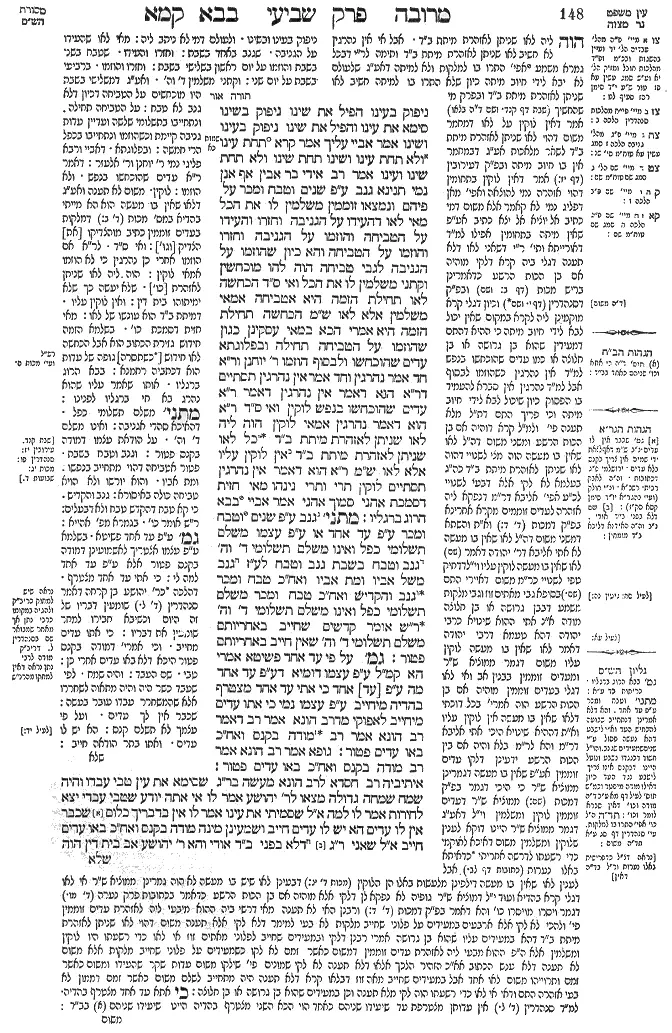
Bava Kamma 74b - Guemara
ניפוק בעינו הפיל את שינו ניפוק בשינו סימא את עינו והפיל את שינו ניפוק בעינו ושינו אמר אביי עליך אמר קרא (שמות כא, כו) תחת עינו ולא תחת עינו ושינו תחת שינו ולא תחת שינו ועינו אמר רב אידי בר אבין אף אנן נמי תנינא גנב ע"פ שנים וטבח ומכר על פיהם ונמצאו זוממין משלמין לו את הכל מאי לאו דהעידו על הגניבה וחזרו והעידו על הטביחה והוזמו על הגניבה וחזרו והוזמו על הטביחה והא כיון שהוזמו על הגניבה לגבי טביחה הוה להו מוכחשין וקתני משלמין לו את הכל ואי ס"ד הכחשה לאו תחילת הזמה היא אטביחה אמאי משלמין אלא לאו ש"מ הכחשה תחילת הזמה היא אמרי הכא במאי עסקינן כגון שהוזמו על הטביחה תחילה ובפלוגתא עדים שהוכחשו ולבסוף הוזמו ר' יוחנן ור"א חד אמר נהרגין וחד אמר אין נהרגין תסתיים דר"א הוא דאמר אין נהרגין דאמר ר"א עדים שהוכחשו בנפש לוקין ואי ס"ד ר"א הוא דאמר נהרגין אמאי לוקין הוה ליה לאו שניתן לאזהרת מיתת ב"ד וכל לאו שניתן לאזהרת מיתת ב"ד אין לוקין עליו אלא לאו ש"מ ר"א הוא דאמר אין נהרגין תסתיים לוקין תרי ותרי נינהו מאי חזית דסמכת אהני סמוך אהני אמר אביי בבא הרוג ברגליו:
מתני׳ גנב ע"פ שנים וטבח ומכר ע"פ עד אחד או ע"פ עצמו משלם תשלומי כפל ואינו משלם תשלומי ד' וה' גנב וטבח בשבת גנב וטבח לע"ז גנב משל אביו ומת אביו ואח"כ טבח ומכר גנב והקדיש ואח"כ טבח ומכר משלם תשלומי כפל ואינו משלם תשלומי ד' וה' ר"ש אומר קדשים שחייב באחריותם משלם תשלומי ד' וה' שאין חייב באחריותם פטור:
גמ׳ על פי עד אחד פשיטא אמרי הא קמ"ל ע"פ עצמו דומיא דע"פ עד אחד מה ע"פ [עד] אחד כי אתי עד אחד מצטרף בהדיה מיחייב ע"פ עצמו נמי כי אתו עדים מיחייב לאפוקי מדרב הונא אמר רב דאמר רב הונא אמר רב מודה בקנס ואח"כ באו עדים פטור:
גופא אמר רב הונא אמר רב מודה בקנס ואח"כ באו עדים פטור:
איתיביה רב חסדא לרב הונא מעשה בר"ג שסימא את עין טבי עבדו והיה שמח שמחה גדולה מצאו לר' יהושע אמר לו אי אתה יודע שטבי עבדי יצא לחירות אמר לו למה א"ל שסמיתי את עינו אמר לו אין בדבריך כלום שכבר אין לו עדים הא יש לו עדים חייב ושמעינן מינה מודה בקנס ואח"כ באו עדים חייב א"ל שאני ר"ג דלא בפני ב"ד אודי והא ר' יהושע אב בית דין הוה
Comments from Rashi on Masechet Bava Kamma Page 74b
ניפוק בעינו ובשינו . ולעולם דמי לא ניתב ליה: מאי לאו שהעידו על הגניבה . שגנב באחד בשבת: וחזרו והעידו . שטבח בשני בשבת והוזמו על יום ראשון בשלישי בשבת: וחזרו והוזמו . ברביעי בשבת על יום שני: וקתני משלמין ד' וה' . ואע"ג דמשלישי בשבת היו מוכחשים על הטביחה דכיון דלא גנב לא טבח: על הטביחה תחילה . ונתחייבו בתשלומי שלשה ועדיין עדות גניבה קיימת וכשהוזמו ונתחייבו בכפל הרי חמשה: ובפלוגתא . דאביי ורבא פליגי נמי ר' יוחנן ור' אלעזר: דאמר ר"א עדים שהוכחשו בנפש . ולא הוזמו: לוקין . משום לא תענה ואע"ג דלאו שאין בו מעשה הוא הא מייתי בהדיא במס' מכות (ד' ב:) דמלקות בעדים זוממין כתיב מוהצדיקו הצדיק [וגו']: ואי ס"ד . לר"א אם הוזמו אחרי כן נהרגין כי לא הוזמו אמאי לוקין: הוה ליה לאו שניתן לאזהרת [כו'] . שלא יעשה כך שלא ימיתוהו בית דין: ואין לוקין עליו . דמיתת ב"ד הוא עונשו של לאו: מאי חזית דסמכת כו' . בשלמא הזמה חידוש גזירת הכתוב הוא אבל הכחשה לאו חידוש [כשתסרה] גופה של עדות הוא דכתביה רחמנא: בבא הרוג ברגליו . אותו שאמר עליו שהוא נהרג בא חי ברגליו לפנינו: מתני' משלם תשלומי כפל . דהאיכא סהדי אגניבה: ואינו משלם ד' וה' . על הודאת עצמו דמודה בקנס פטור: וגנב וטבח בשבת . פטור אטביחה דהוי מתחייב בנפשו: ומת אביו . והוא יורשו ולא הויא טביחה כולה באיסורא: גנב והקדיש . כי קא טבח דהקדש טבח ולא דבעלים: ר"ש אומר כו' . בגמרא מפ' אהייא: גמ' ע"פ עד אחד פשיטא . בשלמא ע"פ עצמו אצטריך לאשמועינן דמודה בקנס פטור אלא ע"פ עד אחד למה לי: כי אתי עד אחד מצטרף . דהלכה כר' יהושע בן קרחה דאמר סנהדרין (ד' ל.) שומעין דבריו של זה היום וכשיבא חבירו למחר שומעין את דבריו: כי אתו עדים מחייב . וכי אמרי' דמודה בקנס פטור היכא דלא באו עדים אחרי כן: טבי . שם העבד: והיה שמח . לפי שעבד כשר היה והיה מתאוה לשחררו אלא שהמשחרר עבדו עובר בעשה: שכבר אין לך עדים . ועל פי עצמך לא תשלם קנס: הא יש לו עדים . ואתו בתר הודאה חייב:
Comments from Tosafot - Bava Kamma 74b
הוה ליה לאו שניתן לאזהרת מיתת ב"ד . אבל אי אין נהרגין לא חשיב לאו שניתן לאזהרת מיתת ב"ד ותימה לר"י דבכל גמרא משמע אפי' התרו בו למלקות ולא למיתה דאע"ג שלעולם לא יבא לידי חיוב מיתה כיון שלא התרו בו למיתה חשיב לאו שניתן לאזהרת מיתת ב"ד ובפרק מי שהחשיך (שבת דף קנד. ושם ד"ה בלאו) אמר דאין לוקין על לאו דמחמר . משום דהוי לאו שניתן לאזהרת מיתת ב"ד לשאר מלאכות אע"ג דבמחמר אין בו חיוב מיתה ובפ"ק דעירובין (דף יז:) אמר דאין לוקין בתחומין דהוי אזהרה נמי להוצאה ואפי' מאן דפליג נמי לא קאמר אלא משום דמי כתיב אל יוציא אל יצא כתיב אע"פ שאין מיתה בתחומין אפילו למ"ד דאורייתא ותי' ר"י דשאני לאו דלא תענה דגלי ביה קרא דלקי מוהיה אם בן הכות הרשע כדאמרינן בריש מכות (דף ב: ושם) ובפ"ק דסנהדרין (דף י. ושם) וכיון דגלי קרא מוקמינן ליה לקרא במקום שאין יכול לבא לידי חיוב מיתה כי ההיא דהתם דמעידין שהוא בן גרושה או בן חלוצה או כמו עדים שהוכחשו בנפש למ"ד אין נהרגין כשהוזמו לבסוף אבל למ"ד נהרגין אין סברא להעמיד בו הפסוק כיון שיכול לבא לידי חיוב מיתה וכי פריך התם דת"ל מלא תענה פי' ולמ"ל קרא דוהיה אם בן הכות הרשע ומשני משום דה"ל לאו שאין בו מעשה הוה מצי לשנויי דהוה לאו שניתן לאזהרת מיתת ב"ד כה"ג בעלמא לא לקי אלא דבעי לשנויי לכ"ע אפי' אליבא דר"מ דנפקא ליה אזהרה לעדים זוממים מקרא אחרינא בפ"ק דמכות (ד' ד:) וא"ת והשתא דמשני משום דה"ל לאו שאין בו מעשה לא אתי אליבא דר' יהודה דאמר (שם) לאו שאין בו מעשה לוקין עליו וי"ל דדחיק טפי לשנויי כר"מ משום דאיירי התם (שם.) בסיפא גבי מאתים זוז וגבי מלקות משמע דבבן גרושה או בן חלוצה מודה א"נ אתי ההוא שינויא כרבי יהודה דהא טעמא דרבי יהודה דאמר לאו שאין בו מעשה לוקין עליו משום דגמר ממוציא ש"ר ומעדים זוממין בבנין אב ואי לאו דגלי בעדים זוממין מוהיה אם בן הכות הרשע הוה אמרי' בכל דוכתי דלאו שאין בו מעשה אין לוקין עליו וא"ת דההיא שינויא היכי אתי אליבא דר"מ והא לר"מ בלא והיה אם בין הכות הרשע ידעינן דלקו עדים זוממין אע"פ שאין בו מעשה דגמרינן ממוציא ש"ר כי היכי דגמר בפ"ק דמכות (שם:) ממוציא ש"ר דעדים זוממין לוקין ומשלמין וי"ל דאע"ג דגמר ממוציא ש"ר היינו דוקא לענין שלוקין ומשלמין משום דאיכא לאוקמי כדי רשעתו לדרשה אחריתי כדאיתא באלו נערות (כתובות דף לב.) אבל לענין לאו שאין בו מעשה דילפינן מלעשות באלו הן הלוקין (מכות ד' יג.) דבעינן לאו שיש בו מעשה לא הוה גמרינן ממוציא ש"ר אי לאו דגלי קרא בהדיא ועוד י"ל דמוציא ש"ר גופיה לא נפקא לן דלקי אלא מוהיה אם בן הכות הרשע כדאמר בכתובות פרק נערה (ד' מו.) דגמר ויסרו מויסרו כו' והא דאמר בפ"ק דמכות (ד' ד:) ורבנן האי לא תענה מאי דרשי ביה ההוא מיבעי ליה לאזהרת עדים זוממין פי' ולהכי לא לקי אלא ארבעים במעידים על פלוני שחייב מלקות לא בעי למימר דלא לקי אלא תענה משום דהוי לאו שניתן לאזהרת מיתת ב"ד דהא במעידים עליו שהוא בן גרושה אמרי רבנן דלקי ובמעידים שחייב לפלוני מאתים זוז אי לאו כדי רשעתו היו לוקין ומשלמין אלא ה"פ ההוא מבעי ליה לאזהרת עדים זוממין דמשום כאשר זמם לא לקו כשמעידים על פלוני שחייב מלקות אלא משום לא תענה דלא ענש הכתוב אא"כ הזהיר הלכך אלאו דלא תענה לא לקי שמונים פי' שילקו משום עדות שקר שהעידו ומשום כאשר זמם ותרוייהו משום לאו אחד אבל במעידים שחייב מאה זוז דבלאו קרא דלא תענה היה מתחייב לשלם משום כאשר זמם דממון לא בעי אזהרה התם ודאי אי לאו כדי רשעתו הוה לקי מלא תענה וכן במעידים שהוא בן גרושה או בן חלוצה: כי אתא עד אחד מצטרף בהדיה . למ"ד סנהדרין (ד' ל.) אין עדותן מצטרפת עד שיעידו שניהם כאחד הוי הכא השני מצטרף בהדיה היינו שיעידו שניהם בב"ד:
Bava Kamma 74b - Mishnah translated into english
the slave should go free on account of his eye, and if he knocked out his tooth he should go free on account of his tooth, and if the master both blinded his eye and knocked out his tooth, the slave should go free on account of both his eye and his tooth, without the master having to pay damages for the loss of his tooth.
Abaye said to him in response: With regard to your claim, the verse states: “And if a man smites the eye of his slave or the eye of his maidservant and destroys it, he shall let him go free for his eye’s sake” (Exodus 21:26). The phrase “for his eye’s sake” indicates: But not for the sake of both his eye and his tooth. The same can be inferred from the subsequent verse: “And if he smites out his bondman’s tooth or his bondwoman’s tooth, he shall let him go free for his tooth’s sake” (Exodus 21:27). The phrase “for his tooth’s sake” indicates: But not for the sake of both his eye and his tooth.
The Gemara returns to Rava’s opinion that the contradiction of testimony is the start of determining that testimony is conspiring testimony. Rav Idi bar Avin said: We too can learn from the mishna that Rava’s claim is correct, as it teaches (72b): If one stole an ox or a sheep, as established based on the testimony of two witnesses, and he subsequently slaughtered the animal or sold it, also based on the testimony of the same witnesses, and these witnesses were found to be conspiring witnesses, these conspiring witnesses must pay everything, i.e., not only the principal amount but also the fourfold or fivefold payment.
What, is it not referring to a case where they testified concerning the theft and then testified concerning the slaughter, and they were subsequently rendered conspiring witnesses with regard to the theft and then were rendered conspiring witnesses with regard to the slaughter?
Rav Idi bar Avin states his inference: But once they were rendered conspiring witnesses with regard to the theft, their testimony with regard to the slaughter is in effect contradicted, i.e., nullified, as testimony concerning the slaughter of an animal without prior testimony establishing that the animal was stolen is meaningless. And yet the mishna teaches that the witnesses must pay everything. And if it enters your mind that the contradiction of testimony is not the start of determining that testimony is conspiring testimony, why should they pay a fine for lying about the slaughter? Their testimony concerning the slaughter was rendered irrelevant before it was established as conspiring testimony. Rather, must one not conclude from this mishna that the contradiction of testimony is the start of determining that testimony is conspiring testimony?
The Sages say in refutation of this inference: With what are we dealing here? We are dealing with a case where the witnesses were rendered conspiring witnesses with regard to the slaughter first, before they were rendered conspiring witnesses in their testimony concerning the theft itself. In this case, the testimony concerning the slaughter was not rendered irrelevant before it was rendered conspiring testimony.
And this is a matter in the dispute between other amora’im, before Rava and Abaye discussed it. As it was stated: With regard to witnesses to a capital crime who were first contradicted by two other witnesses and ultimately were rendered conspiring witnesses, this is a matter of dispute between Rabbi Yoḥanan and Rabbi Elazar. One said: These witnesses are killed, like all conspiring witnesses in a capital case, as the contradiction of testimony is the start of determining that testimony is conspiring testimony, and one said: They are not killed.
The Gemara suggests: It may be concluded that it is Rabbi Elazar who says they are not killed. As Rabbi Elazar says: Witnesses who were contradicted in a case involving the taking of a life, i.e., a capital case, are flogged for violating the prohibition: “You shall not bear false witness against your neighbor” (Exodus 20:13).
And if it enters your mind that it is Rabbi Elazar who says that witnesses to a capital crime who were first contradicted and ultimately found to be conspiring witnesses are killed, why are they flogged in this case? There is always the possibility that they might be rendered conspiring witnesses, which would render them liable to receive court-imposed capital punishment. Consequently, this is a case of a prohibition given as warning of liability for court-imposed capital punishment, and there is a principle that one is not flogged for violating any prohibition given as warning of liability for court-imposed capital punishment.
Rather, isn’t it correct to conclude from this statement that it is Rabbi Elazar who says that witnesses to a capital crime who were first contradicted and ultimately were found to be conspiring witnesses are not killed? The Gemara affirms: It may be concluded that this is so.
The Gemara asks a question with regard to Rabbi Elazar’s opinion that witnesses who were contradicted in a capital case are flogged. Why are they flogged simply because their testimony was contradicted? They are two witnesses, and they are contradicted by two other witnesses. What did you see in the testimony of the second set of witnesses that leads you to rely on those witnesses to the extent that the first set of witnesses is flogged? You could just as well rely on these witnesses, i.e., the first witnesses. How can the court ever determine with certainty that a given testimony is false based merely on contradictory testimony?
Abaye said: The contradiction to which Rabbi Elazar is referring involves a case where the witnesses testified that they saw a certain person murdered, and subsequently the individual who was allegedly killed came to the court on his feet, conclusively disproving their testimony.
MISHNA: If one stole an ox or a sheep, as established based on the testimony of two witnesses, and he subsequently slaughtered or sold the stolen animal, as established based on the testimony of one witness or based on his own admission, i.e., he himself admitted that he performed these acts, without there being any witness testimony, he pays the double payment, but he does not pay the fourfold or fivefold payment.
If one stole an animal and slaughtered it on Shabbat, which is a capital offense, or if he stole an animal and slaughtered it for the purpose of idol worship, or if he stole his father’s animal and subsequently his father died, and afterward he slaughtered or sold it, or if he stole an animal and subsequently he consecrated it as an offering and afterward he slaughtered or sold it, in all these cases the thief pays the double payment, but he does not pay the fourfold or fivefold payment.
Rabbi Shimon says: In the case of sacrificial animals for which the owner bears financial responsibility to replace with another animal if one of the original animals that one stole is lost or dies, the thief is obligated to pay the fourfold or fivefold payment if he slaughters one of the animals. If it is a sacrificial animal for which the owner bears no financial responsibility, the thief is exempt from the fourfold or fivefold payment.
GEMARA: The mishna teaches that if the fact that the thief slaughtered or sold the animal was established based on the testimony of one witness, he is exempt from the fourfold or fivefold payment. The Gemara asks: Isn’t this obvious?
The Sages say in response: By stating this case, the mishna teaches us this halakha: The case of the thief slaughtering the animal established based on the testimony of one witness is similar to a case where it is established based on his own admission. Just as in the case where the slaughter is established based on the testimony of one witness, if one other witness comes and corroborates the testimony of the first, he joins together with the first witness and together their testimony is rendered a valid testimony of two, and the thief becomes obligated to pay the fourfold or fivefold payment, so too, where the slaughter is established based on his own admission, if witnesses come after his admission he becomes obligated to pay the fourfold or fivefold payment.
The Gemara comments: This interpretation of the mishna serves to exclude that which Rav Huna says that Rav says. As Rav Huna says that Rav says: One who admits he is liable to pay a fine is exempt from payment, even if afterward witnesses come and testify to his liability.
Since Rav Huna’s halakha was mentioned, the Gemara discusses in detail the matter itself. Rav Huna says that Rav says: One who admits he is liable to pay a fine is exempt from payment, even if afterward witnesses come and testify to his liability. Rav Ḥisda raised an objection to Rav Huna from a baraita: There was an incident involving Rabban Gamliel, who blinded the eye of his Canaanite slave Tavi, and he experienced great joy as a result. Rabban Gamliel had long wanted to emancipate Tavi, but it is generally prohibited to emancipate a Canaanite slave. The injury provided a fortuitous opportunity for Rabban Gamliel to emancipate his slave, as blinding the eye of one’s slave results in his emancipation (see Exodus 21:27).
Rabban Gamliel encountered Rabbi Yehoshua and said to him: Do you know that my slave Tavi was emancipated? Rabbi Yehoshua said to him: Why? What circumstances enabled you to emancipate him? Rabban Gamliel said to him: I was able to do so, as I blinded his eye. Rabbi Yehoshua said to Rabban Gamliel: Your statement is nothing, and is not grounds for his emancipation, as he has no witnesses who can testify that you did this to him. The principle is that one does not pay a fine based on his own admission. One pays a fine only based on the testimony of witnesses. The requirement to emancipate one’s slave after injuring his eye is a type of fine.
The Gemara infers from the baraita: But if Tavi had witnesses who could testify with regard to the injury, Rabban Gamliel would be obligated to emancipate him, even if they testify after Rabban Gamliel’s admission. And we can learn from this that one who admits that he is liable to pay a fine is liable, even if afterward witnesses come and testify with regard to his liability.
Rav Huna said to Rav Ḥisda: This case involving Rabban Gamliel is different, as he admitted to his actions when he was not in the presence of a court. An admission not in the presence of a court does not exempt the perpetrator from paying the relevant fine. The Gemara challenges: But Rabbi Yehoshua was the president of the court, so it is likely that the encounter took place in court.
Traduction : The William Davidson digital edition of the Koren Noé Talmud, with commentary by Rabbi Adin Even-Israel Steinsaltz.
Bava Kamma 74b : Significance
Next step
Finished studying Bava Kamma 74b? Carry on with the rest of the tractate.
Study Bava Kamma 75aFrequently asked questions: Bava Kamma 74b
Where is Bava Kamma 74b in tractate Bava Kamma?
Bava Kamma 74b is page 146 of 236 in tractate Bava Kamma (Seder Nezikin).
When is daf 74 of Bava Kamma studied in Daf Yomi?
Daf Yomi covers one daf a day, both sides. Daf 74 of Bava Kamma will be studied on June 18, 2031.
Is there a video class on Bava Kamma 74b?
Yes, by Daf Tube, Rabbi Dr. Moshe Weisblum. These classes were published on YouTube by their authors and are gathered on this site.
What is tractate Bava Kamma about?
The Masechet Baba Kama is the first tractate of the Seder Nezikin. The Baba Kama gemara is the study of laws relating to the general aspects and specific orders of tort liability without criminal intent. As well as criminal damage, whether it be theft, violence or burglary The Baba Kama tractate is a gemara which contains 10 chapters.
Your study is also dedicated to them
- L'ilui Nishmat אליעזר בן רחל
- L'ilui Nishmat אסתר בת חיים
- L'ilui Nishmat Amram ben Itshak Loubaton