 Talmud Bavli
Bava Kamma 69b : Youtube
Daf TubeYoutube
2 video classes :
Bava Kamma Page 69b
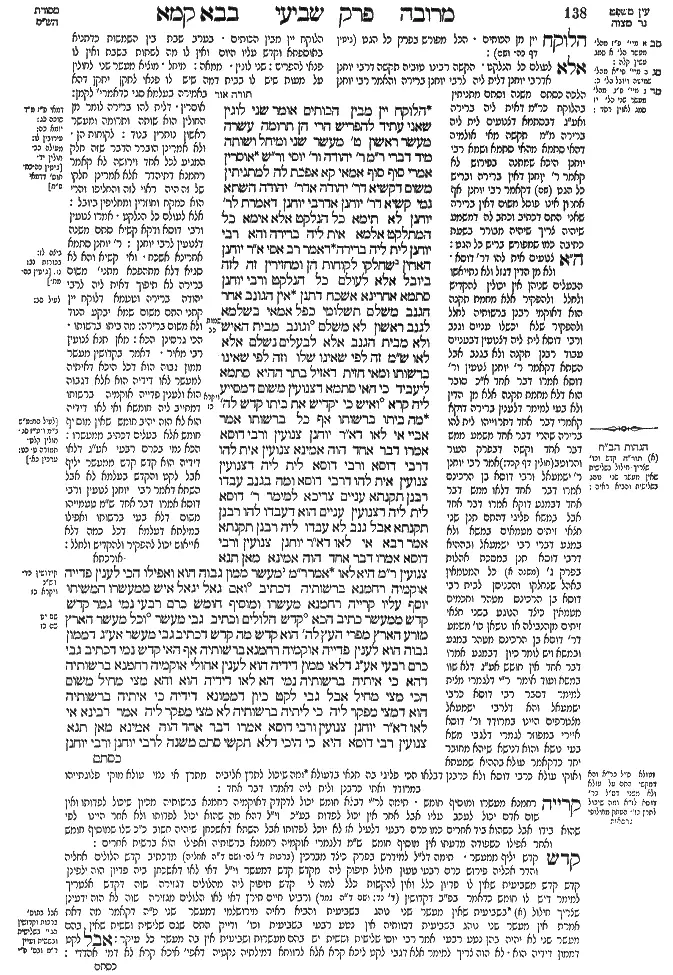
Bava Kamma 69b - Guemara
הלוקח יין מבין הכותים אומר שני לוגין שאני עתיד להפריש הרי הן תרומה עשרה מעשר ראשון ט' מעשר שני ומיחל ושותה מיד דברי ר"מ ר' יהודה ור' יוסי ור"ש אוסרין אמרי סוף סוף אמאי קא אפכת לה למתניתין משום דקשיא דר' יהודה אדר' יהודה השתא נמי קשיא דר' יוחנן אדרבי יוחנן דאמרת לר' יוחנן לא תימא כל הנלקט אלא אימא כל המתלקט אלמא אית ליה ברירה והא רבי יוחנן לית ליה ברירה דאמר רב אסי א"ר יוחנן האחין שחלקו לקוחות הן ומחזירין זה לזה ביובל אלא לעולם כל הנלקט ורבי יוחנן סתמא אחרינא אשכח דתנן אין הגונב אחר הגנב משלם תשלומי כפל אמאי בשלמא לגנב ראשון לא משלם (שמות כב, ו) וגונב מבית האיש ולא מבית הגנב אלא לבעלים נשלם אלא לאו ש"מ זה לפי שאינו שלו וזה לפי שאינו ברשותו ומאי חזית דאזיל בתר ההיא סתמא ליעביד כי האי סתמא דצנועין משום דמסייע ליה קרא (ויקרא כז, יד) ואיש כי יקדיש את ביתו קדש לה' מה ביתו ברשותו אף כל ברשותו אמר אביי אי לאו דא"ר יוחנן צנועין ורבי דוסא אמרו דבר אחד הוה אמינא צנועין אית להו דרבי דוסא ורבי דוסא לית ליה דצנועין צנועין אית להו דרבי דוסא ומה בגנב עבדו רבנן תקנתא עניים צריכא למימר ר' דוסא לית ליה דצנועין עניים הוא דעבדו להו רבנן תקנתא אבל גנב לא עבדו ליה רבנן תקנתא אמר רבא אי לאו דא"ר יוחנן צנועין ורבי דוסא אמרו דבר אחד הוה אמינא מאן תנא צנועין ר"מ היא לאו אמר ר"מ מעשר ממון גבוה הוא ואפילו הכי לענין פדייה אוקמיה רחמנא ברשותיה דכתיב (ויקרא כז, לא) ואם גאל יגאל איש ממעשרו חמשיתו יוסף עליו קרייה רחמנא מעשרו ומוסיף חומש כרם רבעי נמי גמר קדש קדש ממעשר כתיב הכא (ויקרא יט, כד) קדש הלולים וכתיב גבי מעשר (ויקרא כז, ל) וכל מעשר הארץ מזרע הארץ מפרי העץ לה' הוא קדש מה קדש דכתיב גבי מעשר אע"ג דממון גבוה הוא לענין פדייה אוקמיה רחמנא ברשותיה אף האי קדש נמי דכתיב גבי כרם רבעי אע"ג דלאו ממון דידיה הוא לענין אחולי אוקמיה רחמנא ברשותיה דהא כי איתיה ברשותיה נמי הא לאו דידיה הוא והא מצי מחיל משום הכי מצי מחיל אבל גבי לקט כיון דממונא דידיה כי איתיה ברשותיה הוא דמצי מפקר ליה כי ליתיה ברשותיה לא מצי מפקר ליה אמר רבינא אי לאו דא"ר יוחנן צנועין ורבי דוסא אמרו דבר אחד הוה אמינא מאן תנא צנועין רבי דוסא היא כי היכי דלא תקשי סתם משנה לרבי יוחנן ורבי יוחנן
Comments from Rashi on Masechet Bava Kamma Page 69b
הלוקח יין מבין הכותים . בערב שבת בין השמשות כדתניא בתוספתא וקדש עליו היום ואין לו מה לשתות בשבת ואין לו פנאי להפריש: שני לוגין . ממאה: מיחל . מוציא מעשר שני לחולין על מעות שיש לו בבית דמה שיש לו פנאי לתקן יתקן דהא באמירה בעלמא סגי כדאמרי' לקמן: אוסרין . דלית להו ברירה לומר מן החולין הוא שותה ותרומה ומעשר ראשון נותרין בנוד: לקוחות הן . ולא אמרינן הוברר הדבר שזה חלק המגיע לכל אחד וירושה לא קאמר רחמנא דתיהדר אלא אמרינן חלקו של זה היה ראוי לזה והחליפו והרי הוא כמקח וחוזרין ומחליפין ביובל: אלא לעולם כל הנלקט . אמרו צנועין ורבי דוסא ודקא קשיא סתם משנה דצנועין לרבי יוחנן: ר' יוחנן סתמא אחרינא אשכח . ואי קשיא והא לא סגיא דלא מתהפכא מתני' משום ברירה לא תיפוך דאית ליה לרבי יהודה ברירה וטעמא דלוקח יין קתני התם משום שמא יבקע הנוד ולא משום ברירה: מה ביתו ברשותו . הכי גרסינן הכא: מאן תנא צנועין רבי מאיר . דאמר בקדושין מעשר ממון גבוה הוא דכל היכא דאיתיה למעשר לאו דידיה הוא אלא דגבוה הוא ולענין פדייה אוקמיה ברשותו דמחייב ליה חומשא ואי לאו דידיה הוא לא הוה יהיב חומש שאין מוסיף חומש אלא בעלים דכתיב ממעשרו: הכא נמי בכרם רבעי . אע"ג דלאו דידיה הוא קדש קדש ממעשר יליף אבל לקט והקדש בעלמא לא אבל השתא דאמר רבי יוחנן צנועין ורבי דוסא אמרו דבר אחד ש"מ טעמייהו משום דלא בעי ברשותו ואפילו במילתא דעלמא דכל כמה דלא אייאוש יכול להפקיר ולהקדיש ולחלל:
Comments from Tosafot - Bava Kamma 69b
הלוקח יין מן הכותים . הכל מפורש בפרק כל הגט (גיטין דף כה. ושם): אלא לעולם כל הנלקט . הקשה רבינו טוביה תקשה דרבי יוחנן אדרבי יוחנן דלית ליה לרבי יוחנן ברירה והאמר רבי יוחנן . הלכה כסתם משנה וסתם מתניתין בהלוקח כר"מ דאית ליה ברירה ואע"ג דבסתמא דצנועים לית ליה ברירה מ"מ תקשה מאי אולמיה דהאי סתמא מהאי סתמא ושמא רבי יוחנן היכא שמתנה בפירוש לא קאמר ר' יוחנן דאין ברירה ובריש כל הגט (שם) דקאמר רבי יוחנן אף אחרון אינו פוסל משום דאין ברירה שאני התם דכתיב וכתב לה דמשמע שיהיה צריך שיהיה מבורר בשעת כתיבה כמו שמפורש בריש כל הגט: ה"א צנועים אית להו דר' דוסא . ולא מן הדין דגזל ולא נתייאשו הבעלים שניהן אין יכולין להקדיש ולחלל ולהפקיר אלא מחמת תקנה הוא דאוקמי רבנן ברשותיה לחלל ולהפקיר שלא יכשלו עניים וגנב ורבי דוסא לית ליה דצנועין דבעניים עבוד רבנן תקנה ולא בגנב אבל השתא דקאמר ר' יוחנן צנועין ור' דוסא אמרו דבר אחד א"כ סובר הוא דלא מחמת תקנה אלא מן הדין ולא בעי למימר דלענין ברירה דוקא קאמרי דבר אחד דתרוייהו לית להו ברירה שהרי דבר אחד משמע ממש דבר אחד וקשה דבפרק העור והרוטב (חולין דף קכד:) אמר רבי יוחנן ר' ישמעאל ורבי דוסא בן הרכינס אמרו דבר אחד דלאו ממש דבר אחד דבמגע דוקא אמרו דבר אחד אבל במשא פליגי דהתם תנן שני חצאי זיתים מטמאים במשא ולא במגע דברי רבי ישמעאל ובההיא דרבי דוסא תנן במסכת אהלות בפרק ג' (משנה א) כל המטמאין באהל שנחלקו והכניסן לבית רבי דוסא בן הרכינס מטהר וחכמים מטמאין כיצד הנוגע בשני חצאי זיתים מן הנבילה או נושאן כו' משמע דר' דוסא בן הרכינס מטהר במגע ובמשא ויש לומר כיון דבמגע אמרו דבר אחד אין חושש אע"ג דלא שוו במשא ועוד אומר ר"י דלגמרי מצית למימר דסבר רבי דוסא כרבי ישמעאל והא דלרבי ישמעאל מצטרפים היינו במרודד ור' דוסא איירי במפוזר לגמרי דלגבי משא בעי נושא והוא דנישא שיהא מחובר יחד כדקאמר עולא בההיא שמעתא ואוקי עולא כרבי דוסא ולא כרבנן דבלאו הכי פליגי בה תנאי בדעולא ומה שיכול לתרץ אליביה מתרץ אי נמי עולא מוקי פלוגתייהו במרודד ואתי כרבנן ולית ליה דאמרו דבר אחד: קרייה רחמנא מעשרו ומוסיף חומש . תימה לר"י דבלא חומש יכול לדקדק דאוקמיה רחמנא ברשותיה מכיון שיכול לפדותו ואין שום אדם יכול לעכב עליו אבל אחר אין יכול לפדות בע"כ וי"ל דהא מה שהוא יכול לפדותו ולא אחר היינו לפי שהוא בידו אבל כשהוא ביד אחרים כמו כרם רבעי דלעיל אז לא יוכל לפדותו אבל השתא דאשכחן שיהיה חשוב כ"כ שלו שמוסיף חומש ואחר אפילו כשפודה מדעתו אין מוסיף חומש ש"מ דלגמרי אוקמיה רחמנא ברשותיה ואפילו. הוא ברשות אחרים: קדש קדש יליף ממעשר . תימה דל"ל למידרש בפרק כיצד מברכין (ברכות ד' לה. ושם ד"ה אחליה) מדכתיב קדש הלולים אחליה והדר אכליה פירוש כרם רבעי טעון חילול תיפוק ליה מקדש קדש דמעשר וי"ל דאי לאו דאשכחן ביה פדיון הוה ילפינן קדש קדש משביעית שאין לו פדיון כלל ואין להקשות כלל למה לי קדש תיפוק ליה מהלולים דגזירה שוה דקדש אצטריך למימר דיש לו חומש כדאמר בפ"ב דקדושין (ד' נד: ושם ד"ה גמר) ורבינו חיים תירץ דאי לאו הלולים מגזירה שוה לא הוה ידעינן שצריך חילול בשביעית שאין מעשר שני נוהג בשביעית והביא ראיה מירושלמי דמעשר שני פ"ה דקאמר מה דאת אמרת אין מעשר שני נוהג בשביעית דכוותיה אין נטע רבעי בשביעית וכו' ודייק התם שגם שלישית וששית שאין בהם מעשר שני לא יהיה בהן נטע רבעי אמר רבי יוסי שלישית וששית יש בהם מעשרות ושביעית אין בה מעשר כל עיקר: אבל לקט דממון דידיה הוא . לא הוה צריך למימר אלא דגבי לקט ליכא קרא אלא לרווחא דמילתיה נקטיה דאפי' איכא קרא לא דמי אהדדי:
Bava Kamma 69b - Mishnah translated into english
In the case of one who purchases wine from among the Samaritans [Kutim], if there is reason to suspect that teruma and tithes were not separated, and he cannot separate them before the start of Shabbat, he acts as follows. If there are one hundred log of wine in the barrels, he says: Two log that I will separate in the future are teruma, as the mandated average measure of teruma is one-fiftieth; ten log are first tithe; and a tenth of the remainder, nine log, are second tithe. And he desacralizes the second tithe that he will separate in the future by transferring its sanctity onto money, and he may drink the wine immediately, relying on the separation that he will perform later. This is the statement of Rabbi Meir.
Rabbi Yehuda, Rabbi Yosei, and Rabbi Shimon prohibit one from doing so. The objection of these three Sages is presumably that this arrangement relies on the principle of retroactive designation, as at the time of the declaration the identity of the particular portions of wine that will be teruma and tithes is unknown, and these Sages do not accept this principle. It is apparent from this mishna that Rabbi Yehuda does not accept retroactive designation, and therefore he cannot be the one who said that the owner of the field may issue his declaration of relinquishment in the morning.
The Gemara says: Ultimately, why do you reverse the baraita that contains the opinions of Rabbi Yehuda and Rabbi Dosa? It is because there is a difficulty due to the contradiction between one statement of Rabbi Yehuda and another statement of Rabbi Yehuda. Now too, although you have reversed the baraita, a similar problem remains, as there is a difficulty due to the contradiction between one statement of Rabbi Yoḥanan and another statement of Rabbi Yoḥanan.
As you said, according to the opinion of Rabbi Yoḥanan: Do not say that anything that was picked from this vine by passersby shall be desacralized onto these coins. Rather, say that anything that will be picked from this vine shall be desacralized onto these coins. Apparently, Rabbi Yoḥanan here accepts the principle of retroactive designation. But it is established that Rabbi Yoḥanan does not accept the principle of retroactive designation.
As Rav Asi says that Rabbi Yoḥanan says: Brothers who divided property received as an inheritance are considered purchasers from each other, and as purchasers of land they must return the portions to each other in the Jubilee Year, at which point they may redistribute the property. This demonstrates that Rabbi Yoḥanan does not hold that it is retroactively clarified that each brother’s portion was designated for him directly upon their father’s death, but rather all the land was considered joint property until the brothers traded or bought their respective portions from each other at the time of the distribution of the estate.
In light of this objection, the Gemara retracts its previous assertion that Rabbi Yoḥanan reformulated the declaration of the pious ones. Rather, the pious ones actually declared in the past tense: Anything that was picked from this vine by passersby shall be desacralized onto these coins, i.e., the desacralizing took place after the grapes were stolen. If so, the question remains: Why did Rabbi Yoḥanan not accept the opinion of the pious ones, but instead ruled that the owner of an item cannot consecrate it after it has been stolen?
The Gemara answers: Rabbi Yoḥanan found a different unattributed mishna, which contradicts the opinion of the pious ones. As we learned in the mishna here (62b): One who steals an item after a thief has already stolen it, i.e., one who steals a stolen item, does not pay the double payment to the thief or to the prior owner. Why not? Granted that he does not pay to the first thief, as the verse states: “And it was stolen from the house of the man; if the thief shall be found he shall pay double” (Exodus 22:6), which indicates that the double payment applies in the case of an item “stolen from the house of the man,” i.e., from the owner’s jurisdiction, but not to an item stolen from the thief’s house. But let him pay the double payment to the owner, as it presumably still belonged to the owner when the second thief stole it.
Rather, must one not conclude from this that a stolen item is not under the full jurisdiction of either the owner or the thief? It is not under the jurisdiction of this one, the first thief, because it does not belong to him, and it is not under the jurisdiction of that one, the owner, because it is not in his possession. Therefore, neither of them can consecrate the stolen item.
The Gemara asks: Granted that this unattributed mishna disagrees with the mishna that cites the pious ones, but what did you see that led you to follow that unattributed mishna, the one that discusses the double payment? Let Rabbi Yoḥanan act, i.e., rule, in accordance with this unattributed mishna, which states the practice of the pious ones. On what basis did he choose one mishna over the other?
The Gemara answers: Rabbi Yoḥanan followed the mishna that discusses the double payment because there is a verse that supports it: “And when a man shall sanctify his house to be holy to the Lord” (Leviticus 27:14), from which it is derived: Just as one’s house is in his possession, so too anything that one consecrates must be in his possession, excluding items that have been stolen from him.
§ Abaye said: If Rabbi Yoḥanan had not said that the pious ones and Rabbi Dosa said the same thing, i.e., their rulings are identical, I would say that the pious ones accept the opinion of Rabbi Dosa, but Rabbi Dosa does not accept the opinion of the pious ones.
Abaye elaborates: The pious ones accept the opinion of Rabbi Dosa, for the following reason: And if the Sages instituted an ordinance for the sake of a thief, to prevent him from eating unredeemed fourth-year grapes, by allowing the owner to desacralize produce that is no longer in his possession, does it need to be said that they did so for the sake of innocent poor people, as Rabbi Dosa claimed? Conversely, Rabbi Dosa does not accept the opinion of the pious ones, as he says: It is for the sake of poor people that the Sages instituted an ordinance; but the Sages did not institute an ordinance for the sake of a thief, in line with the aforementioned principle: Feed it to the wicked man and let him die.
In a similar vein, Rava said: If Rabbi Yoḥanan had not said that the pious ones and Rabbi Dosa said the same thing, I would say that there is a fundamental difference between the cases of fourth-year produce and gleanings taken by the poor, as one could claim: Who is the tanna who taught the ruling of the pious ones? It is Rabbi Meir.
Doesn’t Rabbi Meir say that second tithe is property belonging to the Most High, rather than the possession of the one who separated it from his produce, and even so, with regard to redemption of the second tithe the Merciful One establishes it in his possession? As it is written concerning the second tithe: “And if a man will redeem any of his tithe, he shall add to it its fifth part” (Leviticus 27:31).
Although according to the opinion of Rabbi Meir, second tithe does not belong to the owner of the produce from which it was separated, nevertheless, with regard to redemption the Merciful One does distinguish between a stranger and one who separated it from his produce, as the Torah refers to the second tithe as “his tithe” and thereby decrees that he, the owner of the crop from which it is separated, can redeem it by adding one-fifth to its value, but no one else can do so. This indicates that although second-tithe produce is not in fact owned by the person, the Torah treats him as the owner of the produce.
With regard to a fourth-year vineyard as well, the Sages derive many of its halakhot from a verbal analogy between second tithe and fourth-year fruit, based on the use of the word “holy” in the context of fourth-year fruit and “holy” in the context of second tithe. It is written here, concerning fourth-year fruit trees: “And in the fourth year all its fruit shall be holy, for giving praise to the Lord” (Leviticus 19:24), and it is written with regard to second tithe: “And all the tithe of the land, whether of the seed of the land or of the fruit of the tree, is the Lord’s; it is holy” (Leviticus 27:30).
From this analogy it is derived: Just as in the case of the term “holy” that is written in connection to second tithe, even though it is property belonging to the Most High, with regard to redemption the Merciful One establishes it in the jurisdiction of the one who separated it, so too in the context of the word “holy” that is written in connection to the fourth-year vineyard, even though it is not his property, as it belongs to the Most High, with regard to desacralizing the Merciful One establishes it in the vineyard owner’s jurisdiction.
The effect of this determination is that even when the fruit is in his jurisdiction it is not his property, and yet he is able to desacralize it. And due to that reason the owner of the vineyard is able to desacralize the fruit even after a thief has taken it. Even in normal circumstances when one desacralizes his fourth-year fruit he is desacralizing fruit that does not belong to him. Consequently, there is no novelty in the ruling that one can desacralize fruit even after it has been taken by a thief.
But with regard to gleanings of the poor, since the extra sheaves that the poor people inadvertently take are the property of the owner of the field, it may be claimed that only when those sheaves are in his possession, i.e., they have not been taken by anyone else, can he relinquish his ownership of them, whereas when they are no longer in his possession he cannot relinquish his ownership of them. Consequently, the pious ones, who permitted redemption of fourth-year produce after it had been stolen, would not necessarily agree with Rabbi Dosa, who allowed the relinquishment of stolen sheaves.
In a similar vein, Ravina said: If Rabbi Yoḥanan had not said that the pious ones and Rabbi Dosa said the same thing, I would say: Who is the tanna who taught the opinion of the pious ones? It is Rabbi Dosa. I would have said this so that an unattributed mishna should not present a difficulty to the opinion of Rabbi Yoḥanan. And the reason why this would have resolved the difficulty is that Rabbi Yoḥanan
Traduction : The William Davidson digital edition of the Koren Noé Talmud, with commentary by Rabbi Adin Even-Israel Steinsaltz.