 Talmud Bavli
Bava Kamma 45b : Youtube
Daf TubeYoutube
2 video classes :
Bava Kamma Page 45b
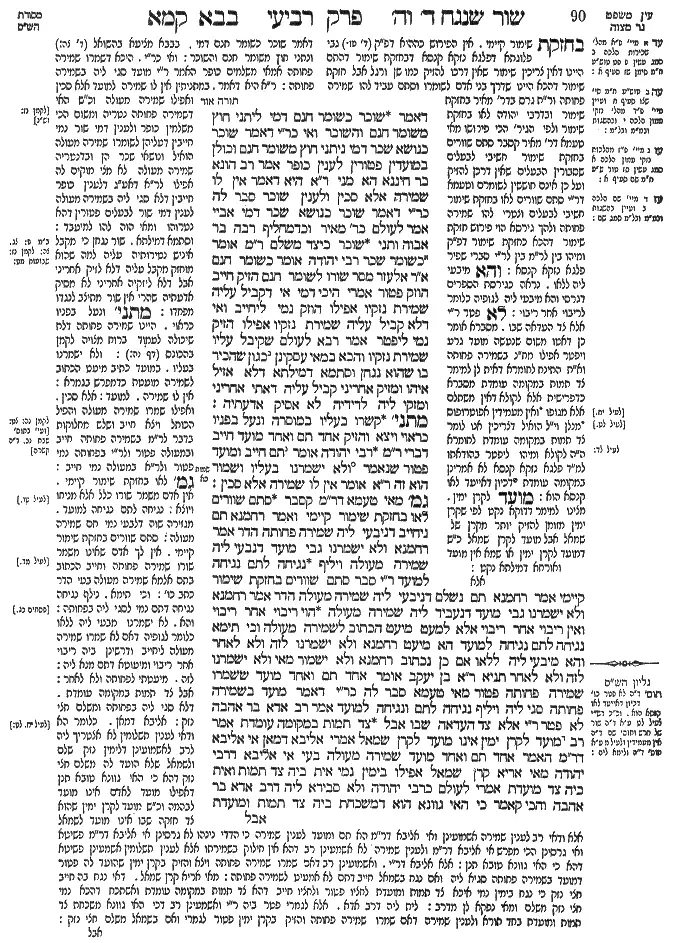
Bava Kamma 45b - Guemara
דאמר שוכר כשומר חנם דמי ליתני חוץ משומר חנם והשוכר ואי כר"י דאמר שוכר כנושא שכר דמי ניתני חוץ משומר חנם וכולן במועדין פטורין לענין כופר אמר רב הונא בר חיננא הא מני ר"א היא דאמר אין לו שמירה אלא סכין ולענין שוכר סבר לה כר"י דאמר שוכר כנושא שכר דמי אביי אמר לעולם כר' מאיר וכדמחליף רבה בר אבוה ותני שוכר כיצד משלם ר"מ אומר כשומר שכר רבי יהודה אומר כשומר חנם א"ר אלעזר מסר שורו לשומר חנם הזיק חייב הוזק פטור אמרי היכי דמי אי דקביל עליה שמירת נזקיו אפילו הוזק נמי ליחייב ואי דלא קביל עליה שמירת נזקיו אפילו הזיק נמי ליפטר אמר רבא לעולם שקיבל עליו שמירת נזקיו והכא במאי עסקינן כגון שהכיר בו שהוא נגחן וסתמא דמילתא דלא אזיל איהו ומזיק אחריני קביל עליה דאתי אחריני ומזקי ליה לדידיה לא אסיק אדעתיה:
מתני׳ קשרו בעליו במוסרה ונעל בפניו כראוי ויצא והזיק אחד תם ואחד מועד חייב דברי ר"מ רבי יהודה אומר תם חייב ומועד פטור שנאמר (שמות כא, לו) ולא ישמרנו בעליו ושמור הוא זה ר"א אומר אין לו שמירה אלא סכין:
גמ׳ מאי טעמא דר"מ קסבר סתם שוורים לאו בחזקת שימור קיימי ואמר רחמנא תם ניחייב דניבעי ליה שמירה פחותה הדר אמר רחמנא ולא ישמרנו גבי מועד דנבעי ליה שמירה מעולה ויליף נגיחה לתם נגיחה למועד ר"י סבר סתם שוורים בחזקת שימור קיימי אמר רחמנא תם נשלם דניבעי ליה שמירה מעולה הדר אמר רחמנא ולא ישמרנו גבי מועד דנעביד ליה שמירה מעולה הוי ריבוי אחר ריבוי ואין ריבוי אחר ריבוי אלא למעט מיעט הכתוב לשמירה מעולה וכי תימא נגיחה לתם נגיחה למועד הא מיעט רחמנא ולא ישמרנו לזה ולא לאחר והא מיבעי ליה ללאו אם כן נכתוב רחמנא ולא ישמור מאי ולא ישמרנו לזה ולא לאחר תניא ר"א בן יעקב אומר אחד תם ואחד מועד ששמרו שמירה פחותה פטור מאי טעמא סבר לה כר"י דאמר מועד בשמירה פחותה סגי ליה ויליף נגיחה לתם ונגיחה למועד אמר רב אדא בר אהבה לא פטר ר"י אלא צד העדאה שבו אבל צד תמות במקומה עומדת אמר רב מועד לקרן ימין אינו מועד לקרן שמאל אמרי אליבא דמאן אי אליבא דר"מ האמר אחד תם ואחד מועד שמירה מעולה בעי אי אליבא דרבי יהודה מאי אריא קרן שמאל אפילו בימין נמי אית ביה צד תמות ואית ביה צד מועדת אמרי לעולם כרבי יהודה ולא סבירא ליה דרב אדא בר אהבה והכי קאמר כי האי גוונא הוא דמשכחת ביה צד תמות ומועדת
Comments from Rashi on Masechet Bava Kamma Page 45b
דאמר שוכר כשומר חנם דמי . בבבא מציעא בהשואל (ד' צה:) ונתני חוץ משומר חנם והשוכר: ואי כר"י . היכא דשמרו שמירה פחותה אמאי משלמים כופר האמר ר"י מועד סגי ליה בשמירה פחותה: ר"א היא דאמר . במתניתין אין לו שמירה למועד אלא סכין ואפילו שמירה מעולה וכ"ש האי דשמירה פחותה נטריה ומשום הכי משלמין כופר ולענין דמי שור נמי חייבין דעליהן לשומרו שמירה מעולה הואיל ונושאי שכר הן ובדנטריה שמירה מעולה לא מצי מוקים לה אפילו לר"א דאע"ג דלענין כופר חייבין דלא סגי ליה בשמירה מעולה לענין דמי שור לבעלים פטורין דהא נטרוהו ומאי הוה להו למיעבד: אלא סכין . ואפילו שמרו שמירה מעולה והפיל הכותל ויצא חייב ושלש מחלוקות בדבר לר"מ בשמירה פחותה חייב ובמעולה פטור ולר"י בפחותה נמי פטור ולר"א במעולה נמי חייב: וסתמא דמילתא . שור נגחן כי מקבל איניש נטירותיה עליה למה שהוא מוחזק מקבל עליה דלא לזיק אחריני אבל דלא ליזקיה אחריני לא מסיק אדעתיה שהרי אין שור מתיצב לנגדו מפחדו: מתני' ונעל בפניו כראוי . היינו שמירה פחותה דלת שיכולה לעמוד ברוח מצויה לקמן בהכונס (בבא קמא דף נה:): ולא ישמרנו בעליו . במועד כתיב מיעט הכתוב לשמירה מועטת כדמפרש בגמרא: אין לו שמירה . למועד: אלא סכין . ואפילו שמרו שמירה מעולה והפיל הכותל ויצא חייב ושלש מחלוקות בדבר לר"מ בשמירה פחותה חייב ובמעולה פטור ולר"י בפחותה נמי פטור ולר"א במעולה נמי חייב: גמ' לאו בחזקת שימור קיימי . אין אדם משמר שורו כלל אלא מניחו ויוצא: נגיחה לתם נגיחה למועד . מגזירה שוה דלבעי נמי תם שמירה מעולה: סתם שוורים בחזקת שימור קיימי . אין לך אדם שאינו משמר שורו שמירה פחותה וחייב הכתוב בתם אלמא שמירה מעולה בעי הדר כתב כו': וכי תימא . נילף נגיחה נגיחה דתם נמי לסגי ליה בפחותה: והא . לא ישמרנו מבעי ליה ללאו כלומר לגופיה דאם לא שמרו שמירה מעולה ליחייב ודרשינן ביה ריבוי אחר ריבוי ומיעוטא דתם מנא ליה: לזה . מיעטתי לפחותה ולא לאחר: אבל צד תמות במקומה עומדת . דלא סגי ליה בפחותה ומשלם חצי נזק: אליבא דמאן . כלומר הא ודאי לענין תשלומין לא אצטריך ליה לרב לאשמועינן דלימין נזק שלם ולשמאל שלא הועד לה משלם חצי נזק דהא כי האי גוונא טובא תנן דאפילו מועד לאדם אינו מועד לבהמה וכ"ש מועד לקרן ימין שהוא צד חזקה שבו אינו מועד לשמאל אלא ודאי רב לענין שמירה אשמועינן ואי אליבא דר"מ הא תם ומועד לענין שמירה כי הדדי נינהו לא גרסינן אי אליבא דר"מ פשיטא ואי גרסינן הכי מפרש אי אליבא דר"מ ולענין שמירה לא אשמעינן רב דהא אין חילוק בשמירתו אלא לענין תשלומין אשמעינן פשיטא דהא כי האי גוונא טובא תנן: אלא אליבא דר"י . ואשמועינן רב דאם שמרו שמירה פחותה ויצא והזיק בקרן ימין שהועד לה פטור דמועד בשמירה פחותה סגיא ליה ואם נגח בשמאל חייב דתם לא אמעיט לשמירה פחותה: מאי אריא קרן שמאל . דאי נגח בה חייב חצי נזק כי נגח בימין נמי איכא צד תמות ומועדת לחציו פטור ולחציו חייב דהא צד תמות במקומה עומדת ואשתכח דהכא נמי חצי נזק משלם ומאי נפקא לן מדרב: לית ליה דרב אדא . אלא לגמרי פטר ביה ר"י ואשמעינן רב דכי האי גוונא משכחת צד תמות ומועדת בחד תורא ולענין שמירה דאם שמרו שמירה פחותה והזיק בקרן ימין פטור לגמרי ואם בשמאל משלם חצי נזק:
Comments from Tosafot - Bava Kamma 45b
בחזקת שימור קיימי. אין הפירוש כההיא דפ"ק (ד' טו.) גבי פלוגתא דפלגא נזקא קנסא דבחזקת שימור דהתם היינו דאין צריכין שימור שאין דרכו להזיק כמו שן ורגל אבל חזקת שימור דהכא היינו שדרך בני אדם לשומרו וסתם עביד להו שמירה פחותה ור"ת גרס בדר' מאיר בחזקת שימור ובדרבי יהודה לאו בחזקת שימור ולפי הגיר' הכי פירושו מאי טעמא דר' מאיר קסבר סתם שוורים בחזקת שימור חשיבי לבעלים שסבורין הבעלים שאין דרכן להזיק ועל כן אינם חוששין לשומרם וטעמא דר"י סתם שוורים לאו בחזקת שימור חשיבי לבעלים ונטרי להו שמירה פחותה ולהך גירסא הוי פירוש חזקת שימור דהכא כחזקת שימור דפ"ק ומיהו בין לר"מ בין לר"י סברי שפיר פלגא נזקא קנסא: והא מיבעי ליה ללאו . נראה כגירסת הספרים דגרסי והא מיבעי ליה לגופיה כלומר לריבוי אחר ריבוי: לא פטר ר"י אלא צד העדאה שבו . מסברא אומר כן דאטו משום שנעשה מועד גרע ויפטר אפילו מח"נ בשמירה פחותה וא"ת התינח לחומרא דאית לן למימר צד תמות במקומה עומדת מסברא כדפרישית אלא לקולא דאין משתלם אלא מגופו. ואין מעמידין אפוטרופוס מנלן וי"ל הואיל דצריכין אנו לומר צד תמות במקומה עומדת לחומרא ה"ה לקולא ומיהו ליפטר בהודאתו למ"ד פלגא נזקא קנסא לא אמרינן במקומה עומדת דכיון דאייעד לאו קנסא הוא: מועד לקרן ימין . מצינו למימר דדוקא נקט לפי שקרן ימין מזומן להזיק יותר מקרן של שמאל אבל מועד לקרן שמאל כ"ש דמועד לקרן ימין או שמא אין מועד ואורחא דמילתא נקט.
Bava Kamma 45b - Mishnah translated into english
who says that a renter is considered like an unpaid bailee with regard to his responsibility for the rented item, let it teach that bailees are liable to compensate the owner, with the exception of an unpaid bailee and a renter.
And if it is in accordance with the opinion of Rabbi Yehuda, who says that a renter is considered like a paid bailee, let it teach: With the exception of an unpaid bailee, as it in fact states; but it should also state that in a case where the oxen are forewarned, all of them are exempt with regard to ransom, as Rabbi Yehuda says in the next mishna that a forewarned ox requires only a reduced level of safeguarding. Therefore, this baraita does not appear to be in accordance with the opinion of either tanna.
Rav Huna bar Ḥinnana said: In accordance with whose opinion is this baraita? It is in accordance with the opinion of Rabbi Eliezer, who says that an ox has no sufficient safeguarding at all other than slaughtering it with a knife; i.e., there is no degree of safeguarding that exempts the ox’s owner, or in the context of the baraita, the bailee, from liability if the ox causes damage or kills. And with regard to a renter, the baraita holds in accordance with the opinion of Rabbi Yehuda, who says that a renter is considered like a paid bailee.
Abaye said: Actually, the baraita is in accordance with the opinion of Rabbi Meir; and it is as Rabba bar Avuh reversed the two opinions and taught: How does a renter pay? In other words, what is his degree of responsibility? Rabbi Meir says: Like a paid bailee. Rabbi Yehuda says: Like an unpaid bailee.
§ Rabbi Elazar says: If the owner conveyed his ox to an unpaid bailee, if the ox caused damage, the bailee is liable to pay damages; but if the ox was injured, he is exempt.
The Sages said: What are the circumstances? If Rabbi Elazar was referring to a bailee who accepted responsibility upon himself for guarding it from causing damage, even if the ox was injured he should be liable. And if he was referring to a bailee who did not accept responsibility for guarding it from causing damage, even if it causes damage he should be exempt from payment.
Rava said: Actually, Rabbi Elazar was referring to a case where he accepted responsibility upon himself for guarding it from causing damage; but here we are dealing with a case where the bailee recognized that the ox was a goring ox, and in that case the normal way of things is that the bailee accepted upon himself responsibility for safeguarding it so that it would not go and injure others, since he knew that it was dangerous. But it presumably did not enter his mind that other oxen would come and injure it. Therefore, he did not accept responsibility for safeguarding against such an occurrence.
MISHNA: If the ox’s owner tied it with reins to a fence or locked the gate before it in an appropriate manner, but nevertheless the ox emerged and caused damage, whether the ox is innocuous or forewarned the owner is liable, since this is not considered sufficient precaution to prevent damage; this is the statement of Rabbi Meir.
Rabbi Yehuda says that if the ox is innocuous the owner is liable even if he safeguarded it appropriately, since the Torah does not limit the required safeguarding for an innocuous ox. But if the ox is forewarned, the owner is exempt from paying compensation for damage, as it is stated in the verse describing damage by a forewarned ox: “And the owner has not secured it” (Exodus 21:36), and this ox that was tied with reins or behind a locked gate was secured.
Rabbi Eliezer says: An ox has no sufficient safeguarding at all other than slaughtering it with a knife; there is no degree of safeguarding that exempts the ox’s owner from liability.
GEMARA: What is the reason for the opinion of Rabbi Meir? He holds that ordinary oxen are not presumed to be under safeguarding, as their owners do not ordinarily safeguard them; and the Merciful One stated in the Torah that one will be liable even for damage caused by an innocuous ox inasmuch as it requires at least a reduced level of safeguarding, such as with reins. The Merciful One then stated with regard to a forewarned ox: “And the owner has not secured it,” to indicate that it is not sufficient to provide it with only a reduced level of safeguarding, as it requires superior safeguarding. And Rabbi Meir derives this requirement with regard to an innocuous ox from a verbal analogy between the term goring stated with regard to an innocuous ox and the term goring stated with regard to a forewarned ox. In both cases superior safeguarding is required; otherwise the owner is liable.
By contrast, Rabbi Yehuda holds that ordinary oxen are presumed to be under some reduced level of safeguarding. Since the Merciful One stated nevertheless that even for damage caused by an innocuous ox the owner will pay, it may be inferred that it requires superior safeguarding. The Merciful One then states with regard to a forewarned ox: “And the owner has not secured it,” emphasizing again that one must provide it with superior safeguarding. This constitutes one amplification following another amplification, and the principle is that an amplification following an amplification is stated only in order to restrict its extent. Accordingly, the verse excludes the requirement of superior safeguarding with regard to a forewarned ox, and therefore reduced safeguarding is sufficient to exempt the owner from liability.
And if you would say that through the verbal analogy between the term goring stated with regard to an innocuous ox and the term goring stated with regard to a forewarned ox the Torah compares their halakhot, nevertheless, the Merciful One restricted this halakha by emphasizing: “And the owner has not secured it,” referring specifically to it, a forewarned ox, and not to the other, i.e., innocuous, ox.
The Gemara asks: But isn’t this phrase necessary for the negative [lav] statement that if the owner does not provide superior safeguarding he is liable? The Gemara answers: If that is so, let the Merciful One write: And the owner has not secured. What is the purpose of the added emphasis: “And the owner has not secured it”? It is to indicate that the restriction of this halakha relates specifically to it, a forewarned ox, and not to the other, i.e., innocuous, ox.
It is taught in a baraita that there is a fourth opinion. Rabbi Eliezer ben Ya’akov says: In the cases of both an innocuous ox and a forewarned ox in which its owner provided reduced safeguarding, he is exempt from liability.
The Gemara asks: What is the reason for his opinion? He holds in accordance with the opinion of Rabbi Yehuda, who says that reduced safeguarding is sufficient for a forewarned ox, and he derives from the verbal analogy between the term goring stated with regard to an innocuous ox and the term goring stated with regard to a forewarned ox that just as reduced safeguarding is sufficient for a forewarned ox, it is sufficient for an innocuous ox as well.
Rav Adda bar Ahava said: Rabbi Yehuda deemed only the forewarned element of the ox exempt. Rabbi Yehuda’s ruling that reduced safeguarding is sufficient to exempt the owner of a forewarned ox relates only to the additional half of the damage that is paid for a forewarned ox beyond the half of the damage that one is liable to pay for an innocuous ox. But the liability for its element of innocuousness remains in place. Therefore, if the owner did not provide superior safeguarding for the forewarned ox he is still liable to pay half the cost of the damage as he would if it were innocuous.
Rav says: If an ox is forewarned with regard to goring with its right horn, it is not thereby forewarned with regard to goring with its left horn.
The Sages said: In accordance with whose opinion is Rav’s statement made? If it is in accordance with the opinion of Rabbi Meir, doesn’t Rabbi Meir say that both an innocuous ox and a forewarned ox require superior safeguarding? If it is in accordance with the opinion of Rabbi Yehuda, why did he state that the ox still has an innocuous element specifically with regard to the left horn? Even with regard to the right horn itself it has both elements; it has an element of innocuousness and it also has a forewarned element.
The Sages said: Actually, Rav’s statement is in accordance with the opinion of Rabbi Yehuda, and he does not hold in accordance with the opinion of Rav Adda bar Ahava that the ox’s innocuous element remains. And this is what he is saying: You find an element both of innocuousness and of a forewarned status in the same ox specifically in a case like this, where an ox is forewarned with regard to one horn but not with regard to the other.
Traduction : The William Davidson digital edition of the Koren Noé Talmud, with commentary by Rabbi Adin Even-Israel Steinsaltz.