 Talmud Bavli
Bava Kamma 106b : Youtube
Daf TubeYoutube
2 video classes :
Bava Kamma Page 106b
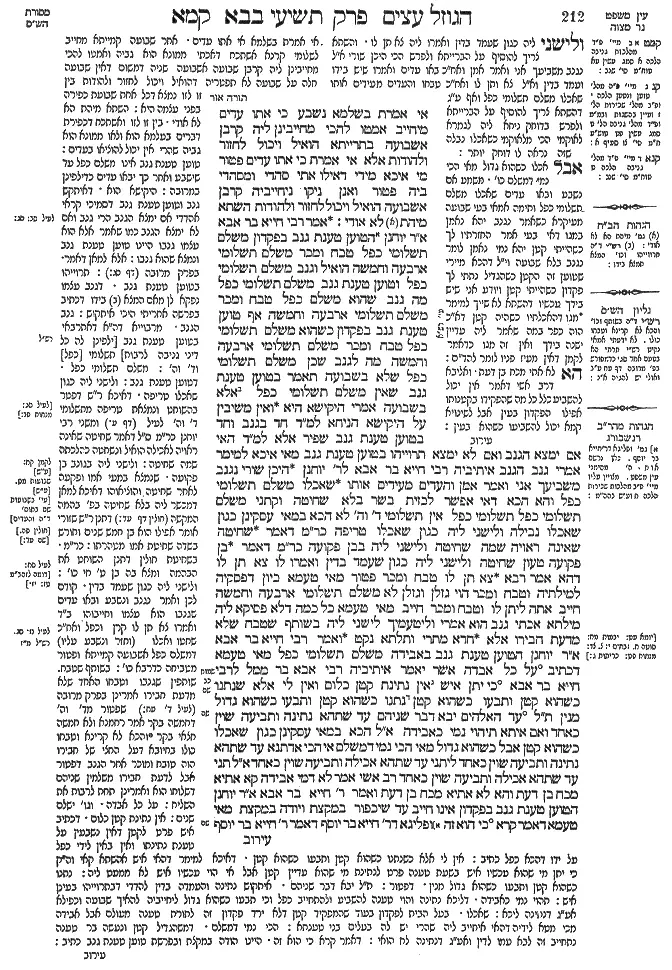
Bava Kamma 106b - Guemara
אי אמרת בשלמא נשבע כי אתו עדים מיחייב אמטו להכי מחייבינן ליה קרבן אשבועה בתרייתא הואיל ויכול לחזור ולהודות אלא אי אמרת כי אתו עדים פטור מי איכא מידי דאילו אתי סהדי ומסהדי ביה פטור ואנן ניקו ניחייביה קרבן אשבועה הואיל ויכול לחזור ולהודות השתא מיהת לא אודי:
אמר רבי חייא בר אבא א"ר יוחנן הטוען טענת גנב בפקדון משלם תשלומי כפל טבח ומכר משלם תשלומי ארבעה וחמשה הואיל וגנב משלם תשלומי כפל וטוען טענת גנב משלם תשלומי כפל מה גנב שהוא משלם כפל טבח ומכר משלם תשלומי ארבעה וחמשה אף טוען טענת גנב בפקדון כשהוא משלם תשלומי כפל טבח ומכר משלם תשלומי ארבעה וחמשה מה לגנב שכן משלם תשלומי כפל שלא בשבועה תאמר בטוען טענת גנב שאין משלם תשלומי כפל אלא בשבועה אמרי היקישא היא ואין משיבין על היקישא הניחא למ"ד חד בגנב וחד בטוען טענת גנב שפיר אלא למ"ד האי אם ימצא הגנב ואם לא ימצא תרוייהו בטוען טענת גנב מאי איכא למימר אמרי גנב הגנב איתיביה רבי חייא בר אבא לר' יוחנן היכן שורי נגנב משביעך אני ואמר אמן והעדים מעידים אותו שאכלו משלם תשלומי כפל והא הכא דאי אפשר לכזית בשר בלא שחיטה וקתני משלם תשלומי כפל תשלומי כפל אין תשלומי ד' וה' לא הכא במאי עסקינן כגון שאכלו נבילה ולישני ליה כגון שאכלו טריפה כר"מ דאמר שחיטה שאינה ראויה שמה שחיטה ולישני ליה בבן פקועה כר"מ דאמר בן פקועה טעון שחיטה ולישני ליה כגון שעמד בדין ואמרו לו צא תן לו דהא אמר רבא צא תן לו טבח ומכר פטור מאי טעמא כיון דפסקיה למילתיה וטבח ומכר הוי גזלן וגזלן לא משלם תשלומי ארבעה וחמשה חייב אתה ליתן לו וטבח ומכר חייב מאי טעמא כל כמה דלא פסיקא ליה מילתא אכתי גנב הוא אמרי וליטעמיך לישני ליה בשותף שטבח שלא מדעת חבירו אלא חדא מתרי ותלתא נקט ואמר רבי חייא בר אבא א"ר יוחנן הטוען טענת גנב באבידה משלם תשלומי כפל מאי טעמא דכתיב (שמות כב, ח) על כל אבדה אשר יאמר איתיביה רבי אבא בר ממל לרבי חייא בר אבא (שמות כב, ו) כי יתן איש אין נתינת קטן כלום ואין לי אלא שנתנו כשהוא קטן ותבעו כשהוא קטן נתנו כשהוא קטן ותבעו כשהוא גדול מנין ת"ל (שמות כב, ח) עד האלהים יבא דבר שניהם עד שתהא נתינה ותביעה שוין כאחד ואם איתא תיהוי נמי כאבידה א"ל הכא במאי עסקינן כגון שאכלו כשהוא קטן אבל כשהוא גדול מאי הכי נמי דמשלם אי הכי אדתנא עד שתהא נתינה ותביעה שוין כאחד ליתני עד שתהא אכילה ותביעה שוין כאחד א"ל תני עד שתהא אכילה ותביעה שוין כאחד רב אשי אמר לא דמי אבידה קא אתיא מכח בן דעת והא לא אתיא מכח בן דעת ואמר ר' חייא בר אבא א"ר יוחנן הטוען טענת גנב בפקדון אינו חייב עד שיכפור במקצת ויודה במקצת מאי טעמא דאמר קרא (שמות כב, ח) כי הוא זה ופליגא דר' חייא בר יוסף דאמר ר' חייא בר יוסף
Comments from Rashi on Masechet Bava Kamma Page 106b
אי אמרת בשלמא אי אתו עדים . אחר שבועה קמייתא מחייב לשלומי קרנא אשתכח דאכתי ממונא הוא גביה ואמטו להכי מחייבינן ליה קרבן שבועה אשבועה שניה דמשום דאין שבועה חלה על שבועה לא תפטריה דהואיל ויכול לחזור ולהודות בין זו לזו נמצא דכל אחת שבועת כפירה בפני עצמה היא: השתא מיהת הא לא אודי . בין זו לזו ואשתכח דכפירת דברים בעלמא הוא ולאו ממונא הוא גביה שהרי אין יכול להוציאו בעדים: טוען טענת גנב . אינו משלם כפל עד שישבע ואחר כך יבאו עדים כדילפינן במרובה: היקישא הוא . דאיתקש גנב וטוען טענת גנב דסמיכי קראי אהדדי אם ימצא הגנב הרי גנב ואם לא ימצא הגנב כמו שאמר אלא הוא עצמו גנבו היינו טוען טענת גנב ונמצא שהוא גנבו: אלא למאן דאמר . בפרק מרובה (דף סג:): תרוייהו בטוען טענת גנב . דגנב עצמו נפקא לן מאם המצא בידו דכתיב בפרשה אחריתי היכי איתקוש: גנב הגנב . מרבוייא דה"א דאתרבאי בטוען טענת גנב [ילפינן לה כל דיני גניבה לרבות] תשלומי [כפל] וד' וה': משלם תשלומי כפל . דטוען טענת גנב: ולישני ליה כגון שאכלו טריפה . דאיכא ר"ש דפטר בהשוחט ונמצאת טריפה מתשלומי ד' וה' לעיל (בבא קמא דף ע.) ומשני רבי יוחנן כר"מ ס"ל דאמר שחיטה שאינה ראויה לאכילה הואיל ונשחטה כהלכתה שמה שחיטה: ולישני ליה בגונב בן פקועה . שנמצא במעי אמו ופקעה לאחר שחיטה והוציאוהו דאיכא למאן דמכשר ליה בלא שחיטה בפ' בהמה המקשה (חולין דף עד:) דתנן ר"ש שזורי אומר אפילו הוא בן חמש שנים וחורש בשדה שחיטת אמו מטהרתו: כר"מ . בשחיטת חולין דתנן השוחט את הבהמה ומצא בה בן ט' חי כו': ולישני ליה כגון שעמד בדין . קודם לכן ואמר נגנב ונשבע ובאו עדים שגנבו הוא עצמו וחייבוהו ב"ד ואמרו צא תן לו קרן וכפל ואח"כ שחטו ואכלו (וחזר ונשבע עליו) דמשלם כפל אשבועה קמייתא ופטור מטביחה כדרבא כו': בשותף שטבח . שותפין שגנבו וטבחו האחד שלא מדעת חבירו אמרינן בפרק מרובה (דף עח:) שפטור מד' וה' דחמשה בקר אמר רחמנא ולא חמשה חצאי בקר והכא לא קרינא וטבחו כולו בחיובא דעל החצי של חבירו הוה טובח ומוכר אחר הגנב דפטור אבל לדעת חבירו משלמין שניהם דשלוחו הוא ואמרינן תחת לרבות את השליח: על כל אבדה . וגו' ישלם שנים: אין נתינת קטן כלום . דכתיב איש פרט לקטן דאין נשבעין על טענת נתינתו ואין באין לידי כפל על ידו דהכא כפל כתיב: אין לי אלא כשנתנו כשהוא קטן ותבעו כשהוא קטן . דאיכא למימר דהאי איש אהשתא קאי וה"ק כי יתן מי שהוא עכשיו איש בשעת טענה פרט לנתינת מי שהוא עדיין קטן אבל אי הוי עכשיו איש לא ממעט ליה: נתנו כשהוא קטן ותבעו כשהוא גדול מנין . דפטור: ת"ל יבא דבר שניהם . איתקוש נתינה והעמדה בדין להדדי דבתרוייהו בעינן איש: תהוי נמי כאבידה . דליכא נתינה והוי טענה להשביע ולהתחייב כפל וכי תבעו כשהוא גדול ליחייביה להאיך שבועה וכפילא אע"ג דנתינה ליכא: שאכלו . בעל הבית לפקדון בעוד שהמפקיד קטן דלא ירד פקדון זה לתורת טענה מעולם אבל אבידה מכי מטא לידיה דהאי איחייב ליה שהרי יש לה בעלים בני טענתא: הכי נמי דמשלם . דמשהגדיל קטן ונעשה בר טענה נתחייב זה לבא עמו לדין ואע"ג דנתינה לא הואי: דאמר קרא כי הוא זה . היינו הודה במקצת ובפרשת טוען טענת גנב כתיב:
Comments from Tosafot - Bava Kamma 106b
ולישני ליה כגון שעמד בדין ואמרו ליה צא תן לו. והשתא צריך להוסיף על הברייתא ולפרש הכי היכן שורי א"ל נגנב משביעך אני ואמר אמן ואח"כ באו עדים ואמרו שיש בידו ועמד בדין וא"ל צא ותן לו ואח"כ טבחו והעדים מעידים אותו שאכלו משלם תשלומי כפל ואף ע"ג דהשתא צריך להוסיף על הברייתא ולפרש בדוחק ניחא ליה לגמרא לאוקמי הכי מלאוקמי כשאכלו נבלה שזה נראה לו דוחק יותר: אבל אכלו כשהוא גדול מאי הכי נמי דמשלם כו' . משמע אם נשבע ובאו עדים שאכלו משלם תשלומי כפל ותימה אמאי בעי שבועה מעיקרא כשאמר נגנב יהא נאמן במגו דאי בעי אמר החזרתיו לך כשהייתי קטן יהא נמי נאמן לומר נגנב בלא שבועה וי"ל דהכא מיירי שטוען זה הקטן כשהגדיל נתתי לך פקדון כשהייתי קטן ויודע אני שיש בידך עכשיו דהשתא לא שייך למימר מגו דהאכלתיו כשהיה קטן דא"כ הוה כפר במה שאמר ליה עדיין ישנה בידך ואין זה מגו כדאמר לקמן דאין מעיז פניו לומר להד"ם: הא לא אתי מכח בן דעת . ואליבא דרב אשי דאמר אין יכול להשביע כלל כל מה שהפקידו בקטנותו אפילו הפקדון בעין אבל לשינויא קמא יכול להשביעו כשהוא בעין:
Bava Kamma 106b - Mishnah translated into english
Granted, if you say that when one takes a false oath and then witnesses come, he is liable to pay, that is why we hold him liable for a guilt-offering for the final oath, since he can still retract and admit his liability and incur an obligation to pay. Consequently, the fact that he took another false oath constitutes an additional false denial of his monetary liability.
But if you say, as Rav did, that even when witnesses come he is exempt from paying, then the mishna’s ruling is difficult, as is there any similar case where if witnesses come and testify with regard to it, he would be exempt, and yet we would stand and obligate him to bring a guilt-offering for a later oath, for no reason other than since he can still retract and admit his liability? As of now, in any event, he has not admitted to any liability and has no extant debt, and any further oaths that he takes are not denials of monetary liability. It follows, then, that Rava’s explanation of Rav’s opinion cannot be undermined by Rav Hamnuna’s challenge.
§ The Gemara cites another ruling concerning the topic of a bailee who claims that a deposit in his possession was stolen. Rabbi Ḥiyya bar Abba says that Rabbi Yoḥanan says: One who falsely states the claim, with regard to a deposit, that a thief stole it, and it becomes clear that he stole it himself, pays double payment. If he slaughtered or sold it, he must pay fourfold or fivefold payment.
He explains his ruling by means of a comparison: Since a thief pays double payment, and one who falsely states the claim that a thief stole the deposit also pays double payment, it follows that just as a thief, who ordinarily pays double payment, and if he slaughtered or sold an animal he stole pays fourfold or fivefold payment, so too, one who falsely states the claim that a thief stole a deposit, who ordinarily pays double payment, if he slaughtered or sold the animal he received as a deposit pays fourfold or fivefold payment.
The Gemara asks: What is notable about the halakha of a thief? It is notable in that he pays double payment even without having taken a false oath; will you say that this stringency should apply with regard to one who falsely states the claim that a thief stole the deposit, who pays double payment only upon taking a false oath? Therefore, one cannot derive from the obligation of a thief to pay fourfold or fivefold payment to the case of one who falsely states the claim that the deposit was stolen.
The Sages say in response: Rabbi Yoḥanan did not base his ruling on a logical inference; rather, it is a derivation based upon a juxtaposition, as the verses discussing a thief and one who falsely states the claim that a deposit was stolen are juxtaposed, and one cannot refute through analysis a derivation based upon juxtaposition.
The Gemara asks: This works out well according to the one who says that one verse is stated with regard to a thief and one verse is stated with regard to one who falsely states the claim that a thief stole the deposit. According to him, there is a juxtaposition, and one can well derive one from the other. But according to the one who says that both this verse: “If the thief shall be found, he shall pay double” (Exodus 22:6), and: “If the thief shall not be found” (Exodus 22:7), are referring to one who falsely states the claim that a thief stole the deposit, and neither verse is referring to a thief, what is there to say?
The Sages say in response: Rabbi Yoḥanan’s ruling is derived from an amplification indicated by the verse not employing the term “thief [gannav],” and instead employing the expanded term “the thief [hagannav].” This teaches that the halakha of the fourfold and fivefold payment applies to one who falsely states the claim that the deposit was stolen, as well.
Rabbi Ḥiyya bar Abba raised an objection to the statement of Rabbi Yoḥanan from a baraita: In a scenario where one said to an unpaid bailee: Where is my ox? Then the bailee responded: It was stolen. And the owner said: I administer an oath to you, and the bailee said: Amen. And the witnesses testify about the bailee that he ate it, he pays double payment. But here, the halakha is that it is impossible to eat even an olive-bulk of meat without slaughtering the animal first, indicating that it must have been slaughtered, and nevertheless it teaches that he pays double payment. It can be inferred that double payment, yes, he pays; but fourfold or fivefold payment, no, he does not pay.
Rabbi Yoḥanan answers: With what are we dealing here? We are dealing with a case where he ate it as an unslaughtered animal carcass. Since it was not killed according to the halakhot of ritual slaughter, the thief does not pay the fourfold or fivefold payment.
The Gemara asks: And let Rabbi Yoḥanan answer Rabbi Ḥiyya bar Abba by saying that it is a case such as where he ate it as an animal with a wound that will cause it to die within twelve months [tereifa], in accordance with Rabbi Shimon’s opinion that the legal status of an act of slaughter that is not fit for accomplishing its full ritual purpose is not considered an act of slaughter for which the thief must pay the fourfold or fivefold payment. The Gemara responds that Rabbi Yoḥanan holds in accordance with the opinion of Rabbi Meir, who says that the legal status of an act of slaughter that is not fit for accomplishing its full ritual purpose is considered an act of slaughter, and the thief would pay the fourfold or fivefold payment.
The Gemara further asks: And let Rabbi Yoḥanan answer Rabbi Ḥiyya bar Abba by saying that the ruling of the baraita is stated with regard to an animal removed from its mother’s womb after the mother was ritually slaughtered [ben pekua], which is permitted for consumption without slaughter, so that there is a possibility that the thief ate it without first slaughtering it. The Gemara responds that Rabbi Yoḥanan holds in accordance with the opinion of Rabbi Meir, who says that a ben pekua requires slaughter.
The Gemara further asks: And let Rabbi Yoḥanan answer Rabbi Ḥiyya bar Abba by saying that it is a case where the bailee stood in judgment in court, and the judges said to him: Go out and give him the stolen animal, and he did not do so, and subsequently slaughtered or sold it? In this case he would not pay the fourfold or fivefold payment, as doesn’t Rava say that if the judges instruct a thief: Go out and give him the stolen animal, and he instead slaughtered or sold it, he is exempt from paying the fourfold or fivefold payment. What is the reason for this? Once the court ruled on his matter, requiring him to give the animal to the owner, and he did not heed the court’s ruling but slaughtered or sold the animal, he is considered a robber, and not a thief; and a robber does not pay fourfold or fivefold payment.
Rava continues: But if the judges say only: You are obligated to give the animal to him, and he did not heed the court’s statement but slaughtered or sold the animal, then he is obligated to pay the fourfold or fivefold payment. What is the reason for this? Since the court has not issued a definitive ruling in this matter, he is still considered a thief rather than a robber.
The Sages say in response: And according to your reasoning, let Rabbi Yoḥanan answer Rabbi Ḥiyya bar Abba by saying that the ruling of the baraita is stated with regard to a partner who slaughtered an animal stolen by him and his partner without the other partner’s knowledge, as the halakha is that in such a case, the thief, i.e., the partner who slaughtered the animal, does not pay fourfold or fivefold payment. Rather, Rabbi Yoḥanan selected one of two or three possible answers but did not mean to say that it was the only possible answer.
§ The Gemara cites a related ruling: And Rabbi Ḥiyya bar Abba says that Rabbi Yoḥanan says: With regard to one who falsely states the claim, with regard to a lost item, that a thief stole it, i.e., he found a lost item, and when the owner requested its return, he claimed that it had been stolen from him, and it became known that he lied and had taken the item himself, he pays double payment. What is the reason for this? As it is written in the verse concerning double payment for a thief: “For any matter of trespass, from an ox, for a donkey, for a sheep, for a garment, or for any lost item about which one shall say: This is it, the claims of both of them shall come before the judges; the one whom the judges convict shall pay double to his neighbor” (Exodus 22:8). It can be seen from here that double payment applies to a false claim of theft even with regard to a lost item.
Rabbi Abba bar Memel raised an objection to Rabbi Ḥiyya bar Abba from a baraita: The verse states: “If a man gives his neighbor money or vessels to safeguard, and it was stolen from the house of the man, if the thief shall be found, he shall pay double” (Exodus 22:6). The use of the word “man” indicates that the giving of a deposit by a minor is nothing. And I have derived only a case where he gives the deposit when he is a minor and lodges the claim concerning it against the bailee when he is still a minor. From where is it derived that the halakha would be the same in a case where he gives the deposit when he is a minor and lodges the claim concerning it against the bailee when he is an adult? The verse states: “The claims of both of them shall come before the judges” (Exodus 22:8), i.e., the claim is valid only when the giving of the deposit and the claim are equal, both done when he is an adult.
Based on the ruling of this baraita, Rabbi Abba bar Memel raises his objection: And if it is so that even one who finds a lost item pays double payment for claiming falsely that it was stolen, indicating that the giving of the item as a deposit by the owner is not an essential condition to render the thief liable for double payment, then the claim of a minor should be like a lost item as well, and one who received a deposit from a minor should be liable for double payment. Rabbi Ḥiyya bar Abba said to him: With what are we dealing here? We are dealing with a case where the bailee consumed the deposit when the owner was still a minor, so that at the time it was consumed, the owner had no legal standing. Therefore, the bailee is not obligated to pay.
Rabbi Abba bar Memel questions this answer: But had the bailee consumed it when the owner was already an adult, what is the halakha; indeed, would the halakha be that the bailee pays? If so, rather than teaching: The claim is valid only when the giving of the deposit and the claim are equal, let the baraita teach: The claim is valid only when the consumption of the deposit and the claim are equal, which would be a more precise ruling. Rabbi Ḥiyya bar Abba said to him: Emend the baraita and teach: The claim is valid only when the consumption of the deposit and the claim are equal.
Rav Ashi said a different answer to Rabbi Abba bar Memel’s objection: The two cases are not comparable, so an objection to Rabbi Ḥiyya bar Abba’s statement concerning a lost item cannot be derived from the case of a minor giving a deposit, because the lost item came into the possession of the finder by the power of one who is mentally competent, as the one who lost it is presumed to be an adult, though he did not personally give it to the finder; but this deposit given by a minor did not come into his possession by the power of one who is mentally competent, as from a halakhic perspective, a minor is not considered mentally competent. Therefore, he has no grounds for a claim.
§ The Gemara quotes a related ruling: And Rabbi Ḥiyya bar Abba says that Rabbi Yoḥanan says: With regard to one who falsely states the claim, with regard to a deposit, that a thief stole it, he is not obligated to take an oath, nor to pay double payment, until he denies part of the claim and admits to part of the claim. What is the reason for this? As the verse states: “About which one shall say: This is it” (Exodus 22:8), indicating an admittance of only this part, but no more. The Gemara notes: And this disagrees with the ruling of Rabbi Ḥiyya bar Yosef, as Rabbi Ḥiyya bar Yosef says:
Traduction : The William Davidson digital edition of the Koren Noé Talmud, with commentary by Rabbi Adin Even-Israel Steinsaltz.