 Talmud Bavli
Eruvin 86b : Youtube
Rabi Yitzchok LobensteinYoutube
2 video classes :
Eruvin Page 86b
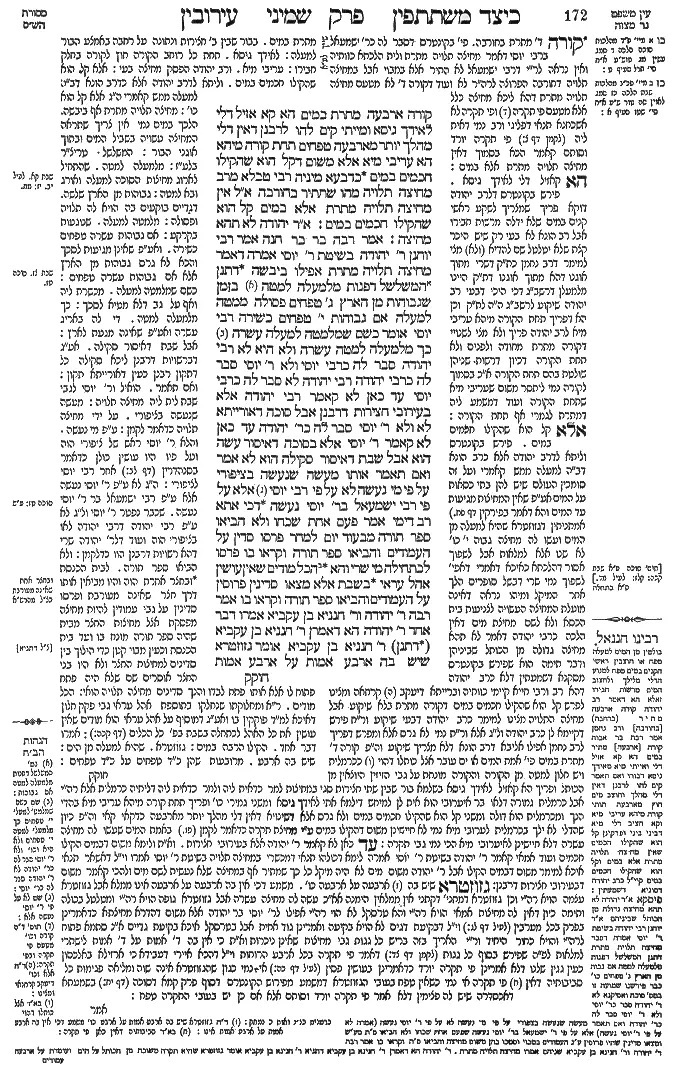
Eruvin 86b - Guemara
קורה ארבעה מתרת במים הא קא אזיל דלי לאידך גיסא ומייתי קים להו לרבנן דאין דלי מהלך יותר מארבעה טפחים תחת קורה מיהא הא עריבי מיא אלא משום דקל הוא שהקילו חכמים במים כדבעא מיניה רבי טבלא מרב מחיצה תלויה מהו שתתיר בחורבה א"ל אין מחיצה תלויה מתרת אלא במים קל הוא שהקילו חכמים במים:
א"ר יהודה לא תהא מחיצה:
אמר רבה בר בר חנה אמר רבי יוחנן ר' יהודה בשיטת ר' יוסי אמרה דאמר מחיצה תלויה מתרת אפילו ביבשה דתנן המשלשל דפנות מלמעלה למטה בזמן שגבוהות מן הארץ ג' טפחים פסולה ממטה למעלה אם גבוהות י' טפחים כשירה רבי יוסי אומר כשם שמלמטה למעלה עשרה כך מלמעלה למטה עשרה ולא היא לא רבי יהודה סבר לה כרבי יוסי ולא ר' יוסי סבר לה כרבי יהודה רבי יהודה לא סבר לה כרבי יוסי עד כאן לא קאמר רבי יהודה אלא בעירובי חצירות דרבנן אבל סוכה דאורייתא לא ולא ר' יוסי סבר לה כר' יהודה עד כאן לא קאמר ר' יוסי אלא בסוכה דאיסור עשה הוא אבל שבת דאיסור סקילה הוא לא אמר ואם תאמר אותו מעשה שנעשה בציפורי על פי מי נעשה לא על פי רבי יוסי אלא על פי רבי ישמעאל בר' יוסי נעשה דכי אתא רב דימי אמר פעם אחת שכחו ולא הביאו ספר תורה מבעוד יום למחר פרסו סדין על העמודים והביאו ספר תורה וקראו בו פרסו לכתחילה מי שרי והא הכל מודים שאין עושין אהל עראי בשבת אלא מצאו סדינין פרוסין על העמודים והביאו ספר תורה וקראו בו אמר רבה ר' יהודה ור' חנניא בן עקביא אמרו דבר אחד ר' יהודה הא דאמרן ר' חנניא בן עקביא (דתנן) ר' חנניא בן עקביא אומר גזוזטרא שיש בה ארבע אמות על ארבע אמות
Comments from Rashi on Masechet Eruvin Page 86b
מתרת במים . בבור שבין ב' חצירות ונתונה על רחבה באמצע הבור למעלה: לאידך גיסא . תחת כל רוחב הקורה חוץ לקורה בחלק חבירו: עריבי מיא . ורב יהודה הפסק מחיצה בעי: אלא קל הוא שהקילו חכמים במים . וליתא לדרב יהודה אלא כדרב הונא דב"ה למעלה ממש קאמרי ה"ג אלא קל הוא כו': מחצה תלויה מתרת אף ביבשה . הלכך במים נמי אין צריך שתראה המחיצה עשויה בשביל המים ובתוך אוגני הבור: המשלשל . טריציי"ר בלע"ז: מלמעלה למטה . שהתחיל לארוג מחיצות הסוכה למעלה ואורג ובא למטה: גבוהות מן הארץ שלשה . דגדיים בוקעים בה הויא לה תלויה ופסולה: מלמטה למעלה . שנוגעות בקרקע: אם גבוהות עשרה טפחים כשירה . ואע"פ שאינן מגיעות לסכך והכא לא גרס גבוהות מן הארץ אלא אם גבוהות עשרה טפחים: כשם שמלמטה למעלה . מכשרת ליה ואף על גב דלא מטיא לסכך: כך מלמעלה למטה . די לה באריג עשרה ואע"פ שאינה מגעת לארץ: אבל שבת דאיסור סקילה . אע"ג דברשויות דרבנן ליכא סקילה כל דתקון רבנן כעין דאורייתא תקון: ואם תאמר . הואיל ור' יוסי לגבי שבת לית ליה מחיצה תלויה: מעשה שנעשה בציפורי . על ידי מחיצה תלויה כדאמר לקמן: ע"פ מי נעשה . והלא ר' יוסי ראש של ציפורי הוה ועל פיו היו עושין כולן כדאמר בסנהדרין (דף לב:) אחר ר' יוסי לציפורי: ה"ג לא ע"פ ר' יוסי נעשה אלא על פי רבי ישמעאל בר ר' יוסי נעשה . שכבר נפטר ר' יוסי ול"ג לא ע"פ רבי יהודה דרבי יהודה לאו בציפורי הוה ועוד דלר' יהודה שרי דהא רשויות דרבנן הוו כדלקמן: ולא הביאו ספר תורה . לבית הכנסת ובחצר אחרת הוה והיו מביאין אותו דרך חצר שאינה מעורבת ופרסו סדינין על גבי עמודין להיות מחיצה מפסקת אצל מחיצות החצר מבית שהיה ספר תורה מונח בו ועד בית הכנסת וכעין מבוי קטן כדי הילוך בין סדינים למחיצות החצר ולא היו בני החצר אוסרים שם שלא היה פתח פתוח לו אלא אותו פתח לבדו והנך סדינים מחיצה תלויה הואי: הכל מודים . ר"א ומחלוקתו שנחלקו בתוספת אהל עראי גבי פקק חלון דאיכא למ"ד פוקקין בו ואע"ג דמוסיף על אהל עראי הוא מודים שאין עושין את כל האהל לכתחלה בשבת בפ' כל הכלים (דף קכה:): אמרו דבר אחד . הקילו הרבה במים: גזוזטרא . שהיא למעלה מן הים: שיש בה ארבעה . מרובעות שהן כ"ד טפחים על כ"ד טפחים:
Comments from Tosafot - Eruvin 86b
הא קאזיל דלי לאידך גיסא . פירש בקונטרס דלרב יהודה דוקא פריך שמצריך לשקע ראשי קנים במים שלא ידלה מרשות חבירו אבל רב הונא לא בעי רק שיש היכר קצת שלא יטלטל שם להדיא (ולא) מצי למימר דרב נחמן כת"ק דשרי מתוך אוגנו דהא מתוך אוגנו דת"ק היינו מלמעלן דרשב"ג דכי היכי דבעי רב יהודה שיקוע לרשב"ג ה"ה לת"ק וכן הא דפריך תחת הקורה מיהא עריבי מיא לרב יהודה פריך ולא מצי לשנויי דקורה מתרת מחודה ולפנים ולא תחת הקורה דכיון דרשות שניהן שולטת בהם תחת הקורה א"כ בסמוך לקורה נמי ליתסר משום שעריבי מיא שתחת הקורה ועוד דמשמע ליה דמתרת לגמרי אף תחת הקורה: אלא קל הוא שהקילו חכמים במים . פירש בקונטרס וליתא לדרב יהודה אלא כרב הונא דב"ה למעלה ממש קאמרי ועל זה סומכין העולם שיש להן בתי כסאות על המים אע"פ שאין המחיצות מגיעות עד המים והא דאמר בפירקין (דף פח.) אמתניתין דגזוזטרא שהיא למעלה מן המים ועשו לה מחיצה גבוה י' כו' לא שנו אלא למלאות אבל לשפוך אסור דהלכתא כאיכא דאמרי דאפי' לשפוך נמי שרי דבשל סופרים הלך אחר המיקל ומיהו נראה דאינה מועלת המחיצה העשויה לצניעות בית הכסא ולא לשם מחיצת מים דאין הלכה כרבי יהודה דאמר לא תהא מחיצה גדולה מן הכותל שביניהן ודבר תימה הוא שפירש בקונטרס מסקנא דשמעתין דלא כרב יהודה דהא רב ורבי חייא קיימי כוותיה וברייתא דיעקב קרחאה ומצינו לפרש קל הוא שהקילו חכמים במים דקורה מתרת בלא שיקוע אבל מחיצה התלויה מצינו למימר כרב יהודה דבעי שיקוע ור"ח פירש דקיימא לן כרב יהודה ול"ג אלא ור"ת נמי לא גרס אלא ומפרש דפריך לרב נחמן אפילו אליבא דרב הונא דלא מצריך שיקוע וה"פ קורה ד' מתרת במים פי' אמת המים או ים עובר אצל כותלו דהוי ככרמלית ויש חלון למטה מן הקורה והקורה מונחת על גבי הזיזין היוצאין מן הכותל ופריך הא קאזיל לאידך גיסא בשלמא בור שבין שתי חצירות סגי במחיצות למר כדאית ליה ולמר כדאית ליה דליתיה כרמלית אלא רה"י אבל כרמלית גמורה דלאו בר איערובי הוא אית לן למיחש דילמא אתי לאידך גיסא ומשני גמירי כו' ופריך תחת קורה מיהא עריבי מיא בהדי הנך ומכרמלית הוא דולה ומשני קל הוא שהקילו חכמים במים ולא גרס אלא דשינויא דאין דלי מהלך יותר מארבעה כדקאי קאי וה"פ כיון שהדלי לא ילך בכרמלית לערובי מיא נמי לא חיישינן משום דהקילו במים ע"י מחיצת תקרה כדאמר לקמן (עירובין פז.) באמת המים שעשו לה מחיצה עשרה דלא חיישינן לאיערובי מיא הכי נמי גבי תקרה: עד כאן לא קאמר ר' יהודה אלא בעירובי חצירות . וא"ת ולימא משום דבמים הקילו חכמים ועוד אמאי קאמר ר' יהודה בשיטת ר' יוסי אמרה לימא דכולהו תנאי דמכשרי במחיצה תלויה בשיטת ר' יוסי אמרו וי"ל דאשאר תנאי איכא למימר משום דבמים הקילו אבל ר' יהודה משום מים לא היה מיקל כל כך שמתיר אף במחיצה שלא נעשית לשם מים ולהכי קאמר משום דבעירובי חצירות דרבנן: גזוזטרא שיש בה ארבעה על ארבעה כו' . משמע דכי אין בה ארבעה על ארבעה אינו ממלא אבל גזוזטרא עצמה הויא רה"י וכן גזוזטרא דמתני' דקתני אין ממלאין הימנה אא"כ עשה לה מחיצה עשרה אבל גזוזטרא גופה הויא רה"י ומטלטל בכולה ותימה כיון דאין לה מחיצות אמאי הויא רה"י והא טרסקל לא הוי רה"י אפילו לר' יוסי בר יהודה אלא משום דהדרא מחיצתא כדאמרינן בפרק בכל מערבין (לעיל עירובין דף לג:) וי"ל דבקיעת דגים לא הויא בקיעה ואמרינן גוד אחית אבל בטרסקל איכא בקיעת גדיים א"נ סתמא פתוח לרה"י והויא כחור היחיד ור"י האריך בזה בריש כל גגות גבי מחיצות שאינן ניכרות וא"ת כי אין בה ד' אמות על ד' אמות לישתרי למלאות לפ"ה שפירש בסוף כל גגות (לקמן עירובין דף צד:) דאמר פי תקרה בכל ארבע הרוחות וי"ל דהכא איירי דעבידא כי ארזילא באלכסון כעין גגין שלנו דלא אמרינן פי תקרה יורד כדאמרינן בעושין פסין (לעיל עירובין דף כה:) אי נמי כגון שהגזוזטרא אינה שוה ומליאה פגימות כל סביבותיה דאין פי תקרה אי נמי כשאין טפח בעובי הגזוזטרא דמשמע מפירוש הקונטרס דסוף פרק קמא דסוכה (דף יח:) בשמעתא דאכסדרה שיש לה פצימין דלא אמר פי תקרה יורד וסותם אלא אם כן יש בעובי התקרה טפח:
Eruvin 86b - Mishnah translated into english
A cross beam of four handbreadths laid across a cistern located between two courtyards permits one to draw water from that cistern.
With this in mind, the following difficulty arises: The bucket he uses to draw the water might drift under the cross beam to the other side of the cistern and bring water from the other courtyard. The Gemara answers: The Sages have established that a bucket does not drift more than four handbreadths from the point where it was lowered, and it will therefore stay on its original side of the partition.
The Gemara raises a difficulty: Nonetheless, the water becomes intermingled under the cross beam, and consequently the bucket will bring up water from the other courtyard. Rather, it must be that the reason for the leniency is not that the cross beam actually prevents the flow of the water, but because the Sages were lenient with regard to water. They allowed a partition suspended above the water to be considered as though it blocked the flow of the water. As Rav Tavla asked of Rav: With regard to a suspended partition, does it permit carrying in a ruin? Do we say that the remnants of the walls suspended in the air are considered as though they descended to the ground and closed off the area, thereby rendering it a private domain? Rav said to him: A suspended partition of this kind permits carrying only in the case of water, as the Sages were lenient with regard to water.
The mishna teaches: Rabbi Yehuda said: There is no need for a partition in the cistern, as a partition inside a cistern is no better than the wall above it. Rabba bar bar Ḥana said that Rabbi Yoḥanan said: Rabbi Yehuda stated this in accordance with the opinion of Rabbi Yosei, who said: A suspended partition permits carrying even on land, as it is considered as though it descended to the ground and sealed off the area. Accordingly, there is no need to erect a partition inside the airspace of a cistern.
As we learned in a mishna: One who lowers sukka walls from above going downward, when the walls are three handbreadths higher than the ground, the sukka is invalid, as they are not considered partitions; but if he constructed walls from below going upward, if they are ten handbreadths high the sukka is valid, even if they do not reach the roofing.
Rabbi Yosei, however, says: Just as with regard to walls constructed from below going upward, ten handbreadths suffice, so too, in the case of walls built from above going downward, ten handbreadths are enough for it to be considered a whole wall, even if it more than three handbreadths above the ground. Similarly, Rabbi Yehuda maintains that a partition suspended above a cistern is considered as though it descended and sealed off the area.
The Gemara rejects this argument: But this is not so, for we can distinguish between the two opinions and claim that neither Rabbi Yehuda holds in accordance with Rabbi Yosei, nor does Rabbi Yosei hold in accordance with Rabbi Yehuda.
The Gemara elaborates: Rabbi Yehuda does not necessarily hold in accordance with Rabbi Yosei, as a distinction can be made between the two cases. Rabbi Yehuda stated his opinion only with regard to the joining of courtyards, which are required by rabbinic law, but in the case of a sukka, which is required by Torah law, no, he did not say that we can rely on suspended partitions.
And conversely, Rabbi Yosei does not necessarily hold in accordance with Rabbi Yehuda, as Rabbi Yosei stated his opinion only with regard to a sukka, which is a prohibition stated in the Torah from a positive commandment. The prohibition is not written as a negative commandment, but it can be inferred from a positive commandment. Neglect of the positive commandment of sukka is not punishable by the court, therefore we are not stringent in this regard. But with regard to Shabbat, which is a prohibition punishable by stoning, Rabbi Yosei did not state his opinion. Consequently, Rabbi Yosei might agree that we must be very stringent with regard to all halakhot of Shabbat, even those that are rabbinic in origin.
And if you ask: That incident, which occurred in Tzippori, when they relied on suspended partitions on land for Shabbat, on whose authority was it performed? It was done not on the authority of Rabbi Yosei, but rather it was performed on the authority of Rabbi Yishmael, son of Rabbi Yosei, who maintains that a suspended partition renders it permitted to carry even if it is over land and even on Shabbat.
The incident transpired in the following manner. As when Rav Dimi came from Eretz Yisrael to Babylonia, he said: It once happened that the people forgot and did not bring a Torah scroll to the synagogue on Friday while it was still day, which meant they were left without a scroll from which to read on Shabbat. On the following day, Shabbat, they spread a sheet over the pillars positioned between the house where the scroll was kept and the synagogue, thereby forming a corridor with partitions suspended on each side. And in this manner they brought the Torah scroll to the synagogue and read from it.
The Gemara expresses surprise at the wording of this account: Did they actually spread sheets on Shabbat? Is it permitted to do so ab initio? But doesn’t everyone agree that one may not erect a temporary tent on Shabbat ab initio? Spreading sheets over pillars is considered constructing a temporary tent.
Rather, what happened was that they found sheets spread over the pillars, which they used as partitions, and in this manner they brought the Torah scroll to the synagogue and read from it.
Rabba said: Rabbi Yehuda and Rabbi Ḥananya ben Akavya said the same thing. Both were very lenient with regard to the halakha of a partition over water. The ruling of Rabbi Yehuda is that which we just said, that the wall of the courtyard permits a cistern. The ruling of Rabbi Ḥananya ben Akavya is as we learned: Rabbi Ḥananya ben Akavya says: In the case of a balcony that contains four cubits by four cubits, which is suspended over water,
Traduction : The William Davidson digital edition of the Koren Noé Talmud, with commentary by Rabbi Adin Even-Israel Steinsaltz.