 Talmud Bavli
Eruvin 63a : Youtube
Rabi Yitzchok LobensteinYoutube
2 video classes :
Eruvin Page 63a
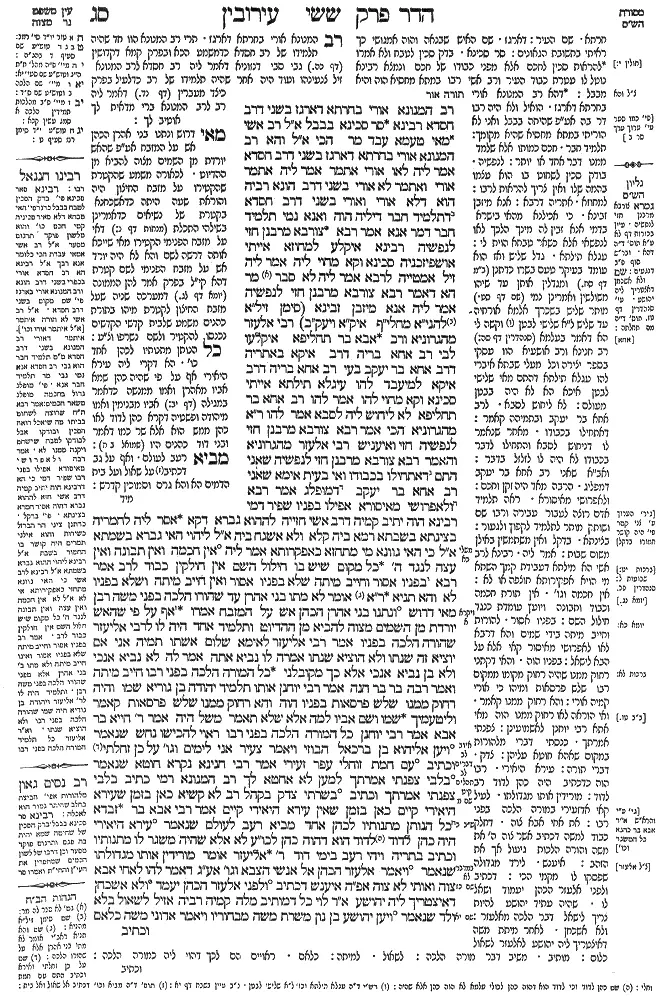
Eruvin 63a - Guemara
רב המנונא אורי בחרתא דארגז בשני דרב חסדא רבינא סר סכינא בבבל א"ל רב אשי מאי טעמא עבד מר הכי א"ל והא רב המנונא אורי בחרתא דארגז בשני דרב חסדא אמר ליה לאו אורי אתמר אמר ליה אתמר אורי ואתמר לא אורי בשני דרב הונא רביה הוא דלא אורי ואורי בשני דרב חסדא דתלמיד חבר דיליה הוה ואנא נמי תלמיד חבר דמר אנא אמר רבא צורבא מרבנן חזי לנפשיה רבינא איקלע למחוזא אייתי אושפיזכניה סכינא וקא מחוי ליה אמר ליה זיל אמטייה לרבא אמר ליה לא סבר מר הא דאמר רבא צורבא מרבנן חזי לנפשיה אמר ליה אנא מיזבן זבינא (סימן זיל"א להני"א מחלי"ף איק"א ויעק"ב) רבי אלעזר מהגרוניא ורב אבא בר תחליפא איקלעו לבי רב אחא בריה דרב איקא באתריה דרב אחא בר יעקב בעי רב אחא בריה דרב איקא למיעבד להו עיגלא תילתא אייתי סכינא וקא מחוי להו אמר להו רב אחא בר תחליפא לא ליחוש ליה לסבא אמר להו ר"א מהגרוניא הכי אמר רבא צורבא מרבנן חזי לנפשיה חזי ואיעניש רבי אלעזר מהגרוניא והאמר רבא צורבא מרבנן חזי לנפשיה שאני התם דאתחילו בכבודו ואי בעית אימא שאני רב אחא בר יעקב דמופלג אמר רבא ולאפרושי מאיסורא אפילו בפניו שפיר דמי רבינא הוה יתיב קמיה דרב אשי חזייה לההוא גברא דקא אסר ליה לחמריה בצינתא בשבתא רמא ביה קלא ולא אשגח ביה א"ל ליהוי האי גברא בשמתא א"ל כי האי גוונא מי מתחזא כאפקרותא אמר ליה (משלי כא, ל) אין חכמה ואין תבונה ואין עצה לנגד ה' כל מקום שיש בו חילול השם אין חולקין כבוד לרב אמר רבא בפניו אסור וחייב מיתה שלא בפניו אסור ואין חייב מיתה ושלא בפניו לא והא תניא ר"א אומר לא מתו בני אהרן עד שהורו הלכה בפני משה רבן מאי דרוש (ויקרא א, ז) ונתנו בני אהרן הכהן אש על המזבח אמרו אף על פי שהאש יורדת מן השמים מצוה להביא מן ההדיוט ותלמיד אחד היה לו לרבי אליעזר שהורה הלכה בפניו אמר רבי אליעזר לאימא שלום אשתו תמיה אני אם יוציא זה שנתו ולא הוציא שנתו אמרה לו נביא אתה אמר לה לא נביא אנכי ולא בן נביא אנכי אלא כך מקובלני כל המורה הלכה בפני רבו חייב מיתה ואמר רבה בר בר חנה אמר רבי יוחנן אותו תלמיד יהודה בן גוריא שמו והיה רחוק ממנו שלש פרסאות בפניו הוה והא רחוק ממנו שלש פרסאות קאמר וליטעמיך שמו ושם אביו למה אלא שלא תאמר משל היה אמר ר' חייא בר אבא אמר רבי יוחנן כל המורה הלכה בפני רבו ראוי להכישו נחש שנאמר (איוב לב, ו) ויען אליהוא בן ברכאל הבוזי ויאמר צעיר אני לימים וגו' על כן זחלתי וכתיב (דברים לב, כד) עם חמת זוחלי עפר זעירי אמר רבי חנינא נקרא חוטא שנאמר (תהלים קיט, יא) בלבי צפנתי אמרתך למען לא אחטא לך רב המנונא רמי כתיב בלבי צפנתי אמרתך וכתיב (תהלים מ, י) בשרתי צדק בקהל רב לא קשיא כאן בזמן שעירא היאירי קיים כאן בזמן שאין עירא היאירי קיים אמר רבי אבא בר זבדא כל הנותן מתנותיו לכהן אחד מביא רעב לעולם שנאמר (שמואל ב כ, כו) עירא היאירי היה כהן לדוד לדוד הוא דהוה כהן לכו"ע לא אלא שהיה משגר לו מתנותיו וכתיב בתריה ויהי רעב בימי דוד ר' אליעזר אומר מורידין אותו מגדולתו שנאמר (במדבר לא, כא) ויאמר אלעזר הכהן אל אנשי הצבא וגו' אע"ג דאמר להו לאחי אבא צוה ואותי לא צוה אפ"ה איענש דכתיב (במדבר כז, כא) ולפני אלעזר הכהן יעמד ולא אשכחן דאיצטריך ליה יהושע א"ר לוי כל דמותיב מלה קמיה רביה אזיל לשאול בלא ולד שנאמר (במדבר יא, כח) ויען יהושע בן נון משרת משה מבחוריו ויאמר אדוני משה כלאם
Comments from Rashi on Masechet Eruvin Page 63a
חרתא . שם העיר: דארגז . שם האיש שבנאה והוה אמגושי כך ראיתי בתשובת הגאונים: סר סכינא . בדק סכין לטבח ולא אמרו להראות סכין לחכם אלא מפני כבודו של חכם ונמצא רבינא נוטל לו עטרת כבוד העיר ורב אשי רבו במתא מחסיא הוה והיא מבבל: דהא רב המנונא אורי בחרתא דארגז . הואיל ולא היה רבו דר בה אע"פ שהיתה בבבל ואני לא הוריתי במתא מחסיא שהיא מקומך: תלמיד חבר . חכם כמותו אלא שלמד ממנו דבר אחד או יותר: לנפשיה . בודק סכין לשחוט בו הוא עצמו בהמה שלו ואין צריך להראות לרבו: למחוזא . אתריה דרבא: אנא מיזבן זבינא . כי אכילנא מהאי בישרא בדמי אנא זבין לה מינך הלכך לאו לנפשאי אלא כשאר טבחא הוית לי: עגלא תילתא . גדל שליש ואז הוא עומד בעיקר טעם בשרו כדתנן (ב"מ דף סח.) ומגדלין אותן עד שיהו משולשין ואמרינן נמי (שם דף סט.) מותר שליש בשכרך אלמא אורחיה עד שליש ל"א שלישי לבטן וקשה לי הא דאמר בעלמא (סנהדרין דף סה:) רב חנינא ורב אושעיא הוו עסקי בספר יצירה וכל מעלי שבתא איברי להו עגלא תילתא דהתם מאי שלישי לבטן איכא הא לא היה בבטן מעולם: לא ליחוש לסבא . לרב אחא בר יעקב ובתמיהה קאמר: דאתחילו בכבודו . מאחר שנאמר לו דניחוש לסבא והתחילו לדבר בכבודו לא היה לו לזלזל בדבר: ואב"א שאני רב אחא בר יעקב דמפליג . הרבה מאד היה זקן וחכם: ולאפרושי מאיסורא . ראה תלמיד אדם רוצה לעבור עבירה ורבו שם ושותק מותר לתלמיד לקפוץ ולגעור: בצינתא . בדקל ואין משתמשין באילן משום שבות: אמר ליה . רבינא לרב אשי הא מילתא דעבידת קמך השתא מי הויא אפקירותא חוצפה או לא: אין חכמה וגו' . אין תורת חכמה וכבוד ותבונה ויועץ עומדת כנגד חילול השם: בפניו אסור . להורות וחייב מיתה בידי שמים והא דרבא לאו לאפרושי מאיסור קאי אלא על הבא לישאל: בפניו הוה . והאי דקתני רחוק ממנו שהיה רחוק מקומו ממקום רבו שלש פרסאות ומיהו כי אורי קמיה אורי: והא רחוק ממנו קאמר . ואי הוראה לאו רחוק ממנו הוה מאי אתא רבי יוחנן לאשמועינן: צפנתי אמרתך . כנסתי דברי מלהורות במקום שאהא חוטא עליהן: צדק . דברי תורה: עירא היאירי . רבו הוה כדכתיב היה כהן לדוד רב לדוד: מורידין אותו מגדולתו . לעיל קאי אדזעירי במורה הלכה בפני רבו: את אחי אבא צוה . דחלק כבוד למשה דכתיב אשר צוה ה' את משה והורה הלכות גיעול אך את הזהב: איענש . לירד מגדולה שפסקו לו מקמי הכי: דכתיב ולפני אלעזר הכהן יעמוד ושאל לו . שהיה עתיד יהושע להיות צריך לישאל דבר הלכה מאלעזר: ולא אשכחן . לאחר מיתת משה דאיצטריך ליה יהושע לאלעזר לשאול כלום: מותיב . משיב דבר מורה הלכה: לשאול . למיתה: כלאם . ראויים הם לכך דהוי ליה כמורה הלכה:
Comments from Tosafot - Eruvin 63a
רב המנונא אורי בחרתא דארגז . תרי רב המנונא הוו חד שהיה תלמידו של רב חסדא כדמשמע הכא ובפרק קמא דקדושין (דף כה.) גבי סבי דנזוניא דאמר ליה רב חסדא לרב המנונא זיל צנעינהו ועוד היה אחר שהיה תלמידו של רב כדלעיל בפרק כיצד מעברין (עירובין דף נד.) דאמר ליה רב לרב המנונא ברי מדאית לך אוטיב לך: מאי דרוש ונתנו בני אהרן הכהן אש על המזבח אע"פ שהאש יורדת מן השמים מצוה להביא מן ההדיוט . לכאורה משמע שהקטרת שהקטירו על מזבח החיצון היה והוראת שעה היתה כדאשכחנא בקטרת של נשיאים כדאמרינן בשילהי התכלת (מנחות דף נ:) דאי על מזבח הפנימי הקטירו מאי שייכא אותה דרשה לשם והא לא היה יורד אש על מזבח הפנימי לשם קטרת דהא קי"ל בפרק אמר להן הממונה (יומא דף לג.) דמערכה שניה שעל מזבח החיצון לקטרת מיהו בתורת כהנים משמע שלבית קדשי הקדשים נכנסו להקטיר ולשם נשרפו וצ"ע: כל הנותן מתנותיו לכהן אחד כו' . הא דקרי ליה עירא היאירי אף על פי שהיה כהן שמא אביו מאהרן ואמו ממנשה כדאמר במגילה (דף יב:) אביו מבנימין ואמו מיהודה ופשטיה דקרא כהן לדוד לאו כהן ממש הוא אלא שר כמו דאמר ובני דוד כהנים היו (שמואל ב ח): מביא רעב לעולם . ואף על גב דכתיב על שאול ועל בית הדמים הא והא גרם וסמוכין קדרש:
Eruvin 63a - Mishnah translated into english
Rav Hamnuna issued halakhic rulings in the town of Ḥarta De’argez during the years of Rav Ḥisda’s life, even though Rav Ḥisda was his teacher.
The Gemara relates that Ravina once examined a slaughterer’s knife in Babylonia to check if it was fit for slaughtering, during the lifetime of his teacher, Rav Ashi, who also lived in Babylonia. Rav Ashi said to him: What is the reason that the Master acted in this manner? Isn’t it prohibited for a disciple to issue rulings while his teacher is still alive?
Ravina said to him: Didn’t Rav Hamnuna issue halakhic rulings in Ḥarta De’argez during the years of Rav Ḥisda’s life, as they were not in the same town, even though they were both located in Babylonia? Since I do not live in the same town as you, it stands to reason that I would be permitted to issue rulings as well. Rav Ashi said to Ravina: It was actually stated that Rav Hamnuna did not issue halakhic rulings during Rav Ḥisda’s lifetime, and that is the correct tradition.
Ravina said to Rav Ashi: In fact, it was stated that Rav Hamnuna issued rulings, and it was also stated that he did not issue rulings, and both traditions are correct. During the years of the life of Rav Huna, Rav Hamnuna’s principal teacher, Rav Hamnuna did not issue rulings at all, but he did issue rulings during the years of Rav Ḥisda’s life, for Rav Hamnuna was Rav Ḥisda’s disciple-colleague. And since I, too, am the Master’s disciple and colleague, I should also be permitted to examine a slaughterer’s knife when I am not in the same town.
Rava said: A Torah scholar may examine a knife for himself and use it for slaughtering, without having to show it to the local Sage. The Gemara relates that Ravina happened to come to Meḥoza, the home town of Rava. His host brought out a knife for slaughtering and showed it to him. He said to him: Go, bring it to Rava, the town Sage, for examination.
The host said to him: Doesn’t the Master hold in accordance with that which Rava said: A Torah scholar may examine a slaughtering knife for himself? In this case I am using the knife to slaughter on your behalf. Ravina said to him: Since I am only buying the meat from you, it is not considered as though I am slaughtering for myself. Rava’s principle does not apply to such a case.
The Gemara cites a mnemonic for the names of the Sages mentioned in the following discussion: Zila Lehanya: Rabbi Elazar from Hagronya; Maḥlif: Rav Abba bar Taḥalifa; Ika: Rav Aḥa bar Ika; and Ya’akov: Rav Aḥa bar Ya’akov.
The Gemara now relates that Rabbi Elazar from Hagronya and Rav Abba bar Taḥalifa happened to come to the house of Rav Aḥa, son of Rav Ika, in the place of jurisdiction of Rav Aḥa bar Ya’akov. Rav Aḥa, son of Rav Ika, wanted to prepare for them a third-born calf, whose meat was considered a delicacy. He brought out a slaughtering knife and showed it to them.
Rav Aḥa bar Taḥalifa said to them: Should we not be concerned with the respect of the Elder, Rav Aḥa bar Ya’akov, and present the knife to him for inspection, as this is his town? Rabbi Elazar from Hagronya said to them: That is unnecessary, since Rava said as follows: A Torah scholar may examine a knife for himself. Rabbi Elazar from Hagronya then inspected the knife, but he was later punished at the hand of Heaven for disregarding the honor of the senior rabbi.
The Gemara expresses surprise: What was Rabbi Elazar from Hagronya’s mistake? Didn’t Rava say: A Torah scholar may examine a slaughtering knife for himself? The Gemara answers: It was different there, as they had already begun to discuss the issue of the honor of Rav Aḥa bar Ya’akov. Had the name of Rav Aḥa bar Ya’akov never arisen, they would have been permitted to examine the knife themselves. Once his name had been mentioned, however, they should have approached him with the knife. Their failure to do so is considered a display of disrespect.
And if you wish, say instead: Rav Aḥa bar Ya’akov is different, as he was illustrious in age and wisdom, and thus deserved more honor than a regular Sage.
Rava said: Even though it is ordinarily prohibited for a disciple to issue a halakhic ruling in his teacher’s place, if he does so in order to separate another person from a prohibition he is committing, even in his teacher’s presence it seems well, i.e., it is permitted. The Gemara relates that Ravina was once sitting before Rav Ashi when he saw a certain man tying his donkey to a palm tree on Shabbat, in violation of the decree of the Sages against utilizing trees on Shabbat. He raised his voice to him in protest, but the man paid him no attention. Ravina then said to Rav Ashi: Let this man be in excommunication for transgressing the words of the Sages and ignoring a scholar’s rebuke.
Afterward, Ravina said to Rav Ashi: Behavior such as this, the way I acted in your presence just now, does it appear like irreverent behavior? Rav Ashi said to him: With regard to this it is stated: “There is no wisdom or understanding or council against the Lord” (Proverbs 21:30). The Sages expounded this verse as follows: Wherever a desecration of God’s name is involved, no respect is paid even to a teacher, i.e., in such a situation one should disregard the respect due to his teacher’s wisdom and understanding and object to the inappropriate behavior.
Rava said: With regard to one who issues a halakhic ruling in his teacher’s location without the intention of preventing someone from violating a prohibition, the following distinction applies: In the teacher’s actual presence, the disciple is prohibited to issue such a ruling, and if he does so, he is liable to receive the death penalty at the hand of Heaven. However, when he is not in his actual presence, the disciple is still prohibited to issue the ruling, but he is not liable to receive the death penalty.
The Gemara asks: Is the disciple not liable to receive the death penalty if he issues his ruling not in the teacher’s presence? But wasn’t it taught otherwise in a baraita: Rabbi Eliezer says: The sons of Aaron died only because they issued a halakhic ruling before Moses, their teacher? What did they expound in support of their conclusion that they must bring fire inside as opposed to waiting for fire to come down from the heavens? It is stated in the Torah: “And the sons of Aaron the priest shall put fire on the altar, and lay the wood in order on the fire” (Leviticus 1:7), which led them to say: Although fire descends from Heaven, it is nonetheless a mitzva to bring ordinary fire. Although they derived this from the verses, they were punished for ruling in the presence of their teacher.
It was further related that Rabbi Eliezer had a certain disciple who issued a halakhic ruling in his presence. Rabbi Eliezer said to his wife, Imma Shalom: I will be surprised if this one completes his year, i.e., if he lives until the end of the year. And so it was, he did not complete his year.
His wife said to him: Are you a prophet? He said to her: I am not a prophet, nor the son of a prophet, but I have received the following tradition: Anyone who issues a halakhic ruling in his teacher’s presence is liable to receive the death penalty.
And Rabba bar bar Ḥana said that Rabbi Yoḥanan said: That disciple was named Yehuda ben Gurya, and he was three parasangs away from Rabbi Eliezer. Apparently, one is liable for the death penalty even if he did not issue his ruling in his teacher’s presence.
The Gemara answers: In fact, the incident took place in the actual presence of the teacher, which is why the disciple was punished. The distance mentioned refers to the distance between the student’s usual place and the teacher. The Gemara expresses surprise: But didn’t Rabba bar bar Ḥana say that he was three parasangs away from his teacher? That implies that this was his distance from his teacher at the time of the ruling. The Gemara answers: And, according to your reasoning, that the details of the story must relate to the time of the ruling, why mention his name and his father’s name? Rather, the details were given so that you should not say it was a parable. That is also the reason why he provided the details concerning the student’s usual place. This does not contradict the fact that Yehuda ben Gurya issued his ruling in the actual presence of his teacher.
The Gemara continues to discuss the same topic. Rabbi Ḥiyya bar Abba said that Rabbi Yoḥanan said: Whoever issues a halakhic ruling in his teacher’s presence is deserving of being bitten by a snake, as it is stated: “And Elihu, son of Barachel the Buzite answered and said, I am young, and you are very old; therefore I held back [zaḥalti] and I was afraid, and did not declare my opinion to you” (Job 32:6), and it is written: “With the venom of the crawling things of [zoḥalei] the dust” (Deuteronomy 32:24), which refers to snakes. Elihu’s statement is understood as follows: I must apologize for speaking in my teacher’s presence, for one who does so is liable to be punished with the bite of a snake.
Ze’eiri said that Rabbi Ḥanina said: Whoever issues a halakhic ruling in his teacher’s presence is called a sinner, as it is stated: “Your word have I hidden in my heart, that I might not sin against You” (Psalms 119:11). In what case would speaking one’s word entail a sin? In a case where one rules on a matter of halakha in the presence of his teacher.
Rav Hamnuna raised a contradiction between the verse previously mentioned and another verse: It is written: “Your word have I hidden in my heart,” implying that David did not want to reveal the words of Torah, whereas in a second verse it is written: “I have preached righteousness in the great congregation” (Psalms 40:10). He answered: This is not difficult. Here, in the verse in which David remained silent, it is referring to the period when Ira HaYa’iri, David’s teacher, was alive; there, in the verse where he publicized his words, it is referring to the period when Ira HaYa’iri was no longer alive.
Having mentioned Ira HaYa’iri, the Gemara now cites a related teaching. Rabbi Abba bar Zavda said: Whoever gives all his priestly gifts to one priest has acted improperly and brings famine into the world as punishment. As it is stated: “And also Ira HaYa’iri was a priest for David” (II Samuel 20:26), which invites the question: Was he a priest for David alone, and not for anyone else? Rather, it means that David would send all his priestly gifts to him alone, i.e., he was the only priest to enjoy David’s gifts. And it is written afterward: “And there was a famine in the days of David, three years, year after year” (II Samuel 21:1).
Rabbi Eliezer says: Anyone who rules in his teacher’s presence is lowered from his position of greatness, as it is stated: “And Elazar the priest said to the men of war who went to battle: This is the statute of the Torah which the Lord commanded Moses” (Numbers 31:21). Although Elazar said to the soldiers: God commanded this statute to my father’s brother, while to me He did not command it, even so he was punished for speaking in this manner in the presence of his teacher, Moses.
What was his punishment? As it is written that God had told Moses with regard to Joshua: “And he shall stand before Elazar the priest, who shall inquire for him by the judgment of the Urim before the Lord: at his word shall they go out, and at his word they shall come in, both he, and all the children of Israel with him, even all the congregation” (Numbers 27:21). Elazar was originally awarded a place of great honor. But we do not find in the Bible that Joshua ever had need of him. It is never stated that Joshua made use of the Urim through Elazar, which shows that Elazar never achieved the greatness promised him.
With regard to this same issue, Rabbi Levi said: Whoever answers a word in the presence of his teacher will go down to the netherworld childless, as it is stated: “And Joshua bin Nun, the minister of Moses from his youth, answered and said: My lord Moses, shut them in” (Numbers 11:28). Since he spoke to his teacher out of turn, he was punished by remaining childless.
Traduction : The William Davidson digital edition of the Koren Noé Talmud, with commentary by Rabbi Adin Even-Israel Steinsaltz.