 Talmud Bavli
Eruvin 100a : Youtube
Rabi Yitzchok LobensteinYoutube
2 video classes :
Eruvin Page 100a
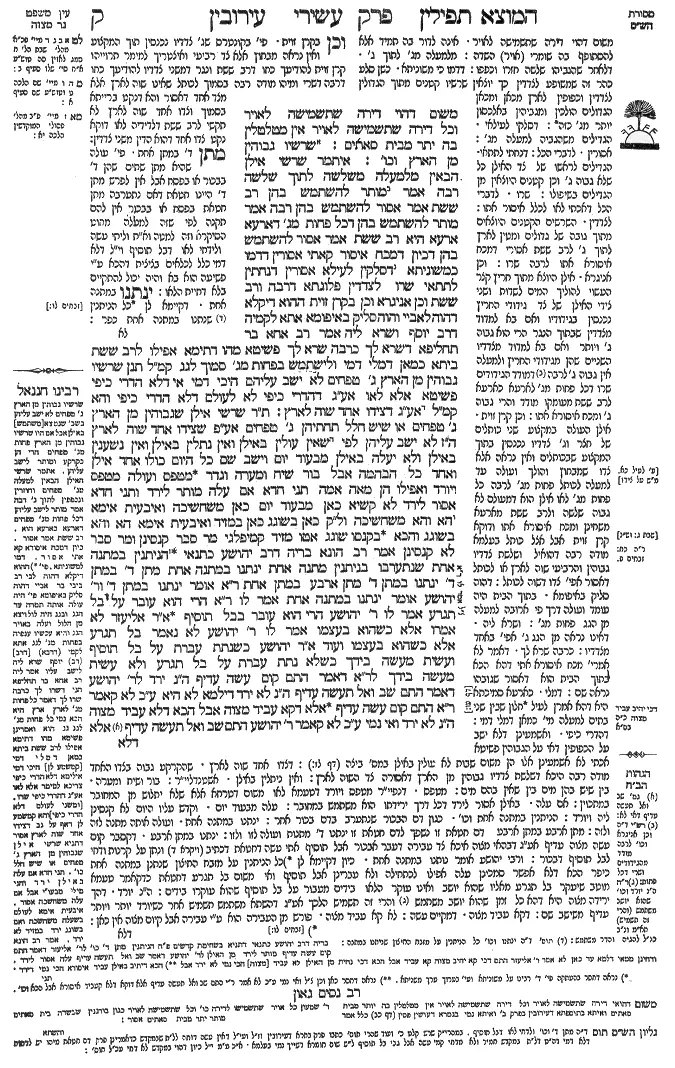
Eruvin 100a - Guemara
משום דהוי דירה שתשמישה לאויר וכל דירה שתשמישה לאויר אין מטלטלין בה יתר מבית סאתים:
שרשיו גבוהין מן הארץ וכו':
איתמר שרשי אילן הבאין מלמעלה משלשה לתוך שלשה רבה אמר מותר להשתמש בהן רב ששת אמר אסור להשתמש בהן רבה אמר מותר להשתמש בהן דכל פחות מג' דארעא ארעא היא רב ששת אמר אסור להשתמש בהן דכיון דמכח איסור קאתי אסורין דדמו כמשוניתא דסלקין לעילא אסורין דנחתין לתתאי שרו לצדדין פלוגתא דרבה ורב ששת וכן אניגרא וכן בקרן זוית ההוא דיקלא דהוה לאביי והוה סליק באיפומא אתא לקמיה דרב יוסף ושרא ליה אמר רב אחא בר תחליפא דשרא לך כרבה שרא לך פשיטא מהו דתימא אפילו לרב ששת ביתא כמאן דמלי דמי ולישתמש בפחות מג' סמוך לגג קמ"ל תנן שרשיו גבוהין מן הארץ ג' טפחים לא ישב עליהם היכי דמי אי דלא הדרי כיפי פשיטא אלא לאו אע"ג דהדרי כיפי לא לעולם דלא הדרי כיפי והא קמ"ל אע"ג דצידו אחד שוה לארץ:
ת"ר שרשי אילן שגבוהין מן הארץ ג' טפחים או שיש חלל תחתיהן ג' טפחים אע"פ שצידו אחד שוה לארץ ה"ז לא ישב עליהן לפי שאין עולין באילן ואין נתלין באילן ואין נשענין באילן ולא יעלה באילן מבעוד יום וישב שם כל היום כולו אחד אילן ואחד כל הבהמה אבל בור שיח ומערה וגדר מטפס ועולה מטפס ויורד ואפילו הן מאה אמה תני חדא אם עלה מותר לירד ותני חדא אסור לירד לא קשיא כאן מבעוד יום כאן משחשיכה ואיבעית אימא הא והא משחשיכה ול"ק כאן בשוגג כאן במזיד ואיבעית אימא הא והא בשוגג והכא בקנסו שוגג אטו מזיד קמיפלגי מר סבר קנסינן ומר סבר לא קנסינן אמר רב הונא בריה דרב יהושע כתנאי הניתנין במתנה אחת שנתערבו בניתנין מתנה אחת ינתנו במתנה אחת מתן ד' במתן ד' ינתנו במתן ד' מתן ארבע במתן אחת ר"א אומר ינתנו במתן ד' ור' יהושע אומר ינתנו במתנה אחת אמר לו ר"א הרי הוא עובר על בל תגרע אמר לו ר' יהושע הרי הוא עובר בבל תוסיף א"ר אליעזר לא אמרו אלא כשהוא בעצמו אמר לו ר' יהושע לא נאמר בל תגרע אלא כשהוא בעצמו ועוד א"ר יהושע כשנתת עברת על בל תוסיף ועשית מעשה בידך כשלא נתת עברת על בל תגרע ולא עשית מעשה בידך לר"א דאמר התם קום עשה עדיף ה"נ ירד לר' יהושע דאמר התם שב ואל תעשה עדיף ה"נ לא ירד דילמא לא היא ע"כ לא קאמר ר"א התם קום עשה עדיף אלא דקא עביד מצוה אבל הכא דלא עביד מצוה ה"נ לא ירד ואי נמי ע"כ לא קאמר ר' יהושע התם שב ואל תעשה עדיף אלא
Comments from Rashi on Masechet Eruvin Page 100a
משום דהוי דירה שתשמישה לאויר . אינה לדור בה תמיד אלא להסתופף בה שומרי (אויר) השדה: מלמעלה מג' לתוך ג' . דלאחר שהגביהו שלשה חזרו וכפפו: דדמו כי משוניתא . כשן סלע כהר זה שמשופע לצדדין כך יוצאין שרשיו קטנים מתוך הגדולין לצדדין וכפופין לארץ מכאן ומכאן הגדולים הולכין ומגביהין באלכסון יותר מג' כזה:  דסלקי לעילאי . הגדילים משהגביה למעלה מג': אסורין . לדברי הכל: דנחתי לתתאי . הגדילים לראשו של צד האילן כל שלא גבוה ג' וכן קטנים היוצאין מן הגדילים בשיפולו: שרו . לדברי הכל דאכתי לאו לכלל איסור אתו: לצדדין . השרשים הקטנים היוצאים מתוך גובה של גדולים ומטין לארץ לתוך ג' לרב ששת אסירי דמכח איסורא אתו לרבה שרו: וכן אניגרא . אילן היוצא מתוך חריץ קצר העשוי להוליך המים לשדות ושני צידי האילן של צד גידודי החריץ נכנסין בגידודיו ואם בא למדוד מצדדין שבתוך הנגר הרי הוא גבוה ג' ויותר ואם בא למדוד מצדדיו השניים שהן מגידודי החריץ ולמעלה אין גבוה ג' לרבה דמודד הגידודים שרו דכל פחות מג' לארעא כארעא לרב ששת מעומקו מודד והרי גבוה ג' ומכח איסורא אתו: וכן קרן זוית . אילן העולה במקצוע שני כותלים של חצר וג' צדדיו נכנסין בתוך המקצוע שבכותלים ואין נראה אלא צדו שמבחוץ והולך ועולה עד למעלה לכותל פחות מג' לרבה כל פחות מג' לאו אילן הוא דמעולם לא גבוה שלשה ולרב ששת מארעא משחינן ומכח איסורא אתו ודוקא קרן זוית אבל אצל כותל בעלמא מודה רבה דהואיל ושלשת צדדיו גבוהין והרביעי שוה לארץ או לכותל דאסור אפי' צדו דשוה לכותל: דהוה סליק באיפומא . בתוך הבית היה עומד ועולה דרך פי ארובה למעלה מן הגג פחות מג': ושרא ליה . דאינו נראה מן הגג ג' אפי' באחד מצדדיו: כרבה שרא לך . דאמר לא אמרי' מכח איסורא אתי דהא הכא בתוך הבית הוא דאסור שגובהו נראה שם: דמלי . כארעא סמיכתא היא דהא אמרן לעיל חלון שבין שני בתים למעלה מי' כמאן דמלי דמי: דהדרי כיפי . ואשמעינן דלא ישב על הכפופין דאי על הגבוהין פשיטא אכתי לא אשמעינן אלו הן משום שבות לא עולין באילן במס' ביצה (דף לז:): דצדו אחד שוה לארץ . שהקרקע גבוה בצדו האחד מודה רבה היכא דשלשת צדדיו גבוהין מן הארץ דאסורה צד השוה לארץ: ואין ניתלין באילן . אשטנדליי"ר: בור ושיח ומערה . בין שיש בהן מים בין שאין בהם מים: מטפס . דנפיי"ר מטפס ויורד דטעמא. לאו משום דטרחא אלא שלא יתלוש מן המחובר במתכוין: אם עלה . באילן אסור לירד דכל דרך ירידתו הוא משתמש במחובר: עלה מבעוד יום . וקדש עליו היום לא קנסינן ליה ויורד: הניתנין במתנה אחת וכו' . כגון דם הבכור שנתערב בדם בכור אחר: ינתנו במתנה אחת . ועולה אותה מתנה לזה ולזה: ינתנו במתן ארבע . דקסבר קום עשה מצוה עדיף אע"ג דבהאי מצוה איכא צד עבירה דעבר אבכור אבל תוסיף אתי עשה דחטאת דכתיב (ויקרא ד) ונתן על קרנות ודחי לבל תוסיף דבכור: מתן ארבע במתן ארבע . דם חטאת זו נשפך לדם חטאת זו ינתנו ד' מתנות ועולה לזו ולזו: ורבי יהושע אומר נותנו במתנה אחת . כיון דקיימא לן כל הניתנין על מזבח החיצון שנתנן במתנה אחת כיפר הכא דלא אפשר סמכינן עלה אפילו לכתחילה ולא עברינן אבל תוסיף ואי משום בל תגרע דחטאת כדקאמר טעמא מוטב שיעקר בל תגרע מאליו שהוא יושב ואינו עוקר הלאו בידים מעבור על בל תוסיף שהוא עוקרו בידים: ה"נ יורד . דהך ירידה מצוה היא דהא כל זמן שהוא יושב משתמש והרי זה תשמיש הלכך אע"ג דהשתא משתמש תשמיש אחר כשיורד יותר ויותר עדיף משישב שם: דקא עביד מצוה . דמקיים עשה: לא קא עביד מצוה . פורש מן העבירה הוא ע"י עבירה אבל קיום מצוה אין כאן:
Comments from Tosafot - Eruvin 100a
וכן בקרן זוית . פי' בקונטרס שג' צדדיו נכנסין תוך המקצוע ואין נראה מבחוץ אלא צד רביעי ואיצטריך למימר תרוייהו קרן זוית להודיעך כחו דרב ששת ונגר דמשני צדדיו להודיעך כחו דרבה דשרי ומיהו מודה רבה בסמוך לכותל שאינו שוה לארץ אלא מצד אחד דאסור והא דנקט ברייתא בסמוך וצדו אחד שוה לארץ לא תקשי לרב ששת דלדידיה לאו דוקא נקט צדו אחד דהוא הדין משני צדדין: מתן ד' במתן אחת . פי' עולה שהיא מתן שתים שהן ד' בבכור או בפסח אבל אין לפרש מתן ד' היינו חטאת דאם נתערבה מתן חטאת בפסח או בבכור אין להם תקנה לפי שזה למעלה מחוט הסיקרא וזה למטה וא"ת וליתי עשה ולידחי לאו דבל תוסיף וי"ל דלא דמי כלל לכלאים בציצית דהכא ע"י פשיעה הוא בא והיה יכול להתקיים בלא דחיית הלאו: ינתנו במתנה אחת . דקיימא לן כל הניתנין שנתנו במתנה אחת כפר:
Eruvin 100a - Mishnah translated into english
This was prohibited because it is a dwelling that serves only the air, i.e., it is used only by someone guarding the fields or the like. It is not used as permanent living quarters, despite its partitions. And the rule with respect to any dwelling that serves only the air is that it is not permitted to carry in it if its area is more than two beit se’a. As it is not a proper place of residence, the Sages treated it as an enclosure.
The mishna states: If the roots of the tree are three handbreadths above the ground, one may not sit on them on Shabbat. It was stated that amora’im disagreed with regard to the roots of a tree that rise up and then bend and come down from above, from a height of three handbreadths to within three handbreadths of the ground. Rabba said: It is permitted to use them, and Rav Sheshet said: It is prohibited to use them.
The Gemara clarifies the rationale of each opinion. Rabba said that it is permitted to use them, as anything less than three handbreadths from the ground is considered as the ground. Rav Sheshet said: It is prohibited to use them; since they come from a prohibited source, they are prohibited. The section of the tree from which they grow is prohibited. Therefore, these roots should likewise be prohibited.
The Gemara proceeds to qualify the dispute: With regard to ascending and descending roots that resemble a rocky crag, those that rise upward are certainly prohibited according to all opinions; those that fall downward are permitted according to everyone. It is the roots that branch out to the sides that are the subject of the dispute between Rabba and Rav Sheshet. Rav Sheshet prohibits using them, while Rabba is lenient.
And likewise, Rabba and Rav Sheshet disagree about a tree that grows in a ditch that has elevated roots, some of which are concealed by the banks of the ditch. The amora’im dispute whether the roots concealed by the banks are considered part of the ground. And likewise, in the case of a tree that grows in a corner between two walls, they disagree as to whether the section between the walls is considered part of the ground.
The Gemara relates that Abaye had a certain palm tree that grew in his house and that projected through an opening in the roof. He came before Rav Yosef to ask him about it, and he permitted him to use the first three handbreadths of the palm tree above the roof, as the tree’s lower part is treated as though it were in the ground.
Rav Aḥa bar Taḥlifa said to Abaye: He who permitted it to you, permitted it to you in accordance with the opinion of Rabba, who maintains that a section of a tree concealed from view in at least two directions is considered as though it were underground. Consequently, the first three handbreadths above that section may be used on Shabbat, as they have the status of the ground.
The Gemara expresses surprise: This is obvious. What novel element is Rav Aḥa bar Taḥlifa teaching us? The Gemara answers: It is necessary, lest you say that in this case it should be permitted even according to Rav Sheshet, as the house is considered full, i.e., it is as though it were filled with earth, and this would mean it is permitted to use the section less than three handbreadths from the roof. Rav Aḥa bar Taḥlifa therefore teaches us that Rav Sheshet is stringent even in this case.
The Gemara attempts to adduce proof from the mishna, in which we learned: If the roots of the tree are three handbreadths above the ground, one may not sit on them. What are the circumstances of this case? If the situation is that the roots do not bend over again, this is obvious, as anything higher than three handbreadths is part of the tree. Rather, doesn’t it mean that one may not sit on them even though they bend back downward to within three handbreadths of the ground? The mishna apparently indicates that if parts of the roots are more than three handbreadths above the ground, it is prohibited to use them along the rest of their entire length, as maintained by Rav Sheshet, contrary to Rabba.
The Gemara rejects this contention: No, actually the mishna is referring to a case where they do not bend back downward, and the tanna comes to teach us the following: Although on one side of the tree the roots are level with the ground, nevertheless, it is prohibited to sit on them, as the roots on the other sides are more than three handbreadths above the ground.
The Sages taught in a baraita: With regard to roots of a tree that are three handbreadths above the ground, or if there is a hollow space beneath them of three handbreadths, although on one side of the tree the roots are level with the ground, one may not sit on them because of the following rule: One may not climb a tree, nor may one hang from a tree by one’s hands, nor may one even lean against a tree on Shabbat.
And similarly, one may not climb a tree on Friday while it is still day and sit there the entire day of Shabbat. This constitutes the use of the tree itself, not merely climbing it, and it is therefore prohibited. This halakha applies both to a tree and to all animals; one may not climb upon them, hang from them, or lean against them. However, the prohibition is not due to the effort involved in climbing, as is evident from the case of a cistern, ditch, cave, or a fence. One may climb up and climb down them, even if they are a hundred cubits deep.
The Gemara comments: It was taught in one baraita: If one climbed up a tree, he is permitted to climb down; and it was taught in one other baraita that he is prohibited to climb down. The Gemara resolves this apparent contradiction: This is not difficult. Here, where it is permitted to descend, one climbed up on Friday, while it was still day; there, where it is prohibited to descend, one climbed up on Shabbat after nightfall.
And if you wish, say instead that both baraitot are referring to a case where one climbed up the tree after nightfall. But even so, it is not difficult: Here, it is permitted to descend, as one climbed up the tree unwittingly; there, it is prohibited to descend, as the baraita is dealing with one who climbed intentionally.
And if you wish, say instead that both baraitot are referring to a case where one climbed up unwittingly, and they disagree about whether or not the Sages penalized an unwitting offender due to an intentional offender. One Sage, who ruled that it is prohibited to descend, maintains that they penalized an unwitting sinner to prevent others from climbing up on purpose and descending. Therefore, one may not come down even if he ascended by mistake. And one Sage, who ruled that it is permitted, maintains that they did not penalize the unwitting sinner in this manner.
Rav Huna, son of Rav Yehoshua, said: This dispute between the two baraitot is parallel to the dispute of the tanna’im, who disagreed with regard to a different matter. The blood of certain sacrifices, e.g., the firstborn and tithe offerings, is sprinkled once on the altar, while the blood of other sacrifices, e.g., burnt-offerings, is sprinkled four times. They require two sprinklings that are four, i.e., two sprinklings on opposite corners, so that the blood falls on all four sides. If the blood of sacrifices that require only one sprinkling becomes intermingled with the blood of other sacrifices that require only one sprinkling, the mixture will be sprinkled once. Likewise, if the blood of sacrifices that require four sprinklings becomes intermingled with the blood of other sacrifices that require four sprinklings, the mixture will be sprinkled four times.
If, however, the blood of a sacrifice that requires four sprinklings becomes intermingled with the blood of a sacrifice that requires only one sprinkling, the tanna’im disagree: Rabbi Eliezer says: The mixture of blood is sprinkled four times. And Rabbi Yehoshua says: It is sprinkled once, and this suffices for the atonement of the sacrifice.
Rabbi Eliezer said to Rabbi Yehoshua: If one sprinkles the blood only once, he transgresses the prohibition “you shall not diminish,” which prohibits the omission of any elements of the performance of a mitzva, as he has not sprinkled the blood of the burnt-offering in the proper manner. Rabbi Yehoshua said to Rabbi Eliezer: According to your ruling, that one must sprinkle the blood four times, he transgresses the prohibition: Do not add (Deuteronomy 13:1), which prohibits the addition of elements to a mitzva, as he sprinkles the blood of the firstborn animal more times than necessary.
Rabbi Eliezer said to Rabbi Yehoshua: They said the prohibition against adding to the mitzvot only where the blood stands by itself, not when it is part of a mixture. Rabbi Yehoshua said to Rabbi Eliezer: Likewise, the prohibition: Do not diminish, was stated only in a case where the blood stands by itself.
And Rabbi Yehoshua further said in defense of his position: When you sprinkle four times, you have transgressed the prohibition: Do not add, with regard to one of the sacrifices, and you also performed an action with your own hand, i.e., you transgress the Torah’s command by means of a positive act. By contrast, when you do not sprinkle four times, even if you have transgressed the prohibition: Do not diminish, you did not perform the action with your own hand. If one is forced to deviate from the commands of the Torah, it is better to do so in a passive manner.
Rav Huna, son of Rav Yehoshua, sought to argue the following: According to Rabbi Eliezer, who said there, with regard to sacrifices, that if both alternatives involve the violation of a prohibition it is preferable to stand and take action, i.e., perform a positive action, here too, one should climb down from the tree, as it is better to perform a single positive transgression by climbing down rather than commit a passive transgression throughout the entire Shabbat by remaining on the tree. By contrast, according to Rabbi Yehoshua, who said with regard to sacrifices that it is preferable to sit and not take action, here too, one should not descend from the tree.
The Gemara refutes this comparison: Perhaps that is not the case, as the two halakhot are not identical. Rabbi Eliezer might have stated his opinion that it is preferable to stand and take action only in the case dealt with there, where one performs a mitzva with respect to the additional sprinklings of the burnt-offering. However, here, where one performs no mitzva whatsoever by descending, indeed, he should not descend.
Alternatively, the comparison can be rejected in a different fashion: Rabbi Yehoshua may have stated his opinion that it is preferable to sit and not take action only in the case dealt with there,
Traduction : The William Davidson digital edition of the Koren Noé Talmud, with commentary by Rabbi Adin Even-Israel Steinsaltz.