 Talmud Bavli
Eruvin 87b : Youtube
Rabi Yitzchok LobensteinYoutube
2 video classes :
Eruvin Page 87b
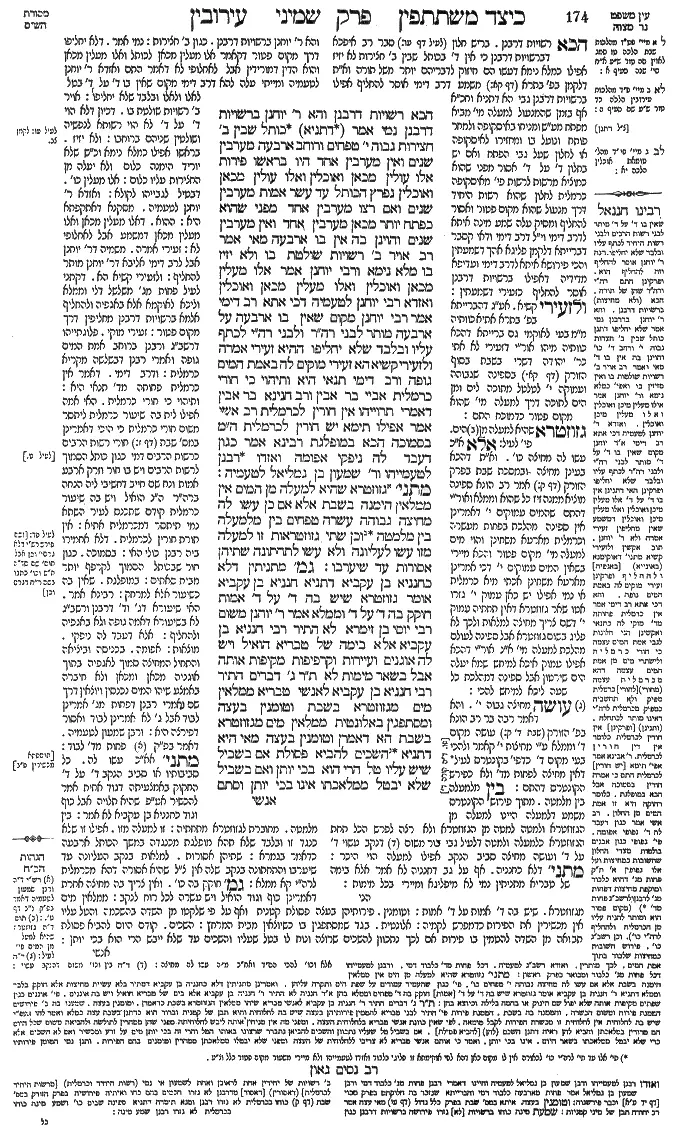
Eruvin 87b - Guemara
הכא רשויות דרבנן והא ר' יוחנן ברשויות דרבנן נמי אמר (דתניא) כותל שבין ב' חצירות גבוה י' טפחים ורוחב ארבעה מערבין שנים ואין מערבין אחד היו בראשו פירות אלו עולין מכאן ואוכלין ואלו עולין מכאן ואוכלין נפרץ הכותל עד עשר אמות מערבין שנים ואם רצו מערבין אחד מפני שהוא כפתח יותר מכאן מערבין אחד ואין מערבין שנים והוינן בה אין בו ארבעה מאי אמר רב אויר ב' רשויות שולטת בו ולא יזיז בו מלא נימא ורבי יוחנן אמר אלו מעלין מכאן ואוכלין ואלו מעלין מכאן ואוכלין ואזדא רבי יוחנן לטעמיה דכי אתא רב דימי אמר רבי יוחנן מקום שאין בו ארבעה על ארבעה מותר לבני רה"ר ולבני רה"י לכתף עליו ובלבד שלא יחליפו ההיא זעירי אמרה ולזעירי קשיא הא זעירי מוקים לה באמת המים גופה ורב דימי תנאי היא ותיהוי כי חורי כרמלית אביי בר אבין ורב חנינא בר אבין דאמרי תרוייהו אין חורין לכרמלית רב אשי אמר אפילו תימא יש חורין לכרמלית ה"מ בסמוכה הכא במופלגת רבינא אמר כגון דעבד לה ניפקי אפומה ואזדו רבנן לטעמייהו ור' שמעון בן גמליאל לטעמיה:
מתני׳ גזוזטרא שהיא למעלה מן המים אין ממלאין הימנה בשבת אלא אם כן עשו לה מחיצה גבוהה עשרה טפחים בין מלמעלה בין מלמטה וכן שתי גזוזטראות זו למעלה מזו עשו לעליונה ולא עשו לתחתונה שתיהן אסורות עד שיערבו:
גמ׳ מתניתין דלא כחנניא בן עקביא דתניא חנניא בן עקביא אומר גזוזטרא שיש בה ד' על ד' אמות חוקק בה ד' על ד' וממלא אמר ר' יוחנן משום רבי יוסי בן זימרא לא התיר רבי חנניא בן עקביא אלא בימה של טבריא הואיל ויש לה אוגנים ועיירות וקרפיפות מקיפות אותה אבל בשאר מימות לא ת"ר ג' דברים התיר רבי חנניא בן עקביא לאנשי טבריא ממלאין מים מגזוזטרא בשבת וטומנין בעצה ומסתפגין באלונטית ממלאין מים מגזוזטרא בשבת הא דאמרן וטומנין בעצה מאי היא דתניא השכים להביא פסולת אם בשביל שיש עליו טל הרי הוא בכי יותן ואם בשביל שלא יבטל ממלאכתו אינו בכי יותן וסתם
Comments from Rashi on Masechet Eruvin Page 87b
והא ר' יוחנן ברשויות דרבנן . כגון ב' חצירות: נמי אמר . דלא יחליפו דרך מקום פטור דקאמר אלו מעלין מכאן לכותל ואלו מעלין מכאן והוא הדין דמורידין אבל לאחלופי לא דאמר התם ואזדא ר' יוחנן לטעמיה ומייתי עלה להא דרב דימי מקום שאין בו ד' על ד' בטל לאלו ולאלו ובלבד שלא יחליפו: אויר ב' רשויות שולטת בו . דכיון דלא הוי ד' על ד' לא הוי רשותא לנפשיה ושולטין שניהם ברוחבו: ולא יזיז . בראשו אפילו כמלא נימא וכ"ש שלא יוריד הימנה כלום ולא יעלה מן החצירות עליו כלום: אלו מעלין כו' . דבטיל לגבייהו לקולא: ואזדא ר' יוחנן לטעמיה . מסקנא דאתקפתא היא: ההוא . דאלו מעלין מכאן ואלו מעלין מכאן דמשמע אבל לאחלופי לא: זעירי אמרה . משמיה דר' יוחנן אבל לרב דימי אליבא דר' יוחנן מותר להחליף: ולזעירי קשיא הא . דקתני לעיל פחות מג' משלשל דלי וממלא וליכא לאוקמא אלא באגפיה ולהחליף אלמא ברשויות דרבנן מחליפין דרך מקום פטור: זעירי מוקי . פלוגתייהו דרשב"ג ורבנן ברוחב אמת המים גופה ואמרי רבנן דבשלשה מקריא כרמלית: ודרב דימי . דאמר אין כרמלית פחותה מד' תנאי היא: ותיהוי כי חורי כרמלית . האי אמה אפילו לית בה שיעור כרמלית ליתסר משום חורי כרמלית כי היכי דאמרינן במס' שבת (דף ז:) חורי רשות הרבים כרשות הרבים דמי כגון כותל הסמוך לרשות הרבים ויש בו חור וזרק ארבע אמות ונח שם חייב דחשיבי ליה הנחה ברה"ר ה"נ הואיל ויש בה שיעור כרמלית קודם שתכנס לעיר השתא נמי תיתסר דמכרמלית אתיא: אין תורת חורין לכרמלית . דלא אחמירו ביה רבנן כולי האי: בסמוכה . כגון חור שבכותל הסמוך לקרפף יותר מבית סאתים: במופלגת . שאין בה כשיעור אלא למרחק: רבינא אמר . האי שיעורא דג' וד' דרבנן ורשב"ג לא בשיעורא דאמה גופה ולא באגפיה ולהחליף: אלא דעבד לה ניפקי . מוצאות: אפומה . בכניסה וביציאה והתחיל המחיצה סמוך לאגפיה בתוך אוגניה מכאן ומכאן ולא חיברה באמצע שיהו המים נכנסין ויוצאין דרך שם ואמרי רבנן דפחות מג' אמרינן לבוד אבל ג' לא אמרינן לבוד ואסור דפירצה היא: ורבן שמעון לטעמיה . דאמר בפרק קמא פחות מד' לבוד: מתני' אא"כ עשו לה . כל סביבותיו או סביב הנקב ד' על ד' החקוק באמצעיתה דגוד אחית אמר להכשיר אע"פ שהיא תלויה אבל כוף וגוד כחנניא בן עקביא לא אמר: בין מלמטה . מחוברת לגזוזטרא מתחתיה: זו למעלה מזו . אפילו זו שלא כנגד זו ובלבד שלא תהא מופלגת מכנגדה במשך הכותל ארבעה כדאמר בגמרא: שתיהן אסורות . למלאות בנקב העליונה עד שיערבו והתחתונה בנקב שלה אין צ"ל שהיא אסורה דהא מכרמלית לרה"י קא ממלא: גמ' חוקק בה כו' . ואין צריך בה מחיצה אחרת דאמרינן כוף וגוד הואיל ויש עשרה לכל רוח לנקב: ממלאין מים מגזוזטרא . שיש בה ד' אמות על ד' אמות: וטומנין . פירותיהן בעצה פסולת קטנית ואף על פי שלקטו מן השדה בהשכמה והטל עליו אין מכשירין את הפירות כדמפרש לקמיה: אלונטית . בגד שמסתפגין בו כשיוצאין מבית המרחץ: השכים . קודם היום להביא פסולת תבואה מן השדה להטמין בו פירות אם לכך נתכוון להשכים שרוצה ונוח לו בטל שעליו והשכים עד שלא ייבש הרי הוא בכי יותן:
Comments from Tosafot - Eruvin 87b
הכא רשויות דרבנן . בריש חלון (לעיל עירובין דף עו:) סבר רב איפכא דברשויות דרבנן כי אין ד' בכותל שבין ב' חצירות לא יזיז אפילו כמלא נימא דעשו הם חיזוק לדבריהם יותר משל תורה וא"ת דלקמן בפ' בתרא (עירובין דף קא:) משמע דרב דימי אוסר להחליף אפילו ברשויות דרבנן גבי הא דתניא וחכ"א אף בזמן שהמנעול למעלה מי' מביא מפתח מע"ש ומניחו באיסקופה ולמחר פותח ונועל בו ומחזירו לאיסקופה או לחלון שעל גבי הפתח ואם יש בחלון ד' על ד' אסור מפני שהוא כמוציא מרשות לרשות פי' מאיסקופה כרמלית לחלון שהוא רשות היחיד דרך מנעול שהוא מקום פטור ואסור להחליף ומסיק עלה שמע מינה איתא לדרב דימי וי"ל דרב דימי ודאי קסבר דברייתא דלקמן פליגא אהך דשמעתין והכי פירושא איתא לדרב דימי ועדיפא מדידיה דאפילו ברשויות דרבנן אוסר להחליף כזעירי דשמעתין: ולזעירי קשיא . אע"ג דהברייתא בפ' בתרא אתיא כוותיה מ"מ בעי לאוקמי גם ברייתא דהכא כוותיה מיהו אור"י דזעירי לא אתי כר' יהודה דשרי בשבת בסוף הזורק (דף קא.) בספינה שגבוהה ועמוקה י' לטלטל מתוכה לים ומן הים לתוכה דרך למעלה מי' שהוא מקום פטור כדמוכח התם: גזוזטרא שהיא למעלה מן הים . פי' לעיל: אלא א"כ עשו לה מחיצה כו' . וא"ת דהכא בעינן מחיצה ובמסכת שבת בפרק הזורק (דף ק:) אמר רב הונא ספינה מוציא ממנה זיז כל שהוא וממלא ואור"י דהתם שהמים עמוקים י' דאמרינן אין ספינה מהלכת בפחות מעשרה וכרמלית מארעא משחינן והוי מים למעלה מי' מקום פטור והכא מיירי בשאין המים עמוקים י' דכי אמרינן מארעא משחינן אכתי מיא כרמלית אי נמי אפילו יש כאן עמוק י' גזרו אטו שאר גזוזטרא דאין תחתיה עמוק י' דשם צריך מחיצה למלאות ולכך לא פליג בשום גזוזטרא אבל ספינה לעולם מהלכת למעלה מי' א"נ אור"י דהכא אפילו עמוק איכא למיחש שמא יעלה הים שירטון אבל ספינה דמהלכת כל שעה ליכא למיחש להכי: עושה מחיצה גבוה י' . והא דאמר רבה בר רב הונא בפ' הזורק (שבת ד' ק:) עושה מקום ד' וממלא ע"י מחיצות י' קאמר ולהכי בעי מקום ד' כדפי' בקונטרס לעיל דאין מחיצה לפחות מד' ולא כפירש הקונטרס דהתם: בין מלמעלה בין מלמטה . מתוך פירוש הקונטרס משמע דלמעלה היינו למעלה מן הגזוזטרא ולמטה למטה מן הגזוזטרא ולא רצה לפרש הכל תחת הגזוזטרא כלמעלה ולמטה דלעיל גבי בור משום דנקב עשוי ד' על ד' ועושה מחיצה סביב הנקב אפילו למעלה הוי היכר: מתני' דלא כחנניה . אף על גב דחנניה לא אמר אלא בימה של טבריא מתניתין נמי לא מיפליגא ומיירי בכל מימות:
Eruvin 87b - Mishnah translated into english
However, here, Rav Dimi is referring to domains by rabbinic law. As the transfer of objects from a private domain to a karmelit is prohibited only by rabbinic decree, the Sages did not prohibit this transfer when it is accomplished by way of an exempt domain.
The Gemara raises a difficulty: But Rabbi Yoḥanan said that transferring objects from one domain to another by way of an exempt domain is prohibited even in the case of domains that apply by rabbinic law. As we learned in a mishna: In the case of a wall that is between two courtyards, if it is ten handbreadths high and four handbreadths wide, the residents establish two eiruvin, a separate one for each courtyard, but they do not establish one joint eiruv.
If there was produce on top of the wall, these, the residents of one courtyard, may ascend from this side and eat them, and those, the residents of the other courtyard, may ascend from the other side and eat them, provided that they do not bring the produce down from the top of the wall to the courtyards.
If the wall is breached, a distinction applies: If the breach is up to ten cubits wide, they may establish two eiruvin, and if they wish, they may establish one eiruv, for it is like an entrance. This breach is similar to any opening of less than ten cubits. If the breach is more than this, they may establish one eiruv, but they may not establish two eiruvin. A breach of this size nullifies the partition, as the two courtyards merge into a single domain.
And we discussed this mishna and raised a question: If this wall is not four handbreadths thick, what is the halakha? Rav said: In that case, the air of two domains controls it. As the wall is not broad enough to be considered a domain of its own, its top belongs to both courtyards, and it is therefore prohibited to both of them. Accordingly, one may not move anything on top of the wall even as much as a hairsbreadth.
And Rabbi Yoḥanan disagreed and said: These, the residents of one courtyard, may carry up their food from their courtyard to the top of the wall and eat it there, and those, the residents of the other courtyard, may likewise carry up their food from their courtyard and eat it there. The entire top of the wall has the status of an exempt domain that can be combined with either courtyard, provided that the residents of the different courtyards do not exchange food between them.
And Rabbi Yoḥanan follows his regular line of argument here, for when Rav Dimi came from Eretz Yisrael to Babylonia, he said that Rabbi Yoḥanan said: A place that contains less than four by four handbreadths is an exempt domain. Consequently, if this place is located between a public domain and a private domain, it is permitted for the people of the private domain and for the people of the public domain to load their burdens onto their shoulders in it, as long as they do not exchange objects with each other by way of the exempt domain. Apparently, Rabbi Yoḥanan prohibited exchanging articles between two domains, even if they are rabbinic domains.
The Gemara answers: That ruling concerning a wall between two courtyards, Ze’eiri stated it in the name of Rabbi Yoḥanan. Rav Dimi transmitted a different tradition of Rabbi Yoḥanan’s opinion. The Gemara raises a difficulty: Nonetheless, this halakha concerning a water channel between two windows is difficult according to Ze’eiri.
The Gemara answers: Ze’eiri explains that the measures mentioned in the baraita are referring to the water channel itself. That is to say, the dispute between Rabban Shimon ben Gamliel and the Sages does not concern the width of the banks of the channel but the width of the channel itself, as they dispute the basic parameters of a karmelit. And Ze’eiri maintains that the teaching of Rav Dimi, that a karmelit can be no less than four handbreadths wide, is in fact the subject of a dispute between tanna’im.
The Gemara raises a difficulty: And let the water channel that passes through the courtyard be treated at least like the cavities of a karmelit, even if it is not wide enough to be considered a karmelit on its own. Just as the cavities in the wall of a private domain are considered a private domain even if they do not include the prescribed measure of a private domain, the water channel passing through the courtyard should likewise be considered as a cavity of the larger water channel in the street. It should therefore have the status of a karmelit.
The Gemara answers: Abaye bar Avin and Rav Ḥanina bar Avin both said: There is no category of cavities for a karmelit. As a karmelit is only a rabbinic in origin, the halakha is not so stringent with regard to this domain. Consequently, a karmelit does not annex nearby cavities.
Rav Ashi said: You can even say that in general there are holes for a karmelit, but this applies only to holes that are adjacent to the karmelit, and are therefore nullified by it. Here, however, we are dealing with a water channel that is far removed from the karmelit. Therefore, it does not assume the status of the karmelit.
Ravina said a different explanation of the dispute between Rabban Shimon ben Gamliel and the Rabbis: The measures of three and four handbreadths refer neither to the width of the water trench nor to the width of its banks. Rather, we are dealing with a case where one fashioned outlets for the water channel at its ends, i.e., one formed gaps in the partitions to allow the water to flow.
And the Rabbis follow their regular line of argument, that the principle of lavud applies only to a gap less than three handbreadths wide. An opening less than three handbreadths is therefore considered completely closed, while one of four is not viewed as closed. And Rabban Shimon ben Gamliel follows his regular line of argument, that the principle of lavud applies even to a gap of four handbreadths.
MISHNA: With regard to a balcony that extends over a body of water, if a hole was opened in the floor, its residents may not draw water from it through the hole on Shabbat, unless they erected for it a partition ten handbreadths high around the hole. It is permitted to draw water by means of that partition, whether it is positioned above the balcony, in which case the partition is seen as descending downward, or whether it is placed below the balcony.
And likewise, with regard to two such balconies, one above the other, if they erected a partition for the upper balcony but they did not erect one for the lower one, the residents are both prohibited from drawing water through the upper one, unless they establish an eiruv between them.
GEMARA: The Gemara comments: The mishna is not in accordance with the opinion of Ḥananya ben Akavya, as it was taught in a baraita that Ḥananya ben Akavya says: If a balcony that contains four cubits by four cubits is suspended above water, one may carve out a hole of four handbreadths by four handbreadths in it and draw water through it. The section of the floor surrounding the hole is considered as though it bent downward and formed a partition ten handbreadths high on all sides. Consequently, no other partition is necessary.
Rabbi Yoḥanan said in the name of Rabbi Yosei ben Zimra: Rabbi Ḥananya ben Akavya permitted a balcony that is not surrounded by partitions only in the case of the Sea of Tiberias, the Sea of Galilee, as it has clearly defined banks that are visible on all sides, and towns and enclosures surround it. It is therefore considered part of an inhabited area. But with regard to other waters, such as larger seas, no, he did not permit them.
Our Sages taught a baraita: Rabbi Ḥananya ben Akavya permitted three activities to the inhabitants of Tiberias: They may draw water from the sea through a hole cut out of a balcony on Shabbat, and they may insulate produce in the pods of legumes, and they may dry themselves on Shabbat with a towel [aluntit].
The Gemara clarifies this baraita: They may draw water through a hole cut out of a balcony on Shabbat is the halakha that we stated above. And they may insulate produce in the pods of legumes; what is this halakha? As it was taught in a baraita: If one rose early in the morning to bring residue from the field, e.g., the straw of wheat or the stalks or pods of legumes, in order to store his produce in them, the following distinction applies: If he rose early because the residue still has dew on it, and he wants to use this moisture for his produce, this instance is considered to be in the following category: If any water be put. Food or produce can contract ritual impurity only if it has come into contact with a liquid, either directly through the action of its owner, or without his direct intervention but with his approval. This is derived from the verse: “But if any water be put on the seed, and any part of their carcass falls on it, it shall be unclean to you” (Leviticus 11:38). Returning to our issue, if this person rose early because the residue still has dew on it, the produce he stores in it is rendered susceptible to ritual impurity, as it has come into contact with the dew with its owner’s approval.
And if one rose early only in order not to neglect his usual work, this is not considered an instance of if it be put, as it was not his intention to place the dew on the produce. Unintended contact with a liquid does not render food susceptible to ritual impurity. And normally, unless they specify otherwise,
Traduction : The William Davidson digital edition of the Koren Noé Talmud, with commentary by Rabbi Adin Even-Israel Steinsaltz.