 Talmud Bavli
Eruvin 18a : Youtube
Rabi Yitzchok LobensteinYoutube
2 video classes :
Eruvin Page 18a
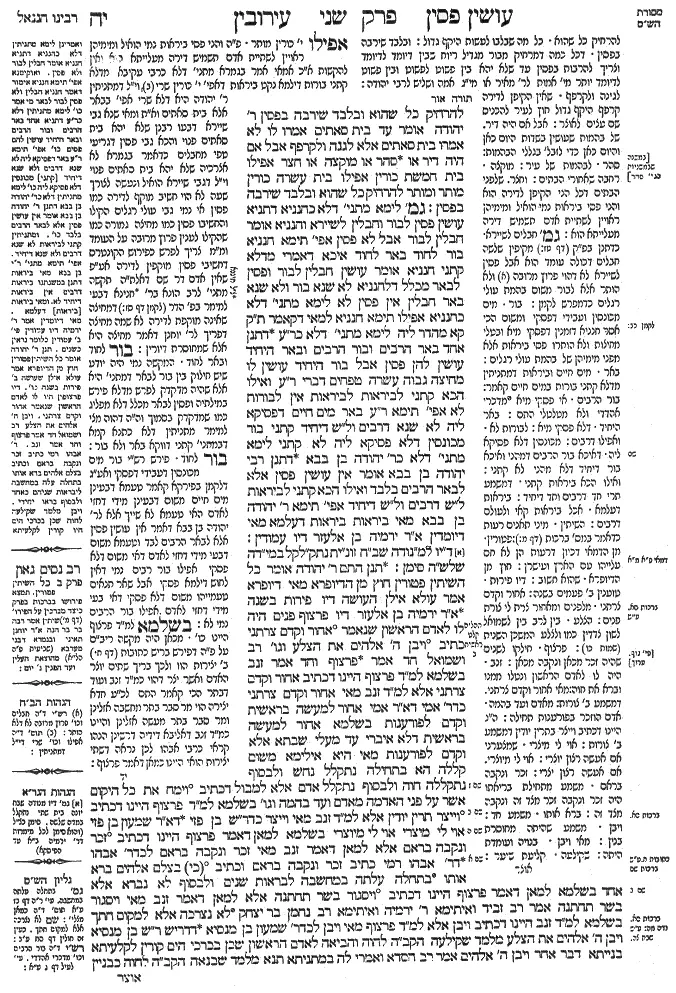
Eruvin 18a - Guemara
להרחיק כל שהוא ובלבד שירבה בפסין ר' יהודה אומר עד בית סאתים אמרו לו לא אמרו בית סאתים אלא לגנה ולקרפף אבל אם היה דיר או סהר או מוקצה או חצר אפילו בית חמשת כורין אפילו בית עשרה כורין מותר ומותר להרחיק כל שהוא ובלבד שירבה בפסין:
גמ׳ לימא מתני' דלא כחנניא דתניא עושין פסין לבור וחבלין לשיירא וחנניא אומר חבלין לבור אבל לא פסין אפי' תימא חנניא בור לחוד באר לחוד איכא דאמרי מדלא קתני חנניא אומר עושין חבלין לבור ופסין לבאר מכלל דלחנניא לא שנא בור ולא שנא באר חבלין אין פסין לא לימא מתני' דלא כחנניא אפילו תימא חנניא למאי דקאמר ת"ק קא מהדר ליה לימא מתני' דלא כר"ע דתנן אחד באר הרבים ובור הרבים ובאר היחיד עושין להן פסין אבל בור היחיד עושין לו מחיצה גבוה עשרה טפחים דברי ר"ע ואילו הכא קתני לביראות לביראות אין לבורות לא אפי' תימא ר"ע באר מים חיים דפסיקא ליה לא שנא דרבים ול"ש דיחיד קתני בור מכונסין דלא פסיקא ליה לא קתני לימא מתני' דלא כר' יהודה בן בבא דתנן רבי יהודה בן בבא אומר אין עושין פסין אלא לבאר הרבים בלבד ואילו הכא קתני לביראות ל"ש דרבים ול"ש דיחיד אפי' תימא ר' יהודה בן בבא מאי ביראות ביראות דעלמא מאי דיומדין א"ר ירמיה בן אלעזר דיו עמודין:
ד"יו למ"נודה שב"ח זונ"ית נתק"לקל במי"דה שלש"ה סימן:
תנן התם ר' יהודה אומר כל השיתין פטורין חוץ מן הדיופרא מאי דיופרא אמר עולא אילן העושה דיו פירות בשנה א"ר ירמיה בן אלעזר דיו פרצוף פנים היה לו לאדם הראשון שנאמר (תהלים קלט, ה) אחור וקדם צרתני כתיב (בראשית ב, כב) ויבן ה' אלהים את הצלע וגו' רב ושמואל חד אמר פרצוף וחד אמר זנב בשלמא למ"ד פרצוף היינו דכתיב אחור וקדם צרתני אלא למ"ד זנב מאי אחור וקדם צרתני כדר' אמי דא"ר אמי אחור למעשה בראשית וקדם לפורענות בשלמא אחור למעשה בראשית דלא איברי עד מעלי שבתא אלא וקדם לפורענות מאי היא אילימא משום קללה הא בתחילה נתקלל נחש ולבסוף נתקללה חוה ולבסוף נתקלל אדם אלא למבול דכתיב (בראשית ז, כג) וימח את כל היקום אשר על פני האדמה מאדם ועד בהמה וגו' בשלמא למ"ד פרצוף היינו דכתיב (בראשית ב, ז) וייצר תרין יודין אלא למ"ד זנב מאי וייצר כדר"ש בן פזי דא"ר שמעון בן פזי אוי לי מיצרי אוי לי מיוצרי בשלמא למאן דאמר פרצוף היינו דכתיב (בראשית ה, ב) זכר ונקבה בראם אלא למאן דאמר זנב מאי זכר ונקבה בראם לכדר' אבהו דר' אבהו רמי כתיב זכר ונקבה בראם וכתיב (בראשית א, כז) (כי) בצלם אלהים ברא אותו בתחלה עלתה במחשבה לבראות שנים ולבסוף לא נברא אלא אחד בשלמא למאן דאמר פרצוף היינו דכתיב (בראשית ב, כא) ויסגור בשר תחתנה אלא למאן דאמר זנב מאי ויסגור בשר תחתנה אמר רב זביד ואיתימא ר' ירמיה ואיתימא רב נחמן בר יצחק לא נצרכה אלא למקום חתך בשלמא למ"ד זנב היינו דכתיב ויבן אלא למ"ד פרצוף מאי ויבן לכדר' שמעון בן מנסיא דדריש ר"ש בן מנסיא ויבן ה' אלהים את הצלע מלמד שקילעה הקב"ה לחוה והביאה לאדם הראשון שכן בכרכי הים קורין לקלעיתא בנייתא דבר אחר ויבן ה' אלהים אמר רב חסדא ואמרי לה במתניתא תנא מלמד שבנאה הקב"ה לחוה כבניין
Comments from Rashi on Masechet Eruvin Page 18a
להרחיק כל שהוא . כל מה שבלבו לעשות היקף גדול: ובלבד שירבה בפסין . דכל כמה דמרחיק מבור מגדיל ריוח שבין דיומד לדיומד וצריך להרבות בפסין עד שלא יהא בין פשוט לפשוט ובין פשוט לדיומד יותר מי' אמות לר' מאיר או מי"ג אמה ושליש לרבי יהודה: לגינה ולקרפף . שאין הקיפן לדירה קרפף היקף גדול חוץ לעיר להכניס שם עצים לאוצר: אבל אם היה דיר . של בהמות שעושין בשדות היום כאן והיום כאן כדי לזבל' בגללי הבהמות: סהר . לבהמות של עיר: מוקצה . רחבה שאחורי הבתים: וחצר . שלפני הבתים דכל הני הקיפן לדירה הוא והני פסי ביראות נמי הואיל ומימיהן ראויין לשתיית אדם תשמיש דירה מעלייתא הוא: גמ' חבלים לשיירא . כדתנן בפ"ק (דף טז:) מקיפין שלשה חבלים דכולה עומד הוא אבל פסין לשיירא לא דהוי פרוץ מרובה ולא הותר אלא לבור משום בהמת עולי רגלים כדמפרש לקמן: בור . מים מכונסין ועבידי דפסקי ומשום הכי אסר חנניא דזמנין דפסקי מיא ובטלי מחיצות ולא הותרו פסי ביראות אלא מפני מימיהן של בהמת עולי רגלים: באר . מים חיים וביראות דמתניתין מדלא קתני בורות במים חיים קאמר: בור הרבים . אי פסקי מיא מדכרי אהדדי ולא מטלטלי התם: באר היחיד . דלא פסקי מיא: לבורות לא . ואפילו דרבים: מכונסין דלא פסיקא ליה . דאיכא בור הרבים דמהני ואיכא בור דיחיד דלא מהני לא קתני: ואילו הכא ביראות קתני . דמשמע תרי חד דרבים וחד דיחיד: ביראות דעלמא . אכל ביראות קאי ולעולם דרבים: השיתין . מיני תאנים רעות כדאמר במס' ברכות (דף מ:): פטורין . מן הדמאי דכיון דרעות הן לא חס עלייהו עם הארץ ועישרן: חוץ מן הדיופרא . שהוא חשוב: דיו פירות . טוענין ב' פעמים בשנה: אחור וקדם צרתני . מלפנים ומאחור צרת לי צורת פנים: הצלע: בין לרב בין לשמואל לשון צדדין כמו ולצלע המשכן השנית (שמות כו): פרצוף . חילקו לשנים שהיה זכר מכאן ונקבה מכאן: זנב . היה לו לאדם הראשון ונטלו ממנו וברא את חוה: מאי אחור וקדם צרתני . דמשמע ב' צורות: מאדם ועד בהמה . אדם הוזכר בפורענות תחילה: ה"ג היינו דכתיב וייצר בתרין יודין דמשמע ב' צורות: אוי לי מיצרי . שמצערני אם אעשה רצון יוצרי: אוי לי מיוצרי . אם אעשה רצון יצרי: זכר ונקבה בראם . משמע מתחילת בריאתו היה זכר ונקבה זכר מצד זה ונקבה מצד זה: ברא אותו . משמע חד: ויבן . משמע שהיתה מחוסרת בנין: מאי ויבן . בנויה ועומדת היתה: שקילעה . קליעת שיער:
Comments from Tosafot - Eruvin 18a
אפילו י' כורין מותר . פ"ה והני פסי ביראות נמי הואיל ומימיהן ראויין לשתיית אדם תשמיש דירה מעלייתא היא ואין להקשות א"כ אמאי אמר בגמרא מתני' דלא כרבי עקיבא מדלא קתני בורות דילמא נקט ביראות דאפי' י' כורין שרי וי"ל דמתניתין ר' יהודה היא דלא שרי אפי' בבאר אלא בית סאתים וא"ת ומאי שנא גבי שיירא דבעו רבנן שלא יהא בית סאתים פנוי והכא גבי פסין דגריעי טפי מחבלים כדאמר בגמרא לא אצרכיה שלא יהא בית סאתים פנוי וי"ל דגבי שיירא הואיל ונעשה לצורך שעה לא הוי חשיב מוקף לדירה כמו פסין אי נמי גבי עולי רגלים הקילו והחשיבו פסין כמו מחיצה גמורה כמו שהקילו לענין פרוץ מרובה על העומד ומ"מ צריך לפרש כפירוש הקונטרס דחשיבי פסין מוקפין לדירה אע"פ שאין אדם דר שם דאלת"ה תקשה מתני' לרב הונא בר' חנינא דבעי למימר בפ' הדר (לקמן עירובין דף סז:) דמחיצה שאינה מוקפת לדירה לא שמה מחיצה דפריך לר' יוחנן דאמר מחיצה היא אלא שמחוסרת דיורין: בור לחוד ובאר לחוד . המקשה נמי היה יודע שיש חילוק בין בור לבאר דמתני' היא אלא שהיה מדקדק לפרש מדלא פירש במילתיה ופסין לבאר מכלל דלא מפליג כמו שמדקדק בסמוך וה"ה דהוה מצי למימר מתניתין דלא כתנא קמא דבמתני' קתני דווקא באר ולא בור: בור לחוד . פירש רש"י בור מים מכונסין דעבידי דפסקי ואע"ג דלקמן בפירקא קאמר טעמא דבעינן מים חיים משום דבעינן מידי דחזי לאדם האי טעמא לא שייך אלא לר' יהודה בן בבא דאמר אין עושין פסין אלא לבאר הרבים לבד וטעמא משום דבעי מידי דחזי לאדם דאי משום דלא פסקי אפילו בור רבים נמי דאין לחוש דילמא פסקי אבל שאר תנאים טעמייהו משום דלא פסקי דאי בעי מידי דחזי לאדם אפילו בור הרבים נמי לא: בשלמא למ"ד פרצוף היינו כו' . מכאן היה מקשה ריב"ם על פ"ה דפירש בריש כתובות (דף ח.) ב' יצירות הוו ולכך בריך שתים יוצר האדם ואשר יצר דהוי כמ"ד זנב ועוד דבתר הכי קאמר התם לכ"ע חדא יצירה הוי מר סבר בתר מחשבה אזלינן ומר סבר בתר מעשה אזלינן והיינו כמ"ד זנב דאליבא דידיה דרשינן הנהו קראי כרבי אבהו לכן נראה דשתי יצירות הואי היינו כמאן דאמר פרצוף:
Eruvin 18a - Mishnah translated into english
to distance the boards from the well and expand the enclosed area by any amount, i.e., as much as one wishes, provided that he increases the number of upright boards between the double posts. Rabbi Yehuda says: The partitioned area may be expanded up to an area of two beit se’a, which is an area of five thousand square cubits.
The Rabbis said to him: They only spoke of an area of two beit se’a with regard to a garden or an enclosure used for storing wood, scrap, and the like [karpef]. But if it was a pen [dir], or a stable [sahar], or a backyard, or a courtyard in front of the house, even if it had an area of five beit kor or even ten beit kor, it is permitted. And it is permitted to distance the boards and expand the enclosed area by any amount, provided that one increases the upright boards between the double posts.
GEMARA: The Gemara suggests: Let us say that the mishna is not in accordance with the opinion of Ḥananya, as it was taught in a baraita: One may arrange upright boards around a water cistern and ropes around a caravan. Ḥananya disagrees and says: One may set up ropes for a cistern, but not upright boards.
The Gemara rejects this suggestion: Even if you say that the mishna was taught in accordance with the opinion of Ḥananya, a cistern of collected rain water has a discrete law, as the water will eventually be consumed and the upright boards will become unnecessary; and a well of spring water has a discrete law, as the water is constantly renewed and the upright boards will remain useful.
Some say a different version of the previous passage: From the fact that the baraita does not teach: Ḥananya says: One may set up ropes around a water cistern and boards around a well, by inference, according to the opinion of Ḥananya, there is no difference between a cistern and a well. In both cases, ropes are indeed permitted, whereas upright boards are not. Let us say the mishna is not in accordance with the opinion of Ḥananya.
The Gemara rejects this argument: Even if you say that the mishna was taught in accordance with the opinion of Ḥananya, he was only replying to that which the first tanna had said; since the first tanna had spoken only of a cistern, there was no need for Ḥananya to fully clarify his own position and distinguish between a cistern and a well.
The Gemara further suggests: Let us say the mishna is not in accordance with the opinion of Rabbi Akiva. As we learned in a mishna: In each of the cases of a public well, a public cistern, and a private well, one may arrange upright boards for them, but in the case of a private cistern, one must establish a proper partition for it ten handbreadths high; this is the statement of Rabbi Akiva.
Whereas here in the mishna it teaches: One may arrange upright boards for a well, from which one may infer that for a well, yes, it is permitted to use posts, but for a cistern, no, it is not permitted. This is opposed to Rabbi Akiva’s opinion, which maintains that posts may be arranged for a public cistern.
The Gemara rejects this argument as well: Even if you say that the mishna is in accordance with the opinion of Rabbi Akiva, the tanna of the mishna teaches the case of a well of spring water, which he can teach in a distinct manner because there is no difference whether it belongs to the public and there is no difference whether it belongs to an individual, as it is always permitted. However, he did not teach the case of a cistern containing collected rain water, which he could not teach in a distinct manner because there is a difference between a public cistern and a private one. However, it cannot be proven from here that he disagrees with Rabbi Akiva.
The Gemara further suggests: Let us say the mishna is not in accordance with the opinion of Rabbi Yehuda ben Bava, as we learned in a mishna: Rabbi Yehuda ben Bava says: One may only arrange upright boards for a public well, whereas here the mishna states: For wells. The plural term implies that there is no difference if the well belongs to the public, and there is no difference if the well belongs to an individual.
The Gemara also rejects this line of reasoning: Even if you say that the mishna is in accordance with Rabbi Yehuda ben Bava, to what is the mishna referring when it says wells? It is referring to wells in general, but the tanna means to include only public wells.
The mishna had mentioned double posts [deyomadin]: The Gemara asks: What are deyomadin? Rabbi Yirmeya ben Elazar said: Two [deyo] posts [amudin], which are put together to create a single corner piece.
Having cited Rabbi Yirmeya ben Elazar’s statement with reference to the prefix deyo, the Gemara cites other statements of his. Two, to one who was ostracized, praise, nourishment, ruin, attribute, three, are mnemonics for the following statements by Rabbi Yirmeya ben Elazar.
We learned there in a mishna: Rabbi Yehuda says: All inferior figs are exempt from being tithed, even if they are of doubtfully tithed produce [demai], as even if the seller is an am ha’aretz, he must certainly have already separated tithes from them, since the loss incurred by tithing is negligible, except for deyufra. The Gemara asks: What is deyufra? Ulla said: A tree that yields two [deyo] harvests of fruit [peirot] each year.
Rabbi Yirmeya ben Elazar also said: Adam was first created with two [deyo] faces, one male and the other female. As it is stated: “You have formed me behind and before, and laid Your hand upon me” (Psalms 139:5). Similarly, it is written: “And the tzela, which the Lord, God, had taken from the man, He made a woman, and brought her unto the man” (Genesis 2:22). Rav and Shmuel disagree over the meaning of the word tzela: One said: It means a female face, from which God created Eve; and one said: Adam was created with a tail [zanav], which God removed from him and from which He created Eve.
The Gemara asks: Granted, according to the one who says that tzela means face; it is understandable that it is written: “You have formed me [tzartani] behind and before.” However, according to the one who says that tzela means tail, what is meant by the verse: “You have formed me [tzartani] behind and before”?
The Gemara answers that this verse is to be understood as bearing a moral message, in accordance with the opinion of Rabbi Ami, as Rabbi Ami said: Behind means Adam was created at the end of the act of creation; and before means that he was first for punishment.
The Gemara asks: Granted, it is understandable that Adam was behind, or last, in the act of creation, meaning that he was not created until the sixth day, Shabbat eve. However, before, or first, for punishment, what does this mean? If you say that he was punished first because of the curse pronounced in the wake of the sin involving the Tree of Knowledge, there is a difficulty. Wasn’t the snake was cursed first, and afterward Eve was cursed, and only at the end was Adam cursed?
Rather, this refers to the punishment of the Flood, as it is written: “And He blotted out every living substance which was upon the face of the ground, both man and cattle, creeping things and fowl of the heaven” (Genesis 7:23). This indicates that the punishment began with man.
The Gemara asks: Granted, according to the one who said that Eve was originally a face or side of Adam; it is understandable that it is written: “Then the Lord God formed [vayyitzer] man” (Genesis 2:7). Vayyitzer is written with a double yod, one for Adam and one for Eve. However, according to the one who said that Eve was created from a tail, what is conveyed by spelling vayyitzer with a double yod?
The Gemara responds: This is interpreted homiletically, in accordance with the opinion of Rabbi Shimon ben Pazi, as Rabbi Shimon ben Pazi said: This comes to emphasize that which one says to himself in every circumstance: Woe unto me from my evil inclination [yetzer] if I perform the will of my Maker, and woe to me from my Maker [Yotzri] if I perform the will of my inclination.
The Gemara asks: Granted, according to the one who said that Eve was a face, it is understandable that it is written: “Male and female, He created them, and blessed them, and called their name Man in the day when they were created” (Genesis 5:2), which indicates that from the very beginning of their creation, He fashioned two faces, one for the male and the other for the female. However, according to the one who said that Eve was created from a tail, what is the meaning of the verse: “Male and female, He created them”?
The Gemara answers: It can be explained in accordance with the opinion of Rabbi Abbahu, as Rabbi Abbahu raised a contradiction between the verses: On the one hand it is written: “Male and female, He created them,” in the plural, and on the other hand it is written: “So God created man in His own image, for in the image of God He created him” (Genesis 1:27), in the singular. At first, the thought entered God’s mind to create two, and ultimately, only one was actually created.
The Gemara asks: Granted, according to the one who said that Eve was a face, it is understandable that it is written: “And He took one of his sides and closed up the flesh in its place” (Genesis 2:21). However, according to the one who said that Eve was created from a tail, what is meant by the verse: “And He closed up the flesh in its place”?
Rav Zevid said, and some say it was Rabbi Yirmeya, and some say it was Rav Naḥman bar Yitzḥak: It was necessary to say that the fleshed closed up only with regard to the place of the incision.
The Gemara challenges the other opinion: Granted, according to the one who said that Eve was created from a tail; it is understandable that it is written: “And the Lord God built the tzela” (Genesis 2:22), as it was a completely new building. However, according to the one who said that Eve was a complete face or side, what is the meaning of: “And He built”? What needed to be built?
The Gemara responds: This must be interpreted homiletically, in accordance with the opinion of Rabbi Shimon ben Menasya, as Rabbi Shimon ben Menasya interpreted homiletically the verse: “And the Lord God built the tzela.” This verse teaches that the Holy One, Blessed be He, braided for Eve her hair, and then brought her to Adam, as in the coastal towns, they call braiding hair building.
Alternatively, the verse: “And the Lord God built,” can be understood as a description of Eve’s basic shape, as Rav Ḥisda said, and some say it is taught in a baraita: This verse teaches that the Holy One, Blessed be He, built Eve like the structure
Traduction : The William Davidson digital edition of the Koren Noé Talmud, with commentary by Rabbi Adin Even-Israel Steinsaltz.