 Talmud Bavli
Eruvin 49a : Youtube
Rabi Yitzchok LobensteinYoutube
2 video classes :
Eruvin Page 49a
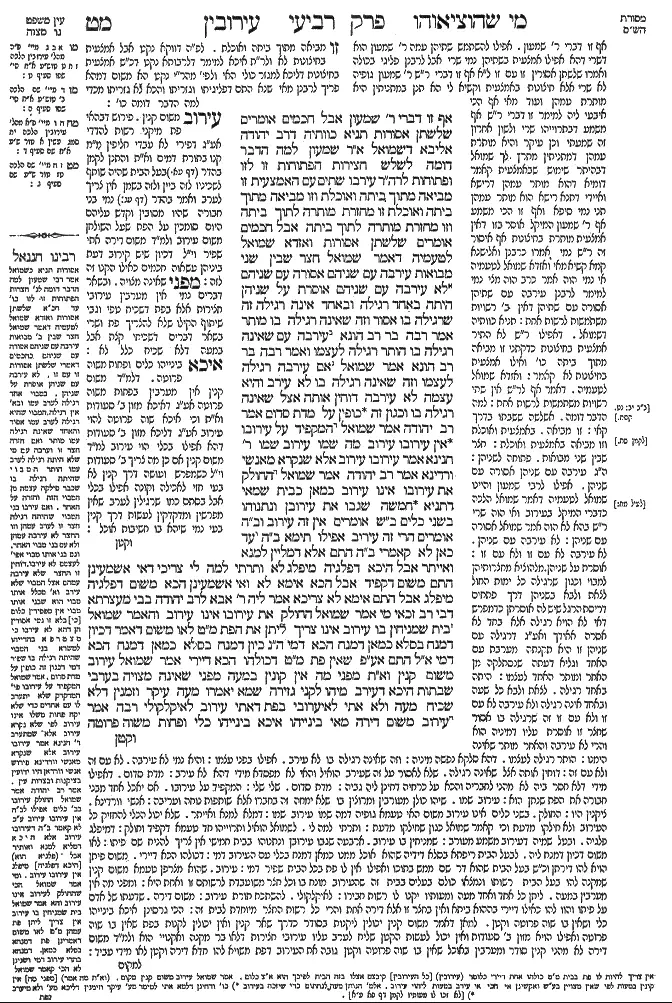
Eruvin 49a - Guemara
אף זו דברי ר' שמעון אבל חכמים אומרים שלשתן אסורות תניא כוותיה דרב יהודה אליבא דשמואל א"ר שמעון למה הדבר דומה לשלש חצירות הפתוחות זו לזו ופתוחות לרה"ר עירבו שתים עם האמצעית זו מביאה מתוך ביתה ואוכלת וזו מביאה מתוך ביתה ואוכלת זו מחזרת מותרה לתוך ביתה וזו מחזרת מותרה לתוך ביתה אבל חכמים אומרים שלשתן אסורות ואזדא שמואל לטעמיה דאמר שמואל חצר שבין שני מבואות עירבה עם שניהם אסורה עם שניהם לא עירבה עם שניהם אוסרת על שניהן היתה באחד רגילה ובאחד אינה רגילה זה שרגילה בו אסור וזה שאינה רגילה בו מותר אמר רבה בר רב הונא עירבה עם שאינה רגילה בו הותר רגילה לעצמו ואמר רבה בר רב הונא אמר שמואל אם עירבה רגילה לעצמו וזה שאינה רגילה בו לא עירב והיא עצמה לא עירבה דוחין אותה אצל שאינה רגילה בו וכגון זה כופין על מדת סדום אמר רב יהודה אמר שמואל המקפיד על עירובו אין עירובו עירוב מה שמו עירוב שמו ר' חנינא אמר עירובו עירוב אלא שנקרא מאנשי ורדינא אמר רב יהודה אמר שמואל החולק את עירובו אינו עירוב כמאן כבית שמאי דתניא חמשה שגבו את עירובן ונתנוהו בשני כלים ב"ש אומרים אין זה עירוב וב"ה אומרים הרי זה עירוב אפילו תימא ב"ה עד כאן לא קאמרי ב"ה התם אלא דמליין למנא ואייתר אבל היכא דפלגיה מיפלג לא ותרתי למה לי צריכי דאי אשמעינן התם משום דקפיד אבל הכא אימא לא ואי אשמעינן הכא משום דפלגיה מיפלג אבל התם אימא לא צריכא אמר ליה ר' אבא לרב יהודה בבי מעצרתא דבי רב זכאי מי אמר שמואל החולק את עירובו אינו עירוב והאמר שמואל בית שמניחין בו עירוב אינו צריך ליתן את הפת מ"ט לאו משום דאמר דכיון דמנח בסלא כמאן דמנח הכא דמי ה"נ כיון דמנח בסלא כמאן דמנח הכא דמי א"ל התם אע"פ שאין פת מ"ט דכולהו הכא דיירי אמר שמואל עירוב משום קנין וא"ת מפני מה אין קונין במעה מפני שאינה מצויה בערבי שבתות היכא דעירב מיהו לקני גזירה שמא יאמרו מעה עיקר וזמנין דלא שכיח מעה ולא אתי לאיערובי בפת דאתי עירוב לאיקלקולי רבה אמר עירוב משום דירה מאי בינייהו איכא בינייהו כלי ופחות משוה פרוטה
Comments from Rashi on Masechet Eruvin Page 49a
אף זו דברי ר' שמעון . אפילו להשתמש שתיהן עמה ר' שמעון הוא דשרי דהא אפילו אמצעית בשתיהן נמי שרי אבל לרבנן פליגי בכולה ואמרו שלשתן אסורין זו עם זו ל"א אף זו דברי ר"ש ר' שמעון גופיה לא שרי אלא חיצונות באמצעית וקשיא לי הא תנן במתניתין היא מותרת עמהן ועוד מאי אף הכי איבעי ליה למימר זו דברי ר"ש אף משמע דבתרוייהו שרי ולשון אחרון זה שמעתי וכן עיקר והיא מותרת עמהן דמתניתין מתרץ לך שמואל דבהיתר שימוש שבאמצעית קאמר דומיא דהוא מותר עמהן דרישא ואיידי דתנא רישא הוא מותר עמהן תני נמי סיפא ואף זו הכי משמע אף ר' שמעון המיקל אוסר בזו דאין אמצעית מותרת בחיצונות אף איסור זה ר"ש נמי אמרו כרבנן ואלישנא קמא קשיא מאי ואזדא שמואל לטעמיה אי נמי הוה אמר כרב הוה מצי נמי למימר לרבנן עירבה עם שתיהן אסורה עם שתיהן דאין ב' רשויות משתמשות לרשות אחת: תניא כוותיה דשמואל . דאפילו ר"ש לא התיר אמצעית בחיצונות כדקתני זו מביאה מתוך ביתה כו' ואילו אמצעית בחיצונות לא קאמר: למה הדבר דומה . אשלשה ששבתו בדרך קאי: זו מביאה . באמצעית ואוכלת וזו מביאה באמצעית ואוכלת: ואזדא שמואל לטעמיה . דאמר אף לר"ש אין שתי רשויות משתמשות לרשות אחת: חצר שבין שני מבואות . פתוחה לשניהן: ה"ג עירבה עם שניהן אסורה עם שניהן . אפילו לרבי שמעון והיינו שמואל לטעמיה דאמר שמואל הלכה כדברי המיקל בעירוב ואי הוה שרי ר"ש בהא לא הוה אמר שמואל אסורה עם שניהן: לא עירבה עם שניהן . לא עירבה לא עם זו ולא עם זו: אוסרת על שניהן . מלהוציא מחצרותיהן למבוי וכגון שרגילה כל ימות החול לצאת ולבא בשניהן דרך פתחים דריסת הרגל שיש לה אוסרתן כדמפרש דאי לא הויא רגילה אלא בחד לא אסרה אאידך ואע"ג דרגילה עם שניהן זו היא תקנתה מערבת עם האחד וגליא דעתה שנסתלקה מן האחר ומותר האחד לעצמו: היתה באחד רגילה . לצאת ולבא כל שעה ובאחד אינה רגילה ולא עירבה לא עם זו ולא עם זו זה שרגילה בו אסור שחצר זו אוסרת עליו דמיניה הוא והרי לא עירבה והאחר מותר שאינה הימנו: הותר רגילה לעצמו . דהא סלקא נפשה מיניה: וזה שאינה רגילה בו לא עירב . אפילו בפני עצמו: והיא נמי לא עירבה . לא עם זה ולא עם זה: דוחין אותה אצל שאינה רגילה . שלא לאסור על זה שעירב הואיל והאי לא מפסדא מידי דהא לא עירב: מדת סדום . דאפילו מידי דלא חסר ביה לא מהני לחבריה והכא על כרחיה דחינן ליה גביה: מדת סדום . שלי שלי: המקפיד על עירובו . אם יאכל אחד מבני חבורה את הפת שנתן הוא: עירוב שמו . שיהו כולן מעורבין ומרוצין בו שלא ימחה זה בחברו אלא שותפות נוחה ועריבה: אנשי וורדינא . ציקנין היו: החולק . בשני כלים אינו עירוב משום האי טעמא גופיה דמה שמו עירוב שמו: שמניחין בו עירוב . ארבעה שגבו עירובן ונתנוהו בבית חמישי אין צריך להניח שם פיתו: דמלא למנא ואייתר . שלא יכול הכלי להחזיק כל העירוב ולא חילקו מדעת וכי קאמר שמואל כגון שחילקו מדעת: ותרתי למה לי . לשמואל הואיל ותרוייהו חד טעמא דקפיד וחולק: דמיפלג פלגיה . ובטל שמיה דעירוב משמע מעורב: שמניחין בו עירוב . ארבעה שגבו עירובן ונתנוהו בבית חמישי אין צריך להניח שם פיתו: לאו משום דכיון דמנח ליה . לבעל הבית ריפתא בסלא דידיה שהוא אוכל ממנו כמאן דמנח בכלי עם העירוב דמי: דכולהו הכא דיירי . משום פיתן הויא להו דירתן וכ"ש בעל הבית שהוא דר שם ממש בתוכו ואפילו אין לו פת בכל הבית שפיר דמי: עירוב . שהוא מצרפן טעמא משום קנין שמקנה להו בעל הבית רשותו ונמצאו כולם בעלים בבית זה שהעירוב מונח בו וכל חצר משועבדת לרשותם זו ואחת היא: ומפני מה אין מערבין במעה . ליתן כל אחד ואחד מעה ומעותיו יקנו לו רשות חבירו: לאיקלקולי . להשתכח תורת עירוב: משום דירה . שדעתו של אדם על פיתו והוו להו כאילו דיירי בההוא ביתא ואין בחצר זו אלא דירה אחת והרי כל רשות החצר מיוחדת לבית זה: הדי גרסינן איכא בינייהו כלי ושאין בו שוה פרוטה וקטן . למאן דאמר משום קנין יכולין ליקנות בסודר כדרך שאר קנין ואין יכולין לקנות בפת שאין בו שוה פרוטה ואפילו הויא מזון ב' סעודות ואין יכול לעשות הקטן שליח לערב עליו עירובי חצירות דלאו בר מקנה ואקנויי הוא ולמ"ד משום דירה לא מהני קנין סודר ומערבין באוכל שאין בו שוה פרוטה וקטן גובה את העירוב דפת משויא להו חדא דירה וקטן לאו מידי עביד:
Comments from Tosafot - Eruvin 49a
זו מביאה מתוך ביתה ואוכלת לפ"ה דווקא נקט אבל אמצעית . בחיצונות לא ולר"ת איכא למימר דלרבותא נקט דכ"ש אמצעית בחיצונות דליכא למגזר כולי האי ולפי' מהר"י נקט הא משום דמהא פריך לרבנן מאי שנא התם דפליגיתו וגזריתו והכא לא גזריתו מכדי למה הדבר דומה כו': עירוב משום קנין . פירוש דבהאי פת מיקני רשות להדדי אע"ג דפירי לא עבדי חליפין מ"מ קנו בתורת דמים וא"ת והתנן לקמן בהדר (עירובין דף עא.) בעל הבית שהיה שותף לשכיניו לזה ביין ולזה בשמן אין צריך לערב ואמר בהדר (דף עג:) נמי בני חבורה שהיו מסובין וקדש עליהם היום סומכין על הפת שעל השולחן משום עירוב ולמ"ד משום דירה אתי שפיר וי"ל דכיון שיש קירוב דעת ביניהן עשאוה חכמים כאילו הקנו זה לזה: מפני שאינה מצויה . ובשאר דברים נמי אין מערבין עירובי חצירות אלא בפת דשכיח טפי וגבי שיתוף הקילו שלא להצריך פת ושרי בשאר דברים דשכיחי קצת אבל במעה דלא שכיח כלל לא: איכא בינייהו כלים ופחות משוה פרוטה . דלמ"ד משום קנין אין מערבין בפחות משוה פרוטה אע"ג דאיכא מזון ב' סעודות וא"ת וכי איכא שוה פרוטה להוי עירוב אע"ג דליכא מזון ב' סעודות דהא אפילו בכלי הוי עירוב למ"ד משום קנין אם כן מה צריך ב' סעודות וי"ל כשמפרש ועושה דרך קנין לא בעי חזי לאכילה וקונה אפילו בכלי אבל בסתם כמו שרגילין לערב שאין מפרשין ומדקדקין לעשות דרך קנין בעי נמי שיהא בו חשיבות אוכל:
Eruvin 49a - Mishnah translated into english
This teaching, that carrying objects from either of the outer courtyards into the middle courtyard is permitted, is also the statement of, i.e., in accordance with, the opinion of Rabbi Shimon. But the Rabbis say: All three courtyards are prohibited, that is to say, carrying is prohibited from any of the courtyards to any of the others.
It was taught in a baraita in accordance with the opinion of Rav Yehuda, in accordance with the opinion of Shmuel. Rabbi Shimon said: To what is this comparable? It is comparable to three courtyards that open into one another, and that also open into a public domain. If the two outer courtyards established an eiruv with the middle one, a resident of one of the outer courtyards may bring food from a house in that courtyard and eat it in the middle courtyard, and likewise a resident of the other courtyard may bring food from a house in that courtyard and eat it in the middle courtyard. And similarly, this resident may bring leftovers from the house where he ate back into the house in that courtyard, and that resident may bring leftovers from the house where he ate back into the house in this courtyard.
However, the Rabbis say: All three courtyards are prohibited. Since the residents of the outer courtyards are prohibited to carry from one outer courtyard to the other, this results in a place where carrying is prohibited, and such a place prohibits carrying in all three courtyards.
The Gemara notes that Shmuel follows his line of reasoning that he used elsewhere, as Shmuel said: With regard to a courtyard that is between two alleyways, if that courtyard established an eiruv with both alleyways, it is prohibited with both of them. Since the residents of the two alleyways are prohibited to carry from one to the other and the eiruv enables the residents of the two alleyways to carry in the courtyard, it is prohibited to carry from the courtyard into the alleyways, so that the residents of the alleyways do not transfer objects from one alleyway to the other via the courtyard.
If the courtyard did not establish an eiruv with either alleyway, it prohibits one to carry in both of them. Since the residents of the courtyard were accustomed to utilizing both alleyways and did not establish an eiruv with either alleyway, the result is that each alleyway has a courtyard that did not establish an eiruv, which prohibits carrying from the courtyard into either alleyway.
If, however, the residents of the courtyard were accustomed to utilizing only one alleyway, while they are not accustomed to utilizing one alleyway, then with regard to the alleyway which they are accustomed to utilizing, it is prohibited to carry there, as the residents of the courtyard did not establish an eiruv with it. But with regard to the alleyway which they are not accustomed to utilizing, it is permitted to carry there, as the residents of the courtyard are not considered residents of that alleyway.
Rabba bar Rav Huna said: With regard to residents of a courtyard who established an eiruv with the alleyway which they were not accustomed to utilizing, the alleyway which they were accustomed to utilizing is permitted to establish an eiruv on its own without the courtyard. The residents of the courtyard have demonstrated their intention to use the other alleyway, despite their not being accustomed to doing so.
And Rabba bar Rav Huna said that Shmuel said: If the alleyway which the residents of the courtyard were accustomed to utilizing established an eiruv on its own without the courtyard, while the alleyway which they were not accustomed to utilizing did not establish an eiruv, and also the courtyard itself did not establish an eiruv with either alleyway, we divert the residents of the courtyard to use the alleyway which they are not accustomed to utilizing. This is because there is one alleyway in which it is prohibited to carry due to the lack of an eiruv, and a second alleyway in which it is permitted to carry; while it is prohibited for the residents of the courtyard to carry. As explained above, were they to utilize the alleyway which they are accustomed to utilizing, the other residents of the alleyway would also be prohibited to carry from their courtyards into the alleyway, despite having established an eiruv for their own alleyway. However, if they use the other alleyway, the residents of that alleyway will not lose anything; since they did not establish an eiruv, it is prohibited for them to carry in that alleyway regardless.
In a case such as this, one compels another to refrain from behavior characteristic of Sodom. We force a person to waive his legal rights in order to prevent him from acting in a manner characteristic of the wicked city of Sodom. If one denies another use of his possessions, even though he would incur no loss or damage by granting use of his property, his conduct is considered to be characteristic of Sodom. The courts may sometimes compel such a person to waive his legal rights.
Rav Yehuda said that Shmuel said: With regard to one who is particular about his eiruv, i.e., that the other people should not eat of the food he contributed, his eiruv is not a valid eiruv. After all, what is its name? Joining [eiruv] is its name, indicating that it must be jointly owned [me’urav] by all the participants in the eiruv. If one person does not allow the other participants to eat of it, it does not belong to all of them and cannot be called an eiruv.
Rabbi Ḥanina said: Even in that case, his eiruv is a valid eiruv, however, that person is called one of the men of Vardina. The men of Vardina were renowned misers, meaning that he is considered to be like them.
Rav Yehuda also said that Shmuel said: With regard to one who divides his eiruv into two parts, his eiruv is not a valid eiruv. This is for the aforementioned reason that, by definition, an eiruv needs to be indicative of joining, and this eiruv is separated into different parts.
The Gemara asks: In accordance with whose opinion did Shmuel state this teaching? Could it be in accordance with the opinion of Beit Shammai, as it was taught in a baraita: With regard to five people who collected their eiruv and placed it in two separate utensils, Beit Shammai say: This is not a valid eiruv, whereas Beit Hillel say: This is an eiruv. It does not stand to reason that Shmuel would follow Beit Shammai, whose opinion is not accepted as normative law.
The Gemara answers: Even if you say that Shmuel stated his opinion in accordance with the opinion of Beit Hillel, Beit Hillel stated their opinion only there, where the first utensil was filled and there was still some food left over, and therefore, some of the leftover food had to be placed in a second utensil. But where they divided it from the outset, even Beit Hillel agree that the eiruv is not valid.
The Gemara asks: Why do I need two rulings that are based on the same principle, i.e., that an eiruv must demonstrate joining? The Gemara answers: Both rulings were necessary. As, had the Gemara taught us the ruling only there, with regard to one who is particular about his eiruv, one might have said that the eiruv is not valid because the person is particular and expressly does not desire that his eiruv be eaten by others. However here, with regard to one who divides the eiruv into different parts, one might say that his portion should not be considered as separated from the rest.
And had the Gemara taught us the ruling only here, with regard to one who divides his eiruv, one might have said that the eiruv is not valid because he divided it up, thereby physically separating himself from the others. However there, with regard to one who is particular about his eiruv, one might say that his portion should not be considered as separated from the rest, since no act of separation was performed. Consequently, both rulings were necessary.
Rabbi Abba said to Rav Yehuda in the olive press in Rav Zakkai’s house: Did Shmuel actually say that in the case of one who divides his eiruv, it is not a valid eiruv? Didn’t Shmuel say elsewhere: The house in which the eiruv is placed need not contribute bread for the eiruv. The Gemara asks: What is the reason for this ruling? Is it not because Shmuel maintains that since there is bread lying in a basket somewhere in the house, it is regarded as if it were placed here with the rest of the eiruv? Here too, one should say that since the bread is placed in a basket, i.e., in one of the two utensils containing the eiruv, it is regarded as if it were placed here with the rest of the eiruv.
Rav Yehuda said to him: There Shmuel validates the eiruv although there is no bread in the house in which the eiruv is deposited. And what is the reason for his ruling? It is because by placing food in a particular house, all the residents of the courtyard are regarded as living here. Therefore, those living in that house need not contribute bread for the eiruv, as they are certainly residents of the house.
Shmuel said: An eiruv that is deposited in a house is effective due to the principle of acquisition, as each person who contributes a portion of food acquires the right to a certain use of the residence and is considered one of its residents.
And if you say: Why then can one not acquire this right through payment of a coin such as a ma’a, but rather only through bread? It is because a ma’a is not always available on Shabbat eve, as many people spend all of their available money for the necessities of Shabbat, and it is difficult to find money available at that hour.
The Gemara asks: If so, according to Shmuel’s opinion, in a case where he established an eiruv with money, it should nonetheless acquire, i.e., be valid. According to his opinion, there is no fundamental reason to invalidate the acquisition of rights in the residence through the payment of money, yet there is no indication that this position is valid.
The Gemara answers: Even Shmuel did not permit one to establish an eiruv with money, due to a decree lest people say that a ma’a is essential, and sometimes a ma’a will not be available, and they will not come to prepare an eiruv with bread, and the halakhic category of eiruv will be forgotten.
Rabba disagreed with Shmuel and said: An eiruv is effective due to the principle of residence. Each person who contributes a portion of food is considered as if he resides, for that Shabbat, in the residence in which the food is deposited.
The Gemara asks: What is the practical, halakhic difference between these two understandings? The Gemara answers: There is a practical difference between them with regard to the question of whether an eiruv may be established with a utensil. If an eiruv is effective based on the principle of acquisition, in accordance with the opinion of Shmuel, then one should be able to establish an eiruv with a utensil; whereas, this would not constitute a valid eiruv, according to the opinion of Rabba.
And another practical difference between them is with regard to whether an eiruv may be established with food that is less than the value of a peruta. According to Shmuel’s opinion, this would not be a valid eiruv, as there is no acquisition with something less than the value of a peruta; whereas according to Rabba’s opinion, since an eiruv is effective by establishing a person’s residence, this can be done even with an amount of food worth less than a peruta.
Traduction : The William Davidson digital edition of the Koren Noé Talmud, with commentary by Rabbi Adin Even-Israel Steinsaltz.