 Talmud Bavli
Eruvin 65a : Youtube
Rabbi Dr. Moshe WeisblumYoutube
1 video class :
Eruvin Page 65a
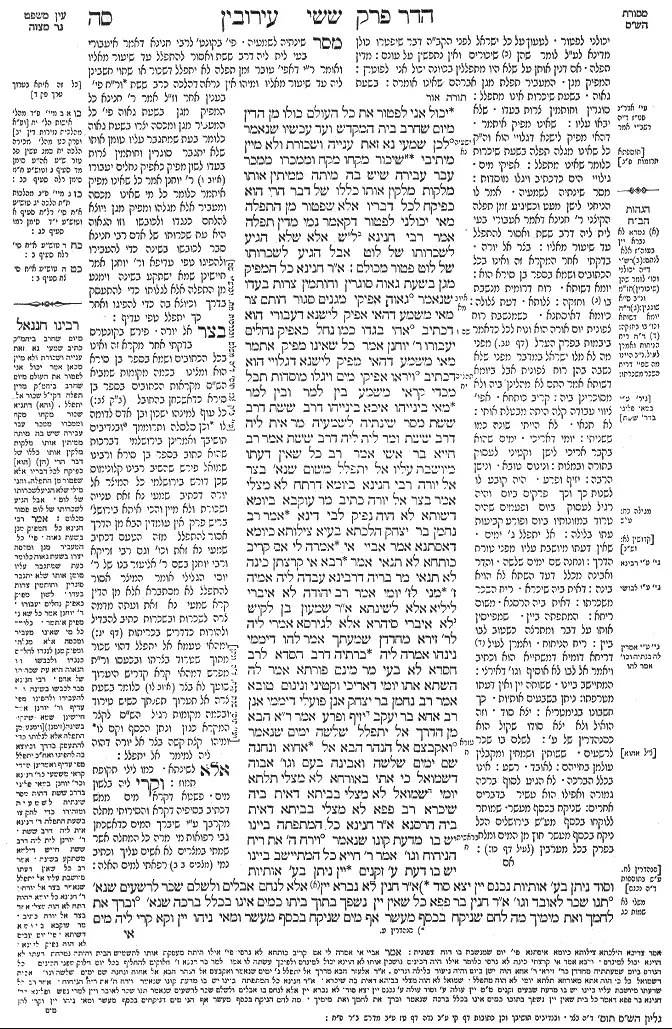
Eruvin 65a - Guemara
יכול אני לפטור את כל העולם כולו מן הדין מיום שחרב בית המקדש ועד עכשיו שנאמר (ישעיהו נא, כא) לכן שמעי נא זאת ענייה ושכורת ולא מיין מיתיבי שיכור מקחו מקח וממכרו ממכר עבר עבירה שיש בה מיתה ממיתין אותו מלקות מלקין אותו כללו של דבר הרי הוא כפיקח לכל דבריו אלא שפטור מן התפלה מאי יכולני לפטור דקאמר נמי מדין תפלה אמר רבי חנינא ל"ש אלא שלא הגיע לשכרותו של לוט אבל הגיע לשכרותו של לוט פטור מכולם:
א"ר חנינא כל המפיק מגן בשעת גאוה סוגרין וחותמין צרות בעדו שנאמר (איוב מא, ז) גאוה אפיקי מגנים סגור חותם צר מאי משמע דהאי אפיק לישנא דעבורי הוא דכתיב (איוב ו, טו) אחי בגדו כמו נחל כאפיק נחלים יעבורו ר' יוחנן אמר כל שאינו מפיק אתמר מאי משמע דהאי מפיק לישנא דגלויי הוא דכתיב (תהלים יח, טז) ויראו אפיקי מים ויגלו מוסדות תבל מכדי קראי משמע בין למר ובין למר מאי בינייהו איכא בינייהו דרב ששת:
דרב ששת מסר שינתיה לשמעיה מר אית ליה דרב ששת ומר לית ליה דרב ששת אמר רב חייא בר אשי אמר רב כל שאין דעתו מיושבת עליו אל יתפלל משום שנא' בצר אל יורה רבי חנינא ביומא דרתח לא מצלי אמר בצר אל יורה כתיב מר עוקבא ביומא דשותא לא הוה נפיק לבי דינא אמר רב נחמן בר יצחק הלכתא בעיא צילותא כיומא דאסתנא אמר אביי אי אמרה לי אם קריב כותחא לא תנאי אמר רבא אי קרצתן כינה לא תנאי מר בריה דרבינא עבדה ליה אמיה ז' מני לז' יומי אמר רב יהודה לא איברי ליליא אלא לשינתא א"ר שמעון בן לקיש לא איברי סיהרא אלא לגירסא אמרי ליה לר' זירא מחדדן שמעתך אמר להו דיממי נינהו אמרה ליה ברתיה דרב חסדא לרב חסדא לא בעי מר מינם פורתא אמר לה השתא אתו יומי דאריכי וקטיני ונינום טובא אמר רב נחמן בר יצחק אנן פועלי דיממי אנן רב אחא בר יעקב יזיף ופרע אמר ר"א הבא מן הדרך אל יתפלל שלשה ימים שנאמר (עזרא ח, טו) ואקבצם אל הנהר הבא אל אחוא ונחנה שם ימים שלשה ואבינה בעם וגו' אבוה דשמואל כי אתי באורחא לא מצלי תלתא יומי שמואל לא מצלי בביתא דאית ביה שיכרא רב פפא לא מצלי בביתא דאית ביה הרסנא א"ר חנינא כל המתפתה ביינו יש בו מדעת קונו שנאמר (בראשית ח, כא) וירח ה' את ריח הניחוח וגו' אמר ר' חייא כל המתיישב ביינו יש בו דעת ע' זקנים יין ניתן בע' אותיות וסוד ניתן בע' אותיות נכנס יין יצא סוד א"ר חנין לא נברא יין אלא לנחם אבלים ולשלם שכר לרשעים שנא' (משלי לא, ו) תנו שכר לאובד וגו' א"ר חנין בר פפא כל שאין יין נשפך בתוך ביתו כמים אינו בכלל ברכה שנא' (שמות כג, כה) וברך את לחמך ואת מימיך מה לחם שניקח בכסף מעשר אף מים שניקח בכסף מעשר ומאי ניהו יין וקא קרי ליה מים
Comments from Rashi on Masechet Eruvin Page 65a
יכולני לפטור . לטעון על כל ישראל לפני הקב"ה דבר שיפטרו כולן מדינא לע"ל לומר שהן שיכורים ואין נתפשין על עונם: מדין תפלה . אם דנין אותן על שלא היו מתפללין בכוונה יכול אני לפוטרן: המפיק מגן . המעביר תפלת מגן אברהם שאינו אומרה: בשעת גאוה . בשעת שיכרות אינו מתפלל: סוגרין וחותמין צרות בעדו . שלא יבאו עליו: שאינו מפיק איתמר . דהאי מפיק לישנא דגלויי הוא וה"ק כל שאינו מגלה תפלה בשעת שיכרות כלומר שאינו מתפלל: אפיקי מים . גילויי הים כדכתיב ויגלו מוסדות: מסר שינתיה לשמעיה . אמר לו הניחני לישן מעט וכשיגיע זמן תפלה הקיצני ר' חנינא דאמר אעבורי בעי לית ליה דרב ששת ואסור להתפלל עד שיעור מאליו: בצר אל יורה . בדקתי אחר המקרא זה ואינו בכל הכתובים ושמא בספר בן סירא הוא: יומא דשותא . רוח דרומית מנשבת בו וחזקה: צלותא . דעת צלולה: כיומא דאיסתנא . כשמנשבת רוח צפונית יום אורה הוא ונוח לכל כדאמר ביבמות בפרק הערל (דף עב.) מפני מה לא מלו ישראל במדבר מפני שלא נשבה בהן רוח צפונית אבל ביומא דשותא אמר התם לא מהלינן ביה ולא מסוכרינן ביה: קריב כותחא . אפי' ציווי עבודה קלה היתה מבטלת אותי: לא תנאי . לא הייתי שונה כמו ששניתי: יומי דאריכי . ימים שהוא בקבר אריכי לישן וקטיני לעסוק בתורה ובמצות: ונינום טובא . ונישן הרבה: יזיף ופרע . היה קובע לו לשנות כך וכך פרקים ביום והיה רגיל לעסוק ביום ופעמים שהיה טרוד במזונותיו ביום ופורע קביעות עתו בלילה: אל יתפלל ג' ימים . שאין דעתו מיושבת עליו מפני טורח הדרך: ונהנה שם ימים שלשה . והדר ואבינה מכלל דעד השתא לא הויא בינה: דאית ביה שיכרא . ריח השכר משכרתו: דאית ביה הרסנא . משום ריחא: המתפתה ביין . שמפייסין אותו על דבר ומתרצה כשטוב לבו ביין: ריח הניחוח . ואמרן לעיל דריחא דומיא דמשתייא הוא וכתיב ויאמר אל לבו לא אוסיף וגו' דאירצי: המתיישב ביינו . ששותה יין ואין דעתו מטרפתו: ניתן בשבעים אותיות . כך חשבונו בגימטריא: יצא סוד . וזה הואיל ולא יצא סודו שקול הוא כסנהדרין של ע': לשלם בו שכר לרשעים . ששותין ושמחין ומקבלין עולמן בחייהם: לאובד . רשע: אינו בכלל הברכה . לא הגיע לסוף ברכה גמורה ואפילו הוא עשיר בדברים אחרים: שניקח בכסף מעשר . שמותר ללוקחו בכסף מע"ש בירושלים הכל ניקח בכסף מעשר חוץ מן המים ומלח בפרק בכל מערבין (לעיל עירובין דף כו:):
Comments from Tosafot - Eruvin 65a
מסר שינתיה לשמעיה . פי' בקונט' לרבי חנינא דאמר איעבורי בעי לית ליה דרב ששת ואסור להתפלל עד שיעור מאליו ואומר ר"י דאפי' עובר זמן תפלה לא יתפלל דשכור או שתוי חשבינן ליה עד שיעור מאליו ומיהו אין נראה דהלכה כרב ששת ור"ח פי' בענין אחר וז"ל אמר ר' חנינא כל המפיק מגן בשעת גאוה פי' כל המעביר מגן ומכסה יצרו בשעת גאוה כלומר בעת שמתגבר עליו טומן אותו שלא יתגבר סוגרין וחותמין צרות בעדו לשון מפיק כאפיק נחלים יעבורו (איוב ו) ר' יוחנן אמר כל שאינו מפיק איתמר כלומר כל מי שאינו מכסה ומעביר אלא מגלהו ומפיק מגן ויוצא להלחם כנגדו ולכובשו וזו הגאוה היא עת שכרותו של אדם רבי חנינא סבר לכובשו בשינה כדי להעבירו ולהפיגו טפי עדיפא ור' יוחנן אמר חיישינן שמא ישתקע בשינה וימנע מן התפלה אלא לגלותו כדי להתעסק בדרך וכיוצא בה כדי להפיגו ואחר כך יתפלל טפי עדיף: בצר אל יורה . פירש בקונטרס בדקתי אחר מקרא זה ואינו בכל הכתובים ושמא בספר בן סירא הוא ומצינו בכמה מקומות שמביא הש"ס מקראות הכתובים בספר בן סירא כדאשכחן בהחובל (ב"ק צב:) כל עוף למינהו ישכון ובן אדם לדומה לו וכן סלסלה ותרוממך ובנדיבים תושיבך ואמרינן בירושלמי דברכות שהוא כתוב בספר בן סירא ורבינו שמואל פירש שהשיב רבינו קלונימוס שכן דורש בירושלמי כל המיצר לישראל יורה דכתיב שמעי נא זאת ענייה ושכורת ולא מיין והכי איתא בירושל' בריש פרק אין עומדין הבא מן הדרך אסור להתפלל מזה הטעם דכתיב שמעי נא זאת וכו' וגם רבי זריקא ורבי יוחנן בשם ר' אליעזר בנו של ר' יוסי הגלילי אומר המיצר אסור להתפלל לא מסתברא אלא מן הדין קרא שמעי נא זאת ועתה מדמה צרה לשכרות ובשכרות כתיב להבדיל ולהורות כדדריש בכריתות (דף יג:) ומהאי טעמא אל יתפלל דהוי שכור מתוך שטרוד בצרתו ובכעסו ור"ת מפרש דמהאי קרא קדריש היערוך שועך לא בצר (איוב לו) כלומר בשעת צרה אל תערוך תפלתך כשיש טירוד ובכמה מקומות רגיל הש"ס לקצר המקרא כגון ונתן הכסף וקם לו ומיהו קצת קשה בצר אל יורה דהוה ליה למימר אל יתפלל: אלא לשינתא . כמו לילי תקופת תמוז: וקרי ליה בלשון מים . פשטא דקרא מים ממש דכתיב בסיפיה דקרא והסירותי מחלה מקרבך ע"י שיברך המים כדאשכחן גבי רפואות מי מרה כל המחלה אשר שמתי במצרים לא אשים עליך וכתיב נמי (מלכים ב ב) רפאתי למים האלה:
Eruvin 65a - Mishnah translated into english
I can make an argument that exempts the entire world from judgment, from the day that the Temple was destroyed until now. As it is stated: “Therefore, hear now this, you afflicted and drunken, but not from wine” (Isaiah 51:21), which teaches that in the wake of the destruction of the Temple, all Jews are considered intoxicated and are not responsible for any sins they commit.
The Gemara raises an objection to this argument from the following baraita: With regard to one who is intoxicated, his acquisition is a binding acquisition; that is, he cannot retract the transaction when he is sober, and similarly, his sale is a binding sale. Moreover, if he committed a transgression for which he is liable to receive the death penalty, he is executed; and if the offense is punishable by lashes, he is flogged. The principle is that he is like a sober person in all matters, except that he is exempt from prayer. Therefore, even if the people of Israel are considered drunk, they are nonetheless responsible for their actions.
The Gemara answers that even Rabbi Elazar ben Azarya did not mean that they should be exempt from liability for all their sins. Rather, what is the meaning of his statement: I can exempt? He, too, meant that he could exempt them from the judgment of prayer, i.e., Jews cannot be held liable for praying without the proper intentions.
Rabbi Ḥanina said: They taught that an intoxicated person is responsible for all his actions only in a case where he did not reach the state of intoxication of Lot; however, if he reached the state of intoxication of Lot, so that he is altogether unaware of his actions, he is exempt from all liability.
Rabbi Ḥanina said: Whoever passes a shield over himself at a time of arrogance, i.e., whoever suppresses his evil inclination as though it were covered with a shield when he is arrogant, e.g., when he is intoxicated or the like (Rabbeinu Ḥananel), troubles will be closed and sealed from him, as it is stated: “The channels of [afikei] his scales are his pride, closed together as with a tight [tzar] seal” (Job 41:7). The verse is interpreted homiletically: When at a time of arrogance a person passes a shield [mapik] over his evil inclination, his troubles [tzarot] will be closed and sealed before him.
The Gemara poses a question: From where may it be inferred that the meaning of this word afik is a formulation denoting passing [aborei]? The Gemara answers: As it is written: “My brothers have dealt deceitfully like a wadi, like the channel [afik] of brooks that pass by [ya’avoru]” (Job 6:15). This implies that the term afik is synonymous with the verb ya’avoru, which refers to something that travels and passes by.
Rabbi Yoḥanan said: This is not the correct interpretation; rather, it was stated that whoever does not cover, but draws out [mapik] a shield at a time of arrogance, troubles will be closed and sealed from him. In other words, a person must draw his weapons and shield in order to fight his evil inclination when it tries to overpower him (Rabbeinu Ḥananel).
The Gemara poses a question: From where may it be inferred that this word mapik is a formulation denoting revealing? The Gemara answers: As it is written: “The channels of [afikei] waters were seen, and the foundations of the world were laid bare” (Psalms 18:16).
The Gemara asks: Now, since the verses may be interpreted both in accordance with the opinion of this Master and in accordance with the opinion of the other Master, what is the practical difference between them? The Gemara answers: The practical difference between them is with regard to the following practice of Rav Sheshet, as Rav Sheshet gave the responsibility for monitoring his sleep to his attendant, instructing the attendant to wake him when the time for prayer arrived. One Sage, Rabbi Ḥanina, is of the opinion that the practice of Rav Sheshet is correct, as Rabbi Ḥanina maintains that if one is in great need of sleep, it is better to nap for a while and then wake up with renewed vigor. And one Sage, Rabbi Yoḥanan, is not of the opinion that the practice of Rav Sheshet is correct. He holds that a person must marshal his strength and pray, rather than succumb to the need for sleep.
Rav Ḥiyya bar Ashi said that Rav said: Anyone whose mind is unsettled should not pray, as it is stated: When distressed, one should not issue decisions. The Gemara relates that Rabbi Ḥanina, on a day that he was angry, would not pray, as he said that it is written: When distressed, one should not issue decisions. The Gemara similarly relates that Mar Ukva, on a day of a south wind, would not venture out to the court, for this hot and harsh wind would disturb his usual clarity of mind.
Rav Naḥman bar Yitzḥak said: The study of halakha requires clarity, as on a day when a north wind blows and clears the skies. Abaye said similarly that if my stepmother says to me: Bring me a dish of kutaḥ, I can no longer study Torah in my usual fashion, as even a simple task such as this troubles me and distracts me from my Torah study.
Similarly, Rava said: If I am bitten by a louse, I can no longer learn in my usual manner. The Gemara relates that the mother of Mar, son of Ravina, would prepare seven garments for him for the seven days of the week, so that he would not be bitten by the lice found in old clothes (Rabbeinu Ḥananel).
Rav Yehuda said: Night was created only for sleep. Rabbi Shimon ben Lakish said: The moon was created only for Torah study by its light. When people said to Rabbi Zeira: Your teachings are exceedingly sharp, he said to them: They were formulated during the daytime hours. This teaches that Torah study during the day is most beneficial to clarity of the mind.
Rav Ḥisda’s daughter said to her father, Rav Ḥisda, who would spend his nights in study: Doesn’t the Master wish to sleep a little? He said to her: Days that are long in quantity but short in the opportunity to study Torah and perform mitzvot will soon arrive, and we will sleep a lot. After I die, there will be more than enough time for sleep.
Rav Naḥman bar Yitzḥak said: We, Torah scholars, are day workers, as our study is performed primarily during the day. The Gemara relates that Rav Aḥa bar Ya’akov would borrow and repay, i.e., if for some reason he neglected to study during the day, he would use the night hours to compensate for the missed time.
Rabbi Elazar said: One who returns home from a journey should not pray for three days while recovering from the hardship of being on the road, as it is stated: “And I gathered them together at the river that runs to Aḥava, and we encamped there for three days, and I inspected the people” (Ezra 8:15), after which it is stated: “Then I proclaimed a fast there, at the river of Aḥava, that we might afflict ourselves before our God, to seek of Him a safe journey for us” (Ezra 8:21), which teaches that they rested three days before praying.
The Gemara relates that Shmuel’s father, when he would return home from his journey, would not pray for three days, as he would have to rest from his journey. Shmuel himself would not pray in a house that contained an alcoholic beverage, as the scent of the alcohol would disturb his concentration during prayer. Similarly, Rav Pappa would not pray in a house that contained small fried fish, due to their smell.
Rabbi Ḥanina said: Whoever is appeased by his wine, i.e., whoever becomes more relaxed after drinking, has in him an element of the mind-set of his Creator, who acted in a similar fashion, as it is stated: “And the Lord smelled the sweet savor, and the Lord said in His heart, I will not again curse the ground any more for man’s sake” (Genesis 8:21). As it were, God acted more favorably toward His creatures after He was appeased with the smell of the burnt offerings. Smell can be as potent as drinking or eating itself.
Rabbi Ḥiyya said: Anyone who remains settled of mind after drinking wine, and does not become intoxicated, has an element of the mind-set of seventy Elders. The allusion is: Wine [yayin spelled yod, yod, nun] was given in seventy letters, as the numerological value of the letters comprising the word is seventy, as yod equals ten and nun equals fifty. Similarly, the word secret [sod spelled samekh, vav, dalet] was given in seventy letters, as samekh equals sixty, vav equals six, and dalet equals four. Typically, when wine entered the body, a secret emerged. Whoever does not reveal secrets when he drinks is clearly blessed with a firm mind, like that of seventy Elders.
Rabbi Ḥanin said: Wine was created only in order to comfort mourners in their distress, and to reward the wicked in this world so they will have no reward left in the World-to-Come, as it is stated: “Give strong drink to him that is ready to perish, and wine to the bitter of soul. Let him drink, and forget his poverty, and remember his misery no more” (Proverbs 31:6). “Him that is ready to perish” refers to the wicked, who will perish from the world, while “the bitter of soul” denotes mourners.
Rabbi Ḥanin bar Pappa said: Anyone in whose house wine does not flow like water is not yet included in the Torah’s blessing, as it is stated: “And He shall bless your bread and your water” (Exodus 23:25). The water mentioned in this verse actually refers to wine, as learned in the following manner: Just as bread is something that may be purchased with second-tithe money, i.e., one is permitted to buy bread with money used to redeem second-tithe, so too the word water in the verse is referring to a liquid that may be purchased with second-tithe money. And what is that? It is wine, as one may buy wine with second-tithe money, but one may not buy water; and nevertheless, the verse calls it “water.”
Traduction : The William Davidson digital edition of the Koren Noé Talmud, with commentary by Rabbi Adin Even-Israel Steinsaltz.