 Talmud Bavli
Eruvin 65b : Youtube
Rabbi Dr. Moshe WeisblumYoutube
1 video class :
Eruvin Page 65b
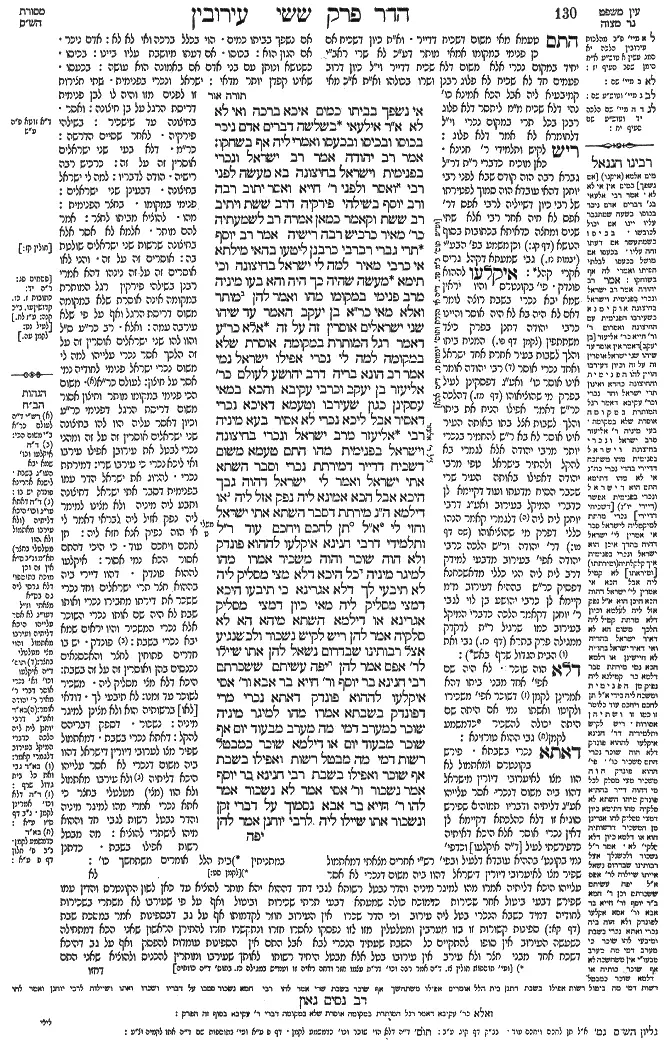
Eruvin 65b - Guemara
אי נשפך בביתו כמים איכא ברכה ואי לא לא א"ר אילעאי בשלשה דברים אדם ניכר בכוסו ובכיסו ובכעסו ואמרי ליה אף בשחקו:
אמר רב יהודה אמר רב ישראל ונכרי בפנימית וישראל בחיצונה בא מעשה לפני רבי ואסר ולפני ר' חייא ואסר יתוב רבה ורב יוסף בשילהי פירקיה דרב ששת ויתיב רב ששת וקאמר כמאן אמרה רב לשמעתיה כר' מאיר כרכיש רבה רישיה אמר רב יוסף תרי גברי רברבי כרבנן ליטעו בהאי מילתא אי כרבי מאיר למה לי ישראל בחיצונה וכי תימא מעשה שהיה כך היה והא בעו מיניה מרב פנימי במקומו מהו ואמר להן מותר ואלא מאי כר"א בן יעקב האמר עד שיהו שני ישראלים אוסרין זה על זה אלא כר"ע דאמר רגל המותרת במקומה אוסרת שלא במקומה למה לי נכרי אפילו ישראל נמי אמר רב הונא בריה דרב יהושע לעולם כר' אליעזר בן יעקב וכרבי עקיבא והכא במאי עסקינן כגון שעירבו וטעמא דאיכא נכרי דאסיר אבל ליכא נכרי לא אסיר בעא מיניה רבי אליעזר מרב ישראל ונכרי בחיצונה וישראל בפנימית מהו התם טעמא משום דשכיח דדייר דמירתת נכרי וסבר השתא אתי ישראל ואמר לי ישראל דהוה גבך היכא אבל הכא אמינא ליה נפק אזל ליה או דילמא ה"נ מירתת דסבר השתא אתי ישראל וחזי לי א"ל (משלי ט, ט) תן לחכם ויחכם עוד ר"ל ותלמידי דרבי חנינא איקלעו לההוא פונדק ולא הוה שוכר והוה משכיר אמרו מהו למיגר מיניה כל היכא דלא מצי מסליק ליה לא תיבעי לך דלא אגרינא כי תיבעי היכא דמצי מסליק ליה מאי כיון דמצי מסליק אגרינא או דילמא השתא מיהא הא לא סלקיה אמר להן ריש לקיש נשכור ולכשנגיע אצל רבותינו שבדרום נשאל להן אתו שיילו לר' אפס אמר להן יפה עשיתם ששכרתם רבי חנינא בר יוסף ור' חייא בר אבא ור' אסי איקלעו לההוא פונדק דאתא נכרי מרי דפונדק בשבתא אמרו מהו למיגר מיניה שוכר כמערב דמי מה מערב מבעוד יום אף שוכר מבעוד יום או דילמא שוכר כמבטל רשות דמי מה מבטל רשות ואפילו בשבת אף שוכר ואפילו בשבת רבי חנינא בר יוסף אמר נשכור ור' אסי אמר לא נשכור אמר להו ר' חייא בר אבא נסמוך על דברי זקן ונשכור אתו שיילו ליה לרבי יוחנן אמר להן
Comments from Rashi on Masechet Eruvin Page 65b
אם נשפך בביתו כמים . הוי בכלל ברכה ואי לא. לא: אדם ניכר . אם הגון הוא: בכוסו . אם דעתו מיושבת עליו ביינו: בכיסו . כשנושא ונותן עם בני אדם אם באמונה הוא עושה: בכעסו . שאינו קפדן יותר מדאי: ישראל ונכרי בפנימית . שתי חצירות זו לפנים מזו והיה לו לבן פנימית דריסת הרגל על בן חיצונה: ואסר . בחיצונה עד שישכיר: בשילהי פירקיה . לאחר שסיים הדרשה: כר"מ . דלא בעי שני ישראלים אוסרין זה על זה: כרכיש רבה רישיה . הודה לדבריו: למה לי ישראל בחיצונה . דבעינן שני ישראלים: פנימי במקומו . בחצר הפנימית: מהו . להוציא מביתו לחצר: אמר להם מותר . אלמא לא אסר אלא בחיצונה שרשות שני ישראלים שולטת בה: אוסרים זה על זה . והני לאו אוסרים זה על זה נינהו דהא אמרי רבנן בשילהי פירקין רגל המותרת במקומה אינה אוסרת שלא במקומה משום דריסת הרגל ואף על פי שלא עירבה עמה: ואלא . רב כר"ע ס"ל והוו להו שני ישראלים אוסרין זה על זה הלכך אסר נכרי עלייהו למה לי משום נכרי ישראל פנימי לחודיה נמי אסר על חיצון: לעולם כר"א . משום הכי פנימי במקומו מותר וחיצון אסור משום דריסת הרגל דפנימי כר"ע וכיון דאסר עליה הוו להו בחיצונה שני ישראלים אוסרין זה על זה ומהני נכרי לבטל את עירובן אפילו עירבו ואי ליכא נכרי כי עירבו שרי: דמירתת נכרי . להרוג את ישראל הדר עמו בפנימית דסבר אתי ישראל דחיצונה ותבע ליה מיניה ולא מצינו למימר ליה נפק אזיל ליה לבראי דאמר לי אי הוה נפיק אנא חזא ליה: תן לחכם ויחכם עוד . כי היכי דהתם אסור הכא נמי אסור: איקלעו לההוא פונדק . דהוו דיירי ביה בההוא חצר תרי ישראלים וחד נכרי ששכר את דירתו מחבירו נכרי ואותו שבת לא היה שם אותו נכרי השוכר אלא נכרי המשכיר והיו יראים שמא יבא נכרי בשבת: פונדק . יש בו חדרים פתוחין לחצר והאכסנאים נכנסים בהן ואוסרין זה על זה בשבת: היכא דלא מצי מסליק ליה . משכיר לשוכר עד זמנו: לא תיבעי לך . דודאי [לאו] ברשותיה הוא ולא מצינן למיגר מיניה: נשכור . דספק דבריהם להקל: דאתא נכרי בשבת . דמאתמול שפיר מצו לערובי דיורין דישראל דהוו ביה משום דנכרי לא אסר עלייהו היכא דליתיה ולא עירבו מאתמול ולא הוו (מצי) מטלטלי בחצר כי אתא נכרי אמרי מהו למיגר מיניה והדר נבטל רשות לגבי חד וההוא מיהו לישתרי להוציא: מה מבטל רשות אפילו בשבת . כדתנן במתניתין בית הלל אומרים משתחשך כו':
Comments from Tosafot - Eruvin 65b
התם טעמא מאי משום דשכיח דדייר . וא"ת כיון דשכיח אם כן פנימי במקומו אמאי מותר דע"כ לא שרי ראב"י יחיד במקום נכרי אלא משום דלא שכיח דדייר וי"ל כיון דרוב פעמים חד לא שכיח לא פלוג רבנן ושרו בכולהו וא"ת א"כ מאי קמיבעיא ליה אבל הכא אמינא כו' נהי דלא שכיח מ"מ ליתסר דלא פלוג רבנן בכל תרי במקום נכרי וי"ל דלחומרא לא אמר דלא פלוג: ריש לקיש ותלמידי ר' חנינא . כאן מוכיח כדברי ר"ת דר"ל גברא רבה הוה קודם שבא לפני רבי יוחנן דהאי עובדא הוה סמוך לפטירתו של רבי כיון דשייליה לרבי אפס דר' אפס לא חיה אחר רבי אלא שתי שנים ומחצה כדאיתא בכתובות בסוף הנושא (דף קג:) וכן משמע בפ' הבע"י (יבמות נז.) גבי שמעתא דקהל גרים אקרי קהל: איקלעו לההוא פונדק . פי' בקונטרס והיו יראין שמא יבא נכרי בשבת רוצה לומר דאם לא היה בא לא היה אוסר והיינו כרבי יהודה דתנן בפרק כיצד משתתפין (לקמן עירובין דף פו.) המניח ביתו והלך לשבות בעיר אחרת אחד ישראל ואחד נכרי אוסר רבי יהודה אומר אינו אוסר כו' ואע"ג דפסקינן לעיל בפרק מי שהוציאוהו (עירובין דף מז.) דהלכה כר"ש דאמר אפילו הניח את ביתו והלך לשבות אצל בתו באותה העיר אינו אוסר לא בא ר"ש להחמיר בנכרי יותר מרבי יהודה אלא לגמרי בא להקל ולהתיר בישראל טפי מרבי יהודה דאפילו באותה העיר שרי שכבר הסיח מדעתו ועוד דקיימא לן כדברי המיקל בעירוב ואע"ג דרבי יוחנן לית ליה דלגמרי קאמר הנהו כללי דפרק מי שהוציאוהו (שם דף מו:) דר' יהודה ור"ש הלכה כרבי יהודה אפי' בעירוב מדבעי למידק דרב לית ליה הני כללי מדאשכחנא דפסיק כר"ש בההיא דעירוב מ"מ קיימא לן כרבי יהושע בן לוי לגבי ר' יוחנן דקאמר הלכה כדברי המיקל בעירוב כמו שרגיל ר"ת לדקדק ממגילה פרק בתרא (דף כז.) גבי ואת הבית הגדול שרף באש: דלא הוה שוכר . לא היה שם אפי' אחד מבני ביתו דהא אמרינן לקמן דשוכר אפי' משכירו ולקיטו ואשתו נמי אם היתה שם היתה יכולה להשכיר כדמשמע לקמן גבי ההוא טורזינא: איקלעו לההוא פונדק כו'. פירש בקונטרס היו שם הרבה בתים של ישראלים שהיו אוסרים זה על זה ויש פירושים שמוגה בהם פונדק יש בו חדרים הרבה פתוחין לחצר והאכסנאים נכנסין בהן ואוסרין זה על זה וגם זה אמת דכי האי גוונא נמי אסרי כמו חבורה ששבתה בטרקלין: דאתא נכרי בשבתא . פירש בקונטרס ומאתמול לא הוו מצו לאיערובי דיורין מישראל דהוו ביה משום דנכרי אסר עלייהו אע"ג דליתיה ודבריו תמוהים שפירש סוגיא זו דלא כהלכתא דקיימא לן דאין נכרי אוסר אלא היכא דאיתיה כדפירשתי לעיל [ד"ה איקלעו] וכדפי' נמי בקונט' בההיא עובדא דלעיל ובפי' רש"י אחרים מצאתי דמאתמול שפיר מצו לאיערובי דיורין דישראל דהוו ביה משום דנכרי לא אסר עלייהו היכא דליתיה אמרו מהו למיגר מיניה והדר נבטל רשותא לגבי דחד דההוא יהא מותר להוציא עד כאן לשון הקונטרס והדין עמו שפירש דבעי ביטול אחר שכירות כדמוכח כולה שמעתא דבעי תרתי שכירות וביטול ואף על פי שעירבו לא משתרי בשכירות לחודיה דמיד כשבא הנכרי בטל ליה עירוב וכי הדר שכרו אין העירוב חוזר לקדמותו אף על גב דבספינות אמר במסכת שבת (דף קא:) ספינות קשורות זו בזו מערבין ומטלטלין מזו לזו נפסקו נאסרו חזרו ונתקשרו חזרו להתירן הראשון שאני הכא דמתחילה כשעשה העירוב אין סופו להתקיים כל השבת שעתיד הנכרי לבא אבל התם אין הספינות עומדות להפסק ואף על גב דהיכא דשכח אחד מבני חצר ולא עירב אין עירובו בטל אלא מבטל היחיד רשותו לאותן שעירבו ומותרין להכניס ולהוציא שאני התם דחזו כולהו לאיערובי מאתמול לפיכך אין בטל העירוב שלהן כלל וגם אין שייך לומר כלל שבת הואיל והותרה הותרה ולא יתבטל עירוב שלהן כשיבא הנכרי בשבת וזה אין נראה לפרש כלל דכאן לא עירבו ולפיכך לא סגי בשכירות לחוד בלא ביטול דהא על כרחך היו יכולין לערב כאן כדפרישית לעיל דהלכה כר' יהודה דנכרי כי ליתיה לא אסר וכיון שהיה מועיל באותו עירוב מנא ליה שלא עירבו ועשו שכירות וביטול דקשיא ליה לקמן דשמואל רביה דאמר אוסרין ואין מערבין אין מבטלין ובסוף שמעתא דקאמר למ"ד שוכרין לא תיבעי לך תרתי עבדינן שכירות וביטול דלמא הכא הוא דעירבו ולא עשו אלא שכירות לחוד על כן נראה כפירוש הקונטרס דאפילו עירבו בטל העירוב לגמרי מיכן כיון שבא הנכרי ואם תאמר ולמה להו הכא תרתי שכירות וביטול בביטול לחודיה סגי כיון דבטלי רשותייהו לגבי חד הוה ליה יחיד במקום נכרי כדאמר לעיל גבי עובדא דהמן בר רסתק דקיימא לן כראב"י יחיד במקום נכרי שרי ואע"ג דמסיק רבא דלא מהני ביטול לעשותו יחיד במקום נכרי משום דא"כ בטלת תורת עירוב מאותו מבוי ה"מ בנכרי שאינו רוצה להשכיר דלא אפשר להו לערב אבל הכא שהוא מתרצה להשכיר ובשבת אחרת יוכלו לערב להתיר לכולן אלא היום שבא הנכרי בשבת לא אפשר מועיל ביטול לעשות יחיד במקום נכרי דאין שייך כאן לומר בטלת תורת עירוב וי"ל כיון שאם לא היה מתרצה להשכיר לא היה מועיל ביטול משום דא"כ ביטלת תורת עירוב אין לחלק בין מתרצה לשאינו מתרצה דאטו אמירת הנכרי תגרום הביטול שיועיל כשיאמר אתרצה לכם להשכיר או לא יועיל כשיאמר לא אתרצה לכם ועוד י"ל דהני אמוראי סבירא להו כר"מ דאמר אסור יחיד במקום נכרי ור' יוחנן דבסמוך נמי לטעמיה דאמר נהגו העם כר"א בן יעקב אבל אורויי לא מורינן אבל אנן סבירא לן ודאי כרבי אליעזר בן יעקב דהא אביי ורבא קיימי כוותיה בעובדא דהמן בר רסתק:
Eruvin 65b - Mishnah translated into english
This teaches that if wine flows in a person’s house like water, there is a blessing, but if not, there is no blessing.
Rabbi Elai said: In three matters a person’s true character is ascertained; in his cup, i.e., his behavior when he drinks; in his pocket, i.e., his conduct in his financial dealings with other people; and in his anger. And some say: A person also reveals his real nature in his laughter.
The Gemara returns to the topic of eiruvin: Rav Yehuda said that Rav said: It once happened that there were two courtyards, one within the other, with a Jew and a gentile living in the inner courtyard, while a single Jew lived in the outer one. The case came before Rabbi Yehuda HaNasi for a decision as to whether carrying in the outer courtyard could be permitted without renting from the gentile, and he prohibited it. The case then came before Rabbi Ḥiyya, and he too prohibited it.
Rabba and Rav Yosef were sitting at the end of Rav Sheshet’s lecture, and Rav Sheshet sat and said: In accordance with whose opinion did Rav say this ruling of his, with regard to the residents of two courtyards? It was in accordance with the opinion of Rabbi Meir, who maintains that a gentile renders it prohibited for even a single Jew who resides with him to carry in the courtyard, and therefore it is necessary for the Jew to rent from him. Rabba nodded his head in agreement with this explanation.
Rav Yosef said: Would two great men like these Sages, Rabba and Rav Sheshet, err in such a matter? If this ruling is in accordance with the opinion of Rabbi Meir, why do I need to state that there is a Jew in the outer courtyard? According to Rabbi Meir, even a single Jew who resides with a gentile may not carry in his courtyard, whether or not another Jew is present.
And even if you say that indeed this is the halakha, that the Jew in the outer courtyard is of no consequence, and that he is only mentioned because the incident that took place, took place in this way, and those who came to ask the question provided all the details without knowing whether they were relevant, this is still difficult. Wasn’t a dilemma raised before Rav himself with regard to this very issue: What is the halakha governing a Jew living in the inner courtyard with regard to his own place? Can he carry in the inner courtyard? And he said to them: It is permitted for him to carry there. Therefore, according to Rav, a gentile does not render it prohibited for a single Jew to carry, which is actually contrary to Rabbi Meir’s opinion.
The Gemara raises a difficulty: Rather, what else can you say? Can you say that he ruled in accordance with the opinion of Rabbi Eliezer ben Ya’akov? Didn’t Rabbi Eliezer ben Ya’akov say: The gentile does not render it prohibited to carry unless there are two Jews living in the same courtyard who themselves render it prohibited for one another to carry without an eiruv? In this case they do not render it prohibited for each other to carry without an eiruv, as they do not live in the same courtyard.
Rather, you might say that he ruled in accordance with the opinion of Rabbi Akiva, who said: The foot of one who is permitted in his own place nonetheless renders it prohibited not in its own place. The Jew in the inner courtyard is permitted to carry in his own courtyard. However, in order to leave his courtyard, he passes through the outer one, in which it is prohibited for him to carry. Therefore, he renders it prohibited for the resident of the outer courtyard as well.
But if that is the case, the following difficulty arises: According to this opinion, why do I need a gentile in the inner courtyard? The single Jew living in the inner courtyard would also suffice to render it prohibited for the resident of the outer courtyard to carry in his own courtyard, even if no gentiles were present at all.
Rav Huna, son of Rav Yehoshua, said that Rav’s ruling should be understood as follows: Actually, Rav ruled in accordance with the opinion of Rabbi Eliezer ben Ya’akov with regard to a gentile, and in accordance with the opinion of Rabbi Akiva with regard to a foot that renders it prohibited to carry. And with what we are dealing here? This is a case where the two Jews established an eiruv with one another. And the reason that Rav prohibited carrying in the outer courtyard is that there is a gentile who renders it prohibited to carry, but if there is no gentile, it is not prohibited, as the Jews established an eiruv with one another, and therefore they are permitted to carry.
The Gemara relates that Rabbi Eliezer raised a dilemma before Rav as follows: If a Jew and a gentile live together in the outer courtyard, and a Jew lives alone in the inner one, what is the halakha? May they carry in the outer courtyard without renting from the gentile? One could argue as follows: There, in the case where the Jew and the gentile share the inner courtyard, the reason the Sages prohibited carrying is because it is common for a Jew and a gentile to live together in such a fashion. Ordinarily a single Jew would not live together in the same courtyard as a gentile, for fear that the gentile might kill him. However, here, the Jew living in the inner courtyard believes that the gentile would be afraid to kill him, as the gentile thinks to himself: Now, were I to kill my neighbor, the Jew living in the outer courtyard might come and say to me: The Jew who used to live by you, where is he? The gentile would not be able to offer as an excuse that the Jew left, for the other Jew from the outer courtyard would know whether or not he passed through his courtyard. Therefore, since that living arrangement is common, the decree applies, and the gentile’s residence in the courtyard renders it prohibited to carry there.
However, here, where the gentile lives in the outer courtyard, he is not afraid of killing his Jewish neighbor, as he says to himself: If the other Jew comes to question me, I will say to him: He went out and went on his way; I do not know where he went. In this case, the gentile would not be concerned that the Jew from the inner courtyard might question his story. Since it is uncommon for a Jew and a gentile to live together in such a fashion, the Sages did not issue a decree that the gentile’s residence renders the courtyard prohibited for carrying.
Or perhaps one would say that here, too, the gentile would be afraid to kill his Jewish neighbor, as he thinks to himself: Now, were I to kill my neighbor, the Jew living in the inner courtyard might come at any moment and see me in the act of killing his friend. Since the gentile does not know when the resident of the inner courtyard will pass through the outer courtyard, there is a chance his crime might be witnessed. In that case, it would not be uncommon for a Jew and a gentile to live together in such a fashion, and the Sages’ decree that the gentile’s residence renders carrying prohibited would apply.
Rav said to Rabbi Eliezer the following verse: “Give to a wise man, and he will be yet wiser” (Proverbs 9:9), i.e., it is proper to be stringent even in such a case. Consequently, carrying is prohibited in the outer courtyard unless the Jews rent from the gentile.
The Gemara relates that Reish Lakish and the students of Rabbi Ḥanina happened to come on Shabbat to a certain inn that had at least three permanent residents, two Jews and a gentile who rented their quarters from the gentile innkeeper. Although the gentile tenant was not present on that Shabbat, the gentile landlord was present. Concerned that the gentile tenant might return during Shabbat and render it prohibited for them to carry, Rabbi Ḥanina’s students wondered whether the gentile landlord can rent out the gentile’s room again for the purpose of an eiruv.
They said: What is the halakha with regard to renting from him? The Gemara clarifies: Anywhere that the landlord cannot remove the tenant, you need not raise the dilemma, for they clearly cannot rent it from him. If the landlord is unable to expel the tenant, the residence temporarily belongs completely to the tenant, and only he can rent it out. Where you need to raise the dilemma is with regard to a situation where he can remove him.
What is the halakha? Does one say that since the landlord can remove the tenant, they can rent the residence from him, as the landlord retains a measure of control over it, and therefore he can rent it out again for the purpose of an eiruv? Or perhaps now, in any case he has not actually removed him, which means the residence is still entirely under the tenant’s jurisdiction?
Reish Lakish said to them: Let us rent it now, as the principle is that one may act leniently in a case of doubt involving a rabbinic prohibition, and when we arrive at our Sages in the South we shall ask them whether we acted properly. Later they came and asked Rabbi Afes, who said to them: You acted well when you rented it from the landlord.
The Gemara relates a similar incident: Rabbi Ḥanina bar Yosef and Rabbi Ḥiyya bar Abba and Rabbi Asi happened to come to a certain inn, and the gentile innkeeper, who was absent when Shabbat began, came on Shabbat. They said: What is the halakha with regard to renting from him now? The Gemara explains the two sides of the question: Is renting from a gentile like making an eiruv? If so, just as one who establishes an eiruv may do so only while it is still day, so too, one who rents a gentile’s property must do so while it is still day.
Or perhaps one who rents from a gentile is like one who renounces rights to his domain; just as one who renounces rights to his domain may do so even on Shabbat itself, so too, one who rents a gentile’s property may do so even on Shabbat. In that case, they would be able to rent from the gentile in exchange for something of value, even on Shabbat itself.
Rabbi Ḥanina bar Yosef said: Let us rent, while Rabbi Asi said: Let us not rent. Rabbi Ḥiyya bar Abba said to them: Let us rely now on the words of the Elder, Rabbi Ḥanina bar Yosef, and rent. Later they came and asked Rabbi Yoḥanan about the matter, and he said to them:
Traduction : The William Davidson digital edition of the Koren Noé Talmud, with commentary by Rabbi Adin Even-Israel Steinsaltz.