 Talmud Bavli
Eruvin 14b : Youtube
Rabi Yitzchok LobensteinYoutube
2 video classes :
Eruvin Page 14b
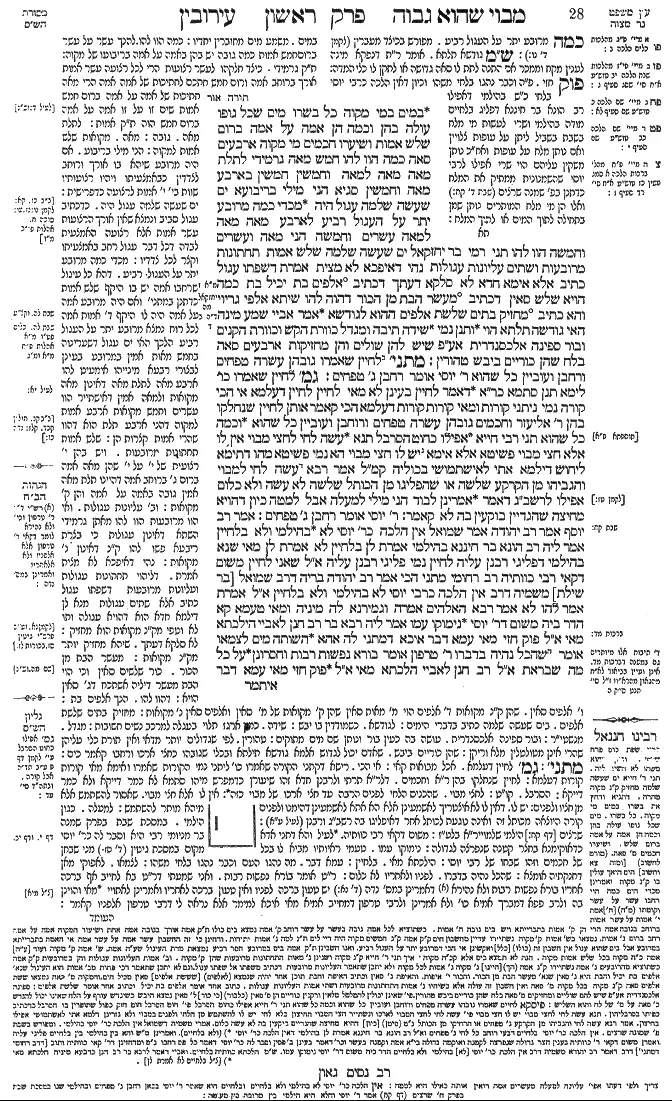
Eruvin 14b - Guemara
במים במי מקוה כל בשרו מים שכל גופו עולה בהן וכמה הן אמה על אמה ברום שלש אמות ושיערו חכמים מי מקוה ארבעים סאה כמה הוו להו חמש מאה גרמידי לתלת מאה מאה למאה וחמשין חמשין בארבע מאה וחמשין סגיא הני מילי בריבועא ים שעשה שלמה עגול היה מכדי כמה מרובע יתר על העגול רביע לארבע מאה מאה למאה עשרים וחמשה הני מאה ועשרים וחמשה הוו להו תני רמי בר יחזקאל ים שעשה שלמה שלש אמות תחתונות מרובעות ושתים עליונות עגולות נהי דאיפכא לא מצית אמרת דשפתו עגול כתיב אלא אימא חדא לא סלקא דעתך דכתיב (מלכים א ז, כו) אלפים בת יכיל בת כמה הויא שלש סאין דכתיב (יחזקאל מה, יד) מעשר הבת מן הכור דהוה להו שיתא אלפי גריוי והא כתיב (דברי הימים ב ד, ה) מחזיק בתים שלשת אלפים ההוא לגודשא אמר אביי שמע מינה האי גודשה תלתא הוי ותנן נמי שידה תיבה ומגדל כוורת הקש וכוורת הקנים ובור ספינה אלכסנדרית אע"פ שיש להן שולים והן מחזיקות ארבעים סאה בלח שהן כוריים ביבש טהורין:
מתני׳ לחיין שאמרו גובהן עשרה טפחים ורחבן ועוביין כל שהוא ר' יוסי אומר רחבן ג' טפחים:
גמ׳ לחיין שאמרו כו' לימא תנן סתמא כר"א דאמר לחיין בעינן לא מאי לחיין לחיין דעלמא אי הכי קורה נמי ניתני קורות ומאי קורות קורות דעלמא הכי קאמר אותן לחיין שנחלקו בהן ר' אליעזר וחכמים גובהן עשרה טפחים ורוחבן ועוביין כל שהוא וכמה כל שהוא תני רבי חייא אפילו כחוט הסרבל תנא עשה לחי לחצי מבוי אין לו אלא חצי מבוי פשיטא אלא אימא יש לו חצי מבוי הא נמי פשיטא מהו דתימא ליחוש דילמא אתי לאישתמושי בכוליה קמ"ל אמר רבא עשה לחי למבוי והגביהו מן הקרקע שלשה או שהפליגו מן הכותל שלשה לא עשה ולא כלום אפילו לרשב"ג דאמר אמרינן לבוד הני מילי למעלה אבל למטה כיון דהויא מחיצה שהגדיין בוקעין בה לא קאמר:
ר' יוסי אומר רחבן ג' טפחים:
אמר רב יוסף אמר רב יהודה אמר שמואל אין הלכה כר' יוסי לא בהילמי ולא בלחיין אמר ליה רב הונא בר חיננא בהילמי אמרת לן בלחיין לא אמרת לן מאי שנא בהילמי דפליגי רבנן עליה לחיין נמי פליגי רבנן עליה א"ל שאני לחיין משום דקאי רבי כוותיה רב רחומי מתני הכי אמר רב יהודה בריה דרב שמואל [בר שילת] משמיה דרב אין הלכה כרבי יוסי לא בהילמי ולא בלחיין א"ל אמרת אמר להו לא אמר רבא האלהים אמרה וגמירנא לה מיניה ומאי טעמא קא הדר ביה משום דר' יוסי נימוקו עמו אמר ליה רבא בר רב חנן לאביי הילכתא מאי א"ל פוק חזי מאי עמא דבר איכא דמתני לה אהא השותה מים לצמאו אומר שהכל נהיה בדברו ר' טרפון אומר בורא נפשות רבות וחסרונן על כל מה שבראת א"ל רב חנן לאביי הלכתא מאי א"ל פוק חזי מאי עמא דבר
Comments from Rashi on Masechet Eruvin Page 14b
במים . משמע מים מחוברין יחדיו: כמה הוו להו . להנך עשר על עשר ברום חמש אמות כמה גובה יש בהן באמה על אמה בריבועו של מקוה: ת"ק גרמידי . כיצד חלקהו לעשר רצועות הרי לכל רצועה עשר אמות אורך ברוחב אמה ורום חמש חתכם לחתיכות של אמה אמה הרי מאה חתיכות של אמה על אמה ברום חמש אמות שים זו על זו אמה על אמה ברום חמש הוה ת"ק אמות: לתלת מאה . גובה: מאה . מקואות שלש אמות למקוה: הני מילי בריבוע . אם היה מרובע שיהא בו אורך ורוחב לצדדין כבאמצעיתו ויהיו רצועותיו שוות בי' י' אמות רצועה כדפרישית: ים שעשה שלמה עגול היה . כדכתיב עגול סביב ונמצא שאין אורך הרצועות עשר אמות אלא רצועה האמצעית לבדה דכל דבר עגול רחב באמצעיתו וקצר לכל צדדיו: מכדי כמה מרובע יתר על העגול רביע . דהא כל עיגול שרחבו אמה יש בו היקף שלש אמות כדתנן במתני' ואם היה מרובע אמה על אמה היה לו היקף ד' אמות אמה לכל רוח נמצא מרובע יתר על העגול רביע הלכך האי ים עגול דשערינוה בחמש מאות אמין במרובע בעינן לבצורי רבעא מינייהו אימעיט להו ארבע מאה לתלת מאה דאינון מאה מקואות ולמאה אמין דאישתייר הוו עשרים וחמש מקואות ארבע אמות למקוה דהני ארבע תלת הוא דהוו שהרי אמות קצרות הן: שלש אמות תחתונות מרובעות . ויש בהן י' רצועות של י' על. ' שהן מאה אמה ברום ג' ברוחב אמה דהיינו תלת מאה אמין גובה באמה על אמה והן מאה מקואות: ושתי עליונות עגולות . ואי הוו מרובעות הוו להו מאתן גרמידי השתא דאינון עגולות כי בצרת ריבעא פשו להו ק"נ דאינון נ' מקואות: נהי דאיפכא לא מצית אמרת . דליהוי תחתונות עגולות ועליונות מרובעות דשפתו עגול כתיב אלא שתים עגולות מנא לן דילמא חדא הוא דהויא עגולה ותו לא וטפי מק"נ מקואות הוא מחזיק: לא סלקא דעתך . שיהא מחזיק יותר מק"נ מקואות: מעשר הבת מן הכור . כור שלשים סאין וכי הוי הבת מעשר דיליה אשתכח דג' סאין הויא: דהוו להו . הנך אלפים בת: ו' אלפים סאין . שהן ק"נ מקואות ד' אלפים הוי מ' מאות סאין שהן ק' מקואות של מ' סאין ואלפים סאין נ' מקואות: מחזיק בתים שלשת אלפים . בים שעשה שלמה כתיב בדברי הימים: לגודשא . כשמודדין בו יבש: שידה . כמין ארגז תלוי בעגלה למרכב נשים חשובות: מגדל . מנשטי"ר: ובור ספינה אלכסנדרית . עושה בה כעין בור ונותן שם מים מתוקים: טהורין . לפי שגדולים יותר מדאי ואין תורת כלי עליהן שהרי אינן מטולטלין מלא וריקן: שהן כוריים ביבש . שאדם יכול לגדוש אלמא גודשא תילתא ובכלי שגובהו כחצי ארכו ורחבו קאמר כים: מתני': גמ' לחיין דעלמא . אכל מבואות קאי: אי הכי . רישא דקתני הקורה שאמרו כו' ליתני נמי הקורות שאמרו ואימא מאי קורות קורות דעלמא: לחיין שנחלקו בהן ר"א וחכמים . דלר"א תרתי ולרבנן חדא זהו שיעורן כדמפרש מיהו סתמא לא כמר דייקא ולא כמר דייקא: הסרבל . קו"ט: לחצי מבוי . שהכניס הלחי לפנים הרבה עד חצי אורכו של מבוי כזה:  אין לו אלא חצי מבוי . שאסור להשתמש אלא מן חציו ולפנים: יש לו . דאין לו לא איצטריך לאשמעינן אלא הא אתא לאשמעינן דהימנו ולפנים מיהא מותר להשתמש: למעלה . כגון קורה היוצאה מכותל זה ואינה נוגעת לכותל אחר דאיפליגו בה רשב"ג ורבנן (לעיל ע"א): משום דקאי רבי כוותיה . לעיל והא דתני אדא בר מניומי רבי היא וסבר לה כר' יוסי כדאוקימנא בחצר קטנה שנפרצה לגדולה: נימוקו עמו . טעמי ראיותיו מביא לו בכל מקום במסכת גיטין (ד' סז.) מני שבחן של חכמים וזהו שבחו של רבי יוסי: הילכתא מאי . בלחיין: עמא דבר . מה נהגו העם וכבר נהגו בלחי משהו: לצמאו . לאפוקי מאן דחנקתיה אומצא: שהכל נהיה בדברו . לפניו ולאחריו לא כלום: ר"ט אומר בורא נפשות רבות . ואני שמעתי דר"ט בא לחייב אף ברכה אחריו בורא נפשות רבות ולא נהירא דאמרינן במס' נדה (ד' נא:) יש טעון ברכה לפניו ואין טעון ברכה לאחריו ואמרינן לאתויי מאי והוינן בה ולרב פפא דמברך אמיא כו' ולא אמרינן ולרבי טרפון דמחייב אמיא מאי איכא למימר אלא נראה לי דרבי טרפון אלפניו קאמר:
Comments from Tosafot - Eruvin 14b
כמה מרובע יתר על העגול רביע . מפורש בכיצד מעברין (לקמן עירובין ד' נו:): ש"מ גודשא תלתא . אומר ר"ת דנפקא מינה לענין מקח וממכר אם התנה לתת לו סאה גדושה או לתקן לו כלי המדה: פוק חזי . פ"ה וכבר נהגו בלחי משהו וכיון דאין הלכה כרבי יוסי בלחי כ"ש בהילמי דאפילו רב הונא בר חיננא דפליג בלחיים מודה בהילמי ושרי לעשות מי מלח בשבת בשביל ליתן על עופות צלויין ואם נותן מלח על עופות ואח"כ נותן משקין עליהם הוי שרי אפילו לרבי יוסי שהשמנונית ממתיק את המלח כדתנן בפ' שמנה שרצים (שבת קח, ב) ואלו הן מי מלח המותרים נותן שמן בתחילה לתוך המים או לתוך המלח:
Eruvin 14b - Mishnah translated into english
in water; specifically in the water of a ritual bath. The expression “all his flesh” (Leviticus 15:16) teaches that one must immerse in water that his whole body can enter at once. And how much is that? A cubit by a cubit by the height of three cubits. And the Sages calculated that the volume of water necessary for a ritual bath of this size is forty se’a.
The Gemara now calculates how many ritual baths should have been contained in Solomon’s Sea. The volume of the sea was five hundred cubic cubits, as it was ten cubits in length, ten cubits in width, and five cubits in height. The minimum volume of a ritual bath is three cubic cubits. Therefore, three hundred cubic cubits is the volume of a hundred ritual baths, and one hundred and fifty cubic cubits is the volume of another fifty ritual baths. Consequently, four hundred and fifty cubic cubits are enough to contain a hundred and fifty ritual baths; but the volume of the sea was five hundred.
The Gemara answers that there is an error in the calculation: These calculations with regard to the volume of the sea would apply to a square, but the sea fashioned by Solomon was round, and its volume was therefore smaller.
The Gemara continues to ask: Now, how much larger is a square of ten-by-ten cubits than a circle with a diameter of ten cubits? A quarter. Consequently, four hundred cubic cubits of our original calculation must be reduced to three hundred, which is the volume of one hundred ritual baths; and the remaining hundred cubits must be reduced to seventy-five, which is the volume of twenty-five ritual baths. According to this calculation, Solomon’s Sea was the size of only one hundred and twenty-five ritual baths, not one hundred and fifty as stated above.
In answer to this question, Rami bar Yeḥezkel taught as follows: In the sea that Solomon fashioned, the three lower cubits were square and the upper two were round. Consequently, the three lower cubits of the sea contained the volume of a hundred ritual baths, and its upper two cubits contained the volume of fifty ritual baths, for a total of one hundred and fifty ritual baths.
The Gemara comments: Although you cannot say the opposite, that the bottom of the sea was round, as it is written in the verse that its brim was round; you can, however, say that only one cubit on top was round.
The Gemara rejects this possibility: This cannot enter your mind, as it is written with regard to the sea: “And it was a handbreadth thick, and its brim was wrought like the brim of a cup, like the petals of a lily; it contained two thousand bat” (i Kings 7:26). How much is the measure of a bat? Three se’a, as the verse states: “Concerning the ordinance of oil, the bat of oil, you shall offer the tenth part of a bat out of the kor, which is a ḥomer of ten bat, for ten bat are a ḥomer” (Ezekiel 45:14). This proves that the bat is a tenth of a kor, or three se’a, as a kor is thirty se’a. Consequently, the sea, which contained two thousand bat, contained six thousand se’a, the volume of exactly one hundred and fifty ritual baths.
The Gemara asks: Isn’t it written elsewhere with regard to Solomon’s Sea: “It received and held three thousand bat” (ii Chronicles 4:5)? The Gemara answers: That is referring to the heaped measure of dry goods that the sea could hold, as dry goods can be heaped above the brim.
Abaye said: Learn from it that the surplus of dry goods in a vessel relative to liquids is one-third of the contents of the vessel. We also learned the same thing in the following mishna: A carriage, a box, and a cupboard, a round straw barrel, and a round barrel made of reeds, and the cistern of an Alexandrian ship, which is a large vessel placed on a boat and filled with potable water, although these vessels have bottoms, i.e., they are receptacles, since they have a capacity of forty se’a of liquid, which is the equivalent of two kor of dry goods, they are ritually pure. Even if they come into contact with a source of ritual impurity, they do not become impure. Beyond a certain size, containers are no longer considered vessels and, consequently, cannot become ritually impure. This mishna states clearly that a vessel that holds forty se’a of liquids can hold two kor, or sixty se’a, of dry goods.
MISHNA: The side posts the Sages spoke of with regard to rendering an alleyway fit for one to carry within it, their height must be at least ten handbreadths, and their width and thickness may be any amount. Rabbi Yosei says: Their width must be at least three handbreadths.
GEMARA: We learned in the mishna: The side posts the Sages spoke of, etc. The Gemara asks: Shall we say the mishna taught an unattributed ruling in accordance with the opinion of Rabbi Eliezer, who said that in order to permit carrying in an alleyway, we require two side posts?
The Gemara responds: No; what is meant by the plural term side posts? Side posts in general, and not those required by a single alleyway. The Gemara asks: If so, let the previous mishna also teach the halakha of a cross beam with the plural term cross beams, and we would say: What is meant by the plural term cross beams? Cross beams in general.
The Gemara answers that this is what the mishna is saying: Those side posts that Rabbi Eliezer and the Sages disagreed about, of which Rabbi Eliezer required two and the Sages sufficed with one, their height must be at least ten handbreadths, and their width and thickness may be any amount. The Gemara asks: And how much is any amount? Rabbi Ḥiyya taught: Even as small as the string used to tie a coat.
It was taught in a Tosefta: With regard to one who erected a side post for half an alleyway, i.e., he put it up halfway down the alleyway rather than at its entrance, he has the right to carry only in the inner half of the alleyway, but not in the outer half. The Gemara asks: That is obvious; what novel element was introduced here? Rather, say: He may carry in the inner half of the alleyway even though there is no side post at the entrance to the alleyway. The Gemara asks: That too is obvious. The Gemara explains that nonetheless there is a novelty here: Lest you say that we should be concerned that if it is permitted to carry in the inner half one might come to use the entire alleyway, the Tosefta teaches that carrying in the inner half is permitted.
Rava said: With regard to one who erected a side post in an alleyway and raised it three handbreadths from the ground, or distanced it three handbreadths from the wall, he has not done anything, as it is not a valid side post. Even according to the opinion of Rabban Shimon ben Gamliel, who said: We say that objects separated by a gap of up to four handbreadths are considered connected, that applies only above, e.g., to a cross beam that does not reach the wall of the alleyway; but below, since it is a partition through which goats can pass, as a goat can pass through an opening three handbreadths high, even he did not say that they are considered connected.
We learned in the mishna that Rabbi Yosei says: The width of the side posts must be at least three handbreadths. Rav Yosef said that Rav Yehuda said that Shmuel said: The halakha is not in accordance with the opinion of Rabbi Yosei, not with regard to preparing salt brine [hilmei] on Shabbat, and not with regard to side posts.
Rav Huna bar Ḥinana said to him: With regard to brine you told us that the halakha is not in accordance with the opinion of Rabbi Yosei, but with regard to side posts you did not tell us this; perhaps you have forgotten that the halakha is in accordance with his view in that case. Rav Yosef asked: What is different about brine, with regard to which the Sages disagree with Rabbi Yosei? In the case of side posts also the Sages disagree with him, and therefore the halakha should not be in accordance with his view in either case. Rav Huna bar Ḥinana said to him: Side posts are different, as Rabbi Yehuda HaNasi holds in accordance with the opinion of Rabbi Yosei, and therefore the halakha may be decided in accordance with their jointly held position.
The Gemara reports that Rav Raḥumei taught this version of the previous discussion: Rav Yehuda, the son of Rav Shmuel bar Sheilat, said in the name of Rav: The halakha is not in accordance with the opinion of Rabbi Yosei, not with regard to brine and not with regard to side posts. At some later point, someone said to him: Did you really say this? He said to them: No. Rava said, reinforcing his words with an oath: By God! He did in fact say this, and I learned it from him, but he later retracted this ruling. And what is the reason he retracted it? Due to the well-known principle that Rabbi Yosei’s reasoning [nimmuko] is with him, and the halakha follows his opinion even against the majority view.
Rava bar Rav Ḥanan said to Abaye: What is the accepted halakha with regard to the width of a side post? He said to him: Go out and observe what the people are doing; it is common practice to rely on a side post of minimal width.
The Gemara notes that there are those who taught that this answer was given with regard to this discussion: One who drinks water to quench his thirst recites the following blessing prior to drinking: By Whose word all things came to be. Rabbi Tarfon disagrees and says he recites the blessing: Who creates the many forms of life and their needs, for all that You have created. Rav Ḥanan said to Abaye: What is the halakha? He said to him: Go out and observe what the people are doing; the customary practice is to say: By Whose word all things came to be.
Traduction : The William Davidson digital edition of the Koren Noé Talmud, with commentary by Rabbi Adin Even-Israel Steinsaltz.