 Talmud Bavli
Zevahim 9a : Youtube
Daf TubeYoutube
2 video classes :
Zevahim Page 9a
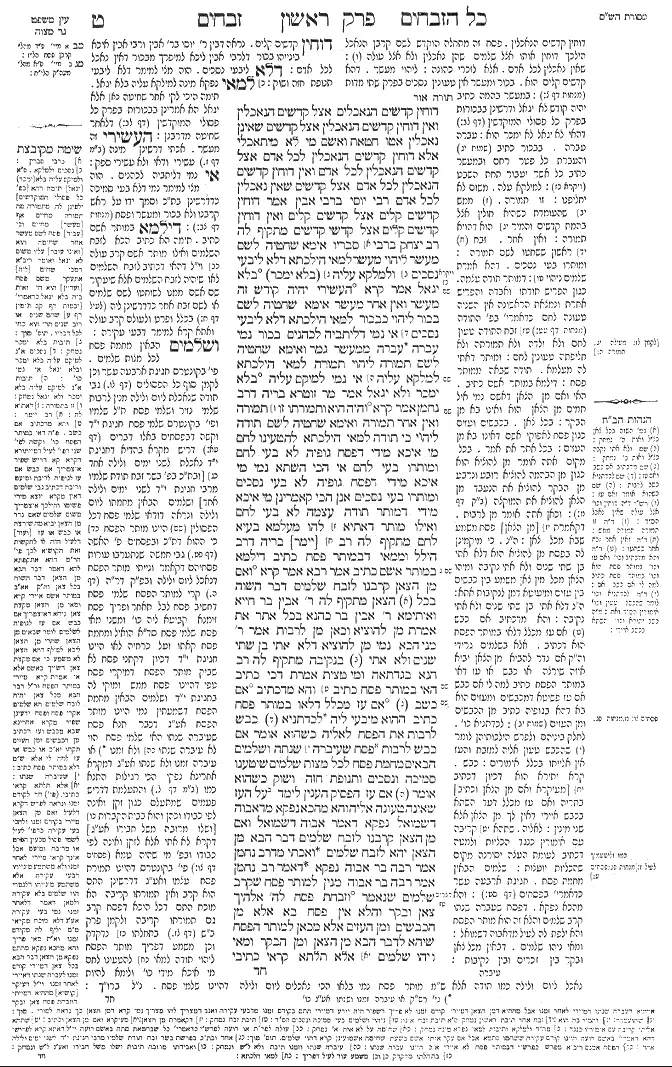
Zevahim 9a - Guemara
דוחין קדשים הנאכלים אצל קדשים הנאכלין ואין דוחין קדשים הנאכלין אצל קדשים שאינן נאכלין אטו חטאת ואשם מי לא מיתאכלי אלא דוחין קדשים הנאכלין לכל אדם אצל קדשים הנאכלין לכל אדם ואין דוחין קדשים הנאכלין לכל אדם אצל קדשים שאין נאכלין לכל אדם רבי יוסי ברבי אבין אמר דוחין קדשים קלים אצל קדשים קלים ואין דוחין קדשים קלים אצל קדשי קדשים מתקיף לה רב יצחק ברבי סבריו אימא שחטיה לשם מעשר ליהוי מעשר למאי הילכתא דלא ליבעי נסכים ולמלקא עליה (בלא ימכר) (ויקרא כז, לג) בלא יגאל אמר קרא (ויקרא כז, לב) העשירי יהיה קודש זה מעשר ואין אחר מעשר אימא שחטיה לשם בכור ליהוי כבכור למאי הילכתא דלא ליבעי נסכים אי נמי דליתביה לכהנים בכור נמי עברה עברה ממעשר גמר ואימא שחטיה לשם תמורה ליהוי תמורה למאי הילכתא למלקא עליה אי נמי למיקם עליה (ויקרא כז, כח) בלא ימכר ולא יגאל אמר מר זוטרא בריה דרב נחמן אמר קרא (ויקרא כז, י) והיה הוא ותמורתו זו תמורה ואין אחר תמורה ואימא שחטיה לשם תודה ליהוי כי תודה למאי הילכתא להטעינו לחם מי איכא מידי דפסח גופיה לא בעי לחם ומותרו בעי לחם אי הכי השתא נמי מי איכא מידי דפסח גופיה לא בעי נסכים ומותרו בעי נסכים אנן הכי קאמרינן מי איכא מידי דמותר תודה עצמה לא בעי לחם ואילו מותר דאתיא להו מעלמא בעיא לחם מתקיף לה רב [יימר] בריה דרב הילל וממאי דבמותר פסח כתיב דילמא במותר אשם כתיב אמר רבא אמר קרא (ויקרא ג, ו) ואם מן הצאן קרבנו לזבח שלמים דבר השוה בכל הצאן מתקיף לה ר' אבין בר חייא ואיתימא ר' אבין בר כהנא בכל אתר את אמרת מן להוציא וכאן מן לרבות אמר ר' מני הכא נמי מן להוציא דלא אתי בן שתי שנים ולא אתי בנקיבה מתקיף לה רב חנא בגדתאה ומי מצית אמרת דכי כתיב האי במותר פסח כתיב והא מדכתיב (ויקרא ג, ז) אם כשב (ויקרא ג, יב) אם עז מכלל דלאו במותר פסח כתיב ההוא מיבעי ליה לכדתניא כבש לרבות את הפסח לאליה כשהוא אומר אם כבש לרבות פסח שעיברה שנתה ושלמים הבאים מחמת פסח לכל מצות שלמים שיטענו סמיכה ונסכים ותנופת חזה ושוק כשהוא אומר אם עז הפסיק הענין לימד על העז שאינה טעונה אליה והא מהכא נפקא מדאבוה דשמואל נפקא דאמר אבוה דשמואל ואם מן הצאן קרבנו לזבח שלמים דבר הבא מן הצאן יהא לזבח שלמים ואכתי מדרב נחמן אמר רבה בר אבוה נפקא דאמר רב נחמן אמר רבה בר אבוה מנין למותר פסח שקרב שלמים שנאמר (דברים טז, ב) וזבחת פסח לה' אלהיך צאן ובקר והלא אין פסח בא אלא מן הכבשים ומן העזים אלא מכאן למותר הפסח שיהא לדבר הבא מן הצאן ומן הבקר ומאי ניהו שלמי אלא תלתא קראי כתיבי
Comments from Rashi on Masechet Zevahim Page 9a
דוחין קדשים הנאכלין . פסח זה מתחלה הוקדש לשם קרבן הנאכל הילכך דוחין אותו אצל שלמים שהן נאכלין ולא אצל עולה: שאין נאכלין לכל אדם . אלא לזכרי כהונה: ליהוי מעשר . דהא קדשים קלים הוא. בכור ומעשר אין טעונין נסכים בפרק שתי מדות (מנחות דף צ:): במעשר בהמה כתיב יהיה קודש לא יגאל ודרשינן בבכורות בפרק כל פסולי המוקדשין (דף לב:) דהאי לא יגאל לא ימכר הוא: עברה עברה . בבכור כתיב (שמות יג) והעברת כל פטר רחם ובמעשר כתיב כל אשר יעבור תחת השבט (ויקרא כז): למילקא עלה . משום לא יחליפנו: זו תמורה . ממש שהעומדת כשהיא חולין אצל בהמת קדשים והמיר הוא דהויא תמורה: ואין אחר . זבח ראשון ששחטו לשם תמורה: ומותרו בעי נסכים . דהא אמרת שלמים ניהוי: דמותר תודה עצמה . כגון הפריש תודתו ואבדה והפריש אחרת ונמצאת הראשונה אין השניה טעונה לחם כדאמרי' בפ' התודה (מנחות דף עט:) זבח התודה טעון לחם ולא ולדה ולא תמורתה ולא חליפתה טעונין לחם: ומותר דאתי לה מעלמא . תודה שבאה ממותר פסח: דילמא במותר אשם כתיב . האי ואם מן הצאן דאשם נמי איל תמים מן הצאן הוא ואינו בא מן הבקר: בכל צאן . בכבשים ועזים כגון פסח לאפוקי אשם דאינו בא מן העזים: בכל אתר את אמר . בכל מקום אתה אומר מן להוציא הוא כגון מן הבהמה להוציא רובע ונרבע מן הבקר להוציא את הנעבד מן הצאן להוציא את המוקצה (ב"ק דף מ:): וכאן אתה אומר מן לרבות . דקאמרת [מן הצאן] פסח משמע שבא מכל צאן: ה"נ . כי מוקמינן לה בפסח מן להוציא הוא דלא אתי בן שתי שנים ולא אתי נקיבה ומיהו הצאן מכל מין צאן משמע בין כבשים בין עזים ומיעוטא דמן לנקיבות אתא: ה"ג דלא אתי בן שתי שנים ולא אתי נקיבה: והא מדכתיב אם כבש אם עז מכלל דלאו במותר הפסח הוא דכתיב . אלא בשלמים גרידי וה"ק אם נדר להביא מן הצאן יביא איזה שירצה או כבש או עז דאי במותר הפסח כתיב למה לי אם כבש אם עז פשיטא דמכבשים ומעזים הוא בא דהא בגופיה כתיב מן הכבשים ומן העזים (שמות יב): לכדתניא כו' . לחלק ביניהם ולפרש הילכותיהן לומר שהכבש טעון אליה למזבח והעז אין אלייתו בכלל אימורים: כבש . קרא יתירא הוא דכיון דכתיב [מעיקרא ואם מן הצאן וכתיב] בתריה ואם עז מכלל דעד השתא בכבש איירי דאין לך מן הצאן אלא שני מינין: לאליה . שתהא קריבה עם אימורין כנגד הכליות ולמטה דכתיב לעומת העצה יסירנה מקום שהכליות יועצות: שלמים הבאין מחמת פסח . חגיגת ארבעה עשר כדאמרי' בפסחים (דף סט:): והא מהכא נפקא . דפסח שעברה שנתו קרב שלמים והלא זה הוא מותר הפסח והא ילפת לה לעיל מדאבוה דשמואל: ומאי ניהו שלמים . דבאין מכל צאן ובקר בין זכרים ובין נקיבות:
Comments from Tosafot - Zevahim 9a
דוחין קדשים קלים . נראה דבין ר' יוסי בר' אבין ורבי אבין איכא בינייהו בכור דלרבי אבין ליכא למיפרך מבכור דאין נאכל לכל אדם: למאי נפקא מינה למילקא עליה בלא יגאל . תימה היכי לקי אחר שחיטה אלא יגאל הא אמרינן בבכורות בפרק כל פסולי המוקדשין (דף לב:) דלאחר שחיטה מדרבנן: העשירי זה מעשר . אכתי דרשינן מינה (ב"מ דף ז.) עשירי ודאי ולא עשירי ספק: אי נמי דליתביה לכהנים . הוה מצי למימר נמי דלא בעי סמיכה כדדרשינן בת"כ וסמך ידו על ראש קרבנו ולא בכור ומעשר ופסח (מנחות דף צב:): דילמא במותר אשם כתיב . תימה הא כתיב הכא לזבח השלמים ואילו מותר אשם קרב עולה וי"ל דהאי דכתיב לזבח השלמים לאו שיהיה לזבח השלמים אלא שיעקור שם אשם ממנו לשוחטו לשם שלמים או לשם זבח אחר כדדרשינן ליה (לעיל זבחים דף ח:) בכלל ופרט ולעולם קרב עולה ואתא קרא למימר דבעי עקירה: ושלמים הבאין מחמת פסח לכל מצות שלמים . פי' בקונטרס חגיגת ארבעה עשר וכן לקמן סוף כל הפסולים (דף לו.) גבי תודה שנאכלת ליום ולילה מנין לרבות שלמי נזיר ושלמי פסח ת"ל שלמיו ופי' בקונטרס שלמי פסח חגיגת י"ד וקשה דבפסחים באלו דברים (דף עא:) דריש מקרא בהדיא דחגיגת י"ד נאכלת לשני ימים ולילה אחד [ובת"כ בפ' בשר זבח תודת שלמיו מרבי חגיגת י"ד לשני ימים ולילה אחד] ושלמים הבאין מחמתו ליום ולילה ונראה דודאי שלמי פסח דכל הפסולין (שם) היינו מותר הפסח כי ההוא דת"כ ובפסחים פ' האשה (דף פט.) גבי חמשה שנתערבו עורות פסחיהם דקאמר ונייתי מותר הפסח דנאכל ליום ולילה ובפ"ק דר"ה (דף ה.) קרי למותר הפסח שלמי פסח דחשיב פסח לבל תאחר ופריך פסח זימנא קביעא ליה כו' ומשני מאי פסח שלמי פסח סד"א הואיל ומחמת פסח קאתו ועל כרחיה לאו היינו חגיגת י"ד דכיון דקתני פסח לא שביק מותר הפסח דמיקרי פסח טפי דהיינו פסח ממש ומוקי לה בחגיגת י"ד ושלמים הבאין מחמת הפסח דשמעתין נמי היינו מותר הפסח אע"ג דכבר תנא פסח שעיברה שנתו האי שלמי פסח הוי לא עיברה שנתו ולא זמנו או עיברה זמנו ולא שנתו אע"ג דמקרא אחרינא נפקי הכי רגילות התנא כמו (ב"מ דף ל.) והתעלמת דדריש פעמים שמתעלם כגון זקן ואינה לפי כבודו וכהן והוא בבית הקברות [ושלו מרובה משל חבירו אע"ג] דקרא לא אתי אלא לזקן ואינה לפי כבודו ובפ' מי שהיה טמא (פסחים דף צו:) פי' בקונטרס דהיינו תמורת פסח עצמו ואע"ג דדרשינן התם הוא קרב ואין תמורתו קריבה הא מוכח התם דכל היכא דפסח קרב גם תמורתו קריבה ולקמן פרק ב"ש (זבחים דף לז.) בתחלתו נדקדק וכן משמע דפריך מותר הפסח ליהוי תודה למאי להטעינו לחם מי איכא מידי כו' ולימא להיות נאכל ליום ולילה כמו תודה אלא ש"מ מותר פסח נמי בלאו הכי נאכלים ליום ולילה דהיינו שלמי פסח. נ"ל ברו"ך:
Zevahim 9a - Mishnah translated into english
Offerings that are eaten, in this case the Paschal offering, are diverted when slaughtered not for their sake to serve as other types of offerings that are eaten, such as peace offerings. But offerings that are eaten are not diverted to serve as offerings that are not eaten, such as burnt offerings.
The Gemara asks: Is that to say that a sin offering and a guilt offering are not eaten? Why does a Paschal offering receive the status of a peace offering and not that of a sin offering or a guilt offering, which are eaten by the priests?
Rather, the answer should be emended: Offerings that are eaten by every Jewish person are diverted to serve as offerings eaten by every Jewish person, i.e., peace offerings. But offerings eaten by every Jewish person are not diverted to serve as offerings not eaten by every Jewish person, i.e., sin offerings and guilt offerings, which are eaten only by priests.
Rabbi Yosei, son of Rabbi Avin, says that there is a different answer: Offerings of lesser sanctity are diverted to serve as offerings of lesser sanctity, i.e., peace offerings. But offerings of lesser sanctity are not diverted to serve as offerings of the most sacred order, i.e., burnt offerings, sin offerings, or guilt offerings.
Rav Yitzḥak, son of Rabbi Savriyu, objects to this answer: If so, say that if one slaughtered a Paschal offering for the sake of the animal tithe, let it be rendered animal tithe, which, like a Paschal offering, is an offering of lesser sanctity. The Gemara adds: For what halakha does it matter, practically speaking, that a Paschal offering has been rendered an animal tithe rather than a peace offering? It matters because if it is rendered an animal tithe, it should not require libations. And furthermore, if one sells it, he should be flogged for transgressing the prohibition: “It shall not be redeemed” (Leviticus 27:33), which applies to the animal tithe even after its slaughter.
The Gemara responds: The verse states with regard to the animal tithe: “The tenth shall be sacred” (Leviticus 27:32). The definite article indicates that this, the tenth animal, is the tithe, but another animal slaughtered for its sake is not a tithe.
The Gemara challenges: Still, say that if one slaughtered a Paschal offering for the sake of a firstborn animal, let it be rendered like a firstborn. The Gemara adds: For what halakha does it matter, practically speaking, that it has been rendered a firstborn rather than a peace offering? It matters because if it is rendered a firstborn, it should not require libations. Also, this means that one should give it to the priests.
The Gemara answers: With regard to a firstborn too, the verse states: “That you shall set apart [veha’avarta] unto the Lord all that opens the womb” (Exodus 13:12). Since with regard to the animal tithe it is stated: “Whatever passes [ya’avor] under the rod, the tenth shall be holy” (Leviticus 27:32), it is derived by verbal analogy between the passing [avara] stated with regard to a firstborn and the passing [avara] stated with regard to the animal tithe that a Paschal offering cannot become a firstborn either.
The Gemara challenges: But say that if one slaughtered a Paschal offering for the sake of a substitute, let it be rendered a substitute. The Gemara adds: For what halakha does it matter, practically speaking, that it has been rendered a substitute rather than a peace offering? The one who slaughtered it should be flogged for transgressing the prohibition of effecting substitution. Also, its sale should be determined to violate the prohibition: “It shall not be sold or redeemed” (Leviticus 27:28).
Mar Zutra, son of Rav Naḥman, says: It is derived from that which the verse states with regard to substitution: “Then both it and that for which it is changed shall be sacred” (Leviticus 27:33). The verse teaches that only it, the animal substituted, is a substitute, but another animal is not a substitute.
The Gemara challenges: But say that if one slaughtered a Paschal offering for the sake of a thanks offering, let it be rendered like a thanks offering. The Gemara adds: For what halakha does it practically matter that it has been rendered a thanks offering rather than a peace offering? If so, it should require a meal offering of forty loaves of bread.
The Gemara answers: Is there anything, i.e., any situation, comparable to this suggestion that a Paschal offering itself does not require bread, but its leftover, an animal consecrated as a Paschal offering but ultimately not sacrificed on Passover eve, requires bread when slaughtered not for its sake? Such a suggestion is implausible.
The Gemara asks: If so, now that a leftover Paschal offering slaughtered for the sake of a peace offering becomes a peace offering, this objection can also be raised: Is there anything comparable to the suggestion that a Paschal offering itself does not require libations, but its leftover requires libations as a peace offering?
The Gemara explains its answer: This is what we are saying: Is there anything comparable to the suggestion that the leftover of a thanks offering itself does not require bread, but the leftover of an offering from some other category requires bread?
§ It was taught that the verse: “And if his offering for a sacrifice of peace offerings unto the Lord is of the flock” (Leviticus 3:6), teaches that a Paschal offering sacrificed not on Passover eve is rendered a peace offering if sacrificed not for its sake. Rav Yeimar, son of Rav Hillel, objects to this: But from where is it derived that this verse is written with regard to a leftover Paschal offering? Perhaps it is written with regard to a leftover guilt offering; a guilt offering is also brought only from the flock.
Rava says: The verse states: “And if his offering for a sacrifice of peace offerings unto the Lord is of [min] the flock,” where the term “min” indicates that is brought equally from all species of the flock, i.e., from both sheep and goats. A guilt offering, by contrast, is brought only from rams, i.e., male sheep.
Rabbi Avin bar Ḥiyya, and some say Rabbi Avin bar Kahana, objects to this: You say everywhere that the word “min” is stated to exclude items, but here you claim that the word “min” is stated to include all species of the flock? You should say the opposite: The verse indicates an offering that is brought only from some species of the flock, i.e., a guilt offering.
Rabbi Mani says: Here too, the word “min” is stated to exclude certain categories of the flock, as a Paschal offering is not brought from an animal that is in its second year, and is not brought from the female animals of the flock.
The Gemara cites another objection. Rav Ḥana of Baghdad objects to this: How can you say that when this verse is written, it is written with regard to a leftover Paschal offering? But from that which is written in the subsequent verses: “If he brings a lamb” (Leviticus 3:7), and “if his offering is a goat” (Leviticus 3:12), one learns by inference that the passage is not written with regard to a leftover Paschal offering; the Torah states elsewhere, in Exodus 12:5, that a Paschal offering is brought from both lambs and goats, and it is unnecessary to teach this again in Leviticus.
The Gemara answers: Those verses are necessary for that which is taught in a baraita: The word “lamb” is written to include the Paschal offering in the requirement that the tail be offered on the altar, which is written subsequently with regard to a peace offering (Leviticus 3:9), since this halakha is not mentioned in the verses concerning the Paschal offering.
The baraita continues: When the verse states: “If he brings a lamb,” it is to include in all the mitzvot of peace offerings a Paschal offering whose first year has passed and is therefore too old to be sacrificed as a Paschal offering, and peace offerings brought due to a Paschal offering. Specifically, this indicates that they require placing hands on the head of the offering, libations, and the waving of the breast and thigh. And when the verse states: “And if his offering is a goat,” it interrupted the previous matter and taught that the sacrificing of a goat does not require that the tail be burned on the altar.
The Gemara asks: But is it derived from here that a Paschal offering that is too old to be sacrificed as a Paschal offering is sacrificed as a peace offering? It is derived from the verse that Shmuel’s father cites, as Shmuel’s father says: The verse: “And if his offering for a sacrifice of peace offerings unto the Lord is of the flock” (Leviticus 3:6), teaches that an offering that is brought only from the flock, i.e., the Paschal offering, will be a sacrifice of peace offerings.
The Gemara responds: But even without the baraita, Shmuel’s father’s statement is still superfluous, as that halakha is derived from that which Rav Naḥman says that Rabba bar Avuh says. As Rav Naḥman says that Rabba bar Avuh says: From where is it derived that a leftover Paschal offering is sacrificed as a peace offering? As it is stated: “And you shall sacrifice the Passover offering unto the Lord, your God, of the flock and the herd” (Deuteronomy 16:2). Why is the herd mentioned? But isn’t a Paschal offering brought only from the lambs and from the goats? Rather, it is derived from here that a leftover Paschal offering should be sacrificed as an offering brought both from the flock and from the herd. And what is that? It is a peace offering.
Rather, none of these derivations are superfluous, as three verses are written that teach the halakha that a Paschal offering that is sacrificed not on Passover eve is sacrificed as a peace offering.
Traduction : The William Davidson digital edition of the Koren Noé Talmud, with commentary by Rabbi Adin Even-Israel Steinsaltz.