 Talmud Bavli
Zevahim 10b : Youtube
Daf TubeYoutube
2 video classes :
Zevahim Page 10b
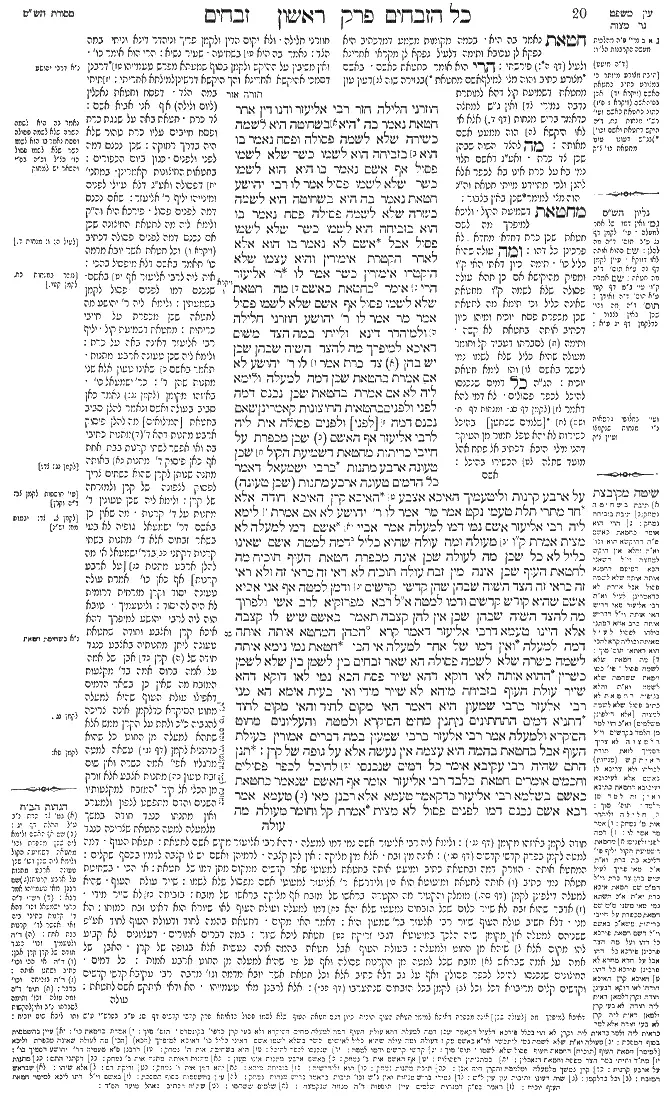
Zevahim 10b - Guemara
חוזרני חלילה חזר רבי אליעזר ודנו דין אחר חטאת נאמר בה היא בשחיטה היא לשמה כשירה שלא לשמה פסולה ופסח נאמר בו הוא בזביחה הוא לשמו כשר שלא לשמו פסול אף אשם נאמר בו הוא הוא לשמו כשר שלא לשמו פסול אמר לו רבי יהושע חטאת נאמר בה היא בשחיטה היא לשמה כשרה שלא לשמה פסולה פסח נאמר בו הוא בזביחה הוא לשמו כשר שלא לשמו פסול אבל אשם לא נאמר בו הוא אלא לאחר הקטרת אימורין והוא עצמו שלא הוקטרו אימורין כשר אמר לו ר' אליעזר הרי אומר (ויקרא ו, י) כחטאת כאשם מה חטאת שלא לשמו פסול אף אשם שלא לשמו פסול אמר מר אמר לו ר' יהושע חוזרני חלילה ולמיהדר דינא ולייתי במה הצד משום דאיכא למיפרך מה להצד השוה שבהן שכן יש בהן צד כרת אמר לו ר' יהושע לא אם אמרת בחטאת שכן דמה למעלה ולימא ליה לא אם אמרת בחטאת שכן נכנס דמה לפני ולפנים בחטאות החיצונות קאמרינן שאם נכנס דמה [לפני] ולפנים פסולה אית ליה לרבי אליעזר אף האשם שכן מכפרת על חייבי כריתות מחטאת דשמיעת הקול שכן טעונה ארבע מתנות כרבי ישמעאל דאמר כל הדמים טעונה ארבע מתנות (שכן טעונה) על ארבע קרנות וליטעמיך האיכא אצבע האיכא קרן האיכא חודה אלא חד מתרי תלת טעמי נקט אמר מר אמר לו ר' יהושע לא אם אמרת לימא ליה רבי אליעזר אשם נמי דמו למעלה אמר אביי אשם דמו למעלה לא מצית אמרת ק"ו מעולה ומה עולה שהיא כליל דמה למטה אשם שאינו כליל לא כל שכן מה לעולה שכן אינה מכפרת חטאת העוף תוכיח מה לחטאת העוף שכן אינה מין זבח עולה תוכיח לא ראי זה כראי זה ולא ראי זה כראי זה הצד השוה שבהן שהן קדשי קדשים ודמן למטה אף אני אביא אשם שהוא קודש קדשים ודמו למטה א"ל רבא מפרזקיא לרב אשי ולפרוך מה להצד השוה שבהן שכן אין להן קצבה תאמר באשם שיש לו קצבה אלא היינו טעמא דרבי אליעזר דאמר קרא (ויקרא ו, יט) הכהן המחטא אותה אותה דמה למעלה ואין דמו של אחר למעלה אי הכי חטאת נמי נימא אותה לשמה כשרה שלא לשמה פסולה הא שאר זבחים בין לשמן בין שלא לשמן כשרין ההוא אותה לאו דוקא דהא שייר פסח הכא נמי לאו דוקא דהא שייר עולת העוף בזביחה מיהא לא שייר מידי ואי בעית אימא הא מני רבי אלעזר ברבי שמעון היא דאמר האי מקום לחוד והאי מקום לחוד דתניא דמים התחתונים ניתנין מחוט הסיקרא ולמטה והעליונים מחוט הסיקרא ולמעלה אמר רבי אלעזר ברבי שמעון במה דברים אמורין בעולת העוף אבל בחטאת בהמה היא עצמה אין נעשה אלא על גופה של קרן:
תנן התם שהיה רבי עקיבא אומר כל דמים שנכנסו להיכל לכפר פסולים וחכמים אומרים חטאת בלבד רבי אליעזר אומר אף האשם שנאמר כחטאת כאשם בשלמא רבי אליעזר כדקאמר טעמא אלא רבנן מאי טעמא אמר רבא אשם נכנס דמו לפנים פסול לא מצית אמרת קל וחומר מעולה מה
Comments from Rashi on Masechet Zevahim Page 10b
חוזרני חלילה . ולא יקום הדין ולקמן פריך וניהדר דינא וניתי במה הצד: נאמר בה היא בשחיטה . שעיר נשיא: הרי הוא אומר כו' . ואין משיבין על ההיקש ולקמן בסוף שמעתא מפרש טעמייהו דרבנן דסמכי אהיקשא אחרינא והך היקשא דרשינן למילתא אחריתי: תיתי במה הצד . דפסח וחטאת נאכלין (ליום ולילה) אף אני אביא אשם: צד כרת . חטאת באה על שגגת כרת ופסח חייבים עליו כרת טהור שלא היה בדרך רחוקה: שכן נכנס דמה לפני ולפנים . כגון ביום הכפורים: בחטאות החיצונות קאמרינן . במתני' דפסולה ואע"ג דלא עיילי לפנים ומינייהו יליף ר' אליעזר: שאם נכנס דמה לפנים פסול . פירכא היא וה"ק ולימא ליה מה לחטאת החיצונה שכן אם נכנס דמה לפנים פסולה דכתיב (ויקרא ו) וכל חטאת אשר יובא מדמה כו' תאמר באשם דלא מיפסיל בהכי: אית ליה לרבי אליעזר אף באשם . שנכנס דמו לפנים פסול לקמן בשמעתין: ולימא ליה ר' יהושע מה לחטאה שכן מכפרת על חייבי כריתות: מחטאת דשמיעת קול . יליף רבי אליעזר דאינה באה על כרת: ולימא ליה שכן טעונה ארבע מתנות . תאמר באשם שאינו טעון אלא שני מתנות שהן ד': כר' ישמעאל כו' . באיזהו מקומן (לקמן זבחים נג:) נאמר כאן סביב בעולה ואשם ונאמר להלן סביב בחטאת [המילואים] מה להלן פיסוק ארבע מתנות דהא ד' מתנות כתיבי בה ואי אפשר לשתי קרנות בבת אחת אף כאן פיסוק ד' מתנות באותה מתנה שנותן לקרן שהוא כשתים צריך לפסוק לצפונה של קרן ולמזרחה של קרן: ולימא ליה שכן טעונין ד' מתנות על ד' קרנות . מה שאין כן באשם דר' ישמעאל גופיה לא בעי בשאר זבחים אלא ד' מתנות בשתי קרנות דקתני בדר' ישמעאל אי מה להלן ארבע מתנות [על ארבע קרנות] אף כאן כו' אמרת עולה טעונה יסוד וקרן מזרחית דרומית לא היה לה יסוד: וליטעמיך . טובא הוה ליה לרבי יהושע למיפרך דהא איכא קרן ואצבע וחודה שחטאת טעונה ליתן מתנותיה באצבע כנגד חודה של קרן אבן של אמה על אמה ברום אמה בד' מקצעות המזבח מה שאין כן בשאר הדמים דאפילו עולת העוף שהיא למעלה מחוט הסיקרא כדלקמן אינה צריכה להגביה כ"כ ולתת על הקרן ממש אלא שתהא למעלה מן החוט כל שהוא כדתניא לקמן (זבחים דף נג.) עשאה למטה מרגליו אפי' אמה כשרה ואין שום זבח טעון מתנות אצבע אלא זורק מן הכלי אל קיר המזבח למקצעותיו השנים והדם מתפשט לצפון ולמערב ואין מתנתו כנגד חודה במשך מלמעלה למטה כחטאת שצריכה כנגד חודה לקמן באיזהו מקומן (זבחים דף נג.): ולימא ליה רבי אליעזר אשם נמי דמו למעלה . דהא רבי אליעזר מקיש אשם לחטאת: חטאת העוף . דמה למטה לקמן בפרק קדשי קדשים (זבחים דף סג.): אינה מין זבח . אלא מין מליקה: אין להן קצבה . לדמיהן ואשם יש לו קצבה לדמיו בכסף שקלים: המחטא אותה . הזורק דמה ובחטאת כתיב ומיעט אותה בחטאת למעוטי שאר קדשים ממקום מתן דמו של חטאת: אי הכי . בשחיטת חטאת נמי כתיב אותה לחטאת ומיעוטא הוא ולידרשא ר' אליעזר למעוטי אשם מפסול שלא לשמו: שייר עולת העוף . שהיא למעלה דילפינן לקמן (זבחים דף סה.) מומלק והקטיר מה הקטרה בראשו של מזבח אף מליקה בראשו של מזבח: בזביחה לא שייר מידי . אדבר שהוא זבח לא שייר כלום שכל הזבחים נמעטו שלא יהא דמו למעלה ועולת העוף לאו שיורא הוא דאינו זבח כמותו: הא מני . דלא חשיב עולת העוף שיור רבי אלעזר בר' שמעון היא: דאמר האי מקום . דחטאת בהמה לחוד ודעולת העוף לחוד אע"פ ששניהם למעלה אין מקומן שוה הלכך במיעוטא דגבי זריקת חטאת ליכא שיור: במה דברים אמורים . דעליונים לא קביע להו מקום אלא שיהא מן החוט ולמעלה: בעולת העוף אבל חטאת בהמה אינה נעשית אלא בגופה של קרן . האבן של אמה על אמה שבראש מזבח שכל למטה מן הקרנות פסולה ואף על פי שהיא למעלה מן החוט ארבע אמות: כל דמים . החיצונים שנכנסו להיכל לכפר פסולין ואף על גב דלא כתיב אלא וכל חטאת אשר יובא מדמה וגו' מרבה רבי עקיבא קדשי קדשים וקדשים קלים מריבויא דכל וכל לקמן בכל הזבחים שנתערבו (זבחים דף פב.): אלא לרבנן מאי טעמייהו . הא ודאי איתקש אשם לחטאת:
Comments from Tosafot - Zevahim 10b
חטאת נאמר בה היא . בכמה מקומות משמע דמדכתיב היא נפקא לן עכובא ותימה דלעיל נפקא לן מקראי אחרינא ולעיל (זבחים דף ה:) פירשתי: הרי הוא אומר כחטאת כאשם . באשם מצורע כתיב והוה מצי למילף אשם מחטאת בגזירה שוה דעון עון מחטאת דשמיעת קול דהא למותרת נדבה גמירי ואין ג"ש למחצה כדאמר בריש מנחות (דף ד) אלא אי לאו היקשא הוה ממעט אשם מאותה: מחטאת דשמיעת הקול . וליכא למיפרך מה לשם חטאת שכן כרת דחדא מחדא לא פרכינן כל דהו: ומה עולה שהיא כליל כו' . תימה כיון דאתי האי ק"ו ומפיק מהיקישא אם כן תהא עולה פסולה שלא לשמה ק"ו מחטאת שאינה כליל וכי תימא מה לחטאת שכן מכפרת פסח יוכיח ומיהו כיון דכתיב אותה בחטאת לא קשה. ותימה לסברתו דעביד קל וחומר מעולה שהיא כליל שלא לשמו נמי ליכשר באשם ותו לימא חטאת יוכיח: הג"ה כל דמים שנכנסו להיכל לכפר פסולים . לא דמי להא דאמר (לקמן זבחים דף סג. ומנחות דף ח. ושם) [שלמים ששחטן] בהיכל כשירות לא יהא טפל חמור מן העיקר דהני מילי היכא דכתיב אל פתח אהל מועד שתלה הכשירו בהיכל:
Zevahim 10b - Mishnah translated into english
I return to my previous claim that a sin offering is unique since its blood is sprinkled above the red line. The discussion is going around [ḥalila] in circles.
Rabbi Eliezer then presented a different logical inference: With regard to a sin offering, the word “it” is stated concerning slaughter, in the verse: “And slaughter it in the place where they kill the burnt offering before the Lord; it is a sin offering” (Leviticus 4:24). The word “it” teaches that if it is sacrificed for its sake it is fit; if it is sacrificed not for its sake it is unfit. And similarly, with regard to a Paschal offering, the word “it” is stated concerning slaughter [zeviḥa], in the verse: “It is the sacrifice [zevaḥ] of the Lord’s Passover” (Exodus 12:27). Here, the word “it” teaches that if it is sacrificed for its sake it is fit; if it is sacrificed not for its sake it is unfit.
And the word “it” is stated with regard to a guilt offering as well, in the verse: “It is a guilt offering” (Leviticus 7:5). Here too, say that the word “it” teaches that if it is sacrificed for its sake it is fit; if it is sacrificed not for its sake it is unfit.
Rabbi Yehoshua said to him: With regard to a sin offering, the word “it” is stated concerning slaughter, teaching that if it is sacrificed for its sake it is fit, but if it is sacrificed not for its sake it is unfit. With regard to a Paschal offering too, the word “it” is stated concerning slaughter, likewise teaching that if it is sacrificed for its sake it is fit, but if it is sacrificed not for its sake it is unfit. But with regard to a guilt offering, the word “it” is stated only after the burning of the sacrificial portions. And since the offering itself is fit even if the sacrificial portions were not burned at all, it is certainly fit if they were burned not for the sake of a guilt offering.
The baraita concludes: Rabbi Eliezer said to him: A sin offering and a guilt offering are juxtaposed in the verse that states: “As is the sin offering, so is the guilt offering” (Leviticus 7:7). The verse teaches that just as a sin offering sacrificed not for its sake is unfit, so too, a guilt offering sacrificed not for its sake is unfit.
§ The Gemara discusses the baraita. The Master said: Rabbi Yehoshua said to him: I return to my previous claim, that a sin offering is unique since its blood is sprinkled above the red line. The discussion is going around in circles. The Gemara asks: And let the derivation revert to its starting point, and let Rabbi Eliezer derive the point by analogy from the common element of the two sources, a sin offering and a Paschal offering. Together they can prove that a guilt offering sacrificed not for its sake is also unfit, since they share no element of stringency that the latter lacks.
The Gemara answers: Even such a derivation is not valid, as it can be refuted: What is notable about their common element? A sin offering and a Paschal offering are notable in that they both have an element of karet. A sin offering is brought for a transgression punishable by karet when committed intentionally, and one who refrains intentionally from bringing a Paschal offering is liable to be punished with karet. A guilt offering, by contrast, has no element of karet.
§ The baraita states: Rabbi Yehoshua said to him: Your comparison of a guilt offering to a sin offering is not valid. If you say a halakha with regard to a sin offering, whose blood is sprinkled above the red line, should you necessarily say the same with regard to a guilt offering, whose blood is sprinkled below that line? The Gemara challenges: And let Rabbi Yehoshua say to him another refutation: Your comparison is not valid, as if you say the halakha with regard to a sin offering, whose blood enters the innermost sanctum, i.e., the Holy of Holies, on Yom Kippur, must the same be said for a guilt offering, whose blood never enters the innermost sanctum?
The Gemara answers: We are stating a comparison of a guilt offering to a sin offering specifically with regard to the external sin offerings, whose blood does not enter the innermost sanctum.
The Gemara counters: If so, Rabbi Yehoshua could have refuted the comparison by pointing out another difference between a sin offering and a guilt offering, as, if the blood of an external sin offering enters the innermost sanctum, it is disqualified. This is not so in the case of the blood of a guilt offering.
The Gemara answers: Rabbi Eliezer holds that a guilt offering whose blood enters the innermost sanctum is also disqualified.
The Gemara counters: Rabbi Yehoshua could have pointed out another distinction, as a sin offering atones for transgressions for which one is liable to receive karet if he committed them intentionally.
The Gemara answers: Rabbi Eliezer derives the halakha specifically from a sin offering brought for hearing the voice, i.e., for falsely taking an oath that one is unable to testify in another’s case. This transgression is not punishable by karet.
The Gemara counters: Rabbi Yehoshua could have pointed out another distinction, that the blood of a sin offering requires four placements on the altar, whereas the blood of a guilt offering requires only two.
The Gemara answers: Perhaps Rabbi Eliezer holds in accordance with the opinion of Rabbi Yishmael, who says that the blood of almost all offerings requires four placements.
The Gemara counters: Rabbi Yehoshua could have pointed out another distinction, that a sin offering’s blood requires placement on all four corners of the altar, whereas the blood of a guilt offering, even according to Rabbi Yishmael, is sprinkled on only two corners.
The Gemara answers: And according to your reasoning, why didn’t Rabbi Yehoshua mention other distinctions between a sin offering and a guilt offering? Isn’t there the requirement that a priest place a sin offering’s blood on the altar with his finger? Isn’t there the requirement to place a sin offering’s blood on the corner of the altar? And even according to the opinion that it is not placed on the corner itself, isn’t there the requirement to place it on the edge of the corner? None of these requirements pertain to any offering other than a sin offering. Rather, Rabbi Yehoshua mentioned one of two or three valid claims at his disposal.
§ The Master says: Rabbi Yehoshua said to him: Your comparison is not valid. If you say this with regard to a sin offering, whose blood is sprinkled above the red line, should you necessarily say the same with regard to a guilt offering, whose blood is sprinkled below that line? The Gemara challenges: Let Rabbi Eliezer say to him: The blood of a guilt offering is also sprinkled above the red line, since Rabbi Eliezer holds that the halakhot of a guilt offering and a sin offering are parallel.
Abaye said: You cannot say that the blood of a guilt offering is presented above the red line, due to an a fortiori inference from the case of a burnt offering: Just as in the case of a burnt offering, which is treated stringently in that it is totally consumed on the altar, its blood is presented below the red line, all the more so is it not clear that in the case of a guilt offering, which is not totally consumed on the altar, its blood is presented below the red line?
The Gemara rejects the inference: What is notable about a burnt offering? It is notable in that it does not atone for a sin, unlike a guilt offering. Perhaps this is why its blood is presented below the red line.
The Gemara answers: A bird sin offering can prove the point, as it atones for a sin, and still its blood is presented below the red line.
The Gemara rejects this as well: What is notable about a bird sin offering? It is notable in that it is not a type of offering that is slaughtered; it is killed by pinching the nape of its neck. Perhaps this is why its blood is presented below the red line.
The Gemara answers: If so, a burnt offering can prove the point, since it is slaughtered, and its blood is still presented below the red line. Therefore, the halakha is derived from a combination of the halakhot of a burnt offering and a bird sin offering: The aspect of this case is not like the aspect of that case and the aspect of that case is not like the aspect of this case. Their common element is that they are offerings of the most sacred order, and their blood is presented below the red line. So too, I shall include a guilt offering in this halakha, as it is an offering of the most sacred order, and therefore its blood is presented below the red line.
Rava of Parzakya said to Rav Ashi: Let Rabbi Eliezer refute this inference: What is notable about the common element of the two cases? It is notable in that neither a burnt offering nor a bird sin offering has a fixed value. Need you say that the same halakhot apply to a guilt offering, which has a fixed value of two silver shekels (see Leviticus 5:15)?
Rather, this is Rabbi Eliezer’s reason for not claiming that the blood of a guilt offering is presented below the red line: As the verse states with regard to the presenting of the blood of a sin offering: “The priest who offers it” (Leviticus 6:19). The word “it” indicates that its blood is presented above the red line, but the blood of another slaughtered offering is not presented above the red line.
The Gemara asks: If so, if Rabbi Eliezer accepts that the word “it” indicates exclusivity, let him also say that the verse: “And slaughter it for a sin offering” (Leviticus 4:33), teaches that only a sin offering is fit if slaughtered for its sake, and unfit if slaughtered not for its sake. Consequently, other slaughtered offerings, whether slaughtered for their sake or not for their sake, are fit. Why then does Rabbi Eliezer deem a guilt offering unfit if slaughtered not for its sake?
The Gemara answers: That instance of the word “it” does not indicate that the halakha applies specifically to a sin offering and to no other offerings, as the Torah excludes the Paschal offering from such a generalization. A Paschal offering is certainly disqualified if sacrificed not for its sake.
The Gemara counters: If so, here too, with regard to the presenting of the blood above the red line, one must say the word “it” does not indicate that this halakha applies specifically to a sin offering and no other offerings, as the Torah excludes a bird burnt offering from such a generalization. The blood of a bird burnt offering is presented above the red line.
The Gemara answers: With regard to offerings that require slaughter, in any event, the Torah excluded nothing from the generalization. Bird offerings are irrelevant, as they are killed by the pinching of the nape.
And if you wish, say instead that even the blood of a bird burnt offering is presented in a manner different from that of a sin offering. In accordance with whose opinion is this suggestion? It is in accordance with the opinion of Rabbi Elazar, son of Rabbi Shimon, who says: This place where the blood of a sin offering is presented is discrete, and that place where the blood of a bird burnt offering is presented is discrete.
As it is taught in a baraita: The blood that must be placed on the lower half of the altar is placed anywhere from the red [hasikra] line and below, and the blood that must be placed on the upper half is placed anywhere from the red line and above. Rabbi Elazar, son of Rabbi Shimon, said: In what case is this statement said? It is said with regard to a bird burnt offering. But the placement of the blood of an animal sin offering is itself performed only on the actual corner of the altar.
§ We learned in a mishna elsewhere (81b): As Rabbi Akiva would say: Any blood that should have been sprinkled on the external altar but instead entered to atone in the Sanctuary is unfit. And the Rabbis say: That is the halakha only with regard to the blood of a sin offering. Rabbi Eliezer says: The halakhic status of a guilt offering is also like that of a sin offering, as it is stated: “As is the sin offering, so is the guilt offering” (Leviticus 7:7).
The Gemara asks: Granted, the opinion of Rabbi Eliezer is understandable, as he states the reason for his opinion. But what is the reason for the opinion of the Rabbis?
Rava said: You cannot say that the blood of a guilt offering that entered into the Sanctuary is disqualified, due to an a fortiori inference from the case of a burnt offering: Just as
Traduction : The William Davidson digital edition of the Koren Noé Talmud, with commentary by Rabbi Adin Even-Israel Steinsaltz.