 Talmud Bavli
Zevahim 111a : Youtube
Daf TubeYoutube
2 video classes :
Zevahim Page 111a
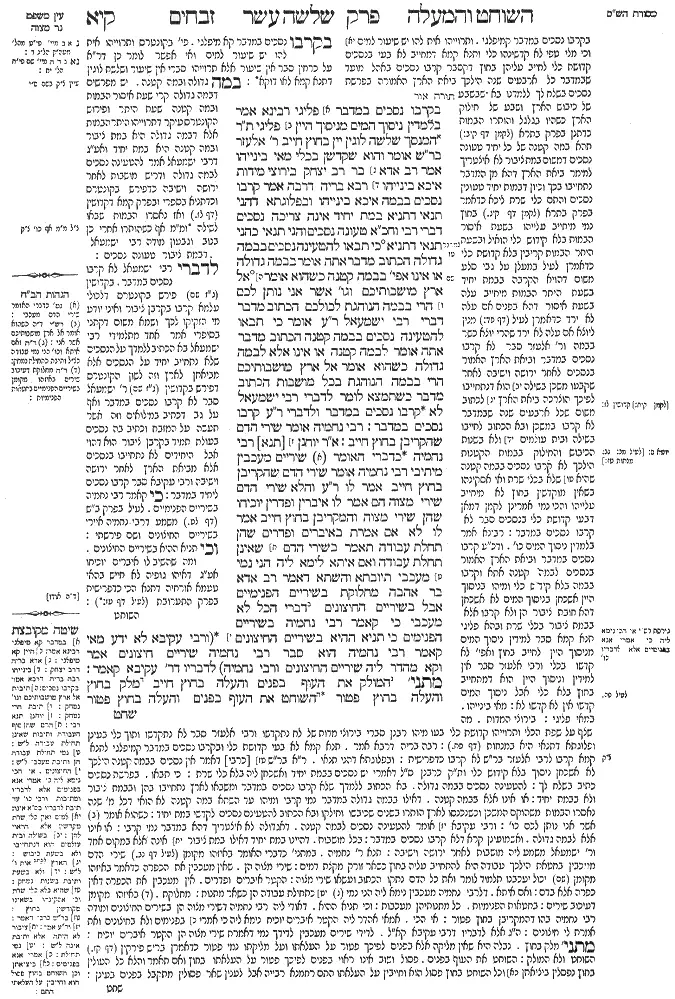
Zevahim 111a - Guemara
בקרבו נסכים במדבר פליגי רבינא אמר בלמדין ניסוך המים מניסוך היין פליגי ת"ר המנסך שלשה לוגין יין בחוץ חייב ר' אלעזר בר"ש אומר והוא שקדשן בכלי מאי בינייהו אמר רב אדא בר רב יצחק בירוצי מידות איכא בינייהו רבא בריה דרבה אמר קרבו נסכים בבמה איכא בינייהו ובפלוגתא דהני תנאי דתניא במת יחיד אינה צריכה נסכים דברי רבי וחכ"א טעונה נסכים והני תנאי כהני תנאי דתניא (במדבר טו, ב) כי תבאו להטעינה נסכים בבמה גדולה הכתוב מדבר אתה אומר בבמה גדולה או אינו אפי' בבמה קטנה כשהוא אומר (במדבר טו, ב) אל ארץ מושבותיכם וגו' אשר אני נותן לכם הרי בבמה הנוהגת לכולכם הכתוב מדבר דברי רבי ישמעאל ר"ע אומר כי תבאו להטעינה נסכים בבמה קטנה הכתוב מדבר אתה אומר לבמה קטנה או אינו אלא לבמה גדולה כשהוא אומר אל ארץ מושבותיכם הרי בבמה הנוהגת בכל מושבות הכתוב מדבר כשתמצא לומר לדברי רבי ישמעאל לא קרבו נסכים במדבר ולדברי ר"ע קרבו נסכים במדבר:
רבי נחמיה אומר שירי הדם שהקריבן בחוץ חייב:
א"ר יוחנן [תנא] רבי נחמיה כדברי האומר שיריים מעכבין מיתיבי רבי נחמיה אומר שירי הדם שהקריבן בחוץ חייב אמר לו ר"ע והלא שירי הדם שירי מצוה הם אמר לו איברין ופדרין יוכיחו שהן שירי מצוה והמקריבן בחוץ חייב אמר לו לא אם אמרת באיברים ופדרים שהן תחלת עבודה תאמר בשירי הדם שאינן תחלת עבודה ואם איתא לימא ליה הני נמי מעכבי תיובתא והשתא דאמר רב אדא בר אהבה מחלוקת בשיריים הפנימיים אבל בשיריים החיצונים דברי הכל לא מעכבי כי קאמר רבי נחמיה בשיריים הפנימים כי תניא ההיא בשיריים החיצונים (ורבי עקיבא לא ידע מאי קאמר רבי נחמיה הוא סבר רבי נחמיה שיריים חיצונים אמר וקא מהדר ליה שיריים החיצונים ורבי נחמיה) לדבריו דר' עקיבא קאמר:
מתני׳ המולק את העוף בפנים והעלה בחוץ חייב מלק בחוץ והעלה בחוץ פטור השוחט את העוף בפנים והעלה בחוץ פטור
Comments from Rashi on Masechet Zevahim Page 111a
בקרבו נסכים במדבר קמיפלגי . ותרוייהו אית להו יש שיעור למים וכי מלי טפי לא קדשינהו כלי ותנא קמא דמחייב לא בעי בנסכים קדושת כלי לחייב עליהן בחוץ דקסבר קרבו נסכים באהל מועד שבמדבר כל ארבעים שנה הילכך ביאת הארץ האמורה בפרשת נסכים בשלח לך ללמדנו בא שבשבע של כיבוש הארץ ושבע של חילוק הארץ כשהיו בגלגל והותרו הבמות כדתנן בפרק בתרא (לקמן זבחים דף קיב:) תהא במה קטנה של כל יחיד טעונה נסכים דמשום במת ציבור לא איצטריך למימר ביאת הארץ דהא מן המדבר נתחייבו בכך וכיון דבמות יחיד טעונין נסכים והתם כלי שרת ליכא כדאמר בפרק בתרא (לקמן זבחים דף קיג.) בחוץ נמי מיחייב עלייהו בשעת איסור הבמות בלא קידוש כלי הואיל ובשעת היתר הבמות קריבין בלא קדושת כלי כדאמרן לעיל במעלן על גבי סלע משום דהויא הקרבה בבמת יחיד בשעת היתר הבמות מיחייב עלה בשעת איסור דהא בפנים אם עלה לא ירד כדאמרן לעיל (זבחים דף פד:) מנין ליוצא אם עלה לא ירד שהרי יוצא כשר בבמה ור' אלעזר סבר לא קרבו נסכים במדבר וביאת הארץ האמור בנסכים לאחר ירושה וישיבה לאחר שקבעו משכן בשילה הוא דנתחייבו לפיכך הוצרכה ביאת הארץ לכתוב משום שכל ארבעים שנה שבמדבר לא קרבו במשכן ובא הכתוב לחייבו בשילה ובית עולמים ולא בשנות הכיבוש והחילוק בבמות הקטנות הילכך לא קרבו נסכים בבמה קטנה שהיא שלא בכלי שרת ואי אסקינהו בשאין מוקדשין בחוץ לא מיחייב עלייהו והכי נמי אמרינן לקמן דמאן דבעי קדושת כלי בנסכים סבר לא קרבו נסכים במדבר: רבינא אמר בלמדין ניסוך המים כו' . ודכ"ע קרבו נסכים במדבר וביאת הארץ האמור בנסכים לבמה קטנה אתא וקרבו בבמה בלא קידוש כלי ומיהו בניסוך היין אשכחן בניסוך המים לא אשכחן דהא חובת ציבור הן ולא קרבו אלא בבמת ציבור בכלי שרת ובהא פליגי תנא קמא סבר למידין ניסוך המים מניסוך היין לחייב בחוץ ואפי' לא קדשו בכלי ורבי אלעזר סבר אין למידין וניסוך היין הוא דמתחייב בחוץ בלא כלי אבל ניסוך המים קדשו אין לא קדשו לא: מאי בינייהו . במאי פליגי: בירוצי המדות . מה שצף על שפת הכלי ותרוייהו קדושת כלי בעו מיהו רבנן סברי בירוצי מדות של לח נתקדשו ורבי אלעזר סבר לא נתקדשו ותוך כלי בעינן ופלוגתא דתנאי היא במנחות (דף פח.): רבה בריה דרבא אמר . תנא קמא לא בעי קדושת כלי ובקרבו נסכים במדבר קמיפלגי לתנא קמא קרבו לרבי אלעזר בר"ש לא קרבו כדפרישית: ובפלוגתא דהני תנאי . ר"א בר"ש [כרבי] דאמר אין נסכים בבמה קטנה הילכך לא אשכחן ניסוך בלא קידוש כלי ות"ק כרבנן ס"ל דאמרי יש נסכים בבמת יחיד ואשכחן ליה בלא כלי שרת: כי תבאו . בפרשת נסכים כתיב בשלח לך: להטעינה נסכים בבמה גדולה . בא הכתוב ללמדך שלא קרבו נסכים במדבר ומשבאו לארץ נתחייבו בהן ובבמת ציבור ולא בבמת יחיד: או אינו אלא בבמה קטנה . דאילו בבמה גדולה במדבר נמי קרבי ומיהו עד השתא במה קטנה לא הואי דכל מ' שנה נאסרו הבמות משהוקם המשכן וכשנכנסו לארץ הותרו בשנים שכיבשו וחילקו ובא הכתוב להטעינם נסכים לקדשי במת יחיד: כשהוא אומר אשר אני נותן לכם כו': ורבי עקיבא אומר להטעינה נסכים לבמה קטנה . דאגדולה לא איצטריך דהא במדבר נמי קרבי: או אינו אלא לבמה גדולה . ואשמועינן קרא דלא קרבו נסכים במדבר: בכל מושבות . דהיינו במת יחיד דאילו במת ציבור אינה אלא במקום אחד ור' ישמעאל משמע ליה מושבות לאחר ירושה וישיבה: תנא ר' נחמיה . במתני' כדברי האומר באיזהו מקומן (לעיל זבחים דף נב.) שירי הדם מעכבין בחטאת הילכך עבודה היא להתחייב עליה בחוץ כשאר זורק מקצת דמים: שירי מצוה הן . שאין מעכבין את הכפרה כדאמר באיזהו מקומו (שם) יכול יעכבנו תלמוד לומר ואת כל הדם נתקו הכתוב ועשאו שירי מצוה: הקטר איברים ופדרים . אין מעכבין את הכפרה דאין כפרה אלא בדם: ואם איתא . דלרבי נחמיה מעכבין נימא ליה הני נמי כתחילת עבודה הן כשאר מתנות: מחלוקת . באיזהו מקומן דעיכוב שירים: בחטאות הפנימיות . כל מתנותיהן מעכבות: וכי תניא ההיא . דאודי ליה רבי נחמיה דשירי מצוה הן בשירים החיצונים ומודה רבי נחמיה בהו דהמקריבן בחוץ פטור: אי הכי . אמאי אהדר ליה הקטר איברים יוכיח נימא ליה כי אמרי בפנימים ולא בחיצונים ואת אמרת לי חיצונים: ה"ג אלא לדבריו דרבי עקיבא קא"ל . לדידי שירים מעכבין לדידך נמי דאמרת שירי מצוה הן הקטר איברים יוכיח: מתני' מלק בחוץ . נבלה היא שאין מליקה אלא בפנים לפיכך פטור על העלאתו ועל מליקתו נמי פטור כדאמרן בריש פירקין (דף קז.) השוחט ולא המולק: השוחט את העוף בפנים . פסול ושוב אינו ראוי בפנים לפיכך פטור על העלאתו בחוץ ואם תאמר והלא כל העולין בחוץ נפסלין ביציאתן וכל השוחט בחוץ פסול הוא וחייבין על העלאתו התם רחמנא רבייה אבל לענין שאר פסולין מתקבל בפנים בעינן:
Comments from Tosafot - Zevahim 111a
בקרבו נסכים במדבר קא מיפלגי . פי' בקונטרס ותרוייהו אית להו יש שיעור למים ואי אפשר לומר כן דר"א על כרחין סבר אין שיעור אלא תרוייהו סברי אין שיעור ושלשת לוגין דתנא קמא לאו דוקא: במה גדולה ובמה קטנה . יש מפרשים דבמה גדולה קרי שעת איסור הבמות ובמה קטנה שעת היתר ופירוש הקונטרס עיקר דתרוייהו היתר הבמות אלא דבמה גדולה היא במת ציבור ובמה קטנה היא במת יחיד ואע"ג דרבי ישמעאל אמר להטעינה נסכים לבמה גדולה ודריש מושבות לאחר ירושה וישיבה כדפירש בקונטרס וכדתניא בספרי ובפרק קמא דקדושין (דף לז.) ואז נאסרו הבמות שבאו לשילה ומ"מ אף כשהותרו אחרי כן בנוב וגבעון מודה רבי ישמעאל דבמת ציבור טעונה נסכים: לדברי רבי ישמעאל לא קרבו נסכים במדבר . בקדושין (ג"ז שם) פירש בקונטרס דלכולי עלמא קרבו בקרבן ציבור ואיני יודע מי הזקיקו לכך ושמא משום דקתני בסיפרי אמר אחד מתלמידי רבי ישמעאל בא הכתוב ללמדך על הנסכים שלא נתחייב יחיד על הנסכים אלא מביאתן לארץ וזה לשון הקונטרס דפירש בקדושין (ג"ז שם) ר' ישמעאל סבר לא קרבו נסכים במדבר ואף על גב דכתיב במילואים וזה אשר תעשה על המזבח וכתיב בה נסכים בעולת תמיד בקרבן ציבור הוא דהוי אבל היחידים לא נתחייבו בנסכים אלא מביאת הארץ לאחר ירושה וישיבה ורבי עקיבא סבר קרבו נסכים ליחיד במדבר: כי קאמר רבי נחמיה בשיריים הפנימיים . לעיל בפרק ב"ש (זבחים דף לט.) משמע דרבי נחמיה איירי בשיריים החיצונים ושם פירשתי: וכי תניא ההיא בשיריים החיצונים . ומה שהשיב לו איברים יוכיחו אע"ג דאיהו גופיה לא חייש בהאי טעמא אורחיה דתנא הכי כדפרישית בפרק התערובת (לעיל זבחים דף עז:):
Zevahim 111a - Mishnah translated into english
They disagree with regard to whether one is liable for pouring a libation outside the courtyard that was not first consecrated in a service vessel. This dispute is based on a disagreement with regard to whether wine libations were offered in the Tabernacle in the wilderness before the Jewish people entered Eretz Yisrael. The Gemara will soon explain the logical connection between the two issues.
Ravina said: Everyone agrees that wine libations are valid even if they are not first consecrated in a sacred service vessel. Therefore, one who pours a wine libation outside the courtyard is liable even if it was not first consecrated in a service vessel. They disagree with regard to whether the liability for pouring a water libation can be derived from that of a wine libation. The first tanna holds that it can; Rabbi Elazar, son of Rabbi Shimon, holds that it cannot.
§ The Sages taught in a baraita: One who pours as a libation three log of wine outside the courtyard is liable. Rabbi Elazar, son of Rabbi Shimon, says: And that is in a case where he first consecrated the wine in a sacred service vessel.
What is the difference between them? Rav Adda bar Rav Yitzḥak said: The difference between them is with regard to whether the overfill of measuring vessels is also consecrated. Both agree that one is liable for pouring a libation outside the courtyard only if it was first consecrated in a service vessel. The first tanna holds that the liquid that rises above the rim of a vessel is also consecrated, and if one collects three log of that liquid and pours it as a libation outside the courtyard he is liable. Rabbi Elazar, son of Rabbi Shimon, holds that only the wine within the walls of the vessel itself is consecrated.
Rava, son of Rabba, said: The difference between them is with regard to whether one is liable for pouring a libation outside the courtyard that was not first consecrated in a service vessel. This dispute is based on a disagreement as to whether wine libations were offered on private altars.
He explains: And they disagree with regard to the issue that is the subject of the dispute between these tanna’im, as it is taught in a baraita: An offering sacrificed on a private altar does not need to be accompanied by wine libations; this is the statement of Rabbi Yehuda HaNasi. And the Rabbis say: It does require wine libations. Service vessels are not used in the context of private altars. Therefore, if libations are brought on private altars then it is apparent that libations can be valid even if they were not first consecrated in a service vessel. Accordingly, one would be liable for pouring a libation outside the Temple even if it had not first been consecrated in a service vessel. If libations are not brought on private altars, then there is no precedent of a libation that was not first consecrated in a service vessel, and one would not be liable for pouring a non-consecrated libation outside the Temple.
And the opinion of these tanna’im is like the opinion of those tanna’im, as it is taught in a baraita: In introducing the mitzva to bring wine libations together with animal offerings, the verse states: “When you come into the land of your dwellings, which I give to you” (Numbers 15:2), which indicates that the mitzva to bring libations began only once the Jewish people entered Eretz Yisrael. The verse speaks in order to require that libations be brought with animal offerings that are brought upon a great public altar. This assumes libations were not brought on a public altar in the wilderness. Therefore, it is necessary to teach that upon entering Eretz Yisrael they are required.
Do you say that the verse is referring to offerings brought on a great public altar, or is it even referring to offerings brought on a small private altar? Perhaps libations were brought on the public altar in the wilderness, and it is therefore unnecessary to state that after entering Eretz Yisrael libations should continue to be brought on a public altar. Accordingly, the verse must be teaching that after the Jewish people have entered Eretz Yisrael, libations are required even on private altars. This suggestion is rejected: When the verse states: “Into the land of your dwellings, which I give to you [lakhem],” using the plural form of the word “you,” it is apparent that the verse is speaking of a public altar that is used by everyone; this is the statement of Rabbi Yishmael.
Rabbi Akiva says: Through its introductory clause: “When you come,” the verse speaks in order to require that libations be brought with animal offerings that are brought upon a small private altar. This assumes libations were already brought in the wilderness, and the verse must be teaching that libations are required even on private altars.
Do you say that the verse is speaking of a small private altar outside the Temple? Or is it only referring to a great public altar? Perhaps libations were not brought on the public altar in the wilderness and the verse is necessary in order to teach that upon entering Eretz Yisrael they are required. When the verse states: “Into the land of your dwellings,” it is apparent that the verse is speaking of an altar that is used in all your dwellings, which certainly must be referring to private altars, as there was only one central public altar.
The Gemara explains: When you analyze the matter you will find that you can say that according to the statement of Rabbi Yishmael, libations were not offered in the wilderness. Therefore, it is necessary to teach that upon entering Eretz Yisrael they are required. And according to the statement of Rabbi Akiva libations were offered in the wilderness. Therefore, the verse must be teaching that libations are required even on private altars.
§ The mishna teaches: Rabbi Neḥemya says: For the remainder of the blood of an offering that was supposed to be poured at the base of the altar and that instead one sacrificed outside the courtyard, one is liable.
Rabbi Yoḥanan said: Rabbi Neḥemya taught this halakha in accordance with the statement of the one who says that failure to pour the remainder of the blood at the base of the altar disqualifies the offering.
The Gemara raises an objection from a baraita: Rabbi Neḥemya says that for the remainder of the blood of an offering that one sacrificed outside the courtyard, one is liable. Rabbi Akiva said to him: Isn’t pouring the remainder of the blood considered a non-essential mitzva, which is not indispensable to the validity of the offering? Accordingly, one should not be liable for sacrificing the blood outside the Temple courtyard. Rabbi Neḥemya said to him: Sacrificial limbs and fats of a burnt offering will prove the matter, as they are considered a non-essential mitzva, and yet one who sacrifices them outside the courtyard is liable. Rabbi Akiva said to him: No, if you said that one is liable with regard to the burning of the limbs and fats, which is the start of a sacrificial rite, i.e., burning them is a sacrificial rite in and of itself, shall you also say that this is the halakha with regard to the pouring of the remainder of the blood, which is not the start of a sacrificial rite, but is just the conclusion of the sprinkling of the blood?
The Gemara explains the challenge from the baraita: And if it is so that Rabbi Neḥemya holds that that failure to pour the remainder of the blood at the base of the altar disqualifies the offering, let Rabbi Neḥemya say in response to Rabbi Akiva: These too, i.e., the pouring of the remainder of the blood, are considered to be a sacrificial rite in and of themselves because failure to pour out the remainder disqualifies the offering. The Gemara concludes: Indeed, this is a conclusive refutation.
The Gemara qualifies its rejection: And now that Rav Adda bar Ahava says: The dispute between the tanna’im with regard to whether failure to pour the remainder of the blood disqualifies the offering is only with regard to the remainder of blood that was presented on the inner altar, but with regard to the remainder of blood that was presented on the external altar everyone agrees that failure to pour it does not disqualify the offering; the apparent contradiction between Rabbi Yoḥanan’s statement and the baraita can therefore be resolved. When Rabbi Neḥemya says in the mishna that one is liable for sacrificing the remainder of the blood outside the courtyard, he is referring to the remainder of blood that was presented on the inner altar. The pouring of that blood is considered a rite in and of itself, and one is liable for sacrificing it outside the Temple. When that statement of Rabbi Neḥemya is taught in the baraita, it is referring to the remainder of blood that was presented on the external altar. Concerning such blood, Rabbi Neḥemya concedes that the pouring is not considered a rite in and of itself.
In light of this, the Gemara explains the discussion between Rabbi Akiva and Rabbi Neḥemya: And Rabbi Akiva did not know what Rabbi Neḥemya was saying. Rabbi Akiva thought that Rabbi Neḥemya was stating a ruling about the pouring of the remainder of blood that was presented on the external altar. Therefore, Rabbi Akiva responded to him with a claim relating to the remainder of blood that was presented on the external altar and said that it is a non-essential mitzva. And then Rabbi Neḥemya answered him by saying a defense of his opinion in accordance with the misconception underlying the statement of Rabbi Akiva.
MISHNA: One who pinches the nape of a bird offering inside the Temple courtyard and then offers it up outside the courtyard is liable. But if one pinched its nape outside the courtyard and then offered it up outside the courtyard he is exempt, as pinching the nape of a bird outside the courtyard is not considered valid pinching. One who slaughters, with a knife, a bird offering inside the courtyard and offers it up outside the courtyard is exempt, as slaughtering a bird offering in the Temple courtyard disqualifies it as an offering.
Traduction : The William Davidson digital edition of the Koren Noé Talmud, with commentary by Rabbi Adin Even-Israel Steinsaltz.