 Talmud Bavli
The learning on the whole site is dedicated : L'ilui Nishmat Yechayahou ben Moche
The learning on the whole site is dedicated : L'ilui Nishmat Nissim ben Barukh Malka
The learning on the whole site is dedicated : L'ilui Nishmat Jamila bat Chlomo Abensour
Zevahim 9b : Youtube
Daf TubeYoutube
2 video classes :
Zevahim Page 9b
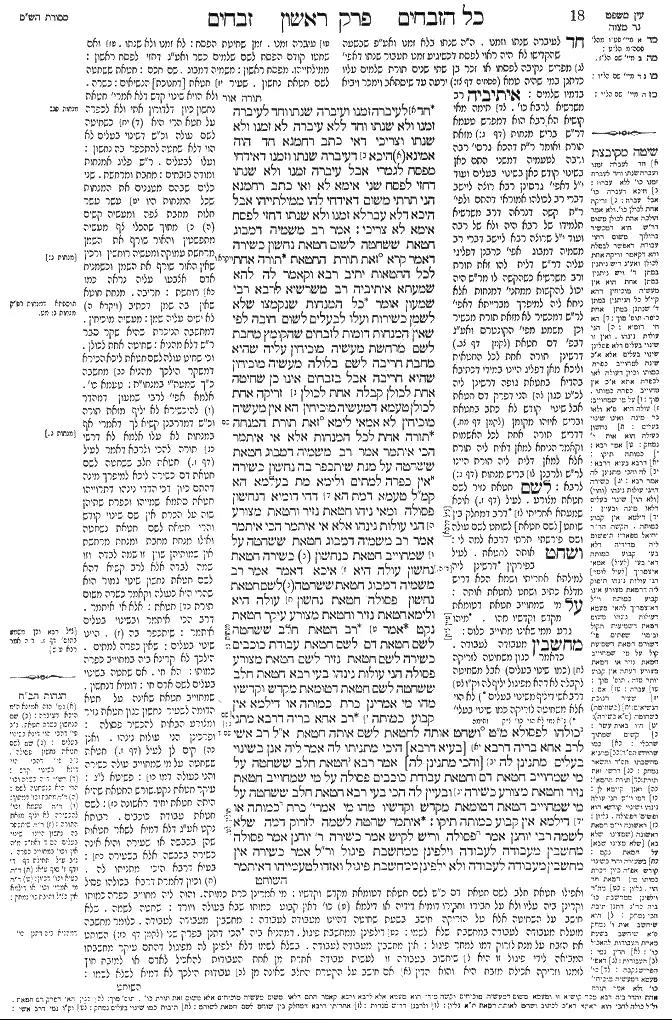
Zevahim 9b - Guemara
חד לעיברה זמנו ועיברה שנתו וחד לעיברה זמנו ולא שנתו וחד ללא עיברה לא זמנו ולא שנתו וצריכי דאי כתב רחמנא חד הוה אמינא היכא דעיברה שנתו וזמנו דאידחי מפסח לגמרי אבל עיברה זמנו ולא שנתו דחזי לפסח שני אימא לא ואי כתב רחמנא הני תרתי משום דאידחי להו ממילתייהו אבל היכא דלא עבר לא זמנו ולא שנתו דחזי לפסח אימא לא צריכי:
אמר רב משמיה דמבוג חטאת ששחטה לשום חטאת נחשון כשירה דאמר קרא (ויקרא ו, יח) זאת תורת החטאת תורה אחת לכל החטאות יתיב רבא וקאמר לה להא שמעתא איתיביה רב משרשיא לרבא רבי שמעון אומר כל המנחות שנקמצו שלא לשמן כשירות ועלו לבעלים לשום חובה לפי שאין המנחות דומות לזבחים שהקומץ מחבת לשם מרחשת מעשיה מוכיחין עליה שהיא מחבת חריבה לשם בלולה מעשיה מוכיחין שהיא חריבה אבל בזבחים אינו כן שחיטה אחת לכולן קבלה אחת לכולן זריקה אחת לכולן טעמא דמעשיה מוכיחין הא אין מעשיה מוכיחין לא אמאי לימא (ויקרא ו, ז) זאת תורת המנחה תורה אחת לכל המנחות אלא אי איתמר הכי איתמר אמר רב משמיה דמבוג חטאת ששחטה על מנת שיתכפר בה נחשון כשירה אין כפרה למתים ולימא מת בעלמא הא קמ"ל טעמא דמת הא דחי דומיא דנחשון פסולה ומאי ניהו חטאת נזיר וחטאת מצורע הני עולות נינהו אלא אי איתמר הכי איתמר אמר רב משמיה דמבוג חטאת ששחטה על שמחוייב חטאת כנחשון כשירה חטאת נחשון עולה היא איכא דאמר אמר רב משמיה דמבוג חטאת ששחטה לשם חטאת נחשון פסולה חטאת נחשון עולה היא ולימא חטאת נזיר וחטאת מצורע עיקר חטאת נקט אמר רב חטאת חלב ששחטה לשם חטאת דם לשם חטאת עבודה זרה כשירה לשם חטאת נזיר לשם חטאת מצורע פסולה הני עולות נינהו בעי רבא חטאת חלב ששחטה לשם חטאת דטומאת מקדש וקדשיו מהו מי אמרינן כרת כמותה או דילמא אין קבוע כמותה רב אחא בריה דרבא מתני כולהו לפסולא מ"ט (ויקרא ד, לג) ושחט אותה לחטאת לשם אותה חטאת א"ל רב אשי לרב אחא בריה דרבא [בעיא דרבא] היכי מתניתו לה אמר ליה אנן בשינוי בעלים מתנינן לה [והכי מתנינן לה] אמר רבא חטאת חלב ששחטה על מי שמחוייב חטאת דם וחטאת עבודת כוכבים פסולה על מי שמחוייב חטאת נזיר וחטאת מצורע כשירה ובעיין לה הכי בעי רבא חטאת חלב ששחטה על מי שמחוייב חטאת דטומאת מקדש וקדשיו מהו מי אמרי' כרת כמותה או דילמא אין קבוע כמותה תיקו:
איתמר שחטה לשמה לזרוק דמה שלא לשמה רבי יוחנן אמר פסולה וריש לקיש אמר כשירה ר' יוחנן אמר פסולה מחשבין מעבודה לעבודה וילפינן ממחשבת פיגול ור"ל אמר כשירה אין מחשבין מעבודה לעבודה ולא ילפינן ממחשבת פיגול ואזדו לטעמייהו דאיתמר
Comments from Rashi on Masechet Zevahim Page 9b
עיברה זמנו . זמן שחיטת הפסח: לא זמנו ולא שנתו . ואם שחטו קודם הפסח לשם שלמים כשר ואע"ג דחזי לפסח ראשון: ממילתייהו . מפסח ראשון: משמיה דמבוג . שם חכם: חטאת ששחטה לשם חטאת נחשון . שעיר חטאת [דחנוכת] הנשיאים: כשרה . ולא הויא שינוי קדש דלא אמרי' חטאת נחשון כיון דלדורון אתי ולא לכפרה על חטא הרי היא כשחיטה לשם עולה וכ"ש דשינוי בעלים לא הוי דלא שחטה להתכפר בה נחשון: ועלו לבעלים . ר"ש פליג אמנחות ומודה בזבחים: מחבת ומרחשת . שני כלים שבהם מטגנים את המנחות שכל המנחות היו עשר עשר חלות מחבת צפה ומעשיה קשים מתוך שהכלי צף מעשיה מתפשטין והאור שורף את השמן מרחשת עמוקה ומעשיה רוחשין ורכין שאין האור שורף את השמן וכשמניח אדם אצבעו עליה נראה כמו רוחשת: חריבה . מנחת חוטא שאין בה שמן דכתיב (ויקרא ה) לא ישים עליה שמן: מעשיה מוכיחין . דמחשבה הניכרת שהיא שקר סבר ר"ש דלא מהניא: שחיטה אחת לכולן . וכי שחיט עולה לשם חטאת ליכא הכירא דמשקר הילכך מהניא מחשבה כ"ך שמעת"י במנחו"ת: טעמא כו' . אלמא אפי' לרבי שמעון דמהדר להיכשירא לא יליף מזאת תורה וכ"ש דמדרבנן קשיא לך דאמרי אף במנחות לא עלו אלמא לא דרשי תורה להכי ולרבא דאמר לעיל (זבחים דף ז.) חטאת חלב ששחטה לשם חטאת דם כשירה ליכא למיפרך מינה דהתם כיון דכי הדדי נינהו דתרוייהו חטאת סתמא שמייהו וכפרת שתיהן שוה על הכרת אין שם שינוי קודש והרי חטאת לשם חטאת נשחטה ואילו מנחת מחבת ומנחת מרחשת אין שמותיהן שוין זו שמה לבדה וזו שמה לבדה אלא לרב קשיא דהא לשם חטאת נחשון שינוי גמור הוא שהרי היא כעולה וקאמר כשרה משום תורת חטאת: אלא אי איתמר . דרב הכי איתמר ובשינוי בעלים איתמר: שיתכפר בה . היינו שינוי בעלים: שאין כפרה למתים . הילכך לא קרינא ביה במחוייב כפרה כמותו: הא חי . אם שחטה בשינוי בעלים לשם אדם חי: דומיא דנחשון . שמחוייב חטאת שאינה על חטא הדומה לשעיר נחשון כגון חטאת נזיר ומצורע הבאות להכשיר פסולה: ופרכינן הני עולות נינהו . ואנן קים לן לעיל (זבחים דף ז.) חטאת ששחטה על מי שמחוייב עולה כשירה והני כעולה דמו: פשיטא ל"ג: עיקר חטאת נקט . שורש החטאת שהיא היתה חטאת יחיד ראשונה: לשם חטאת עבודת כוכבים . רבותא נקט אע"ג דלא דמיא לשאר חטאות שהן בכבשה או שעירה והיא אינה כשירה בכבשה אלא בשעירה: מי אמרינן כרת כמותה . והוה ליה מחוייב כפרה כמותו וקרינן ביה עליו ולא על חבירו וחבירו דומיא דידיה או דילמא כו' דאין קבוע כמותו שבא בעולה ויורד: בעיא דרבא היכי מתניתו לה . וכיון דאמרת דרבא בכולהו פסיל ואפילו חטאת חלב לשם חטאת דם כ"ש לשם חטאת דטומאת מקדש וקדשיו: לשם חטאת עבודת כוכבים . רבותא נקט אע"ג דלא דמיא לשאר חטאות שהן בכבשה או שעירה והיא אינה כשירה בכבשה אלא בשעירה: שחטה לשמה . שלא חישב על השחיטה אלא על הזריקה חישב בשעת שחיטה דהיינו מעבודה לעבודה: מחשבין מעבודה לעבודה . כלומר מחשבה מועלת מעבודה לעבודה במחשבת שלא לשמו: דילפינן ממחשבת פיגול . דמהניא ביה הכי דתנן בפרק שני (לקמן זבחים דף כז:) השוחט את הזבח על מנת לזרוק דמו למחר פיגול: אין מחשבין מעבודה לעבודה . בשלא לשמו דלא ילפינן לה מפיגול דהתם עיקר מחשבתו המביאה לידי פיגול זו היא שיחשוב בעבודה זו לעשות עבודה אחרת מן אחת העבודות להאכיל לאדם או למזבח חוץ לזמנו וזריקה אכילת מזבח היא והוא הדין אם חישב על הקטרת החלב שאינה מן עבודות הילכך לא דמיא לשלא לשמו:
Comments from Tosafot - Zevahim 9b
חד לעיברה שנתו וזמנו . ה"ה שנתו בלא זמנו ואע"פ שבשעה שהקדישו לא היה ראוי לפסח דכשיגיע זמנו תעבור שנתו דאפי' מפריש נקיבה לפסחו או זכר בן שתי שנים תורת שלמים עליו כדתנן במי שהיה טמא (פסחים דף צז:) ירעה עד שיסתאב וימכר ויביא בדמיו שלמים: איתיביה רב משרשיא לרבא כו' . תימה מאי קושיא הא רבא הוא דמפרש טעמא דר"ש בריש מנחות (דף ג:) מזאת תורת ואומר ר"ת דהכא גרסי' רבה ורבה לטעמיה דמשני התם כאן בשינוי קודש כאן בשינוי בעלים ועוד י"ל דאפי' גרסינן רבא רוצה ליישב דברי רב לכולהו אמוראי דהתם ולפי' ר"ת קשה דנראה דרב משרשיא תלמידו של רבא היה ולא של רבה ועוד י"ל שרוצה רבא ליישב דברי רב משמיה דמבוג אפי' כרבנן דפליגי עליה דר"ש דלית להו זאת תורת ורב משרשיא כשהקשה לו מר"ש היה יכול להקשות ממתני' דמנחות אלא ניחא ליה למיפרך מברייתא דאפי' לר"ש דמכשיר לא מזאת תורת מכשיר וכן משמע מפי' הקונטרס ואע"ג דבפ' דם חטאת (לקמן זבחים דף צב.) דרשינן תורה אחת לכל החטאות וליכא מאן דפליג היינו במידי דכתיבא בהדיא בחטאת גופה דרשינן ליה לכ"ע כגון הני דפרק דם חטאת אבל שינוי קודש לא כתב בחטאת ובריש איזהו מקומן (לקמן זבחים דף מח.) דדריש תורה אחת לכל האשמות וקאמר הניחא למאן דאית ליה תורת אלא למאן דלית ליה תורת היינו לר"ש ולרבנן בריש מנחות (דף ג:) לרבא: לשם חטאת נזיר לשם חטאת מצורע . לעיל (זבחים דף ז.) איכא שמעתא אחריתי דרב דמחלק בין שוחט [לשם חטאת] לשוחט לשם עולה ושם פירשתי תרתי דרבא למה לי: ושחט אותה לחטאת . לעיל בפירקין דרשינן ליה למילתא אחריתי ושמא הכא דריש מדלא כתיב ושחט לחטאת אותה: על מי שמחוייב חטאת דטומאת מקדש וקדשיו מהו . מיהו גרע ממי שאינו מחוייב כלום: מחשבין מעבודה לעבודה . כדאמר כגון משחיטה לזריקה (כמו שינוי בעלים) אבל משחיטה לקבלה לא דהא מפיגול יליף לה וק"ו דרב אשי דיליף משינוי בעלים לא הוי אלא משחיטה לזריקה כמו שינוי בעלי' ותימה דלקמן (זבחים דף יג.) דפריך וקבלה מי פסלה כו' ומשני כאן במחשבת שלא לשמן כאן במחשבת פיגול אמאי לא משני אידי ואידי במחשבת שלא לשמן וקבלה לא עשה בה מחשבה כמעשה כגון בשוחט על מנת לקבל שלא לשמן ובזריקה (לא) עשה בה מחשבה כמעשה ונראה לי דלקמן מיירי שחישב בעבודה עצמה אם קבל [לגמור הקבלה] שלא לשמן פסול ואם קבל [לגמור] חוץ לזמנו כשר ואם זרק לגמור הזריקה חוץ לזמנו פסול וכן מקטיר לגמור ההקטרה למחר דהוה פסול אי לאו דמעטיה קרא לקמן משום דאין מעכבת כפרה אבל ליכא לפרושי לקמן מחשבת פיגול דלא פסלה בקבלה כגון שוחט על מנת לקבל דמן חוץ לזמנו דבשלא לשמן נמי לא פסלה דמעבודה לעבודה ילפינן מפיגול (ואי) במקבל על מנת לזרוק חוץ לזמנו הוה פיגול אלא כדפרשינן בחישב בעבודה עצמה. ברו"ך ובלאו הכי תימה דהוי מצי למימר קבלה לא עשה בה מחשבה כמעשה לענין שינוי בעלים:
Zevahim 9b - Mishnah translated into english
One verse teaches this halakha in a case where its time of sacrifice, Passover eve, has passed, and its first year has also passed, disqualifying it for sacrifice as a Paschal offering. And one verse teaches the halakha in a case where its time of sacrifice has passed, but not its first year. And the third one teaches a case where neither its time of sacrifice nor its first year has passed, but it was sacrificed before Passover eve.
And all these verses are necessary. As, had the Merciful One written only one of the verses, I would say that it is referring to a case where both its first year and its time of sacrifice have passed. Only such a Paschal offering should be sacrificed as a peace offering, as it was completely rejected from its status as a Paschal offering. But in a case where its time of sacrifice has passed, but its first year has not passed, in which case it is still fit to be sacrificed as a Paschal offering on the second Pesaḥ, I would say that it is not sacrificed as a peace offering.
And had the Merciful One written only these two verses, one might assume that only these Paschal offerings are sacrificed as peace offerings, as they were both rejected from their status as Paschal offerings. But in a case where neither its time of sacrifice nor its first year have passed, in which case it is still fit to be sacrificed as a Paschal offering on Passover eve, I would say that it is not sacrificed as a peace offering. Therefore, all three verses are necessary.
§ Rav says in the name of Mavog: A sin offering that one slaughtered for the sake of a sin offering of Nahshon, i.e., a sin offering similar to those brought by the princes during the dedication of the Tabernacle (see Numbers, chapter 7), not to atone for a sin but as a gift, is fit and satisfies its owner’s obligation; as the verse states: “This is the law of the sin offering” (Leviticus 6:18), indicating that there is one law for all the sin offerings.
Rava sat and stated this halakha of Mavog. Rav Mesharshiyya raised an objection to Rava from a baraita: Rabbi Shimon says: All meal offerings from which a handful was removed not for their sake but for the sake of another type of meal offering are fit, and satisfied the obligation of the owner, in contrast to animal offerings, which if slaughtered not for their sake do not satisfy their owners’ obligations.
This is because meal offerings are not similar to slaughtered offerings. As, if one removes a handful from a meal offering prepared in a shallow pan for the sake of a meal offering prepared in a deep pan, his intention is demonstrably incorrect, as its mode of preparation proves that it is a meal offering prepared in a shallow pan. Likewise, if one removes a handful from a dry meal offering for the sake of a meal offering mixed with oil, his intention is demonstrably incorrect, as its mode of preparation proves that it is a dry meal offering. The demonstrably incorrect nature of the intention prevents it from affecting the status of the meal offering in any way.
But with regard to slaughtered offerings this is not so. There is one mode of slaughter for all of the offerings, one mode of collection of the blood for all of them, and one mode of sprinkling for all of them. Therefore, improper intention affects the status of the offering; if a rite is performed for the sake of the wrong type of offering, the offering does not satisfy its owner’s obligation.
Rav Mesharshiyya inferred from the baraita: The reason a meal offering satisfies its owner’s obligation even when one removed a handful for the sake of another type of meal offering is that its mode of preparation proves its true nature. But if its mode of preparation does not prove its nature, it does not satisfy its owner’s obligation. Why not? If Mavog’s derivation is correct, let us say likewise that the verse: “This is the law of the meal offering” (Leviticus 6:7), indicates that there is one law for all of the meal offerings, regardless of their mode of preparation.
Rather, if Mavog’s statement was stated, it was stated like this: Rav says in the name of Mavog: A sin offering that one slaughtered on the condition that Nahshon, the prince of Judah, be atoned for by it is fit; this is not considered a change of owner, as there is no atonement for the dead.
The Gemara challenges: But if this was Mavog’s statement, why did he mention Nahshon? Let him state this halakha in reference to a dead person in general.
The Gemara answers: This statement of Mavog teaches us that the reason for the fitness of a sin offering slaughtered for the atonement of Nahshon is that he is dead. Consequently, if it was slaughtered for the sake of a living person obligated to bring a sin offering similar to that of Nahshon, it is unfit. And what is that? It is a nazirite’s sin offering or a leper’s sin offering, which are brought not to atone for a sin but to become ritually pure. Consequently, if one sacrifices a standard sin offering for the sake of one obligated to bring the sin offering of a nazirite or a leper, it is considered a change of owner, and the offering is unfit.
The Gemara counters: Why is the offering disqualified? These sin offerings of a nazirite and a leper are equivalent to burnt offerings, since they are not brought for atonement. Sacrificing a sin offering for the sake of one obligated to bring a burnt offering is not considered deviation with regard to the owner and does not disqualify it (see 3b).
The Gemara answers: Rather, if Mavog’s statement was stated, it was stated like this: Rav says in the name of Mavog: A sin offering that one slaughtered for one who is obligated to bring a sin offering similar to that of Nahshon is fit; Nahshon’s sin offering is equivalent to a burnt offering.
There is one who says that Rav says in the name of Mavog: A sin offering that one slaughtered for the sake of a sin offering of Nahshon is unfit. This is because a sin offering of Nahshon is equivalent to a burnt offering, and he is therefore considered to have deviated from the type of offering.
The Gemara challenges: But why did Mavog mention a sin offering of Nahshon, which one cannot bring at all? Let him say this halakha with regard to a nazirite’s sin offering and a leper’s sin offering, which are also equivalent to burnt offerings. The Gemara explains: Mavog cited the primary sin offering, the first case of an individual sin offering recorded in the Bible.
§ Rav says: A sin offering brought for consuming forbidden fat that one slaughtered for the sake of a sin offering brought for consuming blood, or for the sake of a sin offering brought for engaging in idol worship, is fit; it is not considered deviation from the type of offering.
But if it was slaughtered for the sake of a nazirite’s sin offering, or for the sake of a leper’s sin offering, it is unfit; these sin offerings are equivalent to burnt offerings, as they are not brought for atonement.
Rava raises a dilemma: In the case of a sin offering brought for consuming forbidden fat that one slaughtered for the sake of a sin offering brought for the defiling of the Temple or its sacrificial foods, what is the halakha? Do we say that the offering is fit, as the latter type of sin offering atones for a transgression punishable by karet when committed intentionally, similar to the transgression of consuming forbidden fat?
Or perhaps is it unfit, as a sin offering brought for defiling the Temple is a sliding-scale sin offering, the contents of which vary with the financial situation of the transgressor (see Leviticus 5:3–13), and not a set sin offering, which is always an animal, like a sin offering brought for consuming forbidden fat?
Rav Aḥa, son of Rava, teaches a version of Rav’s statement according to which in all of the cases he mentioned, including one where the sin offering was slaughtered for the sake of a sin offering brought for consuming blood or for engaging in idol worship, the offering is unfit. What is the reason? It is derived from the verse: “And slaughter it [otah] for a sin offering” (Leviticus 4:33), that a sin offering must be slaughtered for the sake of that [otah] sin offering, and no other.
Rav Ashi said to Rav Aḥa, son of Rava: How do you teach Rava’s dilemma? Rava appears to assume that if one slaughters a sin offering for the sake of some other types of sin offering it remains fit. How is this compatible with your version of Rav’s statement, according to which slaughter for the sake of any other type of sin offering disqualifies it?
Rav Aḥa said to him: We teach Rava’s dilemma with regard to deviation with regard to the owner rather than from the type of offering. And this is how we teach it: First, Rava says: A sin offering brought for consuming forbidden fat that one slaughtered for the sake of one who is obligated to bring a sin offering for consuming blood, or for the sake of one who is obligated to bring a sin offering for engaging in idol worship, is unfit. Since the other person is also obligated to bring a sin offering, this is considered deviation with regard to the owner. But if it was slaughtered for one who is obligated to bring a nazirite’s sin offering or a leper’s sin offering, it is fit, as these sin offerings are not brought for atonement. Deviation with regard to the owner disqualifies an offering only if the other owner is obligated to bring a similar offering.
And then we pose the dilemma like this: Rava raises a dilemma: In the case of a sin offering brought for consuming forbidden fat that one slaughtered for the sake of one who is obligated to bring a sin offering for the defiling of the Temple or its sacrificial foods, what is the halakha? Do we say that the offering is unfit, as the one who defiled the Temple or its sacrificial foods is obligated to bring a sin offering for a transgression punishable by karet, similar to the transgression of the owner? Or perhaps it remains fit, as a sin offering brought for defiling the Temple is not a set sin offering like a sin offering brought for consuming forbidden fat?
The Gemara concludes: The dilemma shall stand unresolved.
§ It was stated: If one slaughtered a sin offering for its sake with intent to sprinkle its blood not for its sake but for the sake of another type of offering, Rabbi Yoḥanan says that the offering is unfit, and Reish Lakish says it is fit.
Rabbi Yoḥanan says it is unfit, as in his opinion one can have intention from one rite to affect another rite, i.e., one can disqualify an offering by performing one rite with improper intent about a subsequent rite that he has not yet performed. And we derive this halakha from intent of piggul, i.e., intent while performing one of the main rites to consume the offering after the appointed time, which disqualifies the offering.
And Reish Lakish says that it is fit, as in his opinion one cannot have intention from one rite to affect another rite, and we do not derive halakhot with regard to deviation from the type of offering from intent of piggul.
And Rabbi Yoḥanan and Reish Lakish each follow [ve’azdu] their general line of reasoning in this matter; as it was stated:
Traduction : The William Davidson digital edition of the Koren Noé Talmud, with commentary by Rabbi Adin Even-Israel Steinsaltz.