 Talmud Bavli
The learning on the whole site is dedicated : L'ilui Nishmat יוסף בן מושה
The learning on the whole site is dedicated : L'ilui Nishmat Reuven ben Rivka SEBBAG
The learning on the whole site is dedicated : For the success of Elyahou ben H'anna & family
Zevahim 48a : Youtube
Daf TubeYoutube
2 video classes :
Zevahim Page 48a
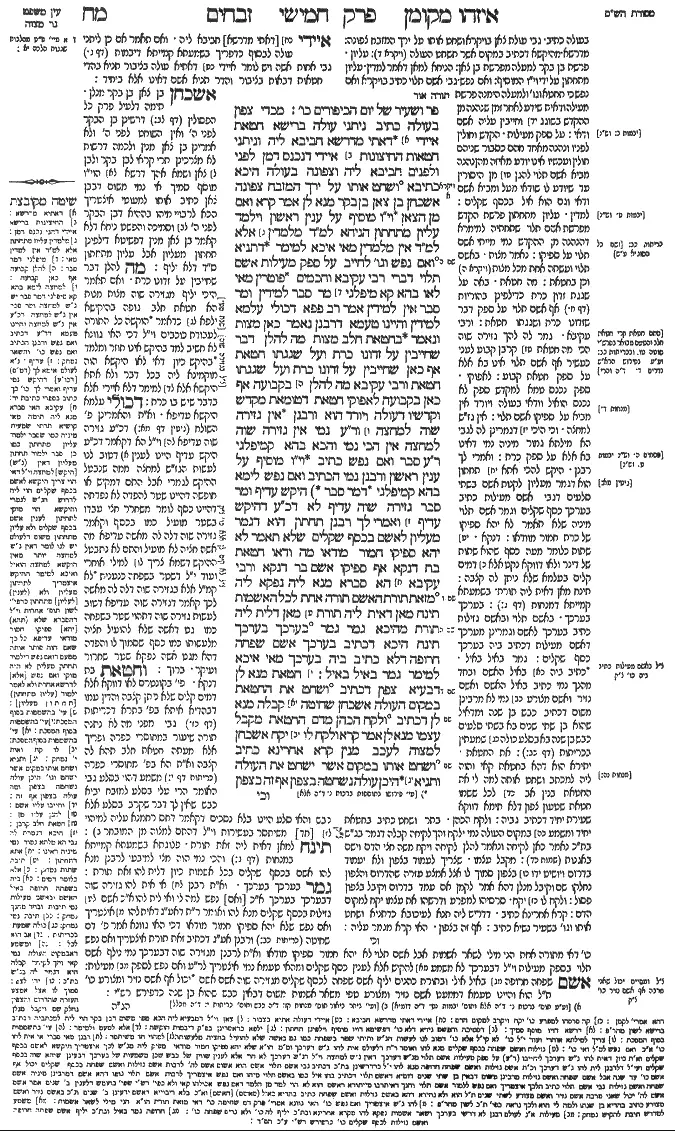
Zevahim 48a - Guemara
פר ושעיר של יום הכיפורים כו':
מכדי צפון בעולה כתיב ניתני עולה ברישא חטאת איידי דאתי מדרשא חביבא ליה וניתני חטאות החיצונות איידי דנכנס דמן לפני ולפנים חביבא ליה וצפונה בעולה היכא כתיבא (ויקרא א, יא) ושחט אותו על ירך המזבח צפונה אשכחן צאן בן בקר מנא לן אמר קרא ואם מן הצאן וי"ו מוסיף על ענין ראשון וילמד עליון מתחתון הניחא למ"ד מלמדין אלא למ"ד אין מלמדין מאי איכא למימר דתניא (ויקרא ה, יז) ואם נפש וגו' לחייב על ספק מעילות אשם תלוי דברי רבי עקיבא וחכמים פוטרין מאי לאו בהא קא מיפלגי מר סבר למידין ומר סבר אין למידין אמר רב פפא דכולי עלמא למידין והיינו טעמא דרבנן נאמר כאן מצות ונאמר בחטאת חלב מצות מה להלן דבר שחייבין על זדונו כרת ועל שגגתו חטאת אף כאן שחייבין על זדונו כרת ועל שגגתו חטאת ורבי עקיבא מה להלן בקבועה אף כאן בקבועה לאפוקי חטאת דטומאת מקדש וקדשיו דעולה ויורד הוא ורבנן אין גזירה שוה למחצה ור"ע נמי אין גזירה שוה למחצה אין הכי נמי והכא בהא קמיפלגי ר"ע סבר ואם נפש כתיב וי"ו מוסיף על ענין ראשון ורבנן נמי הכתיב ואם נפש לימא בהא קמיפלגי דמר סבר היקש עדיף ומר סבר גזירה שוה עדיף לא דכ"ע דהיקש עדיף ואמרי לך רבנן תחתון הוא דגמר מעליון לאשם בכסף שקלים שלא תאמר לא יהא ספיקו חמור מודאו מה ודאו חטאת בת דנקא אף ספיקו אשם בר דנקא ורבי עקיבא הא סברא מנא ליה נפקא ליה (ויקרא ז, א) מזאת תורת האשם תורה אחת לכל האשמות תינח מאן דאית ליה תורת מאן דלית ליה תורת מהיכא גמר גמר (ויקרא ה, טו) בערכך בערכך תינח היכא דכתיב בערכך אשם שפחה חרופה דלא כתיב ביה בערכך מאי איכא למימר גמר באיל באיל:
חטאת מנא לן דבעיא צפון דכתיב (ויקרא ד, כט) ושחט את החטאת במקום העולה אשכחן שחיטה קבלה מנא לן דכתיב (ויקרא ד, כה) ולקח הכהן מדם החטאת מקבל עצמו מנא לן אמר קרא ולקח לו יקח אשכחן למצוה לעכב מנין קרא אחרינא כתיב (ויקרא ד, כד) ושחט אותו במקום אשר ישחט את העולה ותניא היכן עולה נשחטה בצפון אף זה בצפון
Comments from Rashi on Masechet Zevahim Page 48a
בעולה כתיב . גבי עולת צאן בויקרא ושחט אותו על ירך המזבח צפונה: מדרשא . מהיקשא דכתיב במקום אשר תשחט העולה (ויקרא ד): עליון . פרשת בן בקר למעלה מפרשת בן צאן: הניחא למאן דאמר למדין . עליון מתחתון על ידי וי"ו המוסיף: ואם נפש . גבי אשם תלוי כתיב בויקרא ואם נפש כי תחטא וגו' ולמעלה הימנה פרשת מעילה ודאית שידע לאחר זמן שנהנה מן ההקדש בשוגג וחייבין עליה אשם ודאי: על ספק מעילות . הקדש וחולין לפניו ונהנה מאחד מהם כסבור שניהם חולין ועכשיו אינו יודע מאיזה מהן נהנה מביא אשם תלוי להגן מן היסורין עד שיודע לו שודאי מעל ומביא אשם ודאי וגם הוא איל בכסף שקלים: למדין . עליון מתחתון פרשת הקדש מפרשת אשם תלוי שתחתיה למימרא דהנהנה מן ההקדש נמי מייתי אשם תלוי על ספיקו: נאמר מצות . באשם תלוי ועשתה אחת מכל מצות (ויקרא ה) וכן בחטאת: מה חטאת . באה על שגגת זדון כרת כדילפינן בהוריות (דף ח.) אף אשם תלוי על ספק דבר שזדונו כרת ושגגתו חטאת: ורבי עקיבא . גמר לה להך גזירה שוה הכי מה חטאת קרבן קבוע לעני כעשיר אף אשם תלוי אינו בא אלא על ספק חטאת קבוע: לאפוקי . ספק נכנס טמא למקדש ספק לא נכנס הואיל וודאי בעולה ויורד אין מביא על ספיקו אשם תלוי: אין גז"ש למחצה . וכי היכי דגמרינן לה לגבי הא מילתא גמור מיניה נמי דאינו בא אלא על ספק כרת: ואמרי לך רבנן . היקש להכי אתא תחתון הוא דגמר מעליון לקנות אשם בשתי סלעים דגבי אשם מעילות כתיב בערכך כסף שקלים וגמר אשם תלוי מיניה שלא תאמר לא יהא ספיקו של כרת חמור מוודאו: דנקא . שתות כלומר מעה כסף שהוא שתות של דינר ולאו דווקא נקט אלא דמים קלים בעלמא שלא ניתן לה קצבה: תינח מאן דאית ליה תורת . בשמעתא קמייתא דמנחות (דף ג:): בערכך בערכך . באשם תלוי ובאשם גזילות כתיב בערכך לאשם וגמרינן מערכך דאשם מעילות דכתיב ביה בערכך כסף שקלים: גמר באיל באיל . כתיב ביה באיל האשם ובחד מהנך נמי כתיב באיל האשם ואשם נזיר ואשם מצורע נמי לא מרבינן משום דכתיב כבש בן שנה ומדאיל שהוא בן שתי שנים בא בשתי סלעים כבש בן שנה בא בסלע כולה שמעתין בכריתות (דף כב:): את החטאת . יתירא הוא דהא בחטאת קאי והוה ליה למכתב ושחט אותה למה לי את החטאת בנין אב לכל ששמו חטאת שטעון צפון דלא תימא דווקא שעירת יחיד דכתיב גביה: ולקח הכהן . בתר ושחט כתיב בחטאת יחיד ומשמע במקום העולה נמי ילקח והך לקיחה קבלה דגמר בג"ש בת"כ נאמר כאן לקיחה ונאמר להלן לקיחה ויקח משה חצי הדם וישם באגנות (שמות כד): מקבל עצמו . שצריך לעמוד בצפון ולא יעמוד בדרום ויושיט ידו בצפון סמוך לו אצל אמצע עזרה שהדרום והצפון נחלקו שם וקיבל מנלן דהא אמר לקמן אם עמד בדרום וקיבל בצפון פסול: ולקח לו יקח . סרסיהו למפרע ודרשהו את עצמו יקח למקום הדם: קרא אחרינא כתיב . דדריש ליה תנא לעיכובא כדתניא ושחט אותו וגו' בשעיר נשיא כתיב: אף זה בצפון . האי קרא מגמר עליה:
Comments from Tosafot - Zevahim 48a
איידי [דאתי מדרשא] חביבא ליה . ואם תאמר אם כן ליתני עולה לבסוף כדפריך בשמעתא קמייתא דיבמות (דף ג.) גבי אחות אשה ויש לומר איידי דאתיא עולה בציבור תניא בהדי חטאות דבאות בציבור והדר תניא אשם דאינו אלא ביחיד: אשכחן בן צאן בן בקר מנלן . תימה דלעיל פרק כל הפסולין (זבחים דף לב:) דרשינן בן הבקר לפני ה' ואין השוחט לפני ה' ולא אמרינן בן צאן מנין ולכמה דרשות לא מצרכינן תרי קראי לבן בקר ולבן צאן ושמא אהך דרשא הוי"ו מוסף סמיך אי נמי משום דבבן צאן כתיב אותו למעוטי איצטריך הכא לרבויי מיהו בההיא דבן הבקר לפני ה' וסמיכה והפשט ניחא דלא קאמר בן צאן מנין דפשיטא דילפינן תחתון מעליון אבל עליון מתחתון ס"ד דלא יליף: דכולי עלמא היקשא עדיפא . וא"ת והאמרינן פ' השולח (גיטין דף מא:) דכ"ע גזירה שוה עדיפא וי"ל הא דקאמר דכ"ע היקש עדיף היינו לענין דטוב לנו לעשות הגז"ש למחצה ממה שנבטל ההיקש לגמרי אבל התם דמקיש או חופשה דהיינו שטר להפדה לא נפדתה דהיינו כסף לומר משחרר חצי עבדו בשטר מועיל כמו בכסף וקאמר גזירה שוה דלה לה מאשה עדיפא מה אשה חציה לא מועיל והתם לא נתבטל ההיקש דשמא צריך למילי אוחרי ועוד י"ל דשטר בשפחה כנענית לא קמ"ל אלא בגזירה שוה דלה לה מאשה לכך קאמר דגזירה שוה עדיפא דטוב לעשות גזירה שוה דתהוי שטר בשפחה כמו גט דאשה שלא להועיל חציה מלעשותו כמו כסף שסמוך לו והפדה דהא מגט אשה נפקא שטר שחרור ועיקר. ברוך: מה להלן דבר שחייבין על זדונו כרת . ואם תאמר היכי יליף מגזירה שוה מצות מצות הא חטאת חלב גופה בהיקישא ילפא כדאמר הוקשה כל התורה לעבודת כוכבים וי"ל דכי האי גוונא לא חשיב למד בהיקש אינו חוזר ומלמד בהיקש כיון דאי לאו היקשא הוה מוקמינא ליה בכל דבר ולא אתא היקשא אלא למימר דלא איירי אלא בדבר שיש בו כרת: וחטאת בת דנקא . פי' בקונטרס לאו דווקא אלא דמים קלים שלא ניתן קצבה והדין עמו דבהדיא איתא בפ' בתרא דכריתות (דף כז.) גבי מפני מה לא נתנה תורה שיעור במחוסרי כפרה ופריך אלא מעתה חטאת חלב תהא לה קצבה וא"ת הא בפ' מחוסרי כפרה (כריתות דף י:) משמע דהוי בסלע גבי האומר הרי עלי בסלע למזבח יביא כבש שאין לך דבר שקרב בסלע אלא כבש והאי סלע היינו בלא נסכים דקאמר דחס רחמנא עליה למיהוי [חד] משיתסר בעשירות וי"ל דהתם למצוה מן המובחר: תינח למאן דאית ליה זאת תורת . פלוגתא בשמעתא קמייתא במנחות (דף ג:) והכי נמי הוה מצי למיבעי לרבנן מנא להו אשם בכסף שקלים בכל אשמות כיון דלית להו זאת תורת: גמר בערכך בערכך . וא"ת רבנן אי אית להו גזירה שוה דבערכך בערכך א"כ [ואם] נפש למה לי ואי לית להו א"כ אשם גזילות בכסף שקלים מנא להו ואומר ר"ת דאע"ג דאית להו איצטריך ואם נפש שלא יהא ספיקו חמור מודאו דכי האי גוונא אמר פ' דם שחיטה (כריתות כב:) ורבנן אע"ג דכתיב זאת תורת איצטריך ואם נפש כו' דאי מתורה אחת הני מילי לשאר אשמות אבל אשם תלוי לא יהא חמור ספיקו מודאו וא"ת לרבנן מגזירה שוה דבערכך נמי נילף אשם תלוי בספק מעילות וי"ל דבערכך לא משמע להקיש אלא לענין כסף שקלים ומהאי טעמא נמי איצטריך לר"ע ואם נפש לספק מעילות: אשם שפחה חרופה באיל איל . ובתורת כהנים יליף אשם שפחה לכסף שקלים מגזירה שוה אשם אשם יכול אף אשם נזיר ומצורע כו' ת"ל הוא והיינו טעמא דממעט אשם נזיר ומצורע טפי משאר אשמות משום דבאין כבש שהוא בן שנה כדפירש רש"י:
Zevahim 48a - Mishnah translated into english
§ The mishna teaches: With regard to the bull and the goat of Yom Kippur, their slaughter is in the north and the collection of their blood in a service vessel is in the north. The Gemara asks: Why does the mishna list these sin offerings first? After all, while the halakha that slaughter must be in the north of the Temple courtyard is written in the Torah with regard to a burnt offering (Leviticus 1:11), the Torah does not explicitly state that the other offerings must be slaughtered in the north. Therefore, let the tanna of the mishna teach the halakha of a burnt offering first.
The Gemara answers: Since the location for slaughtering the sin offering is derived through interpretation, it is dear to the tanna, and therefore he gives it precedence. The verse states: “Speak to Aaron and to his sons, saying: This is the law of the sin offering: In the place where the burnt offering is slaughtered shall the sin offering be slaughtered before the Lord; it is most holy” (Leviticus 6:18). The Gemara (55a) derives from this verse that the sin offering must be slaughtered in the same place as the burnt offering, i.e., in the north of the Temple courtyard.
The Gemara challenges: But let the tanna of the mishna teach first the halakha of the external sin offerings, since those are the offerings to which the verse is referring. The Gemara explains: Since the blood of the Yom Kippur sin offerings enters the innermost sanctum, these offerings are dear to the tanna, and he taught them first.
The Gemara asks: And where is it written that a burnt offering must be slaughtered in the north of the Temple courtyard? The Gemara answers that with regard to a sheep that is brought as a burnt offering the Torah states: “And he shall slaughter it on the side of the altar northward before the Lord; and Aaron’s sons, the priests, shall dash its blood against the altar round about” (Leviticus 1:11).
The Gemara clarifies: We have found that this verse provides a source that a young sheep burnt offering must be slaughtered in the north. From where do we derive that a young bull burnt offering must also be slaughtered in the north? The Gemara answers: The verse states: “And if his offering be of the flock, whether of the sheep, or of the goats, for a burnt offering, he shall offer it a male without blemish” (Leviticus 1:10). The conjunctive “and” represented by the letter vav adds to the previous matter. The previous passage addresses cattle offerings. And let the upper passage, the place of the slaughter of a bull, be learned from the lower passage, the place of slaughtering a sheep.
The Gemara comments: This works out well according to the one who says that we learn halakhot in this manner. But according to the one who says that we do not learn halakhot in this manner, what is there to say?
As it is taught in a baraita: Immediately following the passage in the Torah addressing a guilt offering for misuse of consecrated property, the Torah discusses the halakhot of a provisional guilt offering, brought by one who is uncertain as to whether he committed a sin that requires a sin offering. The verse states: “And if anyone sin, and does any of the commandments which the Lord has commanded not to be done, though he did not know it, yet is he guilty, and shall bear his iniquity” (Leviticus 5:17). This serves to render him liable to bring a provisional guilt offering for uncertain misuse of consecrated property; this is the statement of Rabbi Akiva. And the Rabbis deem him exempt in such a case. The Gemara suggests: What, is it not that they disagree with regard to this: One Sage, Rabbi Akiva, holds that we learn halakhot of the upper passage from the lower passage, and the other Sage, i.e., the Rabbis, holds that we do not learn halakhot in this manner?
Rav Pappa said: This is not correct, as everyone holds that we learn halakhot of the upper passage from the lower passage. And this is the reason that the Rabbis exempt from bringing an offering one who is uncertain whether he misused consecrated property: They learn a verbal analogy. It is stated here: “And if anyone sin, and does any of the commandments which the Lord has commanded not to be done” (Leviticus 5:17). And it is stated with regard to the sin offering for eating forbidden fat: “And if any one of the common people sin through error, in doing any of the commandments which the Lord has commanded not to be done, and be guilty” (Leviticus 4:27).
The verbal analogy teaches that just as there, the sin offering is brought only for an act that for its intentional violation one is liable to be punished with karet, and for its unwitting violation one is liable to bring a sin offering, so too here, one brings a provisional guilt offering only for an act that for its intentional violation one is liable to be punished with karet, and for its unwitting violation one is liable to bring a sin offering, which is not the case concerning misuse of consecrated property.
The Gemara asks: And what does Rabbi Akiva derive from this verbal analogy? He learns that just as there the verse obligates one to bring a fixed sin offering, so too here, with regard to the provisional guilt offering, one brings it for a case of uncertain transgression of a prohibition for which one would be liable to bring a fixed sin offering, to exclude a sin offering brought for uncertain transgression of the defiling of the Temple or sacrificial foods, as the sin offering for that transgression is not fixed, but is a sliding-scale offering. If the sinner is poor he brings a meal offering or a bird offering; if he is rich he brings an animal offering. In a case of uncertainty one does not bring a provisional guilt offering.
And as for the Rabbis, who derived a different halakha from the verbal analogy, they hold that there is no verbal analogy for half of a matter. Once a provisional guilt offering is compared to a sin offering, it must be completely similar, and both matters are derived from the verbal analogy. The Gemara asks: But Rabbi Akiva also must hold that there is no verbal analogy for half of a matter, so why does he not agree with the derivation of the Rabbis?
The Gemara reconsiders: Yes, this is indeed so. And here they disagree with regard to this: Rabbi Akiva holds that it is written with regard to the provisional guilt offering: “And if anyone sin, and does any of the commandments which the Lord has commanded not to be done, though he did not know it, yet is he guilty, and shall bear his iniquity” (Leviticus 5:17). The word “and” represented by the letter vav adds to the previous matter. When a phrase begins with the conjunction vav, it is a continuation of the previous matter, and the halakhot of the previous passage can be learned from the subsequent passage. Therefore one brings a provisional guilt offering for uncertain misuse of consecrated property.
The Gemara asks: But according to the opinion of the Rabbis also, isn’t it written: “And if anyone sin”? Let us say that they disagree about this: As one Sage, Rabbi Akiva, holds that a derivation from a juxtaposition is preferable, and derives from the juxtaposition of the halakhot of misuse of consecrated property to the halakhot of a provisional guilt offering that one is liable to bring a provisional guilt offering if he is not certain whether he misused consecrated property. And one Sage, i.e., the Rabbis, holds that a derivation from a verbal analogy is preferable, and therefore derives from a verbal analogy between the passage of misuse of consecrated property and the passage of a sin offering for eating forbidden fat that one is not liable to bring a provisional guilt offering if he is not certain whether he misused consecrated property.
The Gemara rejects this: No, it may be that everyone agrees that a derivation from a juxtaposition is preferable. And the Rabbis would say to you that the reason one is exempt from bringing a provisional guilt offering in a case of uncertain misuse of consecrated property is that the juxtaposition should be understood in the opposite manner. It is the lower passage that is derived from the upper passage.
The juxtaposition teaches that a provisional guilt offering must be a ram worth a minimum of two silver shekels, as is the halakha with regard to the offering brought for misuse of consecrated property. This derivation is needed so that you should not say that a provisional guilt offering, brought for his uncertain transgression, should not be more stringent than the offering one brings in a case of his definite transgression. According to that claim, one would say that just as for his definite transgression one may bring a sin offering worth only one-sixth [danka] of a dinar, so too, for his uncertain transgression one may bring a provisional guilt offering worth only one-sixth of a dinar.
The Gemara asks: And from where does Rabbi Akiva derive this conclusion? The Gemara answers: He derives it from the verse that states: “And this is the law of the guilt offering” (Leviticus 7:1), which teaches that there is one law for all of the guilt offerings and they must all be worth at least two shekels, provisional guilt offerings included.
The Gemara asks: This works out well according to one who holds that there is a derivation from the word “law,” but according to the one who does not hold that there is a derivation from the word “law,” from where does he learn that all guilt offerings must have the same minimum value? The Gemara answers: He learns it from a verbal analogy between the term “according to your valuation” stated with regard to a guilt offering for misuse of consecrated property (Leviticus 5:15) and the term “according to your valuation” stated with regard to a provisional guilt offering (Leviticus 5:18) and a guilt offering for robbery (Leviticus 5:25).
The Gemara asks: This works out well concerning guilt offerings where it is written “according to your valuation,” but with regard to a guilt offering brought for engaging in sexual intercourse with an espoused maidservant, concerning which it is not written in the Torah “according to your valuation,” what is there to say? How does one derive that the guilt offering brought for engaging in sexual intercourse with an espoused maidservant must be worth a minimum of two silver shekels?
The Gemara answers that it is derived from a verbal analogy between the term “with the ram” stated with regard to a guilt offering for misuse of consecrated property (Leviticus 5:16) and the term “with the ram” stated with regard to the guilt offering for engaging in sexual intercourse with an espoused maidservant (Leviticus 19:22).
§ The Gemara returns to discuss the mishna. From where do we derive that a sin offering requires slaughter in the north of the Temple courtyard? The Gemara answers: As it is written with regard to an individual sin offering: “And he shall place his hand upon the head of the sin offering, and slaughter the sin offering in the place of the burnt offering” (Leviticus 4:29). Just as a burnt offering must be slaughtered in the north of the Temple courtyard, so too, a sin offering must also be slaughtered in the north.
The Gemara asks: We have found from this verse that the slaughter must be in the north. From where do we derive that collection of the blood must also be in the north? The Gemara answers: As it is written: “And the priest shall take of the blood of the sin offering with his finger and place it upon the corners of the altar of burnt offering, and all its remaining blood he shall pour out at the base of the altar” (Leviticus 4:34). As this verse immediately follows the verse discussing the slaughter of a sin offering, evidently the taking of the blood is performed in the same place as the slaughter.
The Gemara asks: From where do we derive that the one collecting the blood must himself stand in the north of the Temple courtyard? Perhaps he may stand near the north and extend his arm to collect the blood. The Gemara answers that the verse states: “And the priest shall take [velakaḥ]” (Leviticus 4:34), which can be read, as: He will take himself [lo yikkaḥ].
The Gemara asks: We have found that the offering must be slaughtered in the north and the blood collected in the north to perform the mitzva in the optimal manner. From where is it derived that if one slaughters the offering or collects the blood anywhere else the offering is disqualified? The Gemara answers: It is written in another verse which speaks of a goat sin offering brought by a king who sins: “And he shall place his hand upon the head of the goat and slaughter it in the place where they slaughter the burnt offering before the Lord; it is a sin offering” (Leviticus 4:24). And it is taught in a baraita: Where is the burnt offering slaughtered? In the north. This sin offering of a king must also be slaughtered in the north of the Temple courtyard.
Traduction : The William Davidson digital edition of the Koren Noé Talmud, with commentary by Rabbi Adin Even-Israel Steinsaltz.