 Talmud Bavli
Zevahim 119b : Youtube
Daf TubeYoutube
2 video classes :
Zevahim Page 119b
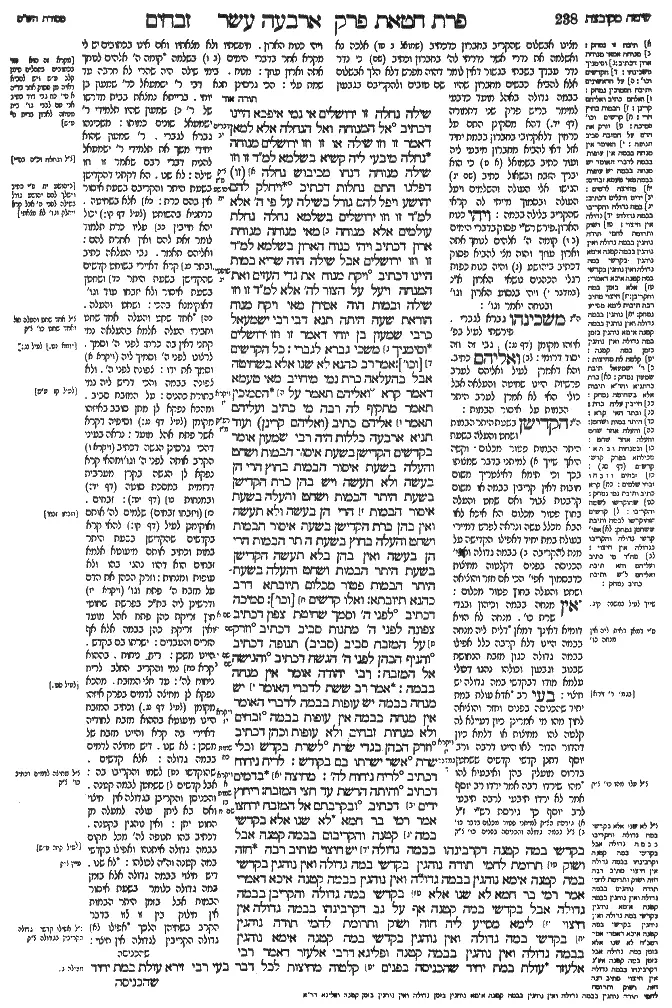
Zevahim 119b - Guemara
שילה נחלה זו ירושלים אי נמי איפכא היינו דכתיב (דברים יב, ט) אל המנוחה ואל הנחלה אלא למאן דאמר זו וזו שילה או זו וזו ירושלים מנוחה נחלה מיבעי ליה קשיא בשלמא למ"ד זו וזו שילה מנוחה דנחו מכיבוש נחלה (זו) דפלגו התם נחלות דכתיב (יהושע יח, י) ויחלק להם יהושע ויפל להם גורל בשילה על פי ה' אלא למ"ד זו וזו ירושלים בשלמא נחלה נחלת עולמים אלא מנוחה מאי מנוחה מנוחת ארון דכתיב ויהי כנוח הארון בשלמא למ"ד זו וזו ירושלים אבל שילה הוה שריא במות היינו דכתיב (שופטים יג, יט) ויקח מנוח את גדי העזים ואת המנחה ויעל על הצור לה' אלא למ"ד זו וזו שילה ובמות הוה אסירן מאי ויקח מנוח הוראת שעה היתה תנא דבי רבי ישמעאל כרבי שמעון בן יוחי דאמר זו וזו ירושלים וסימניך משכי גברא לגברי:
כל הקדשים [וכו']:
אמר רב כהנא לא שנו אלא בשחיטה אבל בהעלאה כרת נמי מיחייב מאי טעמא דאמר קרא (ויקרא יז, ח) ואליהם תאמר על הסמוכין תאמר מתקיף לה רבה מי כתיב ועליהם תאמר אליהם כתיב (ואליהם קרינן) ועוד תניא ארבעה כללות היה רבי שמעון אומר בקדשים הקדישן בשעת איסור הבמות ושחט והעלה בשעת איסור הבמות בחוץ הרי הן בעשה ולא תעשה ויש בהן כרת הקדישן בשעת היתר הבמות ושחט והעלה בשעת איסור הבמות הרי הן בעשה ולא תעשה ואין בהן כרת הקדישן בשעת איסור הבמות ושחט והעלה בחוץ בשעת היתר הבמות הרי הן בעשה ואין בהן בלא תעשה הקדישן בשעת היתר הבמות ושחט והעלה בשעת היתר הבמות פטור מכלום תיובתא דרב כהנא תיובתא:
ואלו קדשים [וכו']:
סמיכה דכתיב (ויקרא א, ג) לפני ה' וסמך שחיטת צפון דכתיב צפונה לפני ה' מתנות סביב דכתיב (ויקרא א, ה) וזרק על המזבח סביב (סביב) תנופה דכתיב (ויקרא יד, יב) והניף הכהן לפני ה' הגשה דכתיב (ויקרא ב, ח) והגישה אל המזבח:
רבי יהודה אומר אין מנחה בבמה:
אמר רב ששת לדברי האומר יש מנחה בבמה יש עופות בבמה לדברי האומר אין מנחה בבמה אין עופות בבמה (ויקרא יז, ה) זבחים ולא מנחות זבחים ולא עופות וכהן דכתיב (ויקרא יז, ו) וזרק הכהן בגדי שרת (שמות כח, מג) לשרת בקדש וכלי שרת (במדבר ד, יב) אשר ישרתו בם בקודש:
לריח ניחוח דכתיב (ויקרא א, ט) לריח ניחוח לה':
מחיצה בדמים דכתיב (שמות כז, ה) והיתה הרשת עד חצי המזבח:
ריחוץ ידים דכתיב (שמות מ, לב) ובקרבתם אל המזבח ירחצו אמר רמי בר חמא לא שנו אלא בקדשי במה קטנה והקריבום בבמה קטנה אבל בקדשי במה קטנה דקרבינהו בבמה גדולה יש חיצוי מותיב רבה חזה ושוק תרומת לחמי תודה נוהגין בקדשי במה גדולה ואין נוהגין בקדשי במה קטנה אימא נוהגין בבמה גדולה ואין נוהגין בבמה קטנה איכא דאמרי אמר רמי בר חמא לא שנו אלא בקדשי במה גדולה והקריבן בבמה גדולה אבל בקדשי במה קטנה אף על גב דקרבינהו בבמה גדולה אין חיצוי לימא מסייע ליה חזה ושוק ותרומת לחמי תודה נוהגין בקדשי במה גדולה ואין נוהגין בקדשי במה קטנה אימא נוהגין בבמה גדולה ואין נוהגין בבמה קטנה ופליגא דרבי אלעזר דאמר רבי אלעזר עולת במת יחיד שהכניסה בפנים קלטוה מחיצות לכל דבר בעי רבי זירא עולת במת יחיד
Comments from Rashi on Masechet Zevahim Page 119b
ויהי כנוח הארון . חיפשתיו ולא מצאתיו ואם אינו בכתובים יש לי מקרא אחר בדברי הימים (ב ו) בשלמה קומה ה' אלהים לנוחך אתה וארון עוזך: מנוח . בימי שילה היה שהרי לא חרבה עד שמת עלי: הכי גרסינן תנא דבי ר' ישמעאל כר' שמעון בן יוחי . ברייתא נמצאת בבית מדרשו של ר' שמעון שהיו תלמידי ר' ישמעאל שונים כמותו: משכינהו גברא לגברי . ר' שמעון שהוא יחידי משך את תלמידי ר' ישמעאל להניח דברי רבם שאמר זו וזו שילה: לא שנו . הא דקתני דהקדישן בשעת היתר והקריבם בשעת איסור אין בהם כרת: אלא בשחיטה . כדתניא בהשוחט (לעיל זבחים דף קו:) יכול יהא חייבין עליו כרת תלמוד לומר זאת להם ואין אחרת להם: ואליהם תאמר . גבי העלאה כתיב ובתר קרא דאיירי בשוחט קדשים שהקדישן בשעת היתר ושחטן בשעת איסור ולא יזבחו עוד וגו' דאוקימנא בהכי: ושחט והעלה . אחד שחט והעלה אחד שחט וחבירו העלה אלמא בהעלאה נמי קתני דאין בה כרת: לפני ה' וסמך . לרצונו לפני ה' וסמיך ליה (ויקרא א) וסמך את ידו: צפונה לפני ה' . ולא צפונה בבמה והכי דריש ליה נמי בתורת כהנים: על המזבח סביב . ומהכא נפקא לן מתן סובב באיזהו מקומן (לעיל זבחים דף נג:) וסיפיה דקרא אשר פתח אהל מועד: נראה בעיני דהכי גרסינן הגשה דכתיב (ויקרא ו) הקרב אותה לפני ה' וגו' ומהאי קרא נפקא לן הגשה בקרן מערבית דרומית במסכת סוטה (דף יד:) ובמנחות (דף יט:): זבחים . (ויזבחו זבחים) שלמים לה' אותם ואוקימנן לעיל (זבחים דף קו:) להאי קרא בקדשים שהקדישן בשעת היתר במות וכתיב אותם מיעוטא אלמא זבחים הוא דהוו נהגי בהו ולא עופות ומנחות: וזרק הכהן את הדם על מזבח ה' פתח וגו' (ויקרא יז) ודרשינן ליה בת"כ בפרשת שחוטי חוץ זריקת כהן פתח אהל מועד ואין זריקת כהן בבמה אלא אף הזרים והעבדים: ישרתו בם בקדש . היינו משכן: ריח ניחוח . בההוא קרא נמי והקריב החלב לריח ניחוח לה': עד חצי המזבח . מהכא נפקא לן מחיצה לדמים בפרק איזהו מקומן (לעיל זבחים דף נג.) וכתיב המזבח היינו מיעוטא בההוא מזבח לחודיה דאיירי בה קרא והיינו מזבח של משכן: לא שנו . דיש מחיצה לדמים בבמה גדולה: אלא קדשים . שהוקדשו לשמו והקריבו בה: אבל קדשים ששחטן לבמה קטנה . והכניסן והקריבן בגדולה אין חיצוי ואם בא ליתן עולה למעלה מן החוט יתן: ואין נוהגין בקטנה . דכתיב בהו תנופה לה' מכל מקום בבמה גדולה איתנהו ואפילו בקדשי במה קטנה וה"ה לכולהו: לא שנו . דיש חיצוי בבמה גדולה אלא בזמן במה גדולה כלומר בשעת איסור הבמות אבל בזמן היתר הבמות אין חילוק בין זו לזו בדבר הקרב בשתיהן הלכך אפילו גדולה הקריבין לגדולה אין חיצוי:
Comments from Tosafot - Zevahim 119b
ויהי כנוח הארון . פירש רש"י פסוק בדברי הימים (ב ו) קומה ה' אלהים לנוחך אתה וארון עוזך והוה מצי להביא פסוק דכתיב ביהושע והיה כנוח כפות רגלי הכהנים נושאי הארון א"נ (במדבר י) ויהי בנסוע הארון וגו' ובנוחה יאמר וגו': ה"ג משכינהו גברא לגברי . פירשתי לעיל בפ' איזהו מקומן (זבחים דף נג:) גבי זה וזה יסוד דרומי: ואליהם כתיב . והא דאמרן לעיל ואליהם לערב פרשיות היינו שחיטה והעלאה אבל כולי האי לא אמרן לערב היתר הבמות על איסור הבמות: ה"ג הקדישן בשעת היתר הבמות ושחט והעלה בשעת היתר הבמות פטור מכלום . וקשה היאך שייך למיתני בדבר שמצותו בכך וכי תימא דאיצטריך משום חובות דאין קריבין בבמה או משום קרבנות צבור ואם שחט והעלה בחוץ פטור מכלום הא איכא לאו הבא מכלל עשה ונראה לפרש דמיירי בעולת במת יחיד דאפילו הקדישה על מנת להקריבה בבמה גדולה ואפי' הכניסה בפנים דקלטוה מחיצות כדבסמוך אפי' הכי אם חזר והוציאה ושחט והעלה בחוץ פטור מכלום: אין מנחה בבמה וכיהון ובגדי שרת כו' . מנחה לא הויא דומיא דאינך דמאן דלית ליה מנחה בבמה היינו דלא קרבה כלל אפילו בבמה גדולה כגון מזבח הנחושת שבנוב וגבעון וכולהו נהגו דכולי עלמא מודו דבקדשי במה גדולה יש חיצוי: בעי רב אדא עולת במת יחיד שהכניסה בפנים וחזר והוציאה לחוץ מהו מי אמרינן כיון דעיילא לה קלטה להו מחיצות או דלמא כיון דהדור הדור לאו היינו דרבה ורב יוסף דתנן קדשי קדשים ששחטן בדרום מועלין בהן ואיבעיא להו מהו שירדו רבה אמר ירדו רב יוסף אמר לא ירדו תיבעי לרבה תיבעי לרב יוסף כך גירסת רש"י ז"ל אבל בספרים ישנים גרסינן קדשי קדשים ששחטן בדרום מועלין בהן אם עלו לא ירדו ואיבעיא להו ירדו מהו שיעלו רבה אמר לא יעלו רב יוסף אמר יעלו תיבעי לרבה כו' ומיירי במשלה בהן האור להכי לכ"ע אם עלו לא ירדו ובריש מעילה (דף ב:) דאמר רבה אם עלו ירדו מיירי בלא משלה בהן האור ותדע בלא ההיא דמעילה צריך לאוקמא הכא במשלה בהן האור דאי בלא משלה אמאי אמר רב יוסף אם ירדו יעלו הא אמרינן פרק ב"ש (לעיל זבחים מג.) כשם שאם עלו לא ירדו כך אם ירדו לא יעלו וכל שכן בשחיטת דרום דגרוע משאר פסולין והכא מיירי בהכניסה חיה וקלטוה כדין במה גדולה להצריך כיהון וריחוץ ידים ורגלים מן הכיור ואם היא שלמים בעי תנופת חזה ושוק ולפי גירסא זו גרסינן בסמוך אברי עולת במת יחיד שעלו למזבח של במה גדולה וירדו מהו שיעלו פירוש דכיון דשחטן בחוץ שמא הוי כמו שחטן בדרום וגם שמא כיון ששחטה בהיתר בחוץ בבמת יחיד שלכך הקדישה תחילה לכולי עלמא היכא דמשלה האור יעלה אבל ללשון ראשון דמבעיא ליה בלא משלה ומדמי ליה לשחיטת דרום הלא פשיטא אפי' שאר פסולין דלא גריעי כמו שחיטת דרום אם עלו וירדו לא יעלו כדאמר עולא פרק ב"ש (שם) אם לא משלה בהן האור כשם שאם עלו לא ירדו כך אם ירדו לא יעלו וצריך לומר הא דקאמר מילתא דפשיטא לרבה ורב יוסף מיבעיא ליה לרבי ינאי היינו לאיכא דאמרי:
Zevahim 119b - Mishnah translated into english
a reference to Shiloh, and with regard to “inheritance,” this is a reference to Jerusalem, or the reverse, i.e., that “rest” is a reference to Jerusalem and “inheritance” is a reference to Shiloh, this is as it is written: “To the rest and to the inheritance [el hamenuḥa ve’el hanaḥala],” utilizing two different phrases. But according to the one, i.e., the school of Rabbi Yishmael, who says that this and that are both references to Shiloh, or according to the opinion of Rabbi Shimon ben Yoḥai that both this and that are references to Jerusalem, the verse should have stated: For you have not as yet come to the rest and inheritance [menuḥa naḥala]. The Gemara concedes that this is difficult.
The Gemara comments: Granted, according to the one, i.e., Rabbi Shimon ben Yoḥai, who says this and that are references to Shiloh, each of the designations may be explained: It is called “rest” because during the period of Shiloh they rested from the conquest in the time of Joshua, and it is called “inheritance” because they divided the portions of land among the tribes there, as it is written: “And Joshua divided the land for them, and he cast a lot for them in Shiloh according to the Lord” (Joshua 18:10).
But according to the one, i.e., the school of Rabbi Yishmael, who says this and that are references to Jerusalem, granted that “inheritance” is a reference to Jerusalem, since it is an eternal inheritance. But with regard to “rest,” what rest was there in the Temple in Jerusalem? The Gemara answers: The rest of the Ark, as it is written: And when the ark rested. In other words, verses occasionally refer to the Temple in Jerusalem as the resting place of the Ark.
The Gemara comments: Granted, according to the one, i.e., Rabbi Shimon ben Yoḥai, who says that this and that are references to Jerusalem, and consequently private altars were forbidden only following the establishment of the Temple in Jerusalem, but during the period of the Tabernacle in Shiloh private altars were permitted, this is as it is written: “So Manoah took the kid with the meal offering, and offered them upon the rock to the Lord” (Judges 13:19), i.e., he sacrificed them upon a private altar and not in Shiloh.
But according to the one, i.e., the school of Rabbi Yishmael, who says that this and that are references to Shiloh, and private altars were forbidden during this period, what is the meaning of: “So Manoah took,” as it was forbidden to sacrifice offerings outside the Temple? The Gemara answers: Permitting this sacrifice was a provisional edict issued in exigent circumstances.
The Gemara notes that with regard to the disagreement between the tanna’im over the interpretation of the words “rest” and “inheritance,” there is another version of that which the school of Rabbi Yishmael taught, which is in accordance with the opinion of Rabbi Shimon ben Yoḥai, who says that this and that are references to Jerusalem. And your mnemonic to remember this is: The man pulled the men, meaning: Rabbi Shimon ben Yoḥai, who is an individual, pulled, i.e., convinced, the members of the school of Rabbi Yishmael to adopt his opinion.
§ The mishna teaches that with regard to all offerings that one consecrated during a period of the permitting of private altars and sacrificed outside their designated area during a period of prohibition of private altars, one is in violation of a positive mitzva and a prohibition, but he is not liable to receive karet for sacrificing them. With regard to this, Rav Kahana says: They taught that only with regard to slaughter of these animals outside the designated area is one not liable to receive karet. But with regard to offering up, one would also be liable to receive karet.
What is the reason for this? It is that immediately following the Torah’s description of an offering that was consecrated during a period of the permitting of private altars the verse states the penalty for sacrificing outside the designated area: “And to them [va’alehem] you shall say” (Leviticus 17:8). The term “alehem,” to them, the first letter of which is the letter aleph, is phonetically similar to the term: Alehem, about them, the first letter of which is the letter ayin. Therefore, the verse can be understood to mean: About that which is written in the adjacent passage you shall say. The preceding passage discusses offerings that were slaughtered outside the Temple, so although there is no penalty of karet for their slaughter, one is liable for karet for sacrificing them upon a private altar.
Rabba objects to this: Is it written: And about them you shall say? “To them” is written, and we read it as “to them.” The verse means that the command should be relayed to Aaron, his sons, and the Jewish people, who are mentioned in the beginning of the passage.
And additionally, it is taught in a baraita: Rabbi Shimon would say four principles with regard to sacrificial animals: With regard to offerings that one consecrated during a period of prohibition of private altars, and slaughtered and offered up outside their designated area during a period of prohibition of private altars, for these one is in violation of a positive mitzva and a prohibition, and they carry the punishment of karet. With regard to one who consecrated them during a period of the permitting of private altars, and slaughtered and offered them up during a period of prohibition of private altars, for these one is in violation of a positive mitzva and a prohibition, but they do not carry the punishment of karet.
With regard to one who consecrated them during a period of prohibition of private altars, and slaughtered and offered them up outside their designated area during a period of the permitting of private altars, for these one is in violation of a positive mitzva, but one has not violated a prohibition with regard to them.
With regard to one who consecrated them during a period of the permitting of private altars, and slaughtered and offered them up during a period of the permitting of private altars, he is exempt from all violations. The baraita states explicitly that there is no distinction between slaughtering and offering up on a private altar: In both cases, one who consecrated the offering during a period of the permitting of private altars and slaughtered or offered it up during a period of prohibition of private altars is exempt from the punishment of karet. The Gemara concludes: The refutation of the opinion of Rav Kahana, who distinguished between slaughter and offering up, is a conclusive refutation.
§ The mishna teaches: And these are the consecrated items, and lists components of the sacrificial service that were performed only on a great public altar, i.e., in the Tabernacle, and not on a private altar. The Gemara clarifies the source of each ritual on the list: The source for the halakha concerning placing hands on the head of an offering is as it is written: “If his offering be a burnt offering…he shall bring it to the entrance of the Tent of Meeting, that he may be accepted before the Lord. And he shall lay his hand upon the head of the burnt offering” (Leviticus 1:3–4).
The source for the halakha concerning slaughtering offerings of the most sacred order in the north is as it is written: “And he shall slaughter it on the side of the altar northward before the Lord” (Leviticus 1:11). The source for the halakha concerning placement of the blood of a burnt offering around, i.e., on all four sides of, the altar, is as it is written: “And Aaron’s sons, the priests, shall…sprinkle the blood roundabout against the altar that is at the entrance of the Tent of Meeting” (Leviticus 1:5).
The source for the halakha concerning waving of those offerings that require waving is as it is written: “And the priest shall take one of the lambs, and offer it for a guilt offering, and the log of oil, and wave them for a wave offering before the Lord” (Leviticus 14:12). The source for the halakha concerning bringing meal offerings to the corner of the altar before the removal of the handful is as it is written: “And he shall bring it to the altar” (Leviticus 2:8). The definite article before the word “altar” indicates that this applies only to the altar in the Tabernacle, and not on a private altar.
§ With regard to the question of whether a meal offering was sacrificed upon an altar outside the Temple, the mishna teaches that Rabbi Yehuda says: There is no meal offering sacrificed on an altar outside the Temple, even a great public altar, e.g., the Tabernacle in Gilgal, Nov, and Gibeon. Rav Sheshet says: According to the statement of the one who says there is a meal offering sacrificed on an altar outside the Temple, there are also bird offerings sacrificed on an altar outside the Temple. According to the statement of the one who says there is no meal offering sacrificed on an altar outside the Temple, there are also no bird offerings sacrificed on an altar outside the Temple.
The reason for this is that the Torah is referring to offerings that were sacrificed during the period of the permitting of private altars as: Slaughtered offerings [zevaḥim], in the verse: “And sacrifice them for sacrifices of [vezaveḥu zivḥei] peace offerings” (Leviticus 17:5), from which it may be inferred: Slaughtered offerings but not meal offerings; slaughtered offerings but not bird offerings, i.e., neither meal offerings nor bird offerings were sacrificed on an altar outside the Temple, including a great public altar.
The Gemara continues detailing the distinctions between great public altars and small private altars: And a priest is required only at a public altar, as it is written: “And the priest shall sprinkle the blood against the altar of the Lord at the entrance of the Tent of Meeting” (Leviticus 17:6). Priestly service vestments are required only at a public altar, as it is written: “And they shall be upon Aaron, and upon his sons when they go into the Tent of Meeting or when they come near to the altar to minister in the sacred place” (Exodus 28:43).
And with regard to service vessels, it is written: “And they shall take all the service vessels wherewith they serve in the sacred place” (Numbers 4:12). With regard to a pleasing aroma, i.e., that limbs that had previously been roasted off the altar should not be placed upon the altar, it is required only on a public altar, as it is written: “And the priest shall sprinkle the blood against the altar of the Lord at the entrance of the Tent of Meeting, and the priest shall make the fat smoke for an aroma pleasing to the Lord” (Leviticus 17:6).
A partition for the blood, i.e., the red line that divides the altar, as the blood of some offerings, e.g., a sin offering, was sprinkled above the line, and the blood of other offerings, e.g., a burnt offering, was sprinkled below the line, was required only on a public altar, as it is written: “And the net may reach halfway up the altar” (Exodus 27:5). The definite article before the word “altar” indicates that this applied only to the altar in the Tabernacle. With regard to the requirement for washing of hands and feet before the service, it is required only on a public altar, as it is written: “When they went into the Tent of Meeting and when they came near to the altar, they shall wash” (Exodus 40:32).
§ Concerning the halakha requiring a partition for the blood, and other halakhot that did not apply to a private altar but did apply to a great public altar, Rami bar Ḥama said: The Sages taught that there is no requirement for a partition only with regard to consecrated sacrificial items to be used on a small private altar, and which one sacrificed upon a small private altar. But in the case of consecrated sacrificial items to be used on a small private altar that were sacrificed upon a great public altar, there is a partition.
Rabba raised an objection from a baraita: The halakha of waving the breast and the thigh of a peace offering and the teruma of the loaves of a thanks offering applies with regard to sacrificial items of a great public altar and does not apply with regard to sacrificial items of a small private altar, even if they were sacrificed upon a great public altar. The Gemara responds: Say that the text of the baraita should be the following: The halakha of waving the breast and thigh and the teruma of the loaves of a thanks offering applies to a great public altar, even with regard to a sacrificial item of a small private altar, but does not apply to a small private altar.
Some say that Rami bar Ḥama said: The Sages taught that there is a requirement for a partition only with regard to sacrificial items of a great public altar that were sacrificed upon a great public altar. But in the case of sacrificial items of a small private altar, even though they were sacrificed upon a great public altar, there is no partition.
The Gemara suggests: Let us say that the following baraita supports the opinion of Rami bar Ḥama: Waving of the breast and thigh of a peace offering and the teruma of the loaves of a thanks offering applies to sacrificial items of a great public altar, and does not apply to sacrificial items of a small private altar.
The Gemara responds: No proof may be brought from here, as I will say that it means the halakha of waving the breast and thigh and the teruma of the loaves of a thanks offering applies to a great public altar, even with regard to the sacrificial items of a private altar, and does not apply to a small private altar. The Gemara notes: And this latter version of Rami bar Ḥama’s statement disagrees with the opinion of Rabbi Elazar, as Rabbi Elazar says: A burnt offering of a private altar that one brought inside, i.e., into the area of a great public altar, is absorbed, i.e., sanctified, by the partitions for all matters.
With regard to the previous matter, Rabbi Zeira raises a dilemma: With regard to a burnt offering of a private altar
Traduction : The William Davidson digital edition of the Koren Noé Talmud, with commentary by Rabbi Adin Even-Israel Steinsaltz.