 Talmud Bavli
The learning on the whole site is dedicated : L'ilui Nishmat Reuven ben Rivka SEBBAG
The learning on the whole site is dedicated : L'ilui Nishmat רינה בת לדיסיה
The learning on the whole site is dedicated : L'ilui Nishmat Yaakov ben Myriam
Zevahim 118b : Youtube
Daf TubeYoutube
2 video classes :
Zevahim Page 118b
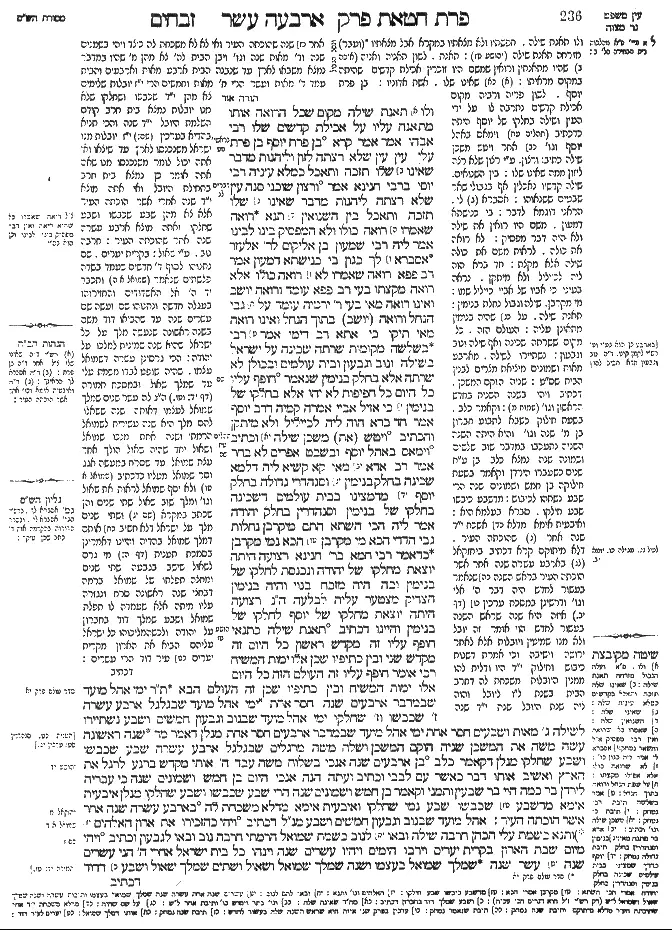
Zevahim 118b - Guemara
ולו תאנת שילה מקום שכל הרואה אותו מתאנח עליו על אכילת קדשים שלו רבי אבהו אמר אמר קרא (בראשית מט, כב) בן פרת יוסף בן פרת עלי עין עין שלא רצתה לזון וליהנות מדבר שאינו שלו תזכה ותאכל כמלא עיניה רבי יוסי ברבי חנינא אמר (דברים לג, טז) ורצון שוכני סנה עין שלא רצתה ליהנות מדבר שאינו שלו תזכה ותאכל בין השנואין תנא רואה שאמרו רואה כולו ולא המפסיק בינו לבינו אמר ליה רבי שמעון בן אליקום לר' אלעזר אסברא לך כגון בי כנישתא דמעון אמר רב פפא רואה שאמרו לא רואה כולו אלא רואה מקצתו בעי רב פפא עומד ורואה יושב ואינו רואה מאי בעי ר' ירמיה עומד על גבי הנחל ורואה (יושב) בתוך הנחל ואינו רואה מאי תיקו כי אתא רב דימי אמר רבי בשלשה מקומות שרתה שכינה על ישראל בשילה ונוב וגבעון ובית עולמים ובכולן לא שרתה אלא בחלק בנימין שנאמר (דברים לג, יב) חופף עליו כל היום כל חפיפות לא יהו אלא בחלקו של בנימין כי אזיל אביי אמרה קמיה דרב יוסף אמר חד ברא הוה ליה לכייליל ולא מיתקן והכתיב (תהלים עח, ס) ויטש (את) משכן שילה וכתיב (תהלים עח, סז) וימאס באהל יוסף ובשבט אפרים לא בחר אמר רב אדא מאי קא קשיא ליה דלמא שכינה בחלק בנימין וסנהדרי גדולה בחלק יוסף מדמצינו בבית עולמים דשכינה בחלקו של בנימין וסנהדרין בחלק יהודה אמר ליה הכי השתא התם מיקרבן נחלות גבי הדדי הכא מי מקרבן הכא נמי מקרבן כדאמר רבי חמא בר' חנינא רצועה היתה יוצאת מחלקו של יהודה ונכנסת לחלקו של בנימין ובה היה מזבח בנוי והיה בנימין הצדיק מצטער עליה לבלעה ה"נ רצועה היתה יוצאת מחלקו של יוסף לחלקו של בנימין והיינו דכתיב (יהושע טז, ו) תאנת שילה כתנאי חופף עליו זה מקדש ראשון כל היום זה מקדש שני ובין כתיפיו שכן אלו ימות המשיח רבי אומר חופף עליו זה העולם הזה כל היום אלו ימות המשיח ובין כתיפיו שכן זה העולם הבא ת"ר ימי אהל מועד שבמדבר ארבעים שנה חסר אחת ימי אהל מועד שבגלגל ארבע עשרה ז' שכבשו וז' שחלקו ימי אהל מועד שבנוב וגבעון חמשים ושבע נשתיירו לשילה ג' מאות ושבעים חסר אחת ימי אהל מועד שבמדבר ארבעים חסר אחת מנלן דאמר מר שנה ראשונה עשה משה את המשכן שניה הוקם המשכן ושלח משה מרגלים שבגלגל ארבע עשרה שבע שכבשו ושבע שחלקו מנלן דקאמר כלב (יהושע יד, ז) בן ארבעים שנה אנכי בשלוח משה עבד ה' אותי מקדש ברנע לרגל את הארץ ואשיב אותו דבר כאשר עם לבבי וכתיב ועתה הנה אנכי היום בן חמש ושמונים שנה כי עבריה לירדן בר כמה הוי בר שבעין ותמני וקאמר בן חמש ושמונים שנה הרי שבע שכבשו ושבע שחלקו מנלן איבעית אימא מדשבע שכבשו שבע נמי שחלקו ואיבעית אימא מדלא משכחת לה (יחזקאל מ, א) בארבע עשרה שנה אחר אשר הוכתה העיר:
אהל מועד שבנוב וגבעון חמשים ושבע מנ"ל דכתיב (שמואל א ד, יח) ויהי כהזכירו את ארון האלהים ותנא כשמת עלי הכהן חרבה שילה ובאו לנוב כשמת שמואל הרמתי חרבה נוב ובאו לגבעון וכתיב (שמואל א ז, ב) ויהי מיום שבת הארון בקרית יערים וירבו הימים ויהיו עשרים שנה וינהו כל בית ישראל אחרי ה' הני עשרים שנה עשר שנה שמלך שמואל בעצמו ושנה שמלך שמואל ושאול ושתים שמלך שאול ושבע דדוד
Comments from Rashi on Masechet Zevahim Page 118b
ולו תאנת שילה . חפשתיו ולא מצאתיו במקרא אבל מצאתיו (ועבר) מזרחה תאנת שילה (יהושע טז): תאנת . לשון תאניה ואניה (איכה ב) שהיו מתאנחין ורואין שמשם היו זוכרין אכילת קדשים שהיתה במקום מראיתו: שאינו שלו . אשת אדוניו: בן פרת יוסף . לשון פריה ורביה מקום אכילת קדשים נתרבה לו על ידי העין ושילה בחלקו של יוסף היתה כדכתיב (תהלים עח) וימאס באהל יוסף וגו' אחר ויטש משכן שילה כתיב: ורצון . ע"י רצון שלא רצה ליזון ממה שאינו שלו: בין השנואים . שילה קדשיו נאכלין אף בגבולי שאר שבטים ששנאוהו: אסברא לי . הראני דוגמא לדבר: בי כנישתא דמעון . משם היו רואין את שילה ולא היה דבר מפסיק: לא רואה את כולה . לראות משם את כולה שילה אלא מקצת: חד ברא הוה ליה לכייליל ולא מיתקן . נראה בעיני כי אביו של אביי כייליל שמו: מי מקרבן . שילה וגבול נחלת בנימין: תאנת שילה . על שהיה בנימין מתאונן עליה: העולם הזה . כל מקום ששרתה שכינה ואף שילה ונוב וגבעון: נשתיירו לשילה . מארבע מאות ושמונים מיציאת מצרים לבנין הבית שס"ט: שניה הוקם המשכן . דכתיב ויהי בשנה השנית בחדש הראשון וגו' (שמות מ): מדשבע כיבשו שבע חילקו . סברא בעלמא היא: וקאמר כלב . בשעת חילוק כשבא לתבוע חברון בן מ' שנה וגו' והיא היתה השנה השניה נתעכבו במדבר שוב שלשים ושמונה שנה נמצא כלב בן ע"ח שנים כשעברו הירדן וקאמר בשעת חילוקה בן חמש ושמונים שנה הרי שבע נשתהו לכיבוש: ואיבעית אימא מדלא אשכח י"ד שנה אחר שהוכתה העיר . דלא מיתוקם קרא דכתיב ביחזקאל (לג) בארבע עשרה שנה אחר אשר הוכתה העיר בראש השנה שנאמר בעשור לחדש היה דבר ה' אלי וגו' ודרשינן במסכת ערכין (דף יב.) איזה היא שנה שראש השנה בעשור לחדש הוי אומר זה יובל ולא מנו שמיטין ויובלות אלא לאחר ירושה וישיבה וכי אמרת דשנות כיבוש וחילוק י"ד היו ודלית להו ממנין היובלות משכחת לה דחרב הבית בשנת ל"ו ליובל והוה ליה שנת היובל שנת י"ד שנה אחר שנה שהוכתה העיר ואי לא לא משכחת לה כיצד ויהי בשמנים שנה וד' מאות שנה וגו' ויבן הבית לה' צא מהן מ' שהיו במדבר נמצא משבאו לארץ עד שנבנה הבית ארבע מאות וארבעים והבית עמד ד' מאות ועשר הרי ח' מאות וחמשים הרי י"ז יובלות שלימים צא מהן י"ד שכבשו ושחלקו שלא מנו יובלות נמצא בית חרב קודם השלמת היובל י"ד שנה והכי תניא בהדיא בערכין (שם:) י"ז יובלות מנו ישראל משנכנסו לארץ עד שיצאו ואי אתה יכול לומר משנכנסו מנו שאם אתה אומר כן נמצא בית חרב בתחילת היובל ואי אתה מוצא י"ד שנה אחרי אשר הוכתה העיר אלא צא מהן שבע שכבשו ושבע שחלקו ואתה מוצא ארבע עשרה שנה אחר שהוכתה העיר: חרבה נוב . ע"י שאול: בקרית יערים . שם נתנוהו לסוף ד' חדשים שעמד בשדה פלשתים שנאמר (שמואל א ה) ותכבד יד ה' אל האשדודים והחזירוהו בעגלה חדשה ונתנוהו שם ועשה שם עשרים שנה עד שהביאו דוד משם בשנה ראשונה שנעשה מלך על כל ישראל שהיא שנה שמינית למלכו על יהודה: הכי גרסינן עשרה דשמואל עצמו . שהיה שופט לבדו משמת עלי עד שמלך שאול ובמסכת תמורה (דף יד: טו.) ה"ג לה עשר שנים שמלך שמואל לעצמו דאותה שנה ששאלו להם מלך היא שנה עשירית לשמואל הרמתי ושנה אחת מלכו שמואל ושאול יחד שהיה שאול הולך אחר עצת שמואל עד שסרח במעשה אגג וסר שמואל מעליו כדכתיב (שמואל א טו) ולא יסף שמואל לראות את שאול וגו' ומלך שוב שאול שתי שנים והן שכתב במקרא (שם יג) ושתי שנים מלך על ישראל דלא חשיב אותם דמלך שמואל בהדיה והיינו דאמרינן בסמכת תענית (דף ה:) מי גרם לשאול שישב בגבעה שתי שנים ומחצה תפלתו של שמואל ברמה דבחצי שנה ראשונה סרח ונגזרה עליו מיתה אלא שעמדה לו תפלת שמואל ושבע שמלך דוד בחברון על יהודה ולכשהמליכוהו כל ישראל עליהם הביא את הארון מקרית יערים עיר דוד הרי עשרים:
Zevahim 118b - Mishnah translated into english
“And the border turned about eastward to Taanath Shiloh” (Joshua 16:6), a place adjacent to Shiloh. Why did it bear the name of Taanath Shiloh? It is because it was the place from which whoever saw the Tabernacle in Shiloh after its destruction would moan [mitane’aḥ] for it with regard to the consumption of sacrificial animals from offerings of lesser sanctity that had been previously permitted there, but was now no longer permitted.
Rabbi Abbahu says that a different biblical allusion may be found in what the verse states in the context of Jacob’s blessing to Joseph: “Joseph is a fruitful vine, a fruitful vine by a fountain [ayin]” (Genesis 49:22). The Gemara interprets the word fountain homiletically: An eye [ayin] that did not wish to partake or derive benefit from something that was not his, i.e., the wife of Potiphar, shall merit to have offerings of lesser sanctity consumed in Shiloh, in Joseph’s portion of Eretz Yisrael, to the fullest extent of its eyes, i.e., from wherever Shiloh can be seen.
Rabbi Yosei, son of Rabbi Ḥanina, says that another allusion may be found in the context of Moses’ blessing to Joseph: “And the good will of Him Who dwelt in the bush [seneh]” (Deuteronomy 33:16). The Gemara interprets the word “seneh” homiletically: An eye that did not wish to derive benefit from something that was not his shall merit to have offerings of lesser sanctity consumed among the haters [senu’in]. In other words, offerings of lesser sanctity may be consumed in any place that overlooks Shiloh, even in the portions of the other tribes, who are described by the Torah as hating Joseph (see Genesis, chapter 37).
§ With regard to the halakha that during the period of Shiloh offerings of lesser sanctity could be eaten in any place that overlooks Shiloh, it was taught: The term: Overlooks, that was stated in the mishna, means that one sees it in its entirety, and there is nothing that obstructs between the seer and the surrounding area. Rabbi Shimon ben Elyakum said to Rabbi Elazar: I shall explain this type of seeing to you: For example, the synagogue of Maon, which was adjacent to the city of Tiberias, and from where Tiberias could be seen. Rav Pappa said that the term: Overlooks, that was stated does not mean that one must see the Tabernacle in Shiloh in its entirety, but rather even if one sees it partially, offerings of lesser sanctity may be consumed there.
With regard to the definition of overlooking, Rav Pappa raises a dilemma: If one is in a place where he stands and sees Shiloh, but if he sits he does not see Shiloh, what is the halakha? Is this considered overlooking? Likewise, Rabbi Yirmeya raises a dilemma: If one is in a place where he can stand upon the bank of the stream and see Shiloh, but if he is in the stream he does not see Shiloh, what is the halakha? No resolution is found for either of these questions, and the Gemara concludes: These dilemmas shall stand unresolved.
§ When Rav Dimi came from Eretz Yisrael to Babylonia, he said that Rabbi Yehuda HaNasi said: The Divine Presence rested upon the Jewish people in three places: In Shiloh, and Nov and Gibeon, and the Eternal House, and in all of those the Divine Presence rested only in the portion of the tribe of Benjamin, as it is stated in Moses’ blessing to Benjamin: “The beloved of the Lord shall dwell in safety by Him; He covers him all the day and He dwells between his shoulders” (Deuteronomy 33:12), meaning: All coverings, i.e., times of resting of the Divine Presence upon the Jewish people, shall be only in the portion of Benjamin.
The Gemara relates that when Abaye went to study Torah with Rav Yosef, he said the statement of Rav Dimi before Rav Yosef. Rav Yosef said in response: Kaylil, Abaye’s father, had one son, and he is not proper. But isn’t it written with regard to the Tabernacle in Shiloh: “And He forsook the Tabernacle of Shiloh” (Psalms 78:60); and it is written: “Moreover He abhorred the tent of Joseph, and chose not the tribe of Ephraim” (Psalms 78:67)? These verses indicate that the Tabernacle in Shiloh was in the portion of Joseph, not of Benjamin.
Rav Adda said: What is Rav Yosef’s difficulty from that verse? Perhaps the Tabernacle was in both the portion of Benjamin and that of Joseph. The Divine Presence was in the portion of Benjamin, and the Great Sanhedrin, which sits adjacent to the location of the Divine Presence, was in the portion of Joseph. This is similar to what we found in the case of the Eternal House, where the Divine Presence was in the portion of Benjamin and the Sanhedrin was in the portion of Judah.
Rav Yosef said to him in response: How can these cases be compared? There, in the Temple in Jerusalem, the portions of Benjamin and Judah were close to each other, and a division in which the Temple was located in the portion of one tribe while the Sanhedrin was located in the portion of another was possible. Here, with regard to Shiloh, are Shiloh and the portion of Benjamin close to each other? The Gemara replies: Here too they are close, as Rabbi Ḥama, son of Rabbi Ḥanina, says: A strip of land protruded from the portion of Judah and entered into the portion of Benjamin, and the altar in the Temple was built on that strip. And the tribe of Benjamin the righteous would agonize over it, desiring to take it into its portion, due to its unique sanctity.
Here too, with regard to the Tabernacle in Shiloh, a strip of land protruded from the portion of Joseph and entered into the portion of Benjamin, which connected Shiloh to the portion of Benjamin, and it was upon that strip, which had the status of Benjamin’s portion, that the Tabernacle stood. And that is what it means concerning that which is written with regard to the boundary of Joseph: “And the border turned about eastward to Taanath Shiloh” (Joshua 16:6), which in this context, is interpreted as meaning that the tribe of Benjamin would bemoan the fact that the Tabernacle in Shiloh was not located entirely in its portion.
The Gemara notes that the dispute between the amora’im with regard to the tribe in which the Tabernacle in Shiloh was located is like a dispute between tanna’im, as it is taught with regard to Moses’ blessing to Benjamin: “He covers him”; this is a reference to the First Temple. “All the day”; this is a reference to the Second Temple. “And He dwells between his shoulders”; this is a reference to the messianic era.
Rabbi Yehuda HaNasi says: “He covers him”; this is a reference to this world. “All the day”; this is a reference to the messianic era. “And He dwells between his shoulders”; this is a reference to the World-to-Come. According to the opinion of the Rabbis, the Divine Presence dwelled in the portion of Benjamin from the first Temple period and onward, but not during the period of the Tabernacle in Shiloh, when it was in the portion of Joseph. However, according to the opinion of Rabbi Yehuda HaNasi, the entire period that the Divine Presence dwelled in this world, including the period of Shiloh, it did so in the portion of Benjamin.
§ With regard to the duration of the different periods mentioned in the mishna, the Sages taught: The days of the Tent of Meeting in the wilderness were forty years, less one year. The days of the Tent of Meeting that were in Gilgal were fourteen years: Seven years during which the Jews conquered the land and seven years during which they divided the land among the tribes. The days of the Tent of Meeting that were in Nov and Gibeon were fifty-seven years, until the Temple in Jerusalem was constructed. Since the Temple was constructed 480 years after the Exodus from Egypt (see I Kings 6:1), it follows that there remain for the period of the Tabernacle in Shiloh 370 years less one.
The Gemara asks: From where do we derive that the days of the Tent of Meeting that were in the wilderness were forty years less one? As the Master said in a baraita: In the first year after the Exodus from Egypt, Moses constructed the Tabernacle; in the second year the Tabernacle was erected, and Moses sent spies. Because of the sin of the spies, the Jewish people remained in the wilderness for forty years. It follows that the Tabernacle in the wilderness stood for thirty-nine years.
From where do we derive that the Tabernacle remained in Gilgal for fourteen years, seven years during which the Jews conquered the land and seven years during which they divided it? As Caleb, son of Jephunneh, said to Joshua at the conclusion of the period of conquest before the land was divided: “Forty years old was I when Moses, the servant of the Lord, sent me from Kadesh Barnea to spy out the land; and I brought him back word as it was in my heart” (Joshua 14:7), and it is written: “And now, I am this day eighty and five years old” (Joshua 14:10).
When the Jewish people crossed the Jordan, how old was Caleb? He was seventy-eight years old: The spies were sent by Moses in the second year after the Exodus from Egypt, and in the fortieth year they crossed the Jordan. And at the time of the division of the Land, he said that he was eighty-five years old. This indicates that it was seven years during which the Jews conquered the land.
The Gemara asks: And from where do we derive that there were seven years during which they divided the land? If you wish, say: Since it was a period of seven years in which they conquered the land, it was presumably also a period of seven years in which they divided the land.
And if you wish, say instead: Because otherwise, you do not find any plausible explanation for the date mentioned by the prophet Ezekiel in the verse: “In the beginning of the year, on the tenth day of the month, in the fourteenth year after that the city was smitten” (Ezekiel 40:1). This indicates that it was a Jubilee Year, unless capturing and dividing the land took a total of fourteen years, after which point they began to calculate Sabbatical and Jubilee Years.
§ The baraita stated that the period of the Tent of Meeting that was in Nov and Gibeon was fifty-seven years. The Gemara asks: From where do we derive this? As it is written in the description of the death of Eli the High Priest, upon being informed that the Ark was captured by the Philistines: “And it came to pass, when he made mention of the Ark of God, that he fell from off his seat backward by the side of the gate, and his neck broke, and he died” (I Samuel 4:18).
And a tanna taught: When Eli the priest died, Shiloh was destroyed and the Jews arrived at Nov, where they erected the Tabernacle. At that time, Samuel began to lead the people. When Samuel from Rama died, Nov was destroyed by Saul (see I Samuel 22:19) and they arrived at Gibeon, where the Tabernacle remained (see I Chronicles 16:39).
The Gemara determines the number of years from when the Ark was captured by the Philistines and Shiloh was destroyed: And it is written: “And it came to pass, from the day that the Ark abode in Kiriath Jearim that the time was long; for it was twenty years; and all the house of Israel yearned after the Lord” (I Samuel 7:2). The Ark was returned by the Philistines to Kiriath Jearim seven months after it was captured, and it remained there for twenty years, until David brought it to Jerusalem.
The Gemara explains that these twenty years are calculated as follows: Ten years that Samuel reigned alone, from the death of Eli until the coronation of Saul, and one year that Samuel and Saul reigned, i.e., Saul reigned for one year during the lifetime of Samuel, and two years that Saul reigned alone after the death of Samuel. And in addition to these thirteen years, there were the seven years of David’s reign in Hebron, before the years of his reign in Jerusalem.
Traduction : The William Davidson digital edition of the Koren Noé Talmud, with commentary by Rabbi Adin Even-Israel Steinsaltz.