 Talmud Bavli
The learning on the whole site is dedicated : L'ilui Nishmat Margalit bat Ledicia
The learning on the whole site is dedicated : L'ilui Nishmat אסתר בת חיים
The learning on the whole site is dedicated : L'ilui Nishmat אליעזר בן רחל
Avodah Zarah 19b : Youtube
Daf TubeYoutube
2 video classes :
Avodah Zarah Page 19b
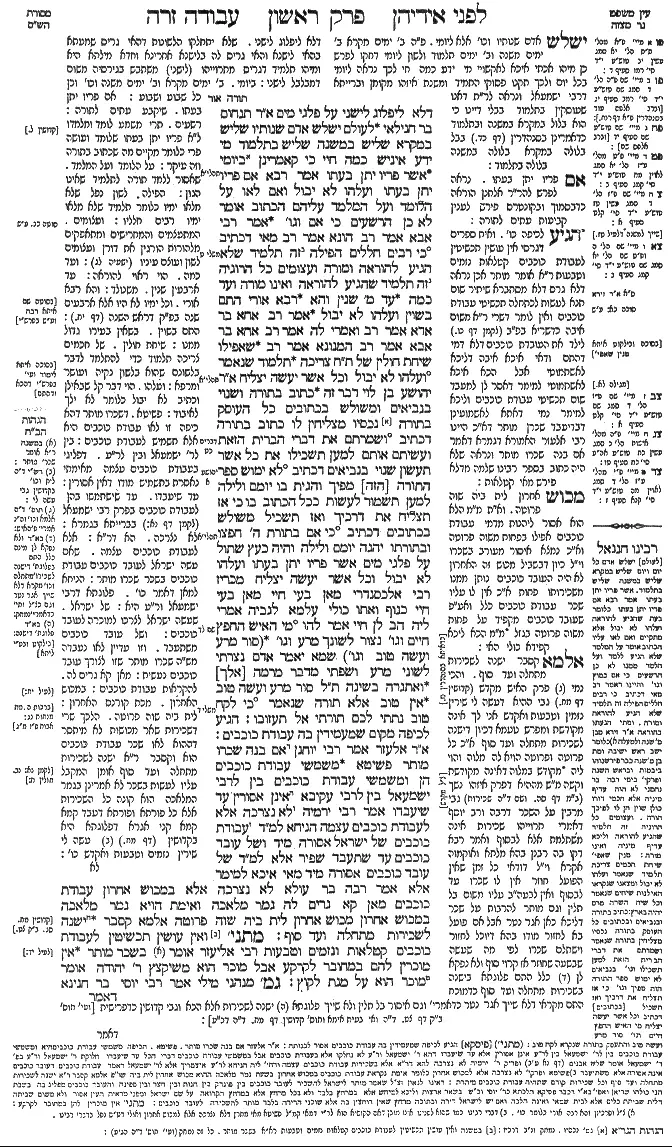
Avodah Zarah 19b - Guemara
דלא ליפלוג לישני על פלגי מים א"ר תנחום בר חנילאי לעולם ישלש אדם שנותיו שליש במקרא שליש במשנה שליש בתלמוד מי ידע איניש כמה חיי כי קאמרינן ביומי (תהלים א, ג) אשר פריו יתן בעתו אמר רבא אם פריו יתן בעתו ועלהו לא יבול ואם לאו על הלומד ועל המלמד עליהם הכתוב אומר לא כן הרשעים כי אם וגו' אמר רבי אבא אמר רב הונא אמר רב מאי דכתיב (משלי ז, כו) כי רבים חללים הפילה זה תלמיד שלא הגיע להוראה ומורה ועצומים כל הרוגיה זה תלמיד שהגיע להוראה ואינו מורה ועד כמה עד מ' שנין והא רבא אורי התם בשוין ועלהו לא יבול אמר רב אחא בר אדא אמר רב ואמרי לה אמר רב אחא בר אבא אמר רב המנונא אמר רב שאפילו שיחת חולין של ת"ח צריכה תלמוד שנאמר (תהלים א, ג) ועלהו לא יבול וכל אשר יעשה יצליח א"ר יהושע בן לוי דבר זה כתוב בתורה ושנוי בנביאים ומשולש בכתובים כל העוסק בתורה נכסיו מצליחין לו כתוב בתורה דכתיב (דברים כט, ח) ושמרתם את דברי הברית הזאת ועשיתם אותם למען תשכילו את כל אשר תעשון שנוי בנביאים דכתיב (יהושע א, ח) לא ימוש ספר התורה [הזה] מפיך והגית בו יומם ולילה למען תשמור לעשות ככל הכתוב בו כי אז תצליח את דרכיך ואז תשכיל משולש בכתובים דכתיב (תהלים א, ב) כי אם בתורת ה' חפצו ובתורתו יהגה יומם ולילה והיה כעץ שתול על פלגי מים אשר פריו יתן בעתו ועלהו לא יבול וכל אשר יעשה יצליח מכריז רבי אלכסנדרי מאן בעי חיי מאן בעי חיי כנוף ואתו כולי עלמא לגביה אמרי ליה הב לן חיי אמר להו (תהלים לד, יג) מי האיש החפץ חיים וגו' נצור לשונך מרע וגו' סור מרע ועשה טוב וגו' שמא יאמר נצרתי לשוני מרע ושפתי מדבר מרמה אלך ואתגרה בשינה ת"ל סור מרע ועשה טוב אין טוב אלא תורה שנאמר (משלי ד, ב) כי לקח טוב נתתי לכם תורתי אל תעזובו:
הגיע לכיפה מקום שמעמידין בה עבודת כוכבים:
א"ר אלעזר אמר רבי יוחנן אם בנה שכרו מותר פשיטא משמשי עבודת כוכבים הן ומשמשי עבודת כוכבים בין לרבי ישמעאל בין לרבי עקיבא אינן אסורין עד שיעבדו אמר רבי ירמיה לא נצרכה אלא לעבודת כוכבים עצמה הניחא למ"ד עבודת כוכבים של ישראל אסורה מיד ושל עובד כוכבים עד שתעבד שפיר אלא למ"ד של עובד כוכבים אסורה מיד מאי איכא למימר אלא אמר רבה בר עולא לא נצרכה אלא במכוש אחרון עבודת כוכבים מאן קא גרים לה גמר מלאכה ואימת הויא גמר מלאכה במכוש אחרון מכוש אחרון לית ביה שוה פרוטה אלמא קסבר ישנה לשכירות מתחלה ועד סוף:
מתני׳ ואין עושין תכשיטין לעבודת כוכבים קטלאות ונזמים וטבעות רבי אליעזר אומר בשכר מותר אין מוכרין להם במחובר לקרקע אבל מוכר הוא משיקצץ ר' יהודה אומר מוכר הוא על מנת לקוץ:
גמ׳ מנהני מילי אמר רבי יוסי בר חנינא
Comments from Rashi on Masechet Avodah Zarah Page 19b
דלא ליפלוג לישני . שלא יתחלקו הלשונות דהאי גריס שמעתא בהאי לישנא והאי גריס לה בלישנא אחרינא וחדא מילתא היא ומיהו תלמיד דגריס מתרוייהו (לישני) משתבש בגירסיה משום דמבלבל לישני: ביומי . ב' ימים מקרא וב' ימים משנה וכו' וכן כל שבוע ושבוע: אם פריו יתן בעתו . שיקבע עתים לתורה: על הלומד ועל המלמד . שאסור ללמד תורה לתלמיד שאינו הגון: רשעים . תרי משמע לומד ומלמדו. ל"א פריו יתן בעתו שלומד ועושה פרי כלומר מקיים מה שכתוב בתורה וזה עיקר: הפילה . לשון נפל שלא מלאו ימיו. כלומר תלמיד שלא מלאו ימיו רבים חלליו: ועצומים . המתעצמים והמחרישים ומתאפקים מלהורות הורגין את דורן. ועצומים לשון ועוצם עיניו (ישעיהו לג): ועד כמה . הוי ראוי להוראה: עד ארבעין שנין . משנולד: והא רבא אורי . וכל ימיו לא היו אלא ארבעים שנה בפ"ק דראש השנה (דף יח.): התם בשוין . בשאין בעירו גדול ממנו: שיחת חולין . של חכמים צריכה תלמוד כדי להתלמד לדבר בלשונם שהוא בלשון נקיה ועושר ומרפא: ועלהו . הוי דבר קל שבאילן וכתיב לא יבול כלומר לא ילך לאיבוד: פשיטא . דשכרו מותר דהא כיפה זו לאו עבודת כוכבים היא אלא תשמיש לעבודת כוכבים: בין לר' ישמעאל ובין לר"ע . דפליגי בעבודת כוכבים עצמה מאימתי נאסרת בתשמיש מודו דאין אסורין: עד שיעבדו . עד שישתמשו בהן לעבודת כוכבים בפרק רבי ישמעאל (לקמן עבודה זרה דף נא:) בברייתא בגמרא: לא נצרכה . הא דר"א: אלא לעבודת כוכבים עצמה . שאם עשה ישראל לעובד כוכבים עבודת כוכבים בשכר שכרו מותר: הניחא למאן דאמר כו' . פלוגתא דרבי ישמעאל ור"ע היא: של ישראל . שעשה ישראל לצרכו למוכרה לעובד כוכבים: ושל עובד כוכבים משתעבד . וזו עדיין לאו נעבדה מש"ה שכרו מותר שזו לצורך עובד כוכבים נעשית: מאן קא גרים לה . להקראות עבודת כוכבים: במכוש האחרון . מכת קורנס האחרון: לית ביה שוה פרוטה . הלכך שרי דשכירות שאר מכושות לא מיתסר דההוא לאו שכר עבודת כוכבים הוא. וקסבר ר"א ישנה לשכירות מתחלה ועד סוף אומן המקבל עליו לעשות בשכר לא אמרינן בגמר המלאכה הוא קונה כל השכירות אלא כל פורתא ופורתא דעבד קמא קמא קני אגרא דפלוגתא היא בקדושין (דף מח.) עשה לי שירין נזמים וטבעות ואקדש כו':
Comments from Tosafot - Avodah Zarah 19b
ישלש אדם שנותיו וכו' אלא ליומי . פ"ה ב' ימים מקרא ב' ימים משנה וב' ימים תלמוד ולשון ליומי דחקו לפרש כן מיהו אכתי איכא לאקשויי מי ידע כמה חי לכך נראה ליומי בכל יום ולכך תקנו פסוקי התמיד ומשנת איזהו מקומן וברייתא דרבי ישמעאל ונראה לר"ת דאנו שעוסקין בתלמוד בבלי דיינו כי הוא בלול במקרא במשנה ובתלמוד כדאמרינן בסנהדרין (דף כד.) בבל בלולה במקרא בלולה במשנה בלולה בתלמוד: אם פריו יתן בעתו . נראה לפרש להר"ר אלחנן הוראה כדבסמוך ובקונטרס פירש לענין קביעות עתים לתורה: הגיע לכיפה כו' . ואית ספרים דגרסי אין עושין תכשיטין לעבודת כוכבים קטלאות נזמים וטבעות ר"א אומר מותר אכן נראה דלא גרס דלא מסתברא שיתיר שום תנא לעשות לכתחלה תכשיטי עבודת כוכבים ואין לומר דשרי ר"א משום איבה כדשריא בפ"ב (לקמן עבודה זרה דף כו.) לילד את העובדת כוכבים דלא דמי דהתם ודאי איכא איבה דליכא לאשתמוטי אבל הכא איכא לאשתמוטי למימר דאסר לן למעבד שום תכשיטי עבודת כוכבים וליכא למימר נמי דאתא לאשמועינן דבדיעבד שכרן מותר דא"כ היינו רבי אלעזר האמורא דגמרא דאמר אם בנה שכרו מותר ונראה שלא היה כתוב בספר רבינו שלמה מדלא פירש מאי קטלאות: מכוש אחרון לית ביה שוה פרוטה . וא"ת מ"מ הלא הוא אסור ליהנות מדמי עבודת כוכבים אפילו בפחות משוה פרוטה וא"כ נמצא איסור מעורב בשכרו וי"ל כיון דבשביל מכוש זה האחרון לא היה העובד כוכבים נותן ממנו משכירותו פחות א"כ אין לו עליו שכר עבודת כוכבים כלל ואע"פ שעובד כוכבים מקפיד על פחות משוה פרוטה בגזל מ"מ הכא ליכא קפידא כולי האי: אלמא קסבר ישנה לשכירות מתחלה ועד סוף . והכי נמי פרק האיש מקדש (קדושין דף מח.) גבי ההיא דעשה לי שירין נזמין וטבעות ואקדש אני לך אינה מקודשת ומפרש טעמא דכיון דישנה לשכירות מתחלה ועד סוף א"כ כל פרוטה ופרוטה הויא לה מלוה והוי ליה מקודש במלוה דאינה מקודשת וקשה מ"ש מההיא דפרק איזהו נשך (ב"מ דף סה. ושם ד"ה שכירות) גבי מרבין על השכר דרבה ורב יוסף דאמרי תרוייהו שכירות אינה משתלמת אלא לבסוף ואמר רבא דקו בה רבנן בהא מלתא ואוקמוה אקרא וי"ל דודאי כל זמן שאין הפועל חוזר אין לו שכרו עד לבסוף ואין לבעה"ב עליו משום בל תלין וגם מותר להרבות על שכר דליכא כאן אגר נטר אבל אם פועל בא לחזור מודו בהא דיוכל לחזור וישתלם שכרו לפי מה שעשה שבשעה שחוזר אז קרוי סוף ולא נפקא לן כלל התם פלוגתא בישנה בשכירות מתחלה ועד סוף כדמוכח התם מקראי דלא שייך אגר נטר כדאמרי' וגם איסור בל תלין ולא שייך פלוגתא ישנה לשכירות אלא הכא וגבי קדושין כדפרישית [ועי' תוס' ב"ק דף צט. ד"ה ואי בעית אימא ותוס' קדושין דף מח. ד"ה דכ"ע]:
Avodah Zarah 19b - Mishnah translated into english
he will not become confused by the different versions of the same statements he hears from each teacher, as he will have no clear authoritative version from one source. The Gemara continues discussing the verse cited above: “By streams [palgei] of water” (Psalms 1:3). Rabbi Tanḥum bar Ḥanilai says: Since the root peh, lamed, gimmel can also refer to dividing, the verse is interpreted as follows: A person should always divide his years into thirds, as follows: One third for Bible, one third for Mishna and one third for Talmud.
The Gemara asks: How can one divide his life this way? Does a person know the length of his life, that he can calculate how much a third will be? The Gemara answers: When we said that a one should divide his time into thirds, the intention was with regard to his days, i.e., he should devote one third of each day to Bible, Mishna, and Talmud, respectively.
The Gemara discusses the continuation of the verse cited above: “That brings forth its fruit in its season and whose leaf does not wither” (Psalms 1:3). Rava says: If one brings forth fruit in its season, i.e., if he acts in accordance with the precepts of Torah that he learns, then his leaf will not wither, as the Torah will sustain him. But if one does not learn with the intention that his studies should lead to action, then with regard to both the one who is taught and with regard to the one who teaches, the verse states about them: “Not so the wicked; but they are like the chaff that the wind drives away” (Psalms 1:4).
Rabbi Abba says that Rav Huna says that Rav says: What is the meaning of that which is written: “For she has cast down [hippila] many wounded and a mighty host are all her slain” (Proverbs 7:26)? This is referring to a student who has not yet reached the level where he can render legal decisions, but nevertheless he already issues decisions. He is like a fetus that emerged from the womb before its time, as the word hippila also means to miscarry. “And a mighty host are all her slain”; this is referring to a student who has reached the level where he can render legal decisions, referred to here as “a mighty host,” but he does not issue decisions, and by refraining from teaching what he knows prevents the masses from learning Torah properly.
And until when is a scholar considered too immature to render legal decisions? He is considered immature until the age of forty years. The Gemara asks: But didn’t Rava issue legal decisions before that age? The Gemara answers: There it is permitted, as in Rava’s case they are equal, i.e., if one has achieved a level of knowledge that is equivalent to that of the foremost scholar in his city, he is permitted to render decisions even before reaching the age of forty.
The Gemara cites another discussion with regard to the aforementioned verse: “And whose leaf does not wither” (Psalms 1:3). Rav Aḥa bar Adda says that Rav says, and some say that it was Rav Aḥa bar Abba who says that Rav Hamnuna says that Rav says: One should know that even the ordinary conversation of Torah scholars require analysis, as it is stated: “And whose leaf does not wither.” This teaches that even the ordinary conversation of a Torah scholar, which is comparable to the leaves of a tree, has great significance like the actual fruit of the tree.
The verse continues: “And in whatsoever he does he shall prosper.” Rabbi Yehoshua ben Levi says: This matter is written in the Torah, and repeated in the Prophets, and stated a third time in the Writings: Concerning anyone who engages in Torah study, his property dealings will be successful. It is written in the Torah, as it is written: “Observe therefore the words of this covenant, and do them, that you may make all that you do to prosper” (Deuteronomy 29:8).
It is repeated in the Prophets, as it is written: “This book of the Torah shall not depart out of your mouth, but you shall meditate on it day and night, that you may observe to do according to all that is written in it; for then you shall make your ways prosperous, and then you shall have good success” (Joshua 1:8). It is stated a third time in the Writings, as it is written: “But his delight is in the Torah of the Lord; and in His Torah he meditates day and night. And he shall be like a tree planted by streams of water, that brings forth its fruit in its season, and whose leaf does not wither; and in whatsoever he does he shall prosper” (Psalms 1:2–3).
The Gemara relates that Rabbi Alexandri would proclaim in public, in the manner of a merchant selling wares: Who desires life? Who desires life? Everyone gathered around him to buy from him, saying to him: Give us life! He stated the following verse to them: “Who is the man that desires life, and loves days, that he may see good in them? Keep your tongue from evil, and your lips from speaking guile” (Psalms 34:13–14).
The psalm continues: “Depart from evil, and do good; seek peace and pursue it” (Psalms 34:15). The Gemara explains: Lest one say: I have kept my tongue from evil and my lips from speaking guile, I will therefore go and indulge in sleep. To counter this possibility, the verse states: “Depart from evil, and do good,” i.e., it is not enough to avoid evil, but one must actively do good. And the word good means nothing other than Torah, as it is stated: “For I have given you a good portion; My Torah, do not abandon it” (Proverbs 4:2).
§ The mishna teaches: One may build with gentiles small platforms and bathhouses, but once he reaches the arched chamber in the bath where the gentiles put up objects of idol worship, it is prohibited for a Jew to continue building it. Rabbi Elazar says that Rabbi Yoḥanan says: If he did continue to build the arched chamber, his wages are permitted. The Gemara asks: Isn’t that obvious? After all, such arched chambers are only accessories of idol worship, and with regard to accessories of idol worship, both according to Rabbi Yishmael and according to Rabbi Akiva, who disagree with regard to deriving benefit from an actual object of idol worship (51b), deriving benefit from accessories of idol worship is not prohibited until they are worshipped.
Rabbi Yirmeya says: Rabbi Elazar’s statement is necessary only to permit the wages of a Jew who built an object of idol worship itself. The Gemara asks: This works out well according to the one who says that an object of idol worship of a Jew is forbidden immediately once it is built, but it is not prohibited to derive benefit from an object of idol worship of a gentile until it is actually worshipped. In this case the idol was built for a gentile, and therefore the laborer may receive payment for his work, as the idol was never worshipped. But according to the one who says that an object of idol worship of a gentile is also forbidden immediately, what can be said?
Rather, Rabba bar Ulla says: Rabbi Elazar’s statement that the worker’s wages are permitted is necessary only with regard to the final stroke with which the laborer completes his work. In the case of an object of idol worship, what causes it to be used for idol worship? It is the completion of labor, and when is the completion of labor achieved? It is achieved with the final stroke of the laborer. The final stroke alone does not have the value of one peruta, and therefore the wages he receives are due when each act of labor is performed during the entire process, not when the final stroke completes the work.
Evidently, Rabbi Elazar holds that the obligation to pay a wage is incurred continuously from the beginning of the period he was hired to its end, not merely upon completion of the work. Since the worker has rights to his wages at every stage of labor performed during the entire period of work, the wages are not considered a benefit that he receives from idol worship, as the object is classified as an object of idol worship only at the very end.
MISHNA: And one may not fashion jewelry for an object of idol worship, and this applies to jewelry such as necklaces [katla’ot], nose rings, and rings. Rabbi Eliezer says: If one fashions them in exchange for payment, it is permitted. The mishna returns to the issue of selling items to gentiles: One may not sell to a gentile any item that is attached to the ground, but one may sell such an item once it is severed from the ground. Rabbi Yehuda says: It is not necessary to sever the item from the ground; rather, one may sell it on the condition that it be severed.
GEMARA: The Gemara asks: From where is this matter, that it is prohibited to sell to a gentile anything that is attached to the ground, derived? Rabbi Yosei bar Ḥanina says:
Traduction : The William Davidson digital edition of the Koren Noé Talmud, with commentary by Rabbi Adin Even-Israel Steinsaltz.