 Talmud Bavli
The learning on the whole site is dedicated : L'ilui Nishmat Yechayahou ben Moche
The learning on the whole site is dedicated : L'ilui Nishmat Margalit bat Ledicia
The learning on the whole site is dedicated : L'ilui Nishmat Reuven ben Rivka SEBBAG
Avodah Zarah 18a : Youtube
Daf TubeYoutube
2 video classes :
Avodah Zarah Page 18a
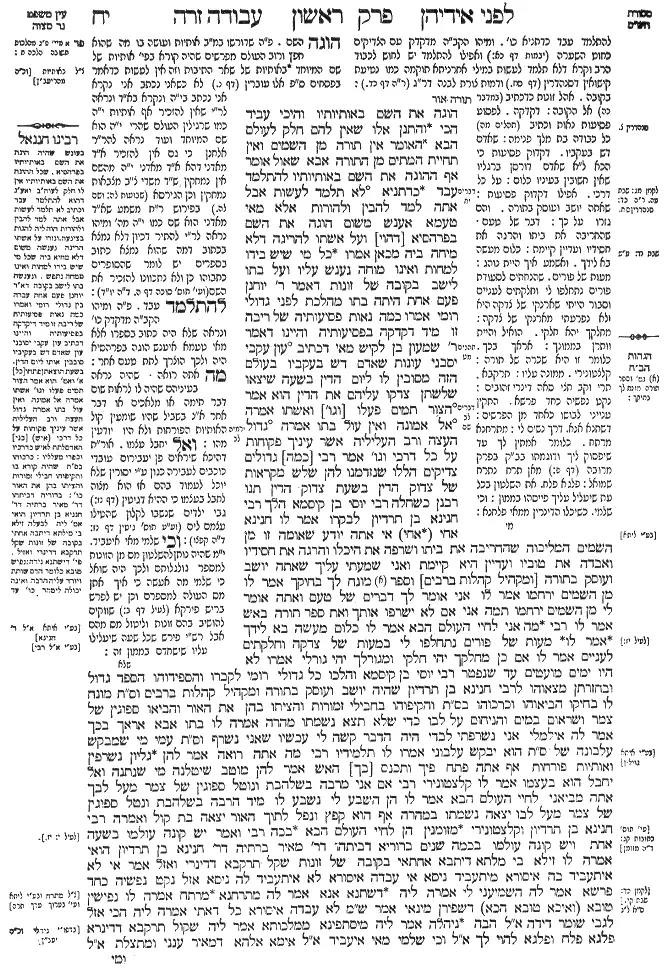
Avodah Zarah 18a - Guemara
הוגה את השם באותיותיו והיכי עביד הכי והתנן אלו שאין להם חלק לעולם הבא האומר אין תורה מן השמים ואין תחיית המתים מן התורה אבא שאול אומר אף ההוגה את השם באותיותיו להתלמד עבד כדתניא (דברים יח, ט) לא תלמד לעשות אבל אתה למד להבין ולהורות אלא מאי טעמא אענש משום הוגה את השם בפרהסיא דהוי ועל אשתו להריגה דלא מיחה ביה מכאן אמרו כל מי שיש בידו למחות ואינו מוחה נענש עליו ועל בתו לישב בקובה של זונות דאמר ר' יוחנן פעם אחת היתה בתו מהלכת לפני גדולי רומי אמרו כמה נאות פסיעותיה של ריבה זו מיד דקדקה בפסיעותיה והיינו דאמר ר' שמעון בן לקיש מאי דכתיב (תהלים מט, ו) עון עקבי יסבני עונות שאדם דש בעקביו בעולם הזה מסובין לו ליום הדין בשעה שיצאו שלשתן צדקו עליהם את הדין הוא אמר (דברים לב, ד) הצור תמים פעלו [וגו'] ואשתו אמרה (דברים לב, ד) אל אמונה ואין עול בתו אמרה (ירמיהו לב, יט) גדול העצה ורב העליליה אשר עיניך פקוחות על כל דרכי וגו' אמר רבי [כמה] גדולים צדיקים הללו שנזדמנו להן שלש מקראות של צדוק הדין בשעת צדוק הדין תנו רבנן כשחלה רבי יוסי בן קיסמא הלך רבי חנינא בן תרדיון לבקרו אמר לו חנינא אחי (אחי) אי אתה יודע שאומה זו מן השמים המליכוה שהחריבה את ביתו ושרפה את היכלו והרגה את חסידיו ואבדה את טוביו ועדיין היא קיימת ואני שמעתי עליך שאתה יושב ועוסק בתורה [ומקהיל קהלות ברבים] וספר מונח לך בחיקך אמר לו מן השמים ירחמו אמר לו אני אומר לך דברים של טעם ואתה אומר לי מן השמים ירחמו תמה אני אם לא ישרפו אותך ואת ספר תורה באש אמר לו רבי מה אני לחיי העולם הבא אמר לו כלום מעשה בא לידך אמר לו מעות של פורים נתחלפו לי במעות של צדקה וחלקתים לעניים אמר לו אם כן מחלקך יהי חלקי ומגורלך יהי גורלי אמרו לא היו ימים מועטים עד שנפטר רבי יוסי בן קיסמא והלכו כל גדולי רומי לקברו והספידוהו הספד גדול ובחזרתן מצאוהו לרבי חנינא בן תרדיון שהיה יושב ועוסק בתורה ומקהיל קהלות ברבים וס"ת מונח לו בחיקו הביאוהו וכרכוהו בס"ת והקיפוהו בחבילי זמורות והציתו בהן את האור והביאו ספוגין של צמר ושראום במים והניחום על לבו כדי שלא תצא נשמתו מהרה אמרה לו בתו אבא אראך בכך אמר לה אילמלי אני נשרפתי לבדי היה הדבר קשה לי עכשיו שאני נשרף וס"ת עמי מי שמבקש עלבונה של ס"ת הוא יבקש עלבוני אמרו לו תלמידיו רבי מה אתה רואה אמר להן גליון נשרפין ואותיות פורחות אף אתה פתח פיך ותכנס בך האש אמר להן מוטב שיטלנה מי שנתנה ואל יחבל הוא בעצמו אמר לו קלצטונירי רבי אם אני מרבה בשלהבת ונוטל ספוגין של צמר מעל לבך אתה מביאני לחיי העולם הבא אמר לו הן השבע לי נשבע לו מיד הרבה בשלהבת ונטל ספוגין של צמר מעל לבו יצאה נשמתו במהרה אף הוא קפץ ונפל לתוך האור יצאה בת קול ואמרה רבי חנינא בן תרדיון וקלצטונירי מזומנין הן לחיי העולם הבא בכה רבי ואמר יש קונה עולמו בשעה אחת ויש קונה עולמו בכמה שנים ברוריא דביתהו דר' מאיר ברתיה דר' חנינא בן תרדיון הואי אמרה לו זילא בי מלתא דיתבא אחתאי בקובה של זונות שקל תרקבא דדינרי ואזל אמר אי לא איתעביד בה איסורא מיתעביד ניסא אי עבדה איסורא לא איתעביד לה ניסא אזל נקט נפשיה כחד פרשא אמר לה השמיעני לי אמרה ליה דשתנא אנא אמר לה מתרחנא מרתח אמרה לו נפישין טובא (ואיכא טובא הכא) דשפירן מינאי אמר ש"מ לא עבדה איסורא כל דאתי אמרה ליה הכי אזל לגבי שומר דידה א"ל הבה ניהלה אמר ליה מיסתפינא ממלכותא אמר ליה שקול תרקבא דדינרא פלגא פלח ופלגא להוי לך א"ל וכי שלמי מאי איעביד א"ל אימא אלהא דמאיר ענני ומתצלת א"ל
Comments from Rashi on Masechet Avodah Zarah Page 18a
להתלמד עבד כדתניא כו' . ומיהו הקב"ה מדקדק עם הצדיקים כחוט השערה (יבמות דף קכא:) ואפילו להתלמד יש לחוש לכבוד הרב וקרא דלא תלמד לעשות במילי אחרניתא תוקמה כמו נטיעת קישואין דסנהדרין (דף סח.) ודמות צורת לבנה דר"ג (ר"ה דף כד.): בקובה . אהל זונות כדכתיב (במדבר כה) אל הקובה: דקדקה . לפסוע פסיעות נאות וכתיב (תהלים מה) כל כבודה בת מלך פנימה: שאדם דש בעקביו . דקדוק פסיעות כי הכא. ל"א שאדם דורסן ברגליו שאין חשובין בעיניו כלום: על כל דרכי . אפילו דקדוק פסיעות: שאתה יושב ועוסק בתורה . והם גזרו על כך: דבר של טעם . שהחריבה את ביתו והרגה את חסידיו ועדיין קיימת: כלום מעשה בא לידך . ואשמע איך היית נוהג: מעות של פורים . שהנחתים לסעודת פורים נתחלפו לי וחלקתים לעניים וסבור הייתי שארנקי של צדקה היא ולא נפרעתי מארנקי של צדקה: מחלקך יהא חלקי . הואיל והיית וותרן בממונך: אראך בכך . כלומר זו היא שכרה של תורה: קלצטונירי . ממונה עליו: תרקבא . תרי וקב חצי סאה דינרי זהובים: נקט נפשיה כחד פרשא . התקין ענייני לבושו כאחד מן הפרשים: דשתנא אנא . דרך נשים לי: מתרחנא מרתח . כלומר אמתין לך עד שיפסוק ליך ודוגמתו בב"ק בפרק מרובה (דף פ:) מאן תרח נתרח שמואל: פלגא פלח . את השלטון בכל עת שיעליל עליך פייסהו בממון: וכי שלמי . כשיכלו הדינרין ממאי פלחנא:
Comments from Tosafot - Avodah Zarah 18a
הוגה השם . פ"ה שדורשו במ"ב אותיות ועושה בו מה שהוא חפץ ורוב העולם מפרשים שהיה קורא בפי' אותיות של שם המיוחד באותיות של שאר התיבות וזה אין לעשות כדאמר בפסחים ס"פ אלו עוברין (דף נ.) לא כשאני נכתב אני נקרא אני נכתב בי"ה ונקרא בא"ד ונראה לר"י שאין להזכיר אף אותיות י"ה כמו שרגילין העולם שהרי י"ה הוא שם המיוחד ועוד נראה להר"ר אלחנן כי גם אין להזכיר א"ד מאדני דהא א"ד מאדני י"ה מהשם אין נמחקין ש"ד משדי צ"ב מצבאות נמחקין וכן הגירסא (שבועות לה: ושם לה.) בפירוש ר"ח משמע שא"ד מאדני הוא שם כמו י"ה מה' ומיהו נראה לר"י להתיר דכיון דלא נמצא בכתוב דמה שהוא נמצא כתוב בספרים יש לומר שהסופרים כתבוהו כן ולא נתכוונו להזכיר את השם (ועי' תוס' סוכה דף ה. ד"ה יו"ד): להתלמד עבד . פ"ה ומיהו הקב"ה מדקדק כו' ונראה שלא היה כתוב בספרו אלא מאי טעמא איענש הוגה בפרהסיא היה ולכך הוצרך לתת טעם אחר: מה אתה רואה . שהיה נראה בעיניהם שהיה לו לראות שום דבר תימה או מלאכים או דבר אחר א"נ בשביל שהיו שומעין קול האותיות הפורחות ולא היו יודעין מהו: ואל יחבל עצמו . אור"ת דהיכא שיראים פן יעבירום עובדי כוכבים לעבירה כגון ע"י יסורין שלא יוכל לעמוד בהם אז הוא מצוה לחבל בעצמו כי ההיא דגיטין (דף נז:) גבי ילדים שנשבו לקלון שהטילו עצמם לים (וע"ע תוס' גיטין דף נז: ד"ה קפצו): וכי שלמי מאי איעביד . י"מ שהיה נותן להשלטון מס מן הזונות למספר גולגלותם ולכך היה שואל כי שלמי מה אעשה כי איך אתן מס העולה למספרם וכן יש לפרש בריש פירקא (לעיל עבודה זרה דף ב:) שווקים להושיב בהם זונות וליטול מס מהם אבל רש"י פירש שכל שעה שיעלילו עליו שישחדם בממון זה:
Avodah Zarah 18a - Mishnah translated into english
pronounce the ineffable name of God with all of its letters, i.e., as it is spelled. The Gemara asks: And how could he do that? But didn’t we learn in the mishna (Sanhedrin 90a): These are the people who have no share in the World-to-Come: One who says that the Torah is not from Heaven or that there is no source from the Torah for the resurrection of the dead. Abba Shaul says: Also one who pronounces the ineffable name as it is written, with all of its letters, has no share in the World-to-Come.
The Gemara answers: Rabbi Ḥanina ben Teradyon did it to teach himself, as it is taught in a baraita with regard to the prohibition against sorcery: “You shall not learn to do” (Deuteronomy 18:9); this indicates: But you may learn to understand and to teach. In other words, certain prohibitions do not apply when one is acting only in order to acquire knowledge of the subject.
The Gemara asks: Rather, what is the reason that he was punished? The Gemara answers: He was punished because he would pronounce the ineffable name of God in public, instead of privately. And his wife was condemned to execution by decapitation because she did not protest his doing so. From here the Sages stated: Anyone who has the capability to protest effectively the sinful conduct of another and does not protest is punished for that person’s sin.
The Gemara asks: And why was his daughter condemned to sit in a brothel? As Rabbi Yoḥanan says: Once, the daughter of Rabbi Ḥanina ben Teradyon was walking before the nobles of Rome, and they said to each other: How pleasant are the steps of this young woman. Upon hearing this, she immediately took care to keep walking in such a fashion that her steps would continue to be pleasing to them. And this is the same as that which Rabbi Shimon ben Lakish says: What is the meaning of that which is written: “The iniquity of my heel encircles me” (Psalms 49:6)? It means that the sins that a person tramples with one’s heel in this world, i.e., dismisses and pays no attention to them as they seem to lack importance, e.g., the way that one walks, come and encircle him on the Day of Judgment.
The Gemara relates: When the three of them went out after being sentenced, they accepted the justice of God’s judgment. Rabbi Ḥanina ben Teradyon said: “The Rock, His work is perfect; for all His ways are justice” (Deuteronomy 32:4). And his wife said the continuation of the verse: “A God of faithfulness and without iniquity.” His daughter said: “Great in counsel, and mighty in work; whose eyes are open upon all the ways of the sons of men, to give every one according to his ways” (Jeremiah 32:19). Rabbi Yehuda HaNasi said: How great are these righteous people, that these three verses, which speak of the acceptance of God’s judgment, occurred to them at the time of accepting the righteousness of His judgment.
§ The Sages taught: When Rabbi Yosei ben Kisma fell ill, Rabbi Ḥanina ben Teradyon went to visit him. Rabbi Yosei ben Kisma said to him: Ḥanina my brother, do you not know that this nation has been given reign by a decree from Heaven? The proof is that Rome has destroyed God’s Temple, and burned His Sanctuary, and killed His pious ones, and destroyed His best ones, and it still exists. Evidently, all of this is by Divine decree. And yet I heard about you that you sit and engage in Torah study, and convene assemblies in public, and have a Torah scroll placed in your lap, thereby demonstrating complete disregard for the decrees issued by the Romans.
Rabbi Ḥanina ben Teradyon said to him: Heaven will have mercy and protect me. Rabbi Yosei ben Kisma said to him: I am saying reasonable matters to you, and you say to me: Heaven will have mercy? I wonder if the Romans will not burn both you and your Torah scroll by fire. Rabbi Ḥanina ben Teradyon said to him: My teacher, what will become of me? Am I destined for life in the World-to-Come?
Rabbi Yosei ben Kisma said to him: Did any special incident occur to you which might serve as an indication? Rabbi Ḥanina ben Teradyon said to him: I confused my own coins that I needed for the festivities of Purim with coins of charity, and I distributed them all to the poor at my own expense. Rabbi Yosei ben Kisma said to him: If that is so, may my portion be of your portion, and may my lot be of your lot.
The Sages said: Not even a few days passed before Rabbi Yosei ben Kisma died of his illness, and all of the Roman notables went to bury him, and they eulogized him with a great eulogy. And upon their return, they found Rabbi Ḥanina ben Teradyon, who was sitting and engaging in Torah study and convening assemblies in public, with a Torah scroll placed in his lap.
They brought him to be sentenced, and wrapped him in the Torah scroll, and encircled him with bundles of branches, and they set fire to it. And they brought tufts of wool and soaked them in water, and placed them on his heart, so that his soul should not leave his body quickly, but he would die slowly and painfully. His daughter said to him: Father, must I see you like this? Rabbi Ḥanina ben Teradyon said to her: If I alone were being burned, it would be difficult for me, but now that I am burning along with a Torah scroll, He who will seek retribution for the insult accorded to the Torah scroll will also seek retribution for the insult accorded to me.
His students said to him: Our teacher, what do you see? Rabbi Ḥanina ben Teradyon said to them: I see the parchment burning, but its letters are flying to the heavens. They said to him: You too should open your mouth and the fire will enter you, and you will die quickly. Rabbi Ḥanina ben Teradyon said to them: It is preferable that He who gave me my soul should take it away, and one should not harm oneself to speed his death.
The executioner [kaltzatoniri] said to him: My teacher, if I increase the flame and take off the tufts of wool from your heart, so that you will die sooner and suffer less, will you bring me to the life of the World-to-Come? Rabbi Ḥanina ben Teradyon said to the executioner: Yes. The executioner said: Take an oath for me, that what you say is true. Rabbi Ḥanina ben Teradyon took the oath for him, and the executioner immediately increased the flame and took off the tufts of wool from his heart, causing his soul to leave his body quickly. The executioner too leaped and fell into the fire and died.
A Divine Voice emerged and said: Rabbi Ḥanina ben Teradyon and the executioner are destined for the life of the World-to-Come. Upon hearing this, Rabbi Yehuda HaNasi wept and said: There is one who acquires his share in the World-to-Come in one moment, such as the executioner, and there is one who acquires his share in the World-to-Come only after many years of toil, such as Rabbi Ḥanina ben Teradyon.
§ The Gemara relates: Berurya, the wife of Rabbi Meir, was a daughter of Rabbi Ḥanina ben Teradyon. She said to Rabbi Meir: It is a disrespectful matter for me that my sister is sitting in a brothel; you must do something to save her. Rabbi Meir took a vessel [tarkeva] full of dinars and went. He said to himself: If no transgression was committed with her, a miracle will be performed for her; if she committed a transgression, no miracle will be performed for her.
Rabbi Meir went and dressed as a Roman knight, and said to her: Accede to my wishes, i.e., engage in intercourse with me. She said to him: I am menstruating [dashtana] and cannot. He said to her: I will wait. She said to him: There are many women in the brothel, and there are many women here who are more beautiful than I. He said to himself: I can conclude from her responses that she did not commit a transgression, as she presumably said this to all who come.
Rabbi Meir went over to her guard, and said to him: Give her to me. The guard said to him: I fear that if I do so, I will be punished by the government. Rabbi Meir said to him: Take this vessel full of dinars; give half to the government as a bribe, and half will be for you. The guard said to him: But when the money is finished, what shall I do? Rabbi Meir said to him: Say: God of Meir answer me! And you will be saved. The guard said to him:
Traduction : The William Davidson digital edition of the Koren Noé Talmud, with commentary by Rabbi Adin Even-Israel Steinsaltz.