 Talmud Bavli
The learning on the whole site is dedicated : L'ilui Nishmat Chemouel Eliezer ben Batcheva
The learning on the whole site is dedicated : L'ilui Nishmat רינה בת לדיסיה
The learning on the whole site is dedicated : L'ilui Nishmat Jacques Isaac Ben Amram Loubaton
Avodah Zarah 17a : Youtube
Daf TubeYoutube
2 video classes :
Avodah Zarah Page 17a
Avodah Zarah 17a - Guemara
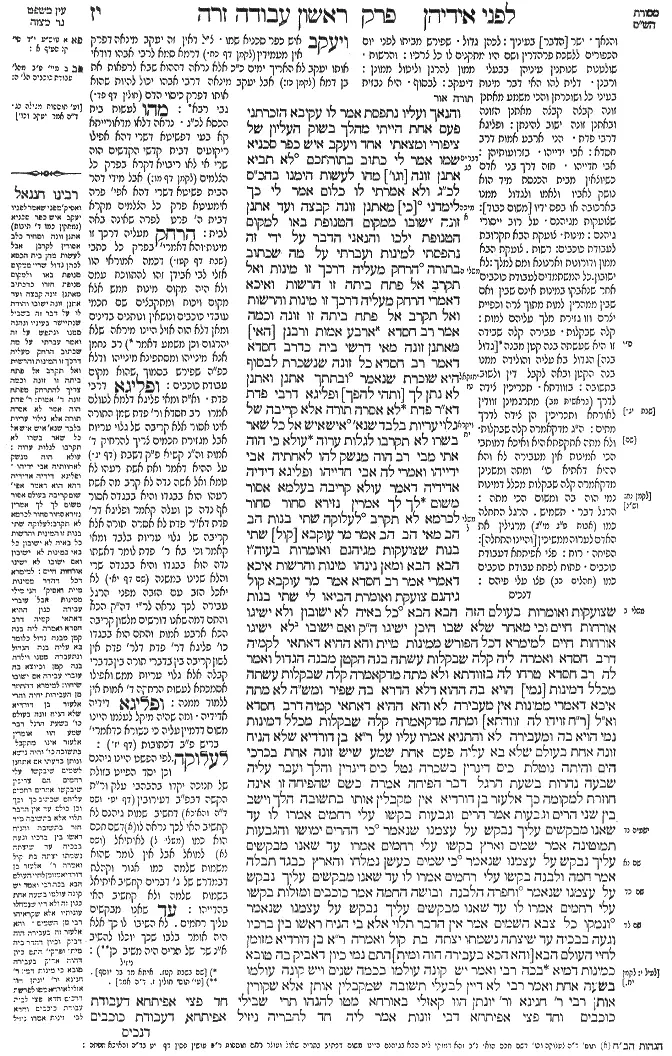
והנאך ועליו נתפסת אמר לו עקיבא הזכרתני פעם אחת הייתי מהלך בשוק העליון של ציפורי ומצאתי אחד ומתלמידי ישו הנוצרי ויעקב איש כפר סכניא שמו אמר לי כתוב בתורתכם (דברים כג, יט) לא תביא אתנן זונה [וגו'] מהו לעשות הימנו בהכ"ס לכ"ג ולא אמרתי לו כלום אמר לי כך לימדני ישו הנוצרי (מיכה א, ז) כי מאתנן זונה קבצה ועד אתנן זונה ישובו ממקום הטנופת באו למקום הטנופת ילכו והנאני הדבר על ידי זה נתפסתי למינות ועברתי על מה שכתוב בתורה (משלי ה, ח) הרחק מעליה דרכך זו מינות ואל תקרב אל פתח ביתה זו הרשות ואיכא דאמרי הרחק מעליה דרכך זו מינות והרשות ואל תקרב אל פתח ביתה זו זונה וכמה אמר רב חסדא ארבע אמות ורבנן [האי] מאתנן זונה מאי דרשי ביה כדרב חסדא דאמר רב חסדא כל זונה שנשכרת לבסוף היא שוכרת שנאמר (יחזקאל טז, לד) ובתתך אתנן ואתנן לא נתן לך [ותהי להפך] ופליגא דרבי פדת דא"ר פדת לא אסרה תורה אלא קריבה של גלוי עריות בלבד שנא' (ויקרא יח, ו) איש איש אל כל שאר בשרו לא תקרבו לגלות ערוה עולא כי הוה אתי מבי רב הוה מנשק להו לאחתיה אבי ידייהו ואמרי לה אבי חדייהו ופליגא דידיה אדידיה דאמר עולא קריבה בעלמא אסור משום לך לך אמרין נזירא סחור סחור לכרמא לא תקרב (משלי ל, טו) לעלוקה שתי בנות הב הב מאי הב הב אמר מר עוקבא [קול] שתי בנות שצועקות מגיהנם ואומרות בעוה"ז הבא הבא ומאן נינהו מינות והרשות איכא דאמרי אמר רב חסדא אמר מר עוקבא קול גיהנם צועקת ואומרת הביאו לי שתי בנות שצועקות ואומרות בעולם הזה הבא הבא (משלי ב, יט) כל באיה לא ישובון ולא ישיגו אורחות חיים וכי מאחר שלא שבו היכן ישיגו ה"ק ואם ישובו לא ישיגו אורחות חיים למימרא דכל הפורש ממינות מיית והא ההיא דאתאי לקמיה דרב חסדא ואמרה ליה קלה שבקלות עשתה בנה הקטן מבנה הגדול ואמר לה רב חסדא טרחו לה בזוודתא ולא מתה מדקאמרה קלה שבקלות עשתה מכלל דמינות [נמי] הויא בה ההוא דלא הדרא בה שפיר ומש"ה לא מתה איכא דאמרי ממינות אין מעבירה לא והא ההיא דאתאי קמיה דרב חסדא וא"ל [ר"ח זוידו לה זוודתא] ומתה מדקאמרה קלה שבקלות מכלל דמינות נמי הויא בה ומעבירה לא והתניא אמרו עליו על ר"א בן דורדיא שלא הניח זונה אחת בעולם שלא בא עליה פעם אחת שמע שיש זונה אחת בכרכי הים והיתה נוטלת כיס דינרין בשכרה נטל כיס דינרין והלך ועבר עליה שבעה נהרות בשעת הרגל דבר הפיחה אמרה כשם שהפיחה זו אינה חוזרת למקומה כך אלעזר בן דורדיא אין מקבלין אותו בתשובה הלך וישב בין שני הרים וגבעות אמר הרים וגבעות בקשו עלי רחמים אמרו לו עד שאנו מבקשים עליך נבקש על עצמנו שנאמר (ישעיהו נד, י) כי ההרים ימושו והגבעות תמוטינה אמר שמים וארץ בקשו עלי רחמים אמרו עד שאנו מבקשים עליך נבקש על עצמנו שנאמר (ישעיהו נא, ו) כי שמים כעשן נמלחו והארץ כבגד תבלה אמר חמה ולבנה בקשו עלי רחמים אמרו לו עד שאנו מבקשים עליך נבקש על עצמנו שנאמר (ישעיהו כד, כג) וחפרה הלבנה ובושה החמה אמר כוכבים ומזלות בקשו עלי רחמים אמרו לו עד שאנו מבקשים עליך נבקש על עצמנו שנאמר (ישעיהו לד, ד) ונמקו כל צבא השמים אמר אין הדבר תלוי אלא בי הניח ראשו בין ברכיו וגעה בבכיה עד שיצתה נשמתו יצתה בת קול ואמרה ר"א בן דורדיא מזומן לחיי העולם הבא [והא הכא בעבירה הוה ומית] התם נמי כיון דאביק בה טובא כמינות דמיא בכה רבי ואמר יש קונה עולמו בכמה שנים ויש קונה עולמו בשעה אחת ואמר רבי לא דיין לבעלי תשובה שמקבלין אותן אלא שקורין אותן רבי ר' חנינא ור' יונתן הוו קאזלי באורחא מטו להנהו תרי שבילי חד פצי אפיתחא דעבודת כוכבים וחד פצי אפיתחא דבי זונות אמר ליה חד לחבריה ניזיל אפיתחא דעבודת כוכבים
Comments from Rashi on Masechet Avodah Zarah Page 17a
והנאך . ישר [הדבר] בעיניך: לכהן גדול . שפירש מביתו לפני יום הכפורים ללשכת פרהדרין ושם היו מתקנים לו כל צרכיו: והרשות . שולטנות שנותנין עיניהן בבעלי ממון להרגן וליטול ממונן: ורבנן . דלית להו האי דבר מינות דיעקב: לבסוף . היא נבזית בעיני כל ושוכרתן. והכי משמע מאתנן זונה קבצה קבצה מאתנן הזונה ובאתנן זונה ישוב להינתן: ופליגא דרבי פדת . הני ארבע אמות דרב חסדא: אבי ידייהו . בזרועותיהן: אבי חדייהו . חזה. דרך בני אדם כשיוצאין מבית הכנסת מיד הוא נושק לאביו ולאמו ולגדול ממנו בארכובה או בפס ידיו [משום כבוד]: שצועקות מגיהנם . על רוב ייסורי גיהנם: מינות . צועקת הבא תקרובת לעבודת כוכבים: רשות . צועקת הבא ממון ודורונות וארנונא ומס למלך: לא ישובון . כל המשתמדים לעבודת כוכבים אחר שנאבקו במינות אינם שבין ואם שבין ממהרין למות מתוך צרה וכפיית יצרם וזו גזירת מלך עליהם למות: קלה שבקלות . עבירה קלה שבידה זו היא שעשתה בנה קטן מבנה [גדול בנה] הגדול בא עליה והולידה ממנו בנה הקטן ובאה לקבל דין ולשוב בתשובה: בזוודתא . תכריכין. צידה לדרך (בראשית מב) מתרגמינן זוודין לאורחא ותכריכין הן צידה לדרך מתים: ה"ג מדקאמרה קלה שבקלות . ולא מתה אתקפתא היא. ואיכא דמותבי הכי אמינות אין מעבירה לא והא ההיא דאתיא כו' ומתה ומשנינן מדקאמרה קלה שבקלות מכלל דמינות נמי הוה בה ומשום הכי מתה: הרגל דבר . תשמיש. הרגל התחלה כמו (אבות פ"ג מי"ג) מרגילין את האדם לערוה ממשיכין [והיינו התחלה]: הפיחה . רוח: פצי אפיתחא דעבודת כוכבים . פתוח לפתח עבודת כוכבים כמו (תהלים כב) פצו עלי פיהם:
Comments from Tosafot - Avodah Zarah 17a
ויעקב איש כפר סכניא שמו . צ"ל דאין זה יעקב מינאה דפרק אין מעמידין (לקמן עבודה זרה דף כח.) דרמא סמא לרבי אבהו דודאי אותו יעקב לא האריך ימים כ"כ אלא נראה דההוא שבא לרפאות את בן דמא (לקמן עבודה זרה כז:) אבל יעקב מינאה דרבי אבהו יכול להיות שהוא אותו דפרק כיסוי הדם (חולין דף פד.) גבי רבא: מהו לעשות בית הכסא לכ"ג . נראה דלאו מדאורייתא קא בעי דפשיטא דשרי דהא אפילו ריקועים דבית קדשי הקדשים הוה שרי אי לאו ריבויא דקרא בפרק כל הצלמים (לקמן עבודה זרה דף מו:) אבל מידי דהר הבית פשיטא דשרי דהא אפי' פרה אימעיטא פרק כל הצלמים מקרא דבית ה' פרט לפרה שאינה באה לבית: הרחק מעליה דרכך זו מינות . והא דאמרי' בפרק כל כתבי (שבת דף קטז.) דכמה אמוראי הוו אזלי לבי אבידן זהו להתווכח עמם ולא היה מקום מינות ממש אלא מקום ויכוח ומתקבצים שם חכמי עובדי כוכבים ונושאין ונותנים בדינים ומאן דלא הוה אזיל היינו מיראה שלא יהרגום וכן משמע דאמר רב נחמן אנא מינייהו ומסתפינא מינייהו ודלא כפ"ה שפירש בסמוך שהוא מקום עבודת כוכבים: ופליגא דרבי פדת . וא"ת ומאי פליגא דלמא לעולם אמרו רב חסדא ור' פדת שמן התורה אינו אסור אלא קריבה של גלוי עריות אבל מגזירת חכמים צריך להרחיק ד' אמות וה"נ קשיא פ"ק דשבת (דף יג.) על ההיא דאמר ואת אשת רעהו לא טמא ואל אשה נדה לא קרב מה אשת רעהו הוא בבגדו והיא בבגדה אסור אף נדה כן ועלה קאמר ופליגא דר' פדת דא"ר פדת לא אסרה תורה אלא קריבה של גלוי עריות בלבד ומאי קאמר וכי בא ר' פדת לומר דאשתו נדה הוא בבגדו והיא בבגדה שרי והלא שנינו במשנה (שם דף יא.) לא יאכל הזב עם הזבה מפני הרגל עבירה לכך נראה לר"י דה"ק הכא והתם דמה שאנו דורשים מלשון קריבה הכא ארבע אמות והתם הוא בבגדו כו' פליגא דר' פדת דלר' פדת אין לשון קריבה בין בדברי תורה בין בדברי קבלה אלא גלוי עריות ממש ואפילו אסמכתא לעשות הרחקה ד' אמות אין ללמוד ממנה: ופליגא דידיה אדידיה . ומה שהיה מיקל לעצמו היינו משום דדמיין עליה כי כשורא כדאמרי' בריש פ"ב דכתובות (דף יז.): לעלוקה . לפי הפשט היינו גיהנם וכן יסד הפייט בזולת של חנוכה יקדו בהבהבי עלק ור"ת הקשה דבפ"ב דעירובין (דף יט. ושם ד"ה והאיכא) דחשיב שמות גיהנם לא קחשיב האי לכך נראה לו דשם חכם הוא כמו (משלי ל) לאיתיאל (ושם לא) למואל אבל אין לומר שהוא משמות שלמה כמו אגור וקהלת דבמדרש של ג' דברים קחשיב איתיאל בשמות שלמה ולא קחשיב האי בהדייהו: עד שאנו מבקשים עליך רחמים . לא השיבו לו כך אלא היה אומר בלבו שכך יוכלו להשיב א"נ שר של הרים היה משיב כן:
Avodah Zarah 17a - Mishnah translated into english
and you derived pleasure from it, and because of this you were held responsible by Heaven. Rabbi Eliezer said to him: Akiva, you are right, as you have reminded me that once I was walking in the upper marketplace of Tzippori, and I found a man who was one of the students of Jesus the Nazarene, and his name was Ya’akov of Kefar Sekhanya. He said to me: It is written in your Torah: “You shall not bring the payment to a prostitute, or the price of a dog, into the house of the Lord your God” (Deuteronomy 23:19). What is the halakha: Is it permitted to make from the payment to a prostitute for services rendered a bathroom for a High Priest in the Temple? And I said nothing to him in response.
He said to me: Jesus the Nazarene taught me the following: It is permitted, as derived from the verse: “For of the payment to a prostitute she has gathered them, and to the payment to a prostitute they shall return” (Micah 1:7). Since the coins came from a place of filth, let them go to a place of filth and be used to build a bathroom.
And I derived pleasure from the statement, and due to this, I was arrested for heresy by the authorities, because I transgressed that which is written in the Torah: “Remove your way far from her, and do not come near the entrance of her house” (Proverbs 5:8). “Remove your way far from her,” this is a reference to heresy; “and do not come near the entrance of her house,” this is a reference to the ruling authority. The Gemara notes: And there are those who say a different interpretation: “Remove your way far from her,” this is a reference to heresy and the ruling authority; “and do not come near the entrance of her house,” this is a reference to a prostitute. And how much distance must one maintain from a prostitute? Rav Ḥisda said: Four cubits.
With regard to the derivation of the verse by Jesus the Nazarene, the Gemara asks: And what do the Sages derive from this phrase: “Payment to a prostitute”? The Gemara answers: They explain it in accordance with the opinion of Rav Ḥisda, as Rav Ḥisda says: Any prostitute who hires herself out to others for money will become so attached to this practice that ultimately, when others no longer wish to hire her, she will hire others to engage in intercourse with her. As it is stated: “And in that you gave payment, and no payment is given to you, therefore you are contrary” (Ezekiel 16:34).
The Gemara comments: And Rav Ḥisda, who stated above that the Torah requires one to maintain a distance of four cubits from a prostitute, disagrees with the opinion of Rabbi Pedat. As Rabbi Pedat says: The Torah prohibited only intimacy that involves engaging in prohibited sexual relations, as it is stated: “None of you shall approach to any that is near of kin to him, to uncover their nakedness” (Leviticus 18:6). The prohibition against intimacy in the Torah applies exclusively to sexual intercourse, and all other kinds of intimacy that do not include actual intercourse are not included in the prohibition.
The Gemara relates: When Ulla would come from the study hall, he would kiss his sisters on their hands. And some say: On their chests. And the Gemara points out that this action of his disagrees with another ruling that Ulla himself issued, as Ulla says: Mere intimacy with a woman with whom one is prohibited from engaging in sexual intercourse is prohibited, due to the maxim: Go, go, we say to a nazirite, go around, go around but do not come near to the vineyard. Just as a nazirite is warned not even to come into close proximity of a vineyard lest he consume a product of the vine, so too one is obligated to distance himself from anyone with whom intercourse is forbidden.
§ In connection to the earlier mention of heresy and the ruling authorities, the Gemara cites a verse: “The horseleech has two daughters: Give, give” (Proverbs 30:15). What is meant by “give, give”? Mar Ukva says: This is the voice of the two daughters who cry out from Gehenna due to their suffering; and they are the ones who say in this world: Give, give, demanding dues and complete allegiance. And who are they? They are heresy and the ruling authority. There are those who say that Rav Ḥisda says that Mar Ukva says: The voice of Gehenna cries out and says: Bring me two daughters who cry and say in this world: Give, give.
The following verse in Proverbs makes reference to a foreign woman, which according to the Sages is a euphemism for heresy: “None that go to her return, neither do they attain the paths of life” (Proverbs 2:19). The Gemara asks: Since those that are drawn to heresy do not return, from where would they attain the path of life? Why is it necessary for the verse to add that they do not attain the paths of life? The Gemara explains that this is what the verse is saying: In general, those who go to her do not return, and even if they return, they do not attain the paths of life, i.e., the pain of their regret will shorten their lives.
The Gemara asks: Is this to say that anyone who separates himself from heresy and returns from his mistaken ways must die? But what about that woman who came before Rav Ḥisda to confess to him, and she said to him: The lightest of the light, i.e., the least of the sins that she committed, is that she conceived her younger son from engaging in intercourse with her older son. And Rav Ḥisda said to her: Prepare funeral shrouds for her, i.e., yourself, as you will certainly die soon, but she did not die.
The above incident refutes the claim that anyone who repents for the sin of heresy must die, as from the fact that she said that the lightest of the light of her sins was that she conceived one son from engaging in intercourse with another son, by inference one can learn that she was also involved in heresy, and yet she did not die. The Gemara answers: That is a case where the woman did not repent properly, and due to that reason she did not die.
There are those who say there is a different version of the objection to the Gemara’s statement that those who repent for the sin of heresy must die: Is that to say that if one repents for the sin of heresy, yes, the result is death, whereas if one repents for the sin of forbidden sexual intercourse he does not die? But what about that woman who came before Rav Ḥisda to confess to him and Rav Ḥisda said to those present: Prepare funeral shrouds for her, and she died? The Gemara answers: From the fact that she said: The lightest of the light, by inference one can learn that she was also involved in heresy.
The Gemara asks: And is it correct that one who repents of the sin of forbidden sexual intercourse does not die? But isn’t it taught in a baraita: They said about Rabbi Elazar ben Durdayya that he was so promiscuous that he did not leave one prostitute in the world with whom he did not engage in sexual intercourse. Once, he heard that there was one prostitute in one of the cities overseas who would take a purse full of dinars as her payment. He took a purse full of dinars and went and crossed seven rivers to reach her. When they were engaged in the matters to which they were accustomed, a euphemism for intercourse, she passed wind and said: Just as this passed wind will not return to its place, so too Elazar ben Durdayya will not be accepted in repentance, even if he were to try to repent.
This statement deeply shocked Elazar ben Durdayya, and he went and sat between two mountains and hills and said: Mountains and hills, pray for mercy on my behalf, so that my repentance will be accepted. They said to him: Before we pray for mercy on your behalf, we must pray for mercy on our own behalf, as it is stated: “For the mountains may depart, and the hills be removed” (Isaiah 54:10). He said: Heaven and earth, pray for mercy on my behalf. They said to him: Before we pray for mercy on your behalf, we must pray for mercy on our own behalf, as it is stated: “For the heavens shall vanish away like smoke, and the earth shall wax old like a garment” (Isaiah 51:6).
He said: Sun and moon, pray for mercy on my behalf. They said to him: Before we pray for mercy on your behalf, we must pray for mercy on our own behalf, as it is stated: “Then the moon shall be confounded, and the sun ashamed” (Isaiah 24:23). He said: Stars and constellations, pray for mercy on my behalf. They said to him: Before we pray for mercy on your behalf, we must pray for mercy on our own behalf, as it is stated: “And all the hosts of heaven shall molder away” (Isaiah 34:4).
Elazar ben Durdayya said: Clearly the matter depends on nothing other than myself. He placed his head between his knees and cried loudly until his soul left his body. A Divine Voice emerged and said: Rabbi Elazar ben Durdayya is destined for life in the World-to-Come. The Gemara explains the difficulty presented by this story: And here Elazar ben Durdayya was guilty of the sin of forbidden sexual intercourse, and yet he died once he repented. The Gemara answers: There too, since he was attached so strongly to the sin, to an extent that transcended the physical temptation he felt, it is similar to heresy, as it had become like a form of idol worship for him.
When Rabbi Yehuda HaNasi heard this story of Elazar ben Durdayya, he wept and said: There is one who acquires his share in the World-to-Come only after many years of toil, and there is one who acquires his share in the World-to-Come in one moment. And Rabbi Yehuda HaNasi further says: Not only are penitents accepted, but they are even called: Rabbi, as the Divine Voice referred to Elazar ben Durdayya as Rabbi Elazar ben Durdayya.
§ In relation to the issue of distancing oneself from idol worship and prostitution, the Gemara relates: Rabbi Ḥanina and Rabbi Yonatan were once walking along the road when they came to a certain two paths, one of which branched off toward the entrance of a place of idol worship, and the other one branched off toward the entrance of a brothel. One said to the other: Let us go by the path that leads to the entrance of the place of idol worship,
Traduction : The William Davidson digital edition of the Koren Noé Talmud, with commentary by Rabbi Adin Even-Israel Steinsaltz.