 Talmud Bavli
The learning on the whole site is dedicated : For the success of Elyahou ben H'anna & family
The learning on the whole site is dedicated : L'ilui Nishmat Jamila bat Chlomo Abensour
The learning on the whole site is dedicated : L'ilui Nishmat Jacques Isaac Ben Amram Loubaton
Avodah Zarah 8a : Youtube
Daf TubeYoutube
2 video classes :
Avodah Zarah Page 8a
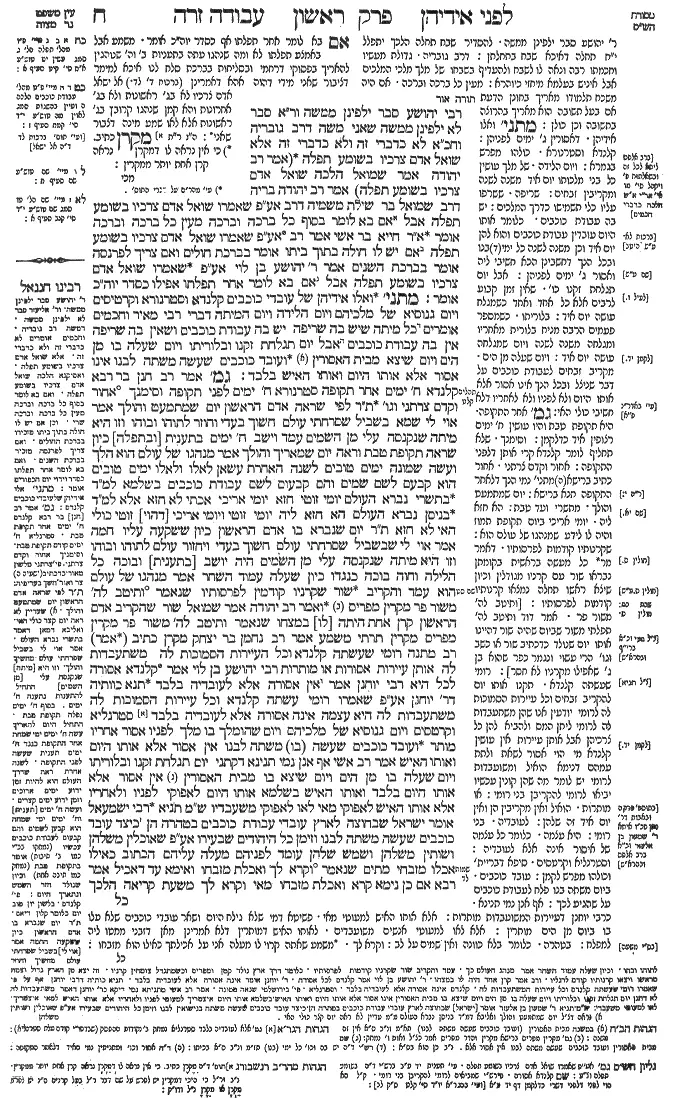
Avodah Zarah 8a - Guemara
רבי יהושע סבר ילפינן ממשה ור"א סבר לא ילפינן ממשה שאני משה דרב גובריה וחכ"א לא כדברי זה ולא כדברי זה אלא שואל אדם צרכיו בשומע תפלה אמר רב יהודה אמר שמואל הלכה שואל אדם צרכיו בשומע תפלה אמר רב יהודה בריה דרב שמואל בר שילת משמיה דרב אע"פ שאמרו שואל אדם צרכיו בשומע תפלה אבל אם בא לומר בסוף כל ברכה וברכה מעין כל ברכה וברכה אומר א"ר חייא בר אשי אמר רב אע"פ שאמרו שואל אדם צרכיו בשומע תפלה אם יש לו חולה בתוך ביתו אומר בברכת חולים ואם צריך לפרנסה אומר בברכת השנים אמר ר' יהושע בן לוי אע"פ שאמרו שואל אדם צרכיו בשומע תפלה אבל אם בא לומר אחר תפלתו אפילו כסדר יוה"כ אומר:
מתני׳ ואלו אידיהן של עובדי כוכבים קלנדא וסטרנורא וקרטיסים ויום גנוסיא של מלכיהם ויום הלידה ויום המיתה דברי רבי מאיר וחכמים אומרים כל מיתה שיש בה שריפה יש בה עבודת כוכבים ושאין בה שריפה אין בה עבודת כוכבים אבל יום תגלחת זקנו ובלוריתו ויום שעלה בו מן הים ויום שיצא מבית האסורין ועובד כוכבים שעשה משתה לבנו אינו אסור אלא אותו היום ואותו האיש בלבד:
גמ׳ אמר רב חנן בר רבא קלנדא ח' ימים אחר תקופה סטרנורא ח' ימים לפני תקופה וסימנך (תהלים קלט, ה) אחור וקדם צרתני וגו' ת"ר לפי שראה אדם הראשון יום שמתמעט והולך אמר אוי לי שמא בשביל שסרחתי עולם חשוך בעדי וחוזר לתוהו ובוהו וזו היא מיתה שנקנסה עלי מן השמים עמד וישב ח' ימים בתענית [ובתפלה] כיון שראה תקופת טבת וראה יום שמאריך והולך אמר מנהגו של עולם הוא הלך ועשה שמונה ימים טובים לשנה האחרת עשאן לאלו ולאלו ימים טובים הוא קבעם לשם שמים והם קבעום לשם עבודת כוכבים בשלמא למ"ד בתשרי נברא העולם יומי זוטי חזא יומי אריכי אכתי לא חזא אלא למ"ד בניסן נברא העולם הא חזא ליה יומי זוטי ויומי אריכי דהוי זוטי כולי האי לא חזא ת"ר יום שנברא בו אדם הראשון כיון ששקעה עליו חמה אמר אוי לי שבשביל שסרחתי עולם חשוך בעדי ויחזור עולם לתוהו ובוהו וזו היא מיתה שנקנסה עלי מן השמים היה יושב בתענית ובוכה כל הלילה וחוה בוכה כנגדו כיון שעלה עמוד השחר אמר מנהגו של עולם הוא עמד והקריב שור שקרניו קודמין לפרסותיו שנאמר (תהלים סט, לב) ותיטב לה' משור פר מקרין מפריס ואמר רב יהודה אמר שמואל שור שהקריב אדם הראשון קרן אחת היתה [לו] במצחו שנאמר ותיטב לה' משור פר מקרין מפריס מקרין תרתי משמע אמר רב נחמן בר יצחק מקרן כתיב אמר רב מתנה רומי שעשתה קלנדא וכל העיירות הסמוכות לה משתעבדות לה אותן עיירות אסורות או מותרות רבי יהושע בן לוי אמר קלנדא אסורה לכל היא רבי יוחנן אמר אין אסורה אלא לעובדיה בלבד תנא כוותיה דר' יוחנן אע"פ שאמרו רומי עשתה קלנדא וכל עיירות הסמוכות לה משתעבדות לה היא עצמה אינה אסורה אלא לעובדיה בלבד סטרנליא וקרטסים ויום גנוסיא של מלכיהם ויום שהומלך בו מלך לפניו אסור אחריו מותר ועובד כוכבים שעשה (בו) משתה לבנו אין אסור אלא אותו היום ואותו האיש אמר רב אשי אף אנן נמי תנינא דקתני יום תגלחת זקנו ובלוריתו ויום שעלה בו מן הים ויום שיצא בו מבית האסורין אין אסור אלא אותו היום בלבד ואותו האיש בשלמא אותו היום לאפוקי לפניו ולאחריו אלא אותו האיש לאפוקי מאי לאו לאפוקי משעבדיו ש"מ תניא רבי ישמעאל אומר ישראל שבחוצה לארץ עובדי עבודת כוכבים בטהרה הן כיצד עובד כוכבים שעשה משתה לבנו וזימן כל היהודים שבעירו אע"פ שאוכלין משלהן ושותין משלהן ושמש שלהן עומד לפניהם מעלה עליהם הכתוב כאילו אכלו מזבחי מתים שנאמר (שמות לד, טו) וקרא לך ואכלת מזבחו ואימא עד דאכיל אמר רבא אם כן נימא קרא ואכלת מזבחו מאי וקרא לך משעת קריאה הלכך
Comments from Rashi on Masechet Avodah Zarah Page 8a
ר' יהושע סבר ילפינן ממשה . להסדיר שבח תחלה הלכך יתפלל י"ח תחלה דאיכא שבח בתחלתן: דרב גובריה . גדולת מעשיו וחכמתו רבה ונאה לו לשבח ולהעדיף בשבחו של מלך מלכי המלכים אבל איניש בעלמא מיחזי כיוהרא: מעין כל ברכה וברכה . אם היה משכח תלמודו מאריך בחונן הדעת אם בעל תשובה הוא מאריך בהרוצה בתשובה וכן כולן: מתני' ואלו אידיהן . דאסורין ג' ימים לפניהן: קלנדא וסטרנורא . כולהו מפרש בגמרא: ויום הלידה . של מלך עושין כל בני מלכותו יום איד משנה לשנה ומקריבין זבחים: שריפה . ששרפו עליו כלי תשמישו כדרך המלכים: יש בה עבודת כוכבים . כלומר אותו היום עובדין עבודת כוכבים והוא להן יום איד וכן משנה לשנה כל ימי בנו. ובכל הנך דחשבינן הכא חשיבי ליה ואסור ג' ימים לפניהן: אבל יום תגלחת זקנו כו' . שאין זמן קבוע לרבים אלא כל אחד ואחד כשמגלח עושה יום איד: בלוריתו . כשמספר פעמים הרבה מניח בלורית מאחריו ומגלחה משנה לשנה ויום שמגלחה עושה יום איד: ויום שעלה מן הים . מקריב זבחים לעבודת כוכבים על דבר שניצל. ובכל הנך אינו אסור אלא אותו היום ולא לפניו ולא לאחריו דלא חשיבי כולי האי: גמ' אחר התקופה . היא תקופת טבת והיו עושין ח' ימים רצופין איד כדלקמן: וסימנך . שלא תחליף לומר קלנדא קרי אותן דלפני התקופה: אחור וקדם צרתני . אחור כתיב ברישא מתני' נמי הנך דלאחר התקופה תנא ברישא: יום שמתמעט והולך . מתשרי ועד טבת: הא חזא ליה . יומי אריכי ביום תקופת תמוז והיה לו לידע שמנהגו של עולם הוא: שקרנותיו קודמות לפרסותיו . דאמר מר כל מעשה בראשית בקומתן נבראו שור עם קרניו מגודלין וכיון שיצא ראשו תחלה נמצאו קרנותיו קודמות לפרסותיו: [ותיטב לה' משור פר . אמר דוד ותיטב לה' תפלתי משור שביום שהיה שור דהיינו אותו יום שנולד כדכתיב שור או כשב וגו' הרי עשוי ונגמר כפר שהוא בן ג' שאפילו מקרניו לא חסר]: רומי שעשתה קלנדא . תקנו אותו יום להקריב זבחים וכל עיירות הסמוכות לה לרומי יודעין אנו שהן משתעבדות לה לרומי ליתן המס ולהביא להן כל צרכיהן אבל אותן עיירות אין עושין קלנדא מי הוי אסור לשאת ולתת עמהם דנימא הואיל ומשועבדות לרומי יש לומר מה שהן קונין עכשיו יביאו לרומי להקריבן בני רומי: או מותרות . הואיל ואין מקריבין הן ואין יום איד זה שלהן: לעובדיה . בני רומי: היא עצמה . כלומר כל עצמה של איסור אינה אלא לעובדיה: וסטרנליא וקרטסים . סיפא דבריית' וכולהו מפרש לקמן: עובד כוכבים . ביום משתה בנו פלח לעבודת כוכבים על שהגיע לכך: אף אנן נמי תנינא . כרבי יוחנן דעיירות המשועבדות מותרות: אלא אותו האיש למעוטי מאי . פשיטא דמי שלא גילח היום ושאר עובדי כוכבים שלא עלו בו ביום מן הים מותרין: אלא לאו למעוטי אנשים משועבדים . לאותו האיש דמותרין דלא אמרינן מאן דזבני ממטו ליה למפלח: בטהרה . כלומר בלא כוונה ואין שמים על לב: וקרא לך . משמע שאתה קרוי לו מעלה אני על אכילתך כאילו הוא מזבחו:
Comments from Tosafot - Avodah Zarah 8a
אם בא לומר אחר תפלתו אף כסדר יוה"כ אומר . משמע אבל באמצע תפלתו לא ומה שנהגו עתה בתעניות ב' וה' שנוהגין להאריך בפסוקי דרחמי ובסליחות בברכת סלח לנו איכא למימר דציבור שאני מידי דהוה אהא דאמרינן (ברכות ד' לד.) אל ישאל אדם צרכיו לא בג' ראשונות ולא בג' אחרונות והא קמן שנהגו קרובץ בג' ראשונות אלא לאו שמע מינה דצבור שאני: ה"ג ר"ת מקרן כתיב . כי אין נראה לו דמקרן נראה קרן אחת יותר ממקרין:
Avodah Zarah 8a - Mishnah translated into english
Rabbi Yehoshua holds that we derive from the case of Moses that one should first praise God in prayer and only afterward issue personal requests. And Rabbi Eliezer holds that we do not derive from Moses how to act, since Moses is different, as his might is great, i.e., he knew how to pray to God in this order. And the Rabbis say: The halakha is not in accordance with the statement of this Sage, who says that one should issue personal requests before praying, nor is it in accordance with the statement of that Sage, who says that personal requests should follow prayer. Rather, a person requests his own needs in the blessing ending: Who listens to prayer. Therefore, when Naḥum the Mede stated that this is the halakha, he was merely concurring with the opinion of the Rabbis.
With regard to the halakhic ruling, Rav Yehuda says that Shmuel says: The halakha is that a person requests his own needs during the Amida prayer in the blessing ending: Who listens to prayer. Rav Yehuda, son of Rav Shmuel bar Sheilat, says in the name of Rav: Although the Sages said that a person requests his own needs in the blessing ending: Who listens to prayer, that is not the only option. Rather, if he wishes to recite at the conclusion of each and every blessing personal requests that reflect the nature of each and every blessing, he may recite them.
Similarly, Rav Ḥiyya bar Ashi says that Rav says: Although the Sages said that a person requests his own needs in the blessing ending: Who listens to prayer, if he has a sick person in his house he recites a special prayer for him during the blessing of the sick. And if he is in need of sustenance, he recites a request during the blessing of the years.
Rabbi Yehoshua ben Levi says: Although the Sages said that a person requests his own needs in the blessing ending: Who listens to prayer; but if one wishes to recite prayers and supplications after finishing his Amida prayer, even if his personal requests are as long as the order of the confession of Yom Kippur, he may recite them.
MISHNA: And these are the festivals of gentiles: Kalenda, Saturnalia, and Kratesis, and the day of the festival of their kings, and the birthday of the king, and the anniversary of the day of the death of the king. This is the statement of Rabbi Meir. And the Rabbis say: Every death that includes public burning is a festival that includes idol worship, and any death that does not include public burning is not a festival that includes idol worship. But in the case of the day of shaving his, i.e., a gentile’s, beard and his locks, and the day of his ascent from the sea, and the day that he left prison, and also in the case of a gentile who prepared a wedding feast for his son and celebrates on that day, engaging in business is prohibited only on that day and with that man.
GEMARA: Rav Ḥanan bar Rava says: When are these festivals celebrated? Kalenda is celebrated during the eight days after the winter solstice, and Saturnalia is celebrated during the eight days before the winter solstice. And your mnemonic to remember which festival is that the one that occurs after the solstice is mentioned first in the mishna, and the festival that takes place before the solstice is mentioned after, as in the verse: “You have hemmed me in behind and before, and laid Your Hand upon me” (Psalms 139:5), where the word “before” appears after the term “behind.”
With regard to the dates of these festivals, the Sages taught: When Adam the first man saw that the day was progressively diminishing, as the days become shorter from the autumnal equinox until the winter solstice, he did not yet know that this is a normal phenomenon, and therefore he said: Woe is me; perhaps because I sinned the world is becoming dark around me and will ultimately return to the primordial state of chaos and disorder. And this is the death that was sentenced upon me from Heaven, as it is written: “And to dust shall you return” (Genesis 3:19). He arose and spent eight days in fasting and in prayer.
Once he saw that the season of Tevet, i.e., the winter solstice, had arrived, and saw that the day was progressively lengthening after the solstice, he said: Clearly, the days become shorter and then longer, and this is the order of the world. He went and observed a festival for eight days. Upon the next year, he observed both these eight days on which he had fasted on the previous year, and these eight days of his celebration, as days of festivities. He, Adam, established these festivals for the sake of Heaven, but they, the gentiles of later generations, established them for the sake of idol worship.
The Gemara raises a difficulty: Granted, according to the one who says that the world was created in the month of Tishrei, one can understand why Adam believed that the days were becoming shorter as part of his punishment, as he saw the short days of the winter and had not yet seen the long days of summer. But according to the one who says that the world was created in the month of Nisan, he had already seen the difference between the short days and the long days, as the days in the month of Nisan become progressively longer with the passage of time. The Gemara answers: Although Adam had experienced short days, he had not seen days that were this short, as in the days before the winter solstice.
The Sages taught: On the day that Adam the first man was created, when the sun set upon him he said: Woe is me, as because I sinned, the world is becoming dark around me, and the world will return to the primordial state of chaos and disorder. And this is the death that was sentenced upon me from Heaven. He spent all night fasting and crying, and Eve was crying opposite him. Once dawn broke, he said: Evidently, the sun sets and night arrives, and this is the order of the world. He arose and sacrificed a bull whose horns preceded its hoofs in the order that they were created, as it is stated: “And it shall please the Lord better than a bullock that has horns and hoofs” (Psalms 69:32). This verse is referring to the one particular bull whose horns preceded its hoofs.
And Rav Yehuda says that Shmuel says: The bull that Adam the first man sacrificed had one horn in its forehead, as it is stated: “And it shall please the Lord better than a bullock that has horns [makrin] and hooves.” The Gemara raises a difficulty: Isn’t makrin plural, which indicates two horns? Rav Naḥman bar Yitzḥak says: Mikkeren is written, i.e., the letter yod is missing from the word, indicating that there was only one horn.
§ Rav Mattana says: Since Rome established the festival of Kalenda on a specific date, and all of the nearby towns are ruled by Rome, i.e., they pay their tax to Rome and provide its needs but do not themselves celebrate the festival, is it prohibited or permitted to engage in business transactions with the gentile residents of those towns? Rabbi Yehoshua ben Levi says: It is prohibited to engage in business during the time of the Kalenda with everyone. Rabbi Yoḥanan says: It is prohibited to engage in business only with its worshippers, whereas it is permitted to engage in business transactions with gentiles who do not celebrate the festival.
The Sage taught in a baraita in accordance with the opinion of Rabbi Yoḥanan: Although they said that Rome has established the festival of Kalenda and all of the nearby towns are ruled by Rome, it is prohibited to engage in business only with its worshippers.
The baraita continues: With regard to the festivals Saturnalia and Kratesis, and the day of the festival of their kings, and the day on which the king was crowned, the halakha is that before the festival it is prohibited to engage in business transactions, whereas after the festival it is permitted. But in the case of a gentile who prepared a feast for his son and celebrates on that day, engaging in business is prohibited only on that day itself and with that man.
Rav Ashi said: We learn in the mishna as well in accordance with Rabbi Yoḥanan’s statement that the prohibition applies only to gentiles who celebrate the festival, not to people who are ruled by them. As the mishna teaches: With regard to the day of shaving his beard and his locks, and the day of his ascent from the sea, and the day that he left prison, engaging in business is prohibited only on that day and with that man.
Rav Ashi explains the proof: Granted, the mishna specifies that the prohibition is limited to that day alone, in order to exclude the days before and after it. But when it states that the prohibition applies only to that man, what does the mishna exclude? Obviously the prohibition does not extend to all gentiles, as it is a personal festival. Doesn’t the mishna’s ruling serve to exclude those who are ruled by him? Therefore, conclude from the language of the mishna that a prohibition extends only to gentiles who celebrate the festival, not to those who are ruled by them.
It is taught in a baraita that Rabbi Yishmael says: Jews who are outside of Eretz Yisrael are considered to engage in idol worship in purity, i.e., unwittingly. How does this occur? In the case of a gentile who prepared a feast for the marriage of his son, and invited all of the Jews in his town, even though they eat of their own kosher food and drink of their own kosher beverages, and their own attendant stands before them, the verse ascribes guilt to them as though they ate of the offerings to the dead, i.e., idols, as it is stated: “And sacrifice to their gods, and they call you, and you eat of their sacrifice” (Exodus 34:15). Since Jews participate in a feast in which the gentile sacrifices offerings to his idol, it is as though they partook of the offering themselves.
The Gemara asks: But why not say that the verse is criticizing the Jews only once they eat from the sacrifice? Rava said: If that is what is meant, let the verse say only: And you eat of their sacrifice. What is meant by the additional phrase: “And they call you”? This indicates that the prohibition occurs from the time of the call. Therefore,
Traduction : The William Davidson digital edition of the Koren Noé Talmud, with commentary by Rabbi Adin Even-Israel Steinsaltz.