 Talmud Bavli
Zevahim 91b : Youtube
Daf TubeYoutube
2 video classes :
Zevahim Page 91b
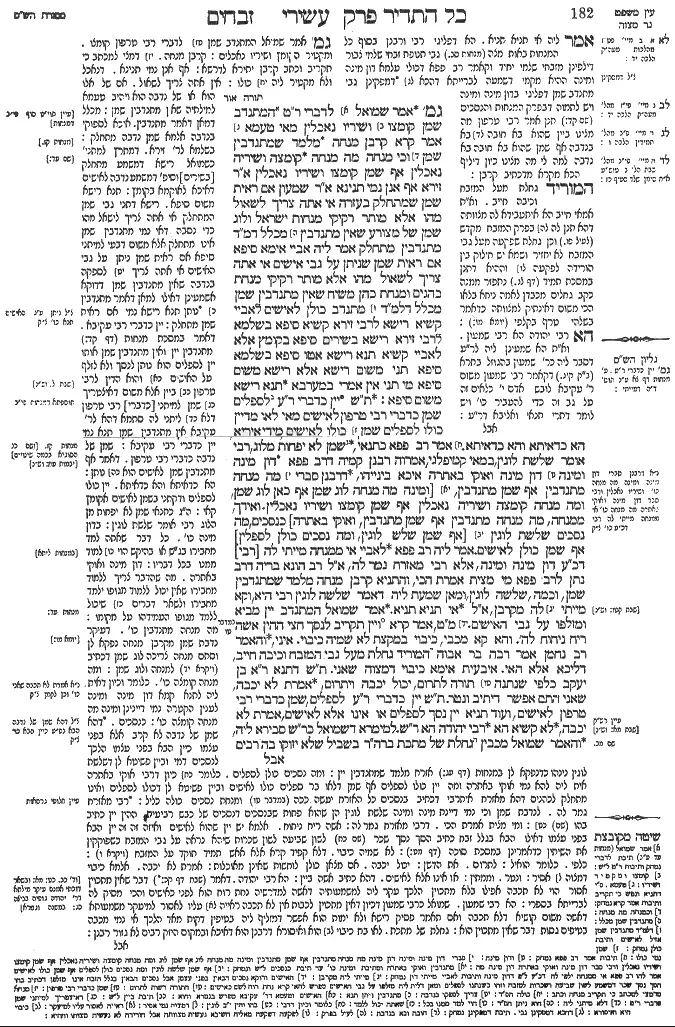
Zevahim 91b - Guemara
גמ׳ אמר שמואל לדברי ר"ט המתנדב שמן קומצו ושיריו נאכלין מאי טעמא אמר קרא קרבן מנחה מלמד שמתנדבין שמן וכי מנחה מה מנחה קומצה ושיריה נאכלין אף שמן קומצו ושיריו נאכלין א"ר זירא אף אנן נמי תנינא א"ר שמעון אם ראית שמן שמתחלק בעזרה אי אתה צריך לשאול מהו אלא מותר רקיקי מנחות ישראל ולוג שמן של מצורע שאין מתנדבין מכלל דמ"ד מתנדבין מתחלק אמר ליה אביי אימא סיפא אם ראית שמן שניתן על גבי אישים אי אתה צריך לשאול מהו אלא מותר רקיקי מנחת כהנים ומנחת כהן משיח שאין מתנדבין שמן מכלל דלמ"ד מתנדב כולן לאישים לאביי קשיא רישא לרבי זירא קשיא סיפא בשלמא לרבי זירא רישא בשירים סיפא בקומץ אלא לאביי קשיא תנא רישא אטו סיפא בשלמא סיפא תני משום רישא אלא רישא משום סיפא מי תני אין אמרי במערבא תנא רישא משום סיפא:
ת"ש יין כדברי ר"ע לספלים שמן כדברי רבי טרפון לאישים מאי לאו מדיין כולו לספלים שמן כולו לאישים מידי איריא הא כדאיתא והא כדאיתא אמר רב פפא כתנאי שמן לא יפחות מלוג רבי אומר שלשת לוגין במאי קמיפלגי אמרוה רבנן קמיה דרב פפא דון מינה ומינה דון מינה ואוקי באתרה איכא בינייהו דרבנן סברי מה מנחה מתנדבין אף שמן מתנדבין [ומינה מה מנחה לוג שמן אף כאן לוג שמן ומה מנחה קומצה ושיריה נאכלין אף שמן קומצו ושיריו נאכלין ואידך ממנחה מה מנחה מתנדבין אף שמן מתנדבין ואוקי באתרה] כנסכים מה נסכים שלשת לוגין [אף שמן שלש לוגין ומה נסכים כולן לספלין] אף שמן כולן לאישים אמר ליה רב פפא לאביי אי ממנחה מייתי לה [רבי] דכ"ע דון מינה ומינה אלא רבי מאזרח גמר לה א"ל רב הונא בריה דרב נתן לרב פפא מי מצית אמרת הכי והתניא קרבן מנחה מלמד שמתנדבין שמן וכמה שלשה לוגין ומאן שמעת ליה דאמר שלשה לוגין רבי היא וקא מייתי לה מקרבן א"ל אי תניא תניא אמר שמואל המתנדב יין מביא ומזלפו על גבי האישים מ"ט אמר קרא (במדבר טו, י) ויין תקריב לנסך חצי ההין אשה ריח ניחוח לה' והא קא מכבי כיבוי במקצת לא שמיה כיבוי איני והאמר רב נחמן אמר רבה בר אבוה המוריד גחלת מעל גבי המזבח וכיבה חייב דליכא אלא האי איבעית אימא כיבוי דמצוה שאני ת"ש דתנא ר"א בן יעקב כלפי שנתנה תורה לתרום יכול יכבה ויתרום אמרת לא יכבה שאני התם אפשר דיתיב ונטר ת"ש יין כדברי ר"ע לספלים שמן כדברי רבי טרפון לאישים ועוד תניא יין נסך לספלים או אינו אלא לאישים אמרת לא יכבה לא קשיא הא רבי יהודה הא ר"ש למימרא דשמואל כר"ש סבירא ליה והאמר שמואל מכבין גחלת של מתכת ברה"ר בשביל שלא יזוקו בה רבים
Comments from Rashi on Masechet Zevahim Page 91b
גמ' אמר שמואל המתנדב שמן לדברי רבי טרפון קומצו . ומקטיר הקומץ ושיריו נאכלים: קרבן מנחה . דמצי למכתב כי תקריב וכתב קרבן יתירא לדרשא: אף אנן נמי תנינא . דנאכל ולא מקטיר ליה כולו: אין אתה צריך לשאול . אם של אלו הוא או של נדבה הוא ויהיב טעמא למילתיה שאין מתנדבין שמן: מכלל דמאן דאמר מתנדבין . איכא לספוקי בנדבה אלמא שמן נדבה מתחלק: בשלמא לר' זירא . דמתרץ למתני' כשמואל רישא דמשמע מתחלק [בשירים] וסיפ' דמשמע נדבה לאישים דאיכא לאוקמא בקומץ: תנא רישא משום סיפא . רישא דתני גבי שמן המתחלק אי אתה צריך לישאל מהו כדי נסבה דאי נמי מתנדבין שמן אינו מתחלק אלא משום דבעי למיתני סיפא אם ראית שמן ניתן על גבי האישים אי אתה צריך לספקה בנדבה שאין מתנדבין שמן דדוקא אשמעינן דאילו למאן דאמר מתנדבין נותן תנא רישא נמי אם ראית שמן מתחלק: יין כדברי רבי עקיבא . דאמר במסכת מנחות (דף קד:) מתנדבין יין ואין מתנדבין שמן אותו יין לספלים הוא נותן לנסך ולא לזלף על האישים והוא הדין לרבי טרפון ביין אלא משום דאיצטריך שמן למיתני [כדברי] רבי טרפון דלא ליתני לה סתמא דהא לר' עקיבא אין מתנדבין שמן תנא נמי יין כדברי רבי עקיבא: שמן של נדבה כדברי רבי טרפון . דאמר אף מתנדבין שמן לאישים הוא נותן: הא כדאיתא והא כדאיתא . יין כולו לספלים ודקתני בשמן לאישים אקומץ קאי: ה"ג כתנאי שמן לא יפחות מן הלוג רבי אומר שלשת לוגין: בדון מינה כו' . כל דבר שאתה למד מחבירו בג"ש או בהיקש הוי למוד ממנו בכל דבריו: דון מינה ואוקי באתרה . מה שהדבר צריך ללמוד מחבירו שאין יכול ללמוד מגופו ילמד מחבירו ולשאר דברים שיכול ללמד מגופו העמידהו על מקומו: מה מנחה מתנדבין כו' . דעיקר נדבת שמן מקרבן מנחה נפקא לן וסתם מנחה צריכה לוג שמן דכתיב (ויקרא יד) למנחה ולוג שמן: ומה מנחה קומצה כו' . כלומר וכיון דאית ליה לתנא קמא דון מינה ומינה לענין הקטרה נמי דיינינן ומינה מה מנחה קומצה כו': כנסכים . דהא שמן של נדבה לא קרב אלא בפני עצמו כיין הבא בפני עצמו הלכך לנסכים דמי וביין פשיטא לן דשלשת לוגין נינהו כדנפקא לן במנחות (דף עג:) אזרח מלמד שמתנדבין יין: ומה נסכים כולן לספלים . כלומר כיון דרבי אוקי באתרה אית ליה להא נמי אוקי באתרה ומה יין כולו לספלים אף שמן דלאו בר ספלים כולו לאישים וביין פשיטא לן דכולו לספלים ואינו מתחלק לכהנים דהא מאזרח איתרבי דכתיב בנסכים כל האזרח יעשה ככה (במדבר טו) ומנחת נסכים כולה כליל: רבי מאזרח גמר לה . לנדבת שמן וכי נמי דיינת מינה ומינה שלשת לוגין הן שהוא פחות שבנסכים דנסכים של כבש רביעית ההין יין כתיב בהו (שם): ומי מצית אמרת הכי . דרבי מאזרח גמר לה: אשה ריח ניחוח . אלמא יש יין שהוא לאישים ואיזה זה זה יין הבא בפני עצמו דאילו הבא בגלל זבח כתיב הסך נסך שכר (שם כח) לשון שביעה לשון שכרות שיהא נראה על גבי המזבח כשפוקקין את השיתין כדאמרינן במסכת סוכה (דף מט:): לא שמיה כיבוי . דלא קפיד קרא אלא אאש תמיד תוקד על המזבח (ויקרא ו): כלפי . כלומר הואיל: לתרום . את הדשן: יכול יכבה . אם מצאן כולן לוחשות שאינן מאוכלות: אמרת לא יכבה . אלמא כיבוי דמצוה אסיר: ונטר . וממתין: או אינו אלא לאישים . דהא כתיב אשה ביין: הא רבי יהודה . דאמר (שבת דף קכ:) דבר שאין מתכוין אסור הוי לא תכבה אפילו בלא מתכוין הלכך עקר ליה למשמעותיה דאשה למדרשיה נחת רוח הוא לפני כאישים והכי מסיק לה לברייתא בספרי: הא רבי שמעון . שמואל כרבי שמעון דכיון דאין מתכוין לכבות אין לא תכבה ראייה עליו לאסור למיעקר משמעותא דאשה משום קושיא דלא תכבה ואם תאמר פסיק רישא ולא ימות הוא אפשר דמזליף ליה בטיפין דקות מאד הלכך אי נמי מכבה בטיפים גסות דבר שאין מתכוין הוא: גחלת של מתכת . לאו בת כיבוי הוא ואיסורא דרבנן הוא דאיכא ובמקום היזק רבים לא גזור רבנן:
Comments from Tosafot - Zevahim 91b
אמר ליה אי תניא תניא . הא דפליגי רבי ורבנן בסוף כל המנחות באות מצה (מנחות סב.) גבי תנופת זבחי שלמי צבור דילפינן מזבחי שלמי יחיד וקאמר רב פפא דכולי עלמא דון מינה ומינה ההיא מקמי דשמעה לברייתא דהכא דמפקינן גבי מתנדב שמן דפליגי בדון מינה ומינה ויש לתמוה דבפרק המנחות והנסכים (שם קד:) תנן אמר רבי טרפון מה מצינו ביין שהוא בא חובה בא בנדבה אף שמן שהוא בא חובה בא נדבה למה לי מה מצינו כיון דיליף הכא מקרא מדכתיב קרבן: המוריד גחלת מעל המזבח וכיבה חייב . וא"ת אמאי חייב הא איתעבידא לה מצוותה דהא תנן לה בפרק המזבח מקדש (לעיל זבחים פו.) וכן גחלת שפקעה מעל גבי המזבח לא יחזיר ושמא יש חילוק בין הורידה לפקעה וההיא דתנן במסכת תמיד (דף לג.) נתפזר ממנה כקב גחלים מכבדן לאמה ניחא בלאו הכי משום דאינתיק למצוותה כדאמר בשלהי טרף בקלפי (יומא מו:): הא רבי יהודה הא רבי שמעון . וא"ת הא שמעינן ליה לר"ע דסבר ליה כר' שמעון בהגוזל בתרא (ב"ק קיג.) דקאמר רבי שמעון משום ר' עקיבא לובש אדם י' כלאים זה על גב זה כדי להעביר כו' ויש לומר דתרי תנאי ואליבא דר"ע:
Zevahim 91b - Mishnah translated into english
GEMARA: Shmuel says: According to the statement of Rabbi Tarfon that oil may be sacrificed as a gift offering, in the case of one who contributes oil, a priest removes a handful of the oil and sacrifices it on the altar, and its remainder is eaten by the priests. What is the reason for the ruling of Shmuel? The verse states: “And when one brings a meal offering [korban minḥa]” (Leviticus 2:1). The superfluous word korban teaches that one may contribute oil, and its status is like that of a meal offering: Just as with regard to a meal offering the priest removes a handful and its remainder is eaten, so too with regard to oil, the priest removes a handful and its remainder is eaten.
Rabbi Zeira said that we learn this halakha in the mishna as well: Rabbi Shimon said: If you saw oil that is being distributed in the Temple courtyard, you do not need to ask what it is; rather, it is left over from the oil of the wafers of the meal offerings of Israelites, or it is left over from the log of oil of a leper, as one does not contribute oil as a gift offering. Rabbi Zeira learns by inference from the mishna that according to the one who says that one may contribute oil, it is distributed to the priests for consumption and it is not sacrificed entirely.
Abaye said to Rabbi Zeira: Say the last clause of the mishna: If you saw oil that is placed on the flames of the altar, you do not need to ask what it is; rather, it is left over from the oil of the wafers of the meal offering of priests or it is left over from the meal offering of the anointed priest, as one does not contribute oil as a gift offering. Abaye learns by inference from the mishna that according to the one who says that one may contribute oil, it is burned in its entirety in the flames on the altar. This contradicts Shmuel’s statement that according to Rabbi Tarfon only a handful of the oil is burned on the altar. The Gemara comments: For Abaye the inference from the first clause of the mishna is difficult, while for Rabbi Zeira the inference from the last clause is difficult.
The Gemara continues: Granted, according to Rabbi Zeira, the inference from the first clause that the oil is distributed for consumption by the priests can be explained as referring to the remainder of the oil, whereas the inference from the last clause that the oil is burned on the altar is referring to the handful removed from the oil. But according to Abaye, the contradictory inferences pose a difficulty. The Gemara answers: One cannot infer anything from the first clause, as the mishna taught the first clause due to the last clause. That is, as the tanna of the mishna wishes to teach the last clause in a certain manner, he teaches the first clause in a similar style, despite the fact that one might come to an erroneous conclusion from the wording of the first clause.
The Gemara asks: Granted, a tanna may teach the last clause of a mishna due to the first clause, i.e., a tanna might teach in a similar formulation to one he had already used. But would a tanna teach the first clause of a mishna due to the last clause? The Gemara answers: Yes; they say in the West, Eretz Yisrael, that a tanna taught the first clause due to the last clause.
The Gemara cites a proof: Come and hear a baraita: If one contributes wine, according to the statement of Rabbi Akiva that one may contribute wine, it is poured into the basins adjacent to the corner of the altar. If one contributes oil, according to the statement of Rabbi Tarfon that one may contribute oil, it is burned in the flames of the altar. What, is it not possible to infer from the fact that the wine is poured in its entirety into the basins that the oil is likewise burned in its entirety in the flames of the altar, contrary to Shmuel’s statement? The Gemara rejects this proof: Are the cases comparable? This case is as it is and that case is as it is, i.e., the donations of wine and the oil are separate cases, and the two statements of the baraita need not accord with each other.
Rav Pappa said: Shmuel’s statement is like one side of a dispute between tanna’im, as it is taught in a baraita: One who contributes oil should not bring less than a log. Rabbi Yehuda HaNasi says: Three log. The Gemara asks: With regard to what principle do the first tanna and Rabbi Yehuda HaNasi disagree? The Sages said this before Rav Pappa: They disagree with regard to the nature of an inference by means of verbal analogy or juxtaposition: Is the secondary case equated to the primary case in all aspects, in accordance with the exegetical principle: Infer from it and again from it; or does the comparison extend only to one specific issue derived from the primary case, in accordance with the principle: Infer from it but interpret the halakha according to its own place, i.e., in all other aspects the cases are not equated?
The Gemara explains that this is the difference between them, as the Rabbis hold by the principle: Infer from it and again from it. The Gemara explains the application of this principle: Just as a meal offering is contributed, so too, oil is contributed, as inferred from the verse addressing the meal offering. And again one infers from this source: Just as a meal offering requires a log of oil, so too here, an offering of oil alone must be a log of oil. And just as with regard to a meal offering the priest removes a handful and its remainder is eaten, so too with regard to oil, the priest removes a handful and its remainder is eaten.
And the other, Rabbi Yehuda HaNasi, holds by the principle: Infer from it but interpret the halakha according to its own place. The Gemara explains that here too, one infers from the case of a meal offering: Just as a meal offering is contributed, so too, oil is contributed. But with regard to all other aspects of this halakha, interpret the halakha according to its own place, and its status is like that of wine libations, which are similar to oil in that they are also poured onto the altar: Just as one contributes libations of three log, so too, when one contributes oil one contributes three log; and just as libations are poured in their entirety into the basins, so too, the oil is burned in its entirety in the flames of the altar.
Rav Pappa said to Abaye: If Rabbi Yehuda HaNasi cited the source of the gift offering of oil from the verse addressing the meal offering he would not disagree with the Rabbis, as everyone employs the principle of: Infer from it and again from it. Rather, Rabbi Yehuda HaNasi derives the gift offering of oil from a verse that deals with libations: “All that are homeborn shall do these things after this manner, in presenting an offering made by fire” (Numbers 15:13). Rabbi Yehuda HaNasi derives from here that just as one may contribute wine libations, so too, one may contribute oil. Therefore, Rabbi Yehuda HaNasi compares oil to wine libations: Just as one contributes libations of three log, so too, one contributes three log of oil.
Rav Huna, son of Rav Natan, said to Rav Pappa: How can you say that, i.e., that according to Rabbi Yehuda HaNasi the source of the gift offering of oil is not from the meal offering? But isn’t it taught in a baraita with regard to the verse: “And when one brings a meal offering [korban minḥa]” (Leviticus 2:1), that the superfluous word korban teaches that one may contribute oil? The baraita continues: And how much must one contribute? Three log. The Gemara explains the question: And whom did you hear who says the gift offering of oil is three log? This is the opinion of Rabbi Yehuda HaNasi, and yet he cites the source of the gift offering of oil from the word korban, which is referring to a meal offering. Rav Pappa said to him: If this baraita is taught, it is taught; and I cannot take issue with it.
§ Shmuel says: One who contributes wine brings it and sprinkles it on the flames of the altar. What is the reason for this? The verse states: “And you shall present for the libation half a hin of wine, for an offering made by fire, of a pleasing aroma to the Lord” (Numbers 15:10). The verse indicates that there is a type of wine libation which is an offering made by fire. The Gemara challenges: But he thereby extinguishes the fire on the altar, and the Torah states: “A perpetual fire shall be kept burning on the altar, it shall not go out” (Leviticus 6:6). The Gemara explains: Extinguishing in a partial manner is not called extinguishing; in other words, this act is not included in the prohibition.
The Gemara asks: Is that so? But doesn’t Rav Naḥman say that Rabba bar Avuh says: One who takes down a coal from upon the altar and extinguishes it is liable for violating the prohibition: “It shall not go out”? The Gemara answers: This statement is referring to a situation where there is only this coal on the altar, and therefore the fire is entirely extinguished. If you wish, say instead that even if partial extinguishing is prohibited, extinguishing for the sake of a mitzva, as in the case of sprinkling wine on the altar, is different, and is permitted.
The Gemara challenges: Come and hear a baraita that Rabbi Eliezer ben Ya’akov teaches: Since the Torah gave a mitzva to remove the ashes of the offerings from the altar, one might have thought that it is permitted to extinguish the coals so that they become ashes and then to remove them. Therefore, you say: He shall not extinguish, in accordance with the verse: “It shall not go out.” Although this is a case of extinguishing for the sake of a mitzva, the baraita deems it prohibited. The Gemara explains: It is different there, as it is possible for the priest to sit and wait until some of the coals become ashes, and then remove them. By contrast, with regard to wine, there is no alternative to sprinkling the wine on the fire, and therefore it is permitted.
The Gemara challenges: Come and hear a baraita that prohibits sprinkling wine on the fire of the altar: If one contributes wine, according to the statement of Rabbi Akiva that one may contribute wine, it is poured into the basins on the altar. If one contributes oil, according to the statement of Rabbi Tarfon that one may contribute oil, it is poured onto the flames of the altar. And it is furthermore taught in a baraita: The wine libation is poured into the basins. The baraita suggests: Or perhaps it is not so; rather, it is poured onto the flames. Therefore, you say: He shall not extinguish.
The Gemara answers: This is not difficult, as that baraita is in accordance with the opinion of Rabbi Yehuda, who holds that even an unintentional action, i.e., a permitted action from which a prohibited action inadvertently ensues, is prohibited; and this statement of Shmuel is in accordance with the opinion of Rabbi Shimon, who maintains that a permitted action from which a prohibited action inadvertently ensues is permitted. The Gemara asks: Is this to say that Shmuel holds in accordance with the opinion of Rabbi Shimon? But doesn’t Shmuel say: One may extinguish a piece of white-hot metal in a public thoroughfare on Shabbat so that the masses will not be injured by it;
Traduction : The William Davidson digital edition of the Koren Noé Talmud, with commentary by Rabbi Adin Even-Israel Steinsaltz.