 Talmud Bavli
Zevahim 113b : Youtube
Daf TubeYoutube
2 video classes :
Zevahim Page 113b
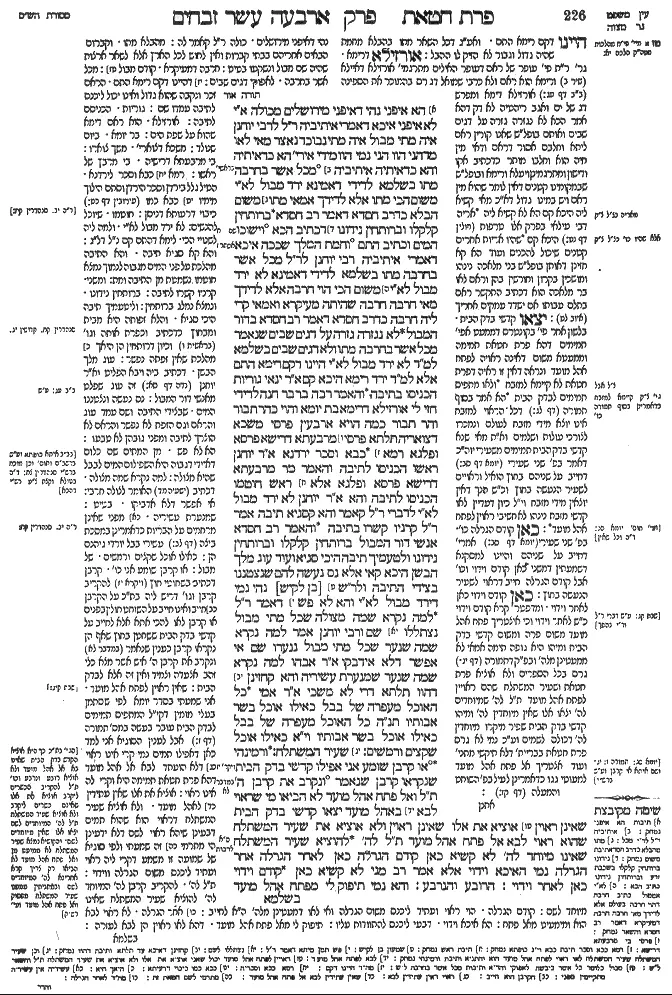
Zevahim 113b - Guemara
הא איפני נהי דאיפני מירושלים מכולה א"י לא איפני איכא דאמרי איתיביה ר"ל לרבי יוחנן איה מתי מבול איה מתי נבוכדנאצר מאי לאו מדהני הוו הני נמי הוו מידי אירי' הא כדאיתיה והא כדאיתיה איתיביה (בראשית ז, כב) מכל אשר בחרבה מתו בשלמא לדידי דאמינא ירד מבול לא"י משום הכי מתו אלא לדידך אמאי מתו משום הבלא כדרב חסדא דאמר רב חסדא ברותחין קלקלו וברותחין נידונו דכתיב הכא (בראשית ח, א) וישוכו המים וכתיב התם (אסתר ז, י) וחמת המלך שככה איכא דאמרי איתיביה רבי יוחנן לר"ל מכל אשר בחרבה מתו בשלמא לדידי דאמינא לא ירד מבול לא"י משום הכי הוי חרבה אלא לדידך מאי חרבה חרבה שהיתה מעיקרא ואמאי קרי ליה חרבה כדרב חסדא דאמר רב חסדא בדור המבול לא נגזרה גזרה על דגים שבים שנאמר מכל אשר בחרבה מתו ולא דגים שבים בשלמא למ"ד לא ירד מבול לא"י היינו דקם רימא התם אלא למ"ד ירד רימא היכא קם א"ר ינאי גוריות הכניסו בתיבה והאמר רבה בר בר חנה לדידי חזי לי אורזילא דרימא בת יומא והוי כהר תבור והר תבור כמה הויא ארבעין פרסי משכא דצואריה תלתא פרסי מרבעתא דרישא פרסא ופלגא רמא כבא וסכר ירדנא א"ר יוחנן ראשו הכניסו לתיבה והאמר מר מרבעתא דרישא פרסא ופלגא אלא ראש חוטמו הכניסו לתיבה והא א"ר יוחנן לא ירד מבול לא"י לדברי ר"ל קאמר והא קסגיא תיבה אמר ר"ל קרניו קשרו בתיבה והאמר רב חסדא אנשי דור המבול ברותחין קלקלו וברותחין נידונו ולטעמיך תיבה היכי סגיא ועוד עוג מלך הבשן היכא קאי אלא נס נעשה להם שנצטננו בצידי התיבה ולר"ש [בן לקיש] נהי נמי דירד מבול לא"י והא לא פש דאמר ר"ל למה נקרא שמה מצולה שכל מתי מבול נצתללו שם ורבי יוחנן אמר למה נקרא שמה שנער שכל מתי מבול ננערו שם אי אפשר דלא אידבקו א"ר אבהו למה נקרא שמה שנער שמנערת עשיריה והא קחזינן דהוו תלתא דרי לא משכי א"ר אמי כל האוכל מעפרה של בבל כאילו אוכל בשר אבותיו תנ"ה כל האוכל מעפרה של בבל כאילו אוכל בשר אבותיו וי"א כאילו אוכל שקצים ורמשים:
שעיר המשתלח:
ורמינהי (ויקרא יז, ד) או קרבן שומע אני אפילו קדשי בדק הבית שנקראו קרבן שנאמר (במדבר לא, נ) ונקרב את קרבן ה' ת"ל ואל פתח אהל מועד לא הביאו מי שראוי לבא באהל מועד יצאו קדשי בדק הבית שאינן ראוין אוציא את אלו שאינן ראוין ולא אוציא את שעיר המשתלח שהוא ראוי לבא אל פתח אהל מועד ת"ל לה' להוציא שעיר המשתלח שאינו מיוחד לה' לא קשיא כאן קודם הגרלה כאן לאחר הגרלה אחר הגרלה נמי האיכא וידוי אלא אמר רב מני לא קשיא כאן קודם וידוי כאן לאחר וידוי:
הרובע והנרבע:
והא נמי תיפוק לי מפתח אהל מועד
Comments from Rashi on Masechet Zevahim Page 113b
נהי דאיפני מירושלים . כולה ר"ל קאמר לה: מהבלא מתו . וקברום הבאים אחריהם בבתי קברות ואין לחוש לכל הארץ אלא לשאר ארצות שהיה שם מבול ונשקעו בטיט: ברותחין נידונו . ונמצא נמלג ברותחין: חרבה דמעיקרא . קודם מבול: מכל אשר בחרבה . לאפוקי דגים שבים: דהיינו דקם רימא התם . הראם זכר ונקבה שהוא גדול ואינו יכול ליכנס לתיבה עמדו שם: גוריות . הכניסם לתיבה: אורזילא . הוא ראם דימא שהוא על שפת הים: בר יומא . ביום שנולד: משכא דצוארי' . משך צוארו: בי מרבעתא דרישיה . בי מרבץ של ראשו: רמא כבא וסכר לירדנא . הטיל גלל בירדן וסכר הירדן וסתם הילוך מימיו כבא כמו (עירובין דף כט:) כיבוי דרעותא דניסן: חוטמו . שיוכל להנשים: לא ירד מבול לא"י . ולמה ליה לשנויי הכי. לימא דהתם קם נ"ל דל"ג: והא קא סגיא תיבה . והא התיבה מהלכת על פני המים מגבוה לנמוך נמצא חוטמו נשמטת מן התיבה ומת: וליטעמיך תיבה היכי סגיא . והלא זפותה היא מבית ומבחוץ כדכתיב וכפרת אותה וגו' (בראשית ו) וכיון דרותחין הן היא מהלכת שאין זפתה נפשר: עוג מלך הבשן . דכתיב ביה ויבא הפליט וא"ר יוחנן (נדה דף סא:) זה עוג שפלט מאנשי דור המבול: נס נעשה ונצטננו המים . שבצידי התיבה ושם עמד עוג והראם וגם הזפת לא נפשר והראם לא הוצרך לתיבה ומפני גובהן לא טבעו: הא לא פש . מן המתים שם כלום דאיידי דגבוה היא השפילום המים לבבל שהיא מצולה: למה נקרא שמה מצולה . דכתיב (ישעיהו מד) האומר לצולה חרבי: אי אפשר דלא אדביקו . בטיט: שמנערת עשיריה . מפני שאינן מרחמים על הבריות כדאמרינן במסכת ביצה (דף לב:) עשירי בבל יורדי גיהנם הן: כאילו אוכל שקצים ורמשים . של מבול: או קרבן שומע אני כו' . קרבן דכתיב בשחוטי חוץ (ויקרא יז) להקריב קרבן וגו' דריש ליה בת"כ על הקרבן חייב ואינו חייב על השוחט חולין בפנים או קרבן לאו להכי אתא אלא לחייב על קדשי בדק הבית ששחטן בחוץ שאף הן נקראו קרבן כענין שנאמר (במדבר לא) ונקרב את קרבן ה' איש אשר מצא כלי זהב אצעדה וצמיד ואין זה אלא לבדק הבית: שאין ראוין לפתח אהל מועד . אני שמעתי בסדר יומא לפי שסתמן בעלי מומין דקי"ל המתפיס תמימים לבדק הבית עובר בעשה במס' תמורה (דף ז:) אבל לענין הסוגיא אני למד כאן דאפילו תמים נמי קרי אינו ראוי דלא הועתד לבא אל אהל מועד דהא פרת חטאת תמימה היא וקרי לה אינו ראוי: אוציא את אלו שאין עתידין לאהל מועד . ולא אוציא שעיר המשתלח דראוי הוא שהוא תמים דבעינן שיהא ראוי לשם דלא ידעינן הי מתרמי זה שמעתי ולפי סוגיא של שמועה זו משמע דקרי ליה ראוי ועתיד ליכנס משום הגרלה ווידוי: ת"ל לה' . להקריב קרבן לה' המיוחד לה' להוציא שעיר המשתלח שאינו מיוחד לשם: קודם הגרלה . הוי ראוי ועתיד ליכנס משום הגרלה ואי לאו דמעטינן מלה' ה"א לחייב: אחר הגרלה . לא ראוי לבא הוא ומימעיט מאל פתח: הא איכא וידוי . דבעי ליכנס להתוודות עליו: תיפוק לי מאל פתח אהל מועד . דהא לאו ראוין הן לבא לעזרה:
Comments from Tosafot - Zevahim 113b
היינו דקם רימא התם . ואע"ג דכל השאר מתו בהבלא מחמת שהיה גדול וגבור לא הזיק לו ההבל: אורזילא דרימא . גר' ר"ת פי' עופר של ראם דעופר האילים מתרגמי' אורזילא דאיילא (שיר ב) ורימא הוא ראם ולא כרבי שמואל דגרס בהמוכר את הספינה (ב"ב דף עג:) אורזילא דימא ומפרש דג של ים ואגב ריהטיה לא דק דהא אמר הכא לא נגזרה גזרה על דגים שבים ואותם בופל"ש שאנו קורין ראם ליתא וחלבם אסור דראם ודאי מין חיה הוא וחלבו מותר כדכתיב אקו ודישון ומתרגמינן ויעלא ורימא ובופל"ש שבמקומינו קטנים דאין לומר שהוא מין ראם ויש במינו גדול דא"כ מאי קשיא ליה היכא קם הא לא קשיא ליה אריה דבי עילאי בפרק אלו טרפות (חולין דף נט:) היכא קם שהיו אריות אחרים קטנים שיכול להכניס ועוד הא קא חזינן דאותן בופל"ש בני מלאכה נינהו ומושכין בקרון וחורשין בהן וראם לאו בר מלאכה הוא דכתיב התקשר ראם בתלם עבותו אם ישדד עמקים אחריך (איוב לט): יצאו קדשי בדק הבית . בלשון אחר פי' בקונטרס דממעט אפי' תמימים דהא פרת חטאת תמימה וממעטא משום דאינה ראויה לפתח אהל מועד ונראה דאין זו ראיה דפרת חטאת לא קיימא למזבח ולאו מתפיס תמימים לבדק הבית הא אמר בסוף תמורה (דף לג:) דכל הראוי למזבח אינו יוצא מידי מזבח לעולם ונמכרו לצורכי עולות ושלמים וא"ת מאי שנא קדשי בדק הבית תמימים משעירי יוה"כ דאמר בפ' שני שעירי (יומא דף סב:) דחייב על שניהם בחוץ הואיל וראויים לשעיר הנעשה בחוץ וכ"ש הנך דאין יוצאין מידי מזבח וי"ל כיון דעדיין לאו קדשי מזבח נינהו לא חשיבי ראוין לפתח אהל מועד: כאן קודם הגרלה כו' . בפ' שני שעירי (יומא דף סב:) אמרי' דחייב על שניהם והיינו למסקנא דשמעתין דמשני כאן קודם וידוי וכו' אבל קודם הגרלה חייב דראוי לשעיר הנעשה בחוץ: כאן קודם וידוי כאן לאחר וידוי . ומדפטר קרא קודם וידוי כ"ש לאחר וידוי וכי איצטריך פתח אהל מועד משום פרה ומשום קדשי בדק הבית ומיהו היא גופה תימה אמאי לא ממעטינן מלה' ובפ"ק דתמורה (דף יג.) גרס בכל הספרים ולא אוציא פרת חטאת ושעיר המשתלח שהם ראויין לפתח אהל מועד ת"ל לה' שמיוחדים לה' יצאו אלו שאין מיוחדין לה' ומיהו קדשי בדק הבית שפיר מיקרו מיוחדין לה' דכולם לשמים וע"כ נמי לא גרס פרת חטאת בבריית' דלא תיקשי מתני' ועוד אצטריך אל פתח אהל מועד למעוטי גגו כדאמרינן לעיל בפ' השוחט והמעלה (זבחים דף קז:):
Zevahim 113b - Mishnah translated into english
as they were already removed. One can respond: This baraita deals exclusively with Jerusalem. Granted that the bones of those who perished in the flood and at the hands of Nebuchadnezzar were removed from Jerusalem, but they were not removed from all of Eretz Yisrael. Therefore, outside Jerusalem, the red heifer may be slaughtered only in a place that has been inspected.
There are those who say the discussion should be inverted, and Reish Lakish raised an objection to Rabbi Yoḥanan, who holds that the flood did not affect Eretz Yisrael, from that baraita, as Rabbi Yehoshua said: Where are the dead of the flood, and where are all of the dead killed by Nebuchadnezzar? Reish Lakish said: What, is it not possible to infer from this question that since those slaughtered by Nebuchadnezzar were in Eretz Yisrael, those who perished in the flood were also there? Rabbi Yoḥanan responds: Are the cases comparable? This is as it is and that is as it is, i.e., the dead of Nebuchadnezzar were indeed in Eretz Yisrael, but the dead of the flood were not, as there was no flood there.
Reish Lakish raised an objection to Rabbi Yoḥanan: With regard to the flood, it is stated: “All in whose nostrils was the breath of the spirit of life, whatsoever was on the dry land, died” (Genesis 7:22). Granted, according to my opinion, that I say the flood descended upon Eretz Yisrael, due to that reason all living creatures on Earth died, even those in Eretz Yisrael. But according to your opinion that the flood did not descend on Eretz Yisrael, why did they die there? Rabbi Yoḥanan responds: They died due to the heat that accompanied the floodwaters, and that spread to Eretz Yisrael as well. Those corpses were then buried in known locations.
The Gemara notes that this is in accordance with the statement of Rav Ḥisda, as Rav Ḥisda says: The generation of the flood sinned with boiling heat, i.e., forbidden sexual intercourse, and they were punished with the boiling heat of the flood waters. As it is written here, with regard to the flood: “And God remembered Noah and every living creature and all the cattle that were with him in the ark; and God made a wind to pass over the earth and the waters calmed [vayashoku hamayim]” (Genesis 8:1); and it is written there, with regard to the execution of Haman: “So they hanged Haman on the gallows that he had prepared for Mordecai. Then the king’s boiling anger was assuaged [shakhakha]” (Esther 7:10). This latter verse indicates that a matter is assuaged from heat; similarly, the flood waters were hot.
There are those who say that this discussion should be inverted, and in fact Rabbi Yoḥanan raised an objection to Reish Lakish from that verse: It is stated that “whatsoever was on the dry land, died” (Genesis 7:22). Granted, according to my opinion, that I say that the flood did not descend upon Eretz Yisrael, due to that reason, there was an area of dry land even during the flood, and all living creatures there died from the heat. But according to your opinion that the flood did descend upon Eretz Yisrael, what is the meaning of “dry land”? There was no dry land anywhere. Reish Lakish responds: The verse is referring to land that had been dry initially, before the flood.
And why does the Torah call it “dry land” during the flood? There was no dry land during the flood. It is in accordance with the opinion of Rav Ḥisda, as Rav Ḥisda says: During the generation of the flood no decree was decreed upon the fish in the sea, as it is stated: “Whatsoever was on the dry land, died” (Genesis 7:22), i.e., only those creatures that had been on dry land, but not the fish in the sea.
The Gemara asks: Granted, according to the one who says the flood did not descend upon Eretz Yisrael, i.e., Rabbi Yoḥanan, this is the explanation of the fact that the reima remained there, in Eretz Yisrael, and survived the flood. But according to the one who says the flood descended upon Eretz Yisrael, i.e., Reish Lakish, how did the reima remain? Given its large size, it clearly could not have fit into Noah’s ark. Rabbi Yannai says: They brought reima cubs into the ark, and they survived the flood.
The Gemara asks: But doesn’t Rabba bar bar Ḥana say: I have seen a day-old offspring of the reima, and it was as large as Mount Tabor. And how large is Mount Tabor? It is forty parasangs. And the length of the cub’s neck was three parasangs, and the place where its head rests, i.e., its neck, was a parasang and a half. It cast feces, and thereby dammed up the Jordan river. Even the cub would have been too large for the ark.
Rabbi Yoḥanan says: They brought only the head of the cub into the ark, while its body remained outside. The Gemara asks: But doesn’t the Master, i.e., Rabba bar bar Ḥana, say that the size of the place where its head rests was a parasang and a half? Consequently, even its head alone would not fit into the ark. Rather, they brought the head, i.e., edge, of its nose into the ark, so that it might breathe.
The Gemara wonders why Rabbi Yoḥanan was compelled to give this answer: But doesn’t Rabbi Yoḥanan say that the flood did not descend upon Eretz Yisrael? According to his opinion, perhaps the reima survived by remaining there during the flood. The Gemara answers that Rabbi Yoḥanan said his answer in accordance with the statement of Reish Lakish.
The Gemara challenges: But the ark was moving upon the water. How was it was possible to keep the nose of the reima in the ark? Reish Lakish says: They tied its horns to the ark, so that the reima would move with it. The Gemara asks: But doesn’t Rav Ḥisda say that the people of the generation of the flood sinned with boiling heat and were punished with boiling heat? How could the reima have survived the boiling water?
The Gemara replies: And according to your reasoning, that it was impossible to survive the boiling water, how did the ark itself move? It was covered with pitch, which melts in boiling water. Moreover, how did Og, king of the Bashan (see Numbers 21:33–35), who according to tradition was of the generation of the flood, stand, i.e., survive the boiling water? Rather, it must be that a miracle was performed for them, namely that the water on the sides of the ark cooled, allowing the ark, the reima, and Og to survive.
The Gemara challenges: But even according to the opinion of Rabbi Shimon ben Lakish, that the flood descended upon Eretz Yisrael and the corpses of those who perished in the flood might impart impurity there, though the flood did indeed descend upon Eretz Yisrael, no trace of the dead remains there. As Reish Lakish says: Why is Babylonia called Metzula (see Isaiah 44:27)? It is because all the dead of the flood, throughout the world, sank [nitztalelu] there. And Rabbi Yoḥanan says: Why is Babylonia called Shinar? It is because all the dead of the flood were deposited [ninaru] there. Evidently, even Reish Lakish says that all who died in the flood, including those from Eretz Yisrael, sank in Babylonia. The Gemara responds: It is impossible that the corpses of some of those in Eretz Yisrael who perished in the flood were not stuck in the mud and remained there.
Having mentioned some explanations for the names of Babylonia, the Gemara adds: Rabbi Abbahu says: Why is it called Shinar? Because it shakes [shemena’eret] its wealthy people, i.e., they do not remain wealthy. The Gemara asks: But we see that there are wealthy people in Babylonia who remain wealthy. The Gemara responds: Their wealth does not extend for three generations.
With regard to the statement that the corpses of those who perished in the flood came to Babylonia, Rabbi Ami says: Concerning anyone who eats the dust of Babylonia, it is as if he eats the flesh of his ancestors, since there is a great deal of dust from the dead there. This is also taught in a baraita: Concerning anyone who eats the dust of Babylonia, it is as if he eats the flesh of his ancestors. And some say: It is as if he eats repugnant creatures and crawling things, which also died in the flood and were absorbed by the ground of Babylonia.
§ The mishna teaches that if one sacrificed the scapegoat of Yom Kippur outside the Temple he is exempt from the prohibition against sacrificing outside, since the Torah states: “And to the entrance of the Tent of Meeting he did not bring it” (Leviticus 17:3–4), and the scapegoat is not fit to be brought to the entrance of the Tent of Meeting.
And the Gemara raises a contradiction from a baraita: The verse states: “To present it as an offering to the Lord” (Leviticus 17:4), and it is derived from the word “offering” that one who slaughters non-sacred animals inside the Temple is not liable. The baraita asks: Or perhaps from the word “offering” I would derive that the prohibition against slaughtering outside the Temple applies even to items consecrated for Temple maintenance, as they too are called offerings, as it is stated with regard to the spoils of the war against Midian: “And we have brought the Lord’s offering, what every man has gotten, of jewels of gold, armlets, and bracelets, signet rings, earrings, and girdles, to make atonement for our souls before the Lord” (Numbers 31:50). These were certainly not items consecrated for the altar.
Therefore, the verse states: “And to the entrance of the Tent of Meeting he did not bring it” (Leviticus 17:4), which teaches that this halakha applies only to that which is fit to come to the entrance of the Tent of Meeting, i.e., is fit to be sacrificed. Excluded are items consecrated for Temple maintenance, which are not fit for sacrifice.
The baraita continues: Perhaps I shall exclude these, i.e., items consecrated for Temple maintenance, which are not fit to be sacrificed upon the altar, from the prohibition against slaughtering outside the Temple, but I shall not exclude the scapegoat, which is fit to come to the entrance of the Tent of Meeting. Therefore, the verse states: “To present it as an offering to the Lord,” which serves to exclude from this prohibition the scapegoat, which is not designated as a sacrifice to the Lord, but is rather sent to Azazel. According to the baraita, the scapegoat is fit to be brought to the entrance of the Tent of Meeting.
The Gemara answers: This is not difficult. Here, the baraita that states that the scapegoat is fit to be brought to the entrance of the Tent of Meeting is referring to before the lottery, wherein the two goats of the Day of Atonement are brought into the Temple courtyard, and the High Priest draws lots to determine which is to be sacrificed to the Lord, and which is for Azazel. There, the mishna that states that the scapegoat is not fit to be brought to the entrance of the Tent of Meeting is referring to after the lottery, at which point it is no longer fit for the Temple. The Gemara challenges: After the lottery it is also fit to be brought inside, as there is still an obligation for the High Priest to recite confession upon it in the Temple courtyard.
Rather, Rav Mani said: This is not difficult, as here, the baraita that states that the scapegoat may be brought to the entrance of the Tent of Meeting is referring to before the confession, when it is still fit to enter the Temple. There, the mishna that states that it is not fit to be brought to the entrance of the Tent of Meeting is referring to after the confession, at which point it is no longer fit to be brought inside.
§ The mishna teaches that with regard to an animal that actively copulated with a person, or an animal that was the object of bestiality, or another disqualified offering such as an animal that was designated for idol worship, or one that was worshipped: If one sacrificed it outside the Temple courtyard, he is exempt. This is because with regard to the prohibition against slaughtering outside, the Torah states: “He did not bring it, to present it as an offering to the Lord before the Tabernacle of the Lord” (Leviticus 17:4), which teaches that there is no liability for slaughtering outside the Temple courtyard an animal that is not fit to be sacrificed.
The Gemara asks: And with regard to this too, derive from the first part of that verse: “To the entrance of the Tent of Meeting,” that, as in the case of the red heifer and the scapegoat, if an animal is not fit to be brought to the entrance of the Tent of Meeting, one is not liable for slaughtering it outside.
Traduction : The William Davidson digital edition of the Koren Noé Talmud, with commentary by Rabbi Adin Even-Israel Steinsaltz.