 Talmud Bavli
Zevahim 108b : Youtube
Daf TubeYoutube
2 video classes :
Zevahim Page 108b
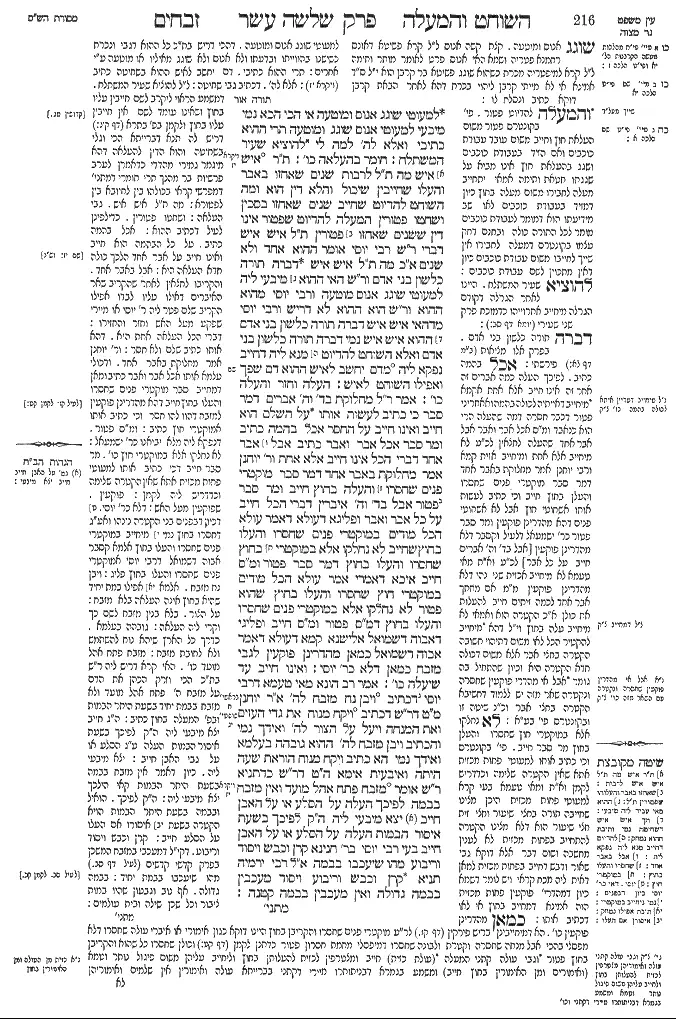
Zevahim 108b - Guemara
למעוטי שוגג אנוס ומוטעה אי הכי הכא נמי מיבעי למעוטי אנוס שוגג ומוטעה תרי ההוא כתיבי ואלא לה' למה לי להוציא שעיר המשתלח:
חומר בהעלאה כו':
ת"ר (ויקרא יז, ג) איש איש מה ת"ל לרבות שנים שאחזו באבר והעלו שחייבין שיכול והלא דין הוא ומה השוחט להדיוט שחייב שנים שאחזו בסכין ושחטו פטורין המעלה להדיוט שפטור אינו דין ששנים שאחזו פטורין ת"ל איש איש דברי ר"ש רבי יוסי אומר ההוא אחד ולא שנים א"כ מה ת"ל איש אי דברה תורה כלשון בני אדם ור"ש האי ההוא מיבעי ליה למעוטי שוגג אנוס מוטעה ורבי יוסי מהוא ההוא ור"ש הוא ההוא לא דריש ורבי יוסי מדהאי איש איש דברה תורה כלשון בני אדם ההוא איש איש נמי דברה תורה כלשון בני אדם ואלא השוחט להדיוט מנא ליה דחייב נפקא ליה (ויקרא יז, ד) מדם יחשב לאיש ההוא דם שפך ואפילו השוחט לאיש:
העלה וחזר והעלה כו':
אמר ר"ל מחלוקת בד' וה' אברים דמר סבר כי כתיב לעשות אותו על השלם הוא חייב ואינו חייב על החסר אכל בהמה כתיב ומר סבר אכל אבר ואבר כתיב אבל אבר אחד דברי הכל אינו חייב אלא אחת ור' יוחנן אמר מחלוקת באבר אחד דמר סבר מוקטרי פנים שחסרו והעלה בחוץ חייב ומר סבר פטור אבל בד וה' איברין דברי הכל חייב על כל אבר ואבר ופליגא דעולא דאמר עולא הכל מודים במוקטרי פנים שחסרו והעלו בחוץ שחייב לא נחלקו אלא במוקטרי בחוץ שחסרו והעלו בחוץ דמר סבר פטור ומ"ס חייב איכא דאמרי אמר עולא הכל מודים במוקטרי חוץ שחסרו והעלו בחוץ שהוא פטור לא נחלקו אלא במוקטרי פנים שחסרו והעלו בחוץ דמ"ס פטור ומ"ס חייב ופליגי דאבוה דשמואל אלישנא קמא דעולא דאמר אבוה דשמואל כמאן מהדרינן פוקעין לגבי מזבח כמאן דלא כר' יוסי:
ואינו חייב עד שיעלה כו':
אמר רב הונא מאי טעמא דרבי יוסי דכתיב (בראשית ח, כ) ויבן נח מזבח לה' א"ר יוחנן מ"ט דר"ש דכתיב (שופטים יג, יט) ויקח מנוח את גדי העזים ואת המנחה ויעל על הצור לה' ואידך נמי והכתיב ויבן מזבח לה' ההוא גובהה בעלמא ואידך נמי הא כתיב ויקח מנוח הוראת שעה היתה ואיבעית אימא ה"ט דר"ש כדתניא ר"ש אומר (ויקרא יז, ו) מזבח פתח אהל מועד ואין מזבח בבמה לפיכך העלה על הסלע או על האבן חייב יצא מיבעי ליה ה"ק לפיכך בשעת איסור הבמות העלה על הסלע או על האבן חייב בעי רבי יוסי בר' חנינא קרן וכבש ויסוד וריבוע מהו שיעכבו בבמה א"ל רבי ירמיה תניא קרן וכבש וריבוע ויסוד מעכבין בבמה גדולה ואין מעכבין בבמה קטנה:
Comments from Rashi on Masechet Zevahim Page 108b
למעוטי שוגג אנוס ומוטעה . דהכי דריש בת"כ כל ההוא דגבי ונכרת כשישנו בהווייתו ובדעתו ולא אנוס ולא שוגג מאיליו או מוטעה ע"י אחרים: תרי ההוא כתיבי . דם יחשב לאיש ההוא בשחיטה כתיב (ויקרא יז): אלא לה' . דכתיב גבי שחיטה: ל"ל להוציא שעיר המשתלח . דמשמע הראוי ליקרב לשם חייבין עליו בחוץ ושאינו עומד לשם אין חייבין עליו בחוץ ולקמן בפ' בתרא (זבחים דף קיג:) דריש לה תנא דברייתא הכי וגלי בשחיטה והוא הדין להעלאה דהא מיגמר גמירי מהדדי כדאמרן לערב פרשיות בר מהנך תרי חומרי דמתני' דמפרשי קראי בכולהו בין לחיובא בין לפטורא: ושחטו פטורין . כדילפינן לעיל דכתיב ההוא: מה ת"ל איש איש . גבי העלאה: אכל בהמה כתיב . על כל הבהמה הוא חייב ואינו חייב על אבר אחד הלכך כולה חדא העלאה היא: אבל באבר אחד . והקריבו לחצאין לאחר שהקריב שאר האיברים דאילו עליו לבדו אפילו הקריב שלם פטר ליה ר' יוסי או מיירי שפקע מעל האש וחזר והחזירו: דברי הכל העלאה אחת היא . דהא אותו כתיב שלם ולא חסר: ור' יוחנן אמר מחלוקת באבר אחד . ודכולי עלמא אותו אכל אבר ואבר כתיב ומאן דמחייב סבר מוקטרי פנים שחסרו והעלו בחוץ חייב דהא מהדרינן פוקעין למזבח דהוו להו חסר וכי כתיב אותו אמוקטרי חוץ כתיב: ומ"ס פטור . דנפקא ליה מלא יביאנו כר' ישמעאל: לא נחלקו אלא במוקטרי חוץ כו' . מר סבר חייב דכי כתיב אותו למעוטי פחות מכזית אתא שאין הקטרה שלימה וכדדריש ליה לקמן: פוקעין . שפוקעין מעל האש: דלא כר' יוסי . דכיון דבפנים בני הקטרה נינהו ואע"ג דחסרו בחוץ נמי מיחייב במוקטרי פנים שחסרו והעלו בחוץ אלמא קסבר אבוה דשמואל דרבי יוסי אמוקטרי פנים שחסרו והעלו בחוץ פליג: ויבן נח מזבח . אלמא אפילו במת יחיד שהיא בחוץ אינה העלאה בלא מזבח: על הצור . בלא בנין מזבח לשם כך וקרי ליה העלאה: גובהה בעלמא . כדרך כל הארץ שיהא נוח להשתמש ולא לחובת מזבח: מזבח פתח אהל מועד כו' . האי קרא דריש ליה ר"ש בת"כ הכי וזרק הכהן את הדם על מזבח ה' פתח אהל מועד ולא מזבח בבמת יחיד בשעת היתר הבמות ובפ' המעלה בחוץ כתיב: ה"ג חייב יצא מיבעי ליה ה"ק לפיכך בשעת איסור הבמות העלה ע"ג הסלע או על גבי האבן חייב: יצא מיבעי ליה . כיון דאמר אין מזבח בבמה בשעת היתר הבמות קאי הילכך יצא מיבעי ליה: ה"ק לפיכך . הואיל ובבמה בשעת היתר הבמות הויא הקטרה בשעת איסורו אם העלו על הסלע חייב: קרן וכבש ויסוד וריבוע . דקי"ל דמעכבי במזבח המשכן בפרק קדשי קדשים (לעיל זבחים דף סב.) מהו שיעכבו בבמת יחיד: בבמה גדולה . אף נוב וגבעון שהיו במות ציבור וכל שכן שילה ובית עולמים:
Comments from Tosafot - Zevahim 108b
שוגג אנוס ומוטעה . קצת קשה אנוס ל"ל קרא פשיטא דאונס רחמנא פטריה ושמא האי אנוס פרט לאומר מותר ותימה ל"ל קרא למיפטריה מכרת כשהוא שוגג. פשיטא בר קרבן הוא י"ל ס"ד אמינא אי לא מייתי קרבן ליהוי בכרת דהא לאחר הבאת קרבן דוקא כתיב ונסלח לו: להוציא שעיר המשתלח . היינו לאחר הגרלה דקודם הגרלה מיחייב אתרוייהו כדמוכח פרק שני שעירי (יומא דף סב:): והמעלה להדיוט פטור . פי' בקונטרס פטור משום העלאת חוץ וחייב משום עובד עבודת כוכבים ואם הזיד בעבודת כוכבים ושגג בהעלאת חוץ אינו מביא על שגגתו חטאת ותימה אמאי יתחייב מעלה לחבירו משום מעלה בחוץ כיון דמזיד בעבודת כוכבים לאו שב מידיעתו הוא דמומר לעבודת כוכבים מומר לכל התורה כולה ובחנם דחק עצמו בקונטרס דמעלה לחבירו אין שייך לחייבו משום עבודת כוכבים כיון דאין מתכוין לשם עבודת כוכבים: דברה תורה כלשון בני אדם . בפרק אלו מציאות (ב"מ דף לא:) פירשתי: אכל בהמה כתיב . לפיכך העלה כמה אברים זה אחר זה אינו חייב אלא אחת אקמא מיחייב דאייתיה לכולה בהמה ואאחריני פטור דכבר חסרה דמה שהעלה הרי הוא כנאבד ומ"ס אכל אבר ואבר אבל אבר אחד שהעלה לחצאין לכ"ע לא מיחייב אלא אחת ומיחייב אזית קמא ורבי יוחנן אמר מחלוקת באבר אחד דמר סבר מוקטרי פנים שחסרו והעלן בחוץ חייב וכי כתיב לעשות אותו אשחוטי חוץ אבל לא אשחוטי פנים דהא מהדרינן פוקעין ומר סבר פטור כר' ישמעאל דלעיל וקסבר דלא מהדרינן פוקעין [אבל בד' וה' אברים חייב על כל אבר] לכ"ע וא"ת מאי טעמא לא מיחייב אכזית שני נהי דלא מהדרינן פוקעין מ"מ אם מחתך אבר אחד לכמה זיתים חייב להעלות את כולן א"כ הקטרה הוא ואמאי לא מיחייב עלה בחוץ וי"ל דהא מיחייב להקטיר הכל לאו משום דתיהוי חשובה הקטרה בחצי אבר אלא משום דכולה חדא הקטרה היא וכיון שהתחיל בה גומר אבל אי מהדרי פוקעין שחסרה ונקטרה שאר מזה יש ללמוד דחשיבא הקטרה בחצי אבר וכ"נ שיטה זו ובקונטרס פי' בע"א: לא נחלקו אלא במוקטרי חוץ שחסרו והעלן בחוץ מר סבר חייב . פי' בקונטרס וכי כתיב אותו למעוטי פחות מכזית אתא שאין הקטרה שלימה וכדדריש לקמן וא"ת ומאי טעמא בעי קרא למעוטי פחות מכזית היכן מצינו שחייבה תורה בחצי שיעור וחצי זית חצי שיעור הוא דלא מצינו הקטרה להתחייב בפחות מכזית לא לענין מחשבה ושום דבר אלא דוקא גבי שאור ודבש דחייב בפחות מכזית למאן דאית ליה מכח קראי ויש לומר דשמא כיון דמהדרי' פוקעין פחות מכזית הוה אמינא דמחייב בחוץ אי לאו דכתיב אותו: כמאן מהדרינן פוקעין כו' . הא דמיחייבינן בריש פירקין (דף קז.) לר"ע מוקטרי פנים שחסרו והקריבן בחוץ היינו דוקא כגון אימורי או איברי עולה שחסרו דלא מפסלי בהכי אבל מנחה שחסרה וקטרת ולבונה שחסרו דמיפסלי מחמת חסרון פטור כדתנן לקמן (זבחים דף קט:) וכולן שחסרו כל שהוא והקריבן בחוץ פטור וגבי עולה קתני המעלה (עולת כזית) חייב ומצטרפין לכזית להעלותן בחוץ וליחייב עליהן משום פיגול נותר וטמא (ואימורים ומן האימורין בחוץ חייב) ומשמע בגמרא דבניתותרו מיירי דקתני בברייתא עולה ואימורין אין שלמים ואימוריהן לא ומוקי לה בניתותרו וכר' יהושע וקצת תימה קומץ ולבונה אמאי לא מיחייב עלייהו בחוץ כשחסרו נהי דמיפסלי לכתחילה מ"מ מתקבלין הם בפנים דאם עלו לא ירדו דהוה ליה פסולו בקדש כשחסר בין קמיצה להקטרה ולמאן דחשיב במנחות פ' קמא (דף ט:) חסרון כבעל מום ניחא וי"ל דאפילו תמצא לומר דאם עלה לא ירד מ"מ סברא הוא למעוטיה מדכתיב אותו על השלם הוא חייב ואינו חייב על החסר כיון דלכתחילה לא יעלה וצריך לדקדק אי מהדרינן פוקעין דידהו ובפרק המזבח מקדש (לעיל זבחים דף פג:) איכא כמה קראי לרבן גמליאל מהיא העולה על מוקדה ולאידך מאשר תאכל האש ועוד דדרשינן לעיל (זבחים דף פו.) ועשית עולותיך הבשר והדם עיכולי עולה אתה מחזיר ואי אתה מחזיר עיכולי גידין ועצמות משמע הא בשר דומיא דגידים ועצמות מהדרינן אפילו במקצת ותימה אי פליג עליה רבי יוסי:
Zevahim 108b - Mishnah translated into english
to exclude from the liability for karet one whose violation was unwitting, or who was compelled to act, or who was mistaken. The term “that man” teaches that only one who offered up with intent is liable to receive karet. The Gemara challenges: If so, here too, with regard to slaughtering outside, the term is necessary to exclude one whose violation was unwitting, or who was compelled to act, or who was mistaken. How can the term be used to teach that only one who acts alone is liable?
The Gemara explains: With regard to slaughtering outside, two instances of the term “that man” are written: “Blood shall be imputed to that man, he has shed blood, and that man shall be cut off from among his people” (Leviticus 17:4). One instance teaches that only one who acts with intent is liable to receive karet, and the other teaches that only one who acts alone is liable.
The Gemara has now justified its claim that the liability of one who slaughters an offering outside for the sake of an ordinary purpose is derived from the phrase “ish ish.” Accordingly, the Gemara asks: But why do I need the term “to the Lord”? The Gemara explains: It is written to exclude from liability one who slaughters the Yom Kippur scapegoat outside the courtyard.
§ The mishna teaches: The greater stringency with regard to offering up outside is that two people who grasped a knife and together slaughtered an offering outside the courtyard are exempt. But if two grasped a limb from an offering and together offered it up outside, they are liable.
The Sages taught in a baraita: What halakha is alluded to when the verse states: “Any man [ish ish]…that offers up a burnt offering or sacrifice” (Leviticus 17:8)? The verse teaches that two people who grasped a limb of an offering and offered it up together outside the courtyard are liable. It is necessary for the verse to teach this, as one might have thought to say: Could this not be derived through an a fortiori inference: If with regard to slaughtering outside the courtyard, one who slaughters for the sake of an ordinary purpose is liable, and nevertheless, two who grasped a knife and together slaughtered an offering are exempt, then with regard to offering up outside the courtyard, where one who offers up for the sake of an ordinary purpose is exempt, is it not logical that two who grasped a limb and offered it up will also be exempt? To counter this, the verse states “ish ish” to teach that they are liable for offering up together; this is the statement of Rabbi Shimon.
Rabbi Yosei says that the halakha concerning this case is derived from a different verse. The term “that [hahu] man” (Leviticus 17:9), which is in the singular, indicates that only one who acts alone is liable, but not two who act together. The baraita asks: If so, what halakha is alluded to when the verse states “ish ish”? The baraita explains: Rabbi Yosei holds that the reason the Torah uses the doubled term “ish ish” is that the Torah spoke in the language of people, and no halakhot are to be derived from it.
The Gemara asks: And Rabbi Shimon, what does he derive from the term “that man”? The Gemara explains: This term: “That man,” is necessary to exclude from liability one whose violation was unwitting, or who was compelled to act, or who was mistaken. The Gemara notes: And Rabbi Yosei derives that halakha from the fact that the verse could have stated hu and instead stated “hahu.” The Hebrew word for: That, hahu, is formed of the definite article ha and the pronoun hu. And Rabbi Shimon does not expound any halakhot from the fact that the verse could have stated hu and instead stated “hahu.” He holds that the expanded form is used because the Torah spoke in the language of people.
The Gemara asks: And as for Rabbi Yosei, from the fact that he holds that nothing is to be derived from the phrase “ish ish” written with regard to offering up, as he holds that the Torah spoke in the language of people, then also with regard to that phrase: “Any man [ish ish]” (Leviticus 17:3), written with regard to slaughtering, since he holds that the Torah spoke in the language of people, he should not derive any halakhot from it. But if so, from where does he derive that one who slaughters outside for the sake of an ordinary purpose is liable? The Gemara answers: He derives it from the verse: “Blood shall be imputed to that man; he has shed blood” (Leviticus 17:4), which teaches that even one who slaughters for the sake of an ordinary man is liable.
§ The mishna teaches: If one unwittingly offered up part of an offering outside the courtyard and then in a different lapse of awareness offered up other parts of that offering and then again, in another lapse of awareness, offered up yet other parts, he is liable to bring a sin offering for each act of offering up; this is the statement of Rabbi Shimon. Rabbi Yosei says: He is liable to bring only one sin offering.
The Gemara cites two opinions concerning the case under dispute. Reish Lakish says: The dispute in the mishna concerns four or five limbs that were offered up in different lapses of awareness. As one Sage, Rabbi Yosei, holds: When it is written: “To sacrifice it” (Leviticus 17:9), which teaches the halakha that for offering up a complete item one is liable but that one is not liable for offering up an incomplete item, it is written with regard to a whole animal. Accordingly, liability to bring a sin offering is incurred only once one offers up the entire animal, even if that was done limb by limb. And the other Sage, Rabbi Shimon, holds that that verse is written with regard to each and every limb of an animal. Accordingly, one is liable for each limb he offered up. But with regard to the offering up of one limb in parts, everyone agrees that a person is liable to bring only one sin offering. According to Rabbi Shimon this would apply even if that were the only limb that was offered up; according to Rabbi Yosei this would apply only if the rest of the animal had already been offered up.
And Rabbi Yoḥanan says: Everyone agrees that one is liable even for offering up a single limb. Furthermore, if an offering is slaughtered outside the courtyard, everyone agrees that one is liable only once an entire limb has been offered up. The dispute in the mishna concerns one limb from an offering that was slaughtered inside the courtyard that was then taken outside and offered up in parts, during different lapses of awareness. As one Sage, Rabbi Shimon, holds that for offerings that are fit to be burned inside the Temple, that became incomplete and were instead offered up outside the Temple, one is liable. Accordingly, one is liable for each part of the limb. And the other Sage, Rabbi Yosei, holds that one is exempt for offering up part of a limb outside the courtyard. Accordingly, liability is incurred only once all the parts of the limb have been offered up. But with regard to offering up four or five limbs, everyone agrees that one is liable for each and every limb, as they understand that the phrase “to sacrifice it” is written with regard to each and every limb.
And Rabbi Yoḥanan disagrees with the opinion of Ulla, as Ulla says: Everyone in the mishna concedes with regard to offerings that are fit to be burned inside the Temple courtyard that became incomplete and were instead offered up outside the courtyard, that one is liable. They disagree only with regard to offerings that, having been slaughtered outside are unfit and so will be burned outside, that became incomplete and were offered up outside. As one Sage, Rabbi Yosei, holds that one is exempt, and the other Sage, Rabbi Shimon, holds that one is liable.
There are those who say there is a different version of Ulla’s statement, according to which he agrees with his teacher, Rabbi Yoḥanan. Ulla says: Everyone in the mishna concedes with regard to offerings that, having been slaughtered outside the Temple are unfit and so will be burned outside, that became incomplete and were offered up outside, that one is exempt. They disagree only with regard to offerings that are fit to be burned inside that became incomplete and were instead offered up outside. As one Sage, Rabbi Yosei, holds that one is exempt, and the other Sage, Rabbi Shimon, holds that one is liable.
And the statement of Shmuel’s father disagrees with the first version of Ulla’s statement, as Shmuel’s father says: In accordance with whose opinion do we restore limbs that were dislodged from upon the altar to the altar? In accordance with whose opinion? It is not in accordance with the opinion of Rabbi Yosei recorded in the mishna. Shmuel’s father assumes that Rabbi Yosei holds that incomplete limbs are never offered up on the altar, even if they were dislodged from the altar. Accordingly, he holds that one is not liable for offering them up outside the Temple courtyard. This is contrary to the first version of Ulla’s opinion, according to which one is liable for offering up incomplete offerings that were slaughtered inside the courtyard. Evidently, Ulla holds that an incomplete limb that was dislodged from the altar is to be restored to the altar.
§ The mishna teaches: Rabbi Yosei says: And one is liable for offering up an offering outside the courtyard only once he offers it up upon the top of an altar that was erected there. Rabbi Shimon says: Even if he offered it up on a rock or on a stone, not an altar, he is liable. Rav Huna says: What is the reason of Rabbi Yosei? As it is written: “And Noah built an altar to the Lord, and took of every pure animal, and of every pure bird, and offered up burnt offerings on the altar” (Genesis 8:20). Noah was particular to use an altar rather than one of the available rocks. Apparently, this was because placing an item upon an altar is the only act that can be considered offering up.
Rabbi Yoḥanan said: What is the reason of Rabbi Shimon? As it is written: “And Manoah took the kid with the meal offering, and offered it up upon the rock, to the Lord” (Judges 13:19). Evidently, even placing an offering upon a rock is considered an act of offering up.
The Gemara explains how each tanna interprets the verse that supports the other. But also according to the other opinion, Rabbi Shimon’s, isn’t it written: “And Noah built an altar to the Lord”? How does he explain that verse? The Gemara answers: That verse is referring merely to an elevated place and not specifically to an altar. But also according to the other opinion, Rabbi Yosei’s, isn’t it written: “And Manoah took…and offered it up upon the rock”? How does he explain that verse? The Gemara answers: The use of a rock in that case was a provisional edict issued in exigent circumstances, by the angel who visited Manoah, and so one cannot derive normative halakha from it.
And if you wish, say instead that the reason of Rabbi Shimon is as it is taught in a baraita: Rabbi Shimon says that the verse states: “And the priest shall sprinkle the blood upon the altar of the Lord at the entrance of the Tent of Meeting” (Leviticus 17:6). From here it is apparent that only in the Sanctuary is there a requirement for an altar, but a specifically erected altar is not required in order to offer up on a private altar during periods when it is permitted to do so. Therefore, one who offered up outside the courtyard on a rock or on a stone is liable.
The Gemara questions the formulation of the baraita: If the baraita was referring to offering up during a period when the use of private altars is permitted, it should have concluded: One who offered up outside on a rock or on a stone has fulfilled his obligation. Why does it state instead that he is liable? The Gemara explains: This is what the baraita is saying: Since there is no requirement for a specifically erected altar during a period when private altars are permitted, therefore, during a period when the use of private altars is prohibited, one who offers up outside on a rock or on a stone is liable.
Rabbi Yosei, son of Rabbi Ḥanina, raises a dilemma: Features that are indispensable with regard to the altar in the Temple are the corner, the ramp leading to the altar, the base of the altar, and the square shape. What is the halakha with regard to whether they are also indispensable for the validity of a private altar during a period when it is permitted to use private altars?
Rabbi Yirmeya said to him: It is taught in a baraita: The corner, the ramp, the base, and the square shape are all indispensable for the validity of a great public altar, but they are not indispensable for the validity of a small private altar.
Traduction : The William Davidson digital edition of the Koren Noé Talmud, with commentary by Rabbi Adin Even-Israel Steinsaltz.