 Talmud Bavli
The learning on the whole site is dedicated : L'ilui Nishmat Amram ben Itshak Loubaton
The learning on the whole site is dedicated : L'ilui Nishmat Yaakov ben Myriam
The learning on the whole site is dedicated : L'ilui Nishmat Reuven ben Rivka SEBBAG
Yoma 80a : Youtube
Daf TubeYoutube
2 video classes :
Yoma Page 80a
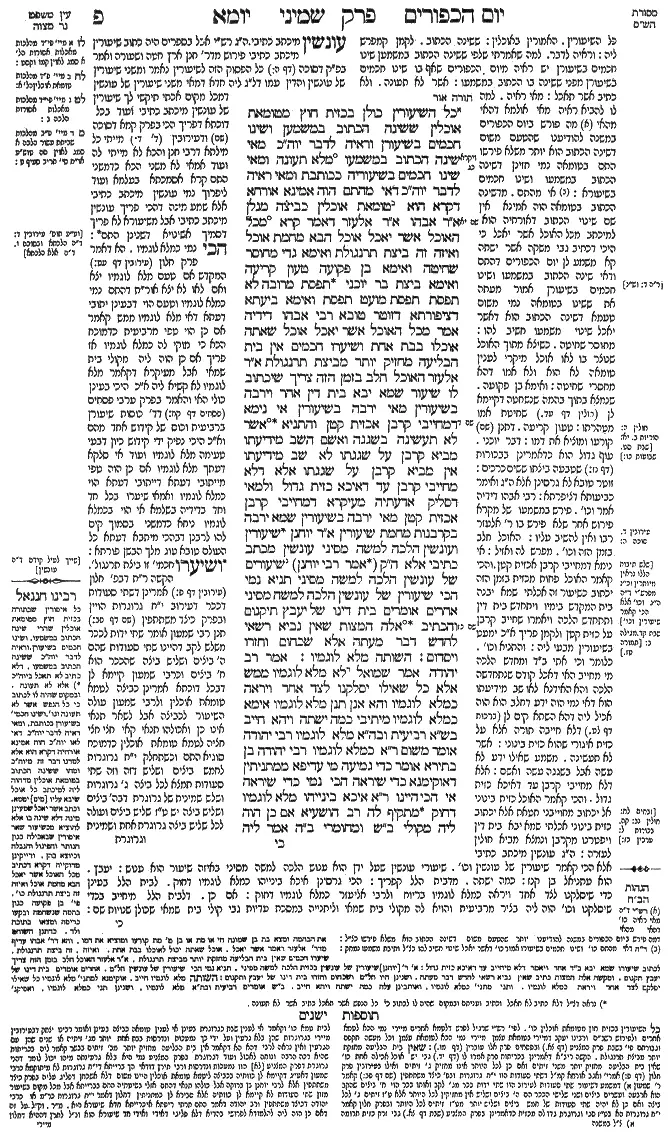
Yoma 80a - Guemara
כל השיעורין כולן בכזית חוץ מטומאת אוכלין ששינה הכתוב במשמען ושינו חכמים בשיעורן וראיה לדבר יוה"כ מאי שינה הכתוב במשמעו (ויקרא כג, כט) מלא תעונה ומאי שינו חכמים בשיעוריה ככותבת ומאי ראיה לדבר יוה"כ דאי מהתם הוה אמינא אורחא דקרא הוא טומאת אוכלין כביצה מנלן א"ר אבהו א"ר אלעזר דאמר קרא (ויקרא יא, לד) מכל האוכל אשר יאכל אוכל הבא מחמת אוכל ואיזה זה ביצת תרנגולת ואימא גדי מחוסר שחיטה ואימא בן פקועה טעון קריעה ואימא ביצת בר יוכני תפסת מרובה לא תפסת תפסת מועט תפסת ואימא ביעתא דציפורתא דזוטר טובא רבי אבהו דידיה אמר מכל האוכל אשר יאכל אוכל שאתה אוכלו בבת אחת ושיערו חכמים אין בית הבליעה מחזיק יותר מביצת תרנגולת א"ר אלעזר האוכל חלב בזמן הזה צריך שיכתוב לו שיעור שמא יבא בית דין אחר וירבה בשיעורין מאי ירבה בשיעורין אי נימא דמחייבי קרבן אכזית קטן והתניא (ויקרא ד, כב) אשר לא תעשינה בשגגה ואשם השב מידיעתו מביא קרבן על שגגתו לא שב מידיעתו אין מביא קרבן על שגגתו אלא דלא מחייבי קרבן עד דאיכא כזית גדול ולמאי דסליק אדעתיה מעיקרא דמחייבי קרבן אכזית קטן מאי ירבה בשיעורין שמא ירבה בקרבנות מחמת שעורין א"ר יוחנן שיעורין ועונשין הלכה למשה מסיני עונשין מכתב כתיבי אלא ה"ק (אמר רבי יוחנן) שיעורים של עונשין הלכה למשה מסיני תניא נמי הכי שיעורין של עונשין הלכה למשה מסיני אחרים אומרים בית דינו של יעבץ תיקנום והכתיב (ויקרא כז, לד) אלה המצות שאין נביא רשאי לחדש דבר מעתה אלא שכחום וחזרו ויסדום השותה מלא לוגמיו אמר רב יהודה אמר שמואל לא מלא לוגמיו ממש אלא כל שאילו יסלקנו לצד אחד ויראה כמלא לוגמיו והא אנן תנן מלא לוגמיו אימא כמלא לוגמיו מיתיבי כמה ישתה ויהא חייב בש"א רביעית ובה"א מלא לוגמיו רבי יהודה אומר משום ר"א כמלא לוגמיו רבי יהודה בן בתירא אומר כדי גמיעה מי עדיפא ממתניתין דאוקימנא כדי שיראה הכי נמי כדי שיראה אי הכי היינו ר"א איכא בינייהו מלא לוגמיו דחוק מתקיף לה רב הושעיא אם כן הוה ליה מקולי ב"ש ומחומרי ב"ה אמר ליה
Comments from Rashi on Masechet Yoma Page 80a
כל השיעורין . האמורין באוכלין: ששינה הכתוב . לקמן קמפרש ליה: וראיה לדבר . למה שאמרתי שלפי ששינה הכתוב במשמען שינו חכמים בשיעורן יש ראיה מיום הכפורים שאף בו שינו חכמים בשיעורן מפני ששינה בו הכתוב במשמעו: אשר לא תעונה . ולא כתיב אשר תאכל: מאי ראיה . למה לו להביא ראיה מאי אולמא דהאי מהאי מה פורש ביום הכפורים במשנה להודיענו שהטעם משום דשינה הכתוב הוא יותר משלא פירשו התם בטומאה נמי חזינן דשינה הכתוב במשמעו ושינו חכמים בשיעורא: אי מהתם . מדשינה הכתוב בטומאה הוה אמינא אין שם שינוי הכתוב דאורחיה הוא למיכתב מכל האוכל אשר יאכל כי היכי דכתיב גבי משקה אשר ישתה קא משמע לן יום הכפורים דהתם ודאי שינה הכתוב במשמעו ושינו חכמים בשיעורן אמור מעתה את ששינו בטומאה נמי משום טעמא דשינה הכתוב הוא דאשר יאכל שינוי משמעו חשיב להו: מחוסר שחיטה . כשיצא מתוך האוכל שנוצר בו לאו אוכל מיקרי לענין טומאה לא הוא ולא אמו דהא מחסרי שחיטה: ואימא בן פקועה . שנמצא בתוך בהמה שנשחטה דקיימא לן (חולין דף עד.) שחיטת אמו מטהרתו: טעון קריעה . דתנן (שם) קורעו ומוציא את דמו: דבר יוכני . עוף גדול הוא כדאמרינן בבכורות (דף נז:) שטבעה ביצתו ששים כרכים: זוטר טובא לא גרסינן אלא ה"ג ואימר כביעותא דציפרתא: רבי אבהו דידיה אמר וכו' . פירש במשמעו של מקרא פירוש אחר שלא פירש בו ר' אלעזר רבו ואין להשיב עליו: האוכל חלב בזמן הזה וכו' . מפרש לה ואזיל: אי נימא דמחייבי קרבן אכזית קטן . והכי קאמר האוכל פחות מכזית בזמן הזה יכתוב כשיעור זה אכלתי שמא יבנה בית המקדש בימיו ויתחדש בית דין ותתחדש הלכה ויאמרו שחייב קרבן על כזית קטן ולקמן פריך א"כ ימעט בשיעורין מבעי ליה: והתניא וכו' . כלומר וכי אתי ב"ד ומחדש הלכה מי מחייב האי דאכל קודם שנתחדשה הלכה והא האידנא לאו שב מידיעתו הוא דאי נמי הוה ידע דחלב הוא הוה אכיל ליה דהא השתא קים לן (ברכות דף לט.) דלא חייבה תורה אלא על כזית איגורי שהוא כזית בינוני: אשר לא תעשינה . משמע שאילו ידע לא עשה אבל בשגגה עשה ואשם: אלא דלא מחייבי קרבן עד דאיכא כזית גדול . והכי קאמר האוכל כזית בינוני אל יכתוב מחוייבני חטאת אלא יכתוב כזית בינוני אכלתי שמא יבא בית דין ויפטרנו מקרבן ונמצא מביא חולין לעזרה: ה"ג עונשין מיכתב כתיבי אלא הכי קאמר שיעורין של עונשין וכו' . שיעורי עונשין שעל ידן הוא ענוש הלכה למשה מסיני באיזה שיעור הוא ענוש: יעבץ . הוא עתניאל בן קנז: כמה ישתה . מדבית הלל קפריך: הכי גרסינן איכא בינייהו כמלא לוגמיו דחוק . לבית הלל בעינן כדי שיסלקנו לצד אחד ויראה כמלא לוגמיו בריוח ולרבי אליעזר כמלא לוגמיו דחוק: אם כן . דלבית הלל מיחייב בכדי שיסלקנו וכו' הוה ליה בציר מרביעית והויא לה מקולי בית שמאי וליתנייה במסכת עדיות גבי קולי בית שמאי שכולן שנויות שם:
Comments from Tosafot - Yoma 80a
ושיערו חכמי' זו ביצת תרנגול' . הקשה ר"ת דבפ' חלון (עירובין דף פ:) אמרינן דשתי סעודות דככר דעירוב י"ח גרוגרות הויין ובפרק כיצד משתתפין (שם דף פב:) תנן רבי שמעון אומר שתי ידות לככר משלש לקב דהיינו שתי סעודות שהם ה' ביצים ושליש ביצה שהככר הוא ח' ביצים וכרבי שמעון קיימא לן דבכל דוכתא אמרינן כביצה לטמא טומאת אוכלין ולרבי שמעון עולה השיעור לכביצה אבל לשאר תנאי אינו כן ואכולהו תנאי קאי חצי חצי חציה לטמא טומאת אוכלין כדמוכח סוגיא התם וכשתחלק י"ח גרוגרות לחמש ביצים ושליש דזה וזה שתי סעודות תמצא לכל ביצה ג' גרוגרות ושלש שמינית של גרוגרת דבה' ביצים ושליש ביצה יש ט"ז שליש ביצים ועולה לכל שליש ביצה גרוגרת אחת ושמינית וגרוגרת גדולה מכזית כדמוכח בר"פ המצניע (שבת דף צא.) כדפרשינן לעיל וא"כ היכי אמרינן בכריתות פרק אמרו לו (דף יד:) גבי יש אוכל אכילה אחת דאין בית הבליעה מחזיק יותר משני זיתים ואור"י דנהי דקיימא לן כר' שמעון בהא דכביצה לטמא טומאת אוכלין בשתי סעודות דעירוב לא קיימא לן כוותיה אלא או כר' מאיר או כרבי יהודה כדמוכח התם דרב יוסף ורבא כרבי מאיר קיימי ואינהו נמי מודו דכביצה לטמא טומאת אוכלין כרבי שמעון דחציה לבית המנוגע וחצי חציה לפסול גויה וחצי חצי חציה לטומאת אוכלים לאו ארבי מאיר ור' יהודה קאי אלא ארבי שמעון וארבי יוחנן קאי שהזכירו שיעור הככר תדע דהא קתני התם בברייתא בגמרא כמה שיעור חצי פרס שתי ביצי' חסר קימעא דברי ר' יהודה ש"מ דקאי בשיטתיה דר' שמעון דקאמר חצי חציה לפסול הגויה בשתי ביצים ור"ת תירץ בע"א וזה לשונו דגרוגרות בלא גרעינין קאמר הכא ונמעכות ונדרסות טפי ונוחים להשימן בבית הבליעה וזיתים יש בהם גרעינין וקשין הן ועגולין ואינן נדבקין בבית הבליעה ולכך הוי שיעור ב' זיתים קשין כשיעור ג' גרוגרות ועוד דרכין ונוחין לאכול וכותבת הגסה עדיפא מכזית וגרוגרו' ובצירא מכביצה (וכו') ולא נהירא לר"י דגרוגרות אין בהן גרעין שהם תאנים שנדרסו וההיא דכריתות (דף יד.) נמי דאין בית הבליעה מחזיק יותר משני זיתים בבשר איירי דלא שייך ביה גרעין וקשה ועגולין: עונשין מיכתב כתיבי . ה"ג רש"י אבל בספרים היה כתוב שיעורין מיכתב כתיבי פירוש מדר' חנן ארץ חטה ושעורה ואמר בפ"ק דסוכה (דף ה.) כל הפסוק הזה לשיעורין נאמר ומשני שיעורין של עונשין והדין עמו דל"ג ליה חדא דמאי משני שיעורין של עונשין דמכל מקום אכתי תיקשי לך שיעורין של עונשין מיכתב כתיבי ועוד בכל דוכתא דפריך הכי בפרק קמא דסוכה (שם) ודעירובין (ד' ד.) מייתי כל מילתא דרבי חנן והכא לא מייתי לה ועוד אמאי לא משני הכא כדמשני התם קרא אסמכתא בעלמא ועוד ליפרוך נמי עונשין מיכתב כתיבי אלא שמע מינה דהכי פריך עונשין מיכתב כתיבי אבל משיעורא לא פריך דסמיך אשינויא דשנינן התם: הכי נמי כמלא לוגמיו הא דאמר . פרק חלון (עיר בין דף עט:) המקדש אם טעם מלא לוגמיו יצא ואם לאו לא יצא אור"ת דהתם נמי כמלא לוגמיו וטעם הוי דבעינן יתובי דעתא דאי מלא לוגמיו ממש קאמר אם כן הוי טפי מרביעית כדמוכח הכא כי מוקי לה כמלא לוגמיו אז פריך אם כן הוה ליה מקולי בית שמאי אבל מעיקרא דקאמר מלא לוגמיו לא קשיא ליה א"כ היכי בעינן כולי האי והאמר בפרק ערבי פסחים (פסחים דף קח:) דד' כוסות שיעורן ברביעית וכוס של קידוש אחד מהם וא"כ היכי נפיק ידי קידוש כיון דבעי טעימה מלא לוגמיו ועוד אי סלקא דעתך מלא לוגמיו אם כן הוה טפי מייתובי דעתא דייתובי דעתא הוי כמלא לוגמיו ואמאי שיערו בכל חד וחד בדידיה בשלמא אי הוי בכמלא לוגמיו ניחא כדמשני בסמוך קים להו לרבנן דבהכי מיתבא דעתא כל העולם טובא עוג מלך הבשן פורתא:
Yoma 80a - Mishnah translated into english
All the measures in the Torah connected to eating are the volume of an olive-bulk, except for the amount of food that renders objects impure, because the verse changed its expression in this case, and the Sages altered the measure accordingly. The proof of this, that the Sages gave it a different measure because the verse used different language for it, is from Yom Kippur. Also in the case of Yom Kippur the Sages assigned a different measure because the verse used a different phrase. The Gemara asks: How did the Sages learn that the verse changed its expression? They learned from: “Any soul which shall not be afflicted” (Leviticus 23:29). The verse does not state: Any soul that shall eat, but rather: “Any soul which shall not be afflicted.” How did the Sages change its measure? One does not violate the prohibition unless he has eaten the volume of a large date-bulk, as opposed to the usual olive-bulk.
The Gemara asks: And what does the baraita mean when it says: A proof for this is from Yom Kippur? Why is the verse pertaining to ritual impurity not sufficient to show that the Sages changed the measure based on the different words in the verse? The Gemara answers: If we learned it only from there, the case of impurity, I would have said that that is the style of the verse, and no halakha can be derived from it. Therefore, the verse pertaining to Yom Kippur teaches that whenever a verse deviates from the usual language, it implies a change in the halakha as well.
§ The Gemara asks: From where do we derive that the measure for impure foods is the volume of an egg-bulk? Rabbi Abbahu said that Rabbi Elazar said that the verse states: “Of all food [okhel] which may be eaten [ye’akhel], on which water comes shall be ritually impure” (Leviticus 11:34). The double usage of the root akhal teaches that the ritual impurity of food applies even to the amount which can be described as food that comes on account of food, i.e., food that comes from another food. And which food is that? A chicken egg. The Gemara asks: And say it is referring to a kid, which comes from a mother goat, and is therefore also food that comes from another food. The Gemara answers: It lacks ritual slaughter. The young goat is not yet food, since it is not edible until it has been slaughtered. The Gemara asks further: And say it is referring to a ben pekua. Since the slaughter of its mother made it fit to eat, the fetus itself need not be slaughtered, even if it survives and continues to live independently of its mother. The Gemara answers: The calf still requires cutting, since it cannot be eaten live, but it does not require ritual slaughter.
The Gemara asks: Even if we claim that the measure for impure foods is an egg-bulk, one could say it is referring to the giant egg-bulk of the bird called bar yokhani. The Gemara answers: If you grasped many, you did not grasp anything; if you grasped few, you grasped something. This means that in a case of doubt, take the smaller number, as it is included in the larger number. Therefore, the correct measure is the volume of a chicken egg. The Gemara questions this: If so, say it is referring to a very small bird’s egg. Consequently, no proof can be brought from the verse that the volume of a chicken egg is the measure for ritual impurity.
Rabbi Abbahu himself said: The verse states: “Of all food which may be eaten.” This is referring to food that you can eat at one time. The Sages estimated: The esophagus cannot hold more than the volume of a chicken’s egg, and therefore this is the measure used for the ritual impurity of foods.
Incidental to the discussion on Torah measures, Rabbi Elazar said: One who unwittingly eats forbidden fat even today must write down the exact measure that he ate, lest another court come in the future and increase the measure.
The Gemara asks: What does it mean to increase the measure? If we say that a future court will obligate him to bring an offering even for the bulk of a small olive, which is less than what is considered an olive-bulk today, he would not be liable to bring a guilt-offering. Wasn’t it taught in a baraita: It was said with regard to guilt-offerings: “And if any one of the common people sin through error, in doing any of the things which the Lord has commanded not to be done, and be guilty” (Leviticus 4:27)? This teaches that one who repents due to his awareness, i.e., one who repents following becoming aware that he performed a transgression, brings an offering for his unwitting transgression.
However, one who does not repent due to his awareness that he sinned does not bring an offering for his unwitting action. Similarly, if one eats less than an olive-bulk, based on the current measures, he will not be obligated to bring a guilt-offering in the future if the measures change, even if the amount that he ate equals the volume of a revised olive-bulk. This is because the individual would not be bringing his offering because he became aware he had sinned, but because the Torah measures had been changed.
Rather, it should be explained as follows: It is possible that in the future a court will not obligate one to bring an offering until he has eaten the bulk of a large olive, which is more than today’s amount. One should write down how much he ate, since in the future a court might rule that the amount he ate is less than the size of an olive, and therefore he will not be obligated to bring an offering.
The Gemara returns to its first suggestion: According to what entered his mind initially, that in the future a court might obligate him to bring an offering for the bulk of a small olive, what is the meaning of increase the measure? Rabbi Elazar should have said decrease the measure. The Gemara answers: The statement may have meant that perhaps there will be an increase in offerings that are brought due to the smaller measure for liability.
With regard to this topic, Rabbi Yoḥanan said: Measures and punishments are halakha transmitted to Moses from Sinai. The Gemara expresses surprise at this: The punishments for all transgressions are written explicitly in the Torah, and therefore are not part of an oral transmission from Moses. Rather, this is what was said: Rabbi Yoḥanan said: Measures that determine liability for punishments are halakha transmitted to Moses from Sinai.
The Gemara comments: This was also taught in a baraita: Measures of punishments are halakha transmitted to Moses from Sinai. Others say: These measures were instituted by the court of Jabez. The Gemara questions this: How can this be? Isn’t it written: “These are the mitzvot which the Lord commanded Moses for the children of Israel at Mount Sinai” (Leviticus 27:34). The word “these” underscores that a prophet is not permitted to introduce any new element related to the Torah and its mitzvot from here on. Rather, over the course of time, the people forgot the measures; subsequently the prophets reestablished the measures and taught them to the masses.
§ We learned in the mishna that one who drinks a cheekful on Yom Kippur is liable. Rabbi Yehuda said that Shmuel said: This does not mean two cheeks actually full. Rather, the measure that determines liability is the volume of liquid if one pushes the drink to one side of his mouth, and it appears as though his cheek were full. The Gemara questions this: Didn’t we learn in the mishna: A cheekful, in the plural form, meaning two cheeks full? The Gemara answers: Say: Like two cheeks full in appearance. If viewed from only one side, one whose cheek is full appears as if his entire mouth is full.
The Gemara raises an objection to this from a baraita: How much does one need to drink on Yom Kippur to be liable? Beit Shammai say: A quarter-log, and Beit Hillel say: Two cheeks full. Rabbi Yehuda says in the name of Rabbi Eliezer: Like two cheeks full in appearance from the side, i.e. a single cheekful. Rabbi Yehuda ben Beteira says: The amount that one can swallow in one gulp. In this baraita, Beit Hillel’s opinion is that the measure for drinking on Yom Kippur is a cheekful. This implies that a cheekful means an actual cheekful.
The Gemara expresses surprise: Is the baraita preferable to the mishna? Since it was established that the measure in the mishna is so that it appears like a cheekful, so too, the baraita can be explained as meaning an amount that looks like two cheeks full. The Gemara questions further: If so, Beit Hillel require an amount that appears like two cheeks full; this is identical with the opinion of Rabbi Eliezer, who says: Like two cheeks full. The Gemara answers: We could say that the practical difference between them is evident in the case of a paltry cheekful, which is not a complete mouthful but slightly less. According to Beit Hillel, one is not liable unless he drinks a full cheekful; but according to Rabbi Eliezer, one is liable even for a paltry mouthful.
Rav Hoshaya strongly objects to this understanding: If so, if Beit Hillel’s measure is a single cheekful, then this is an instance of Beit Shammai’s leniencies and Beit Hillel’s stringencies, since the measure of a quarter-log is larger than a single cheekful. If so, why isn’t this debate listed in tractate Eduyyot, which lists all the cases where Beit Shammai are more lenient than Beit Hillel? He said to him:
Traduction : The William Davidson digital edition of the Koren Noé Talmud, with commentary by Rabbi Adin Even-Israel Steinsaltz.