 Talmud Bavli
Yoma 53a : Youtube
Daf TubeYoutube
3 video classes :
Yoma Page 53a
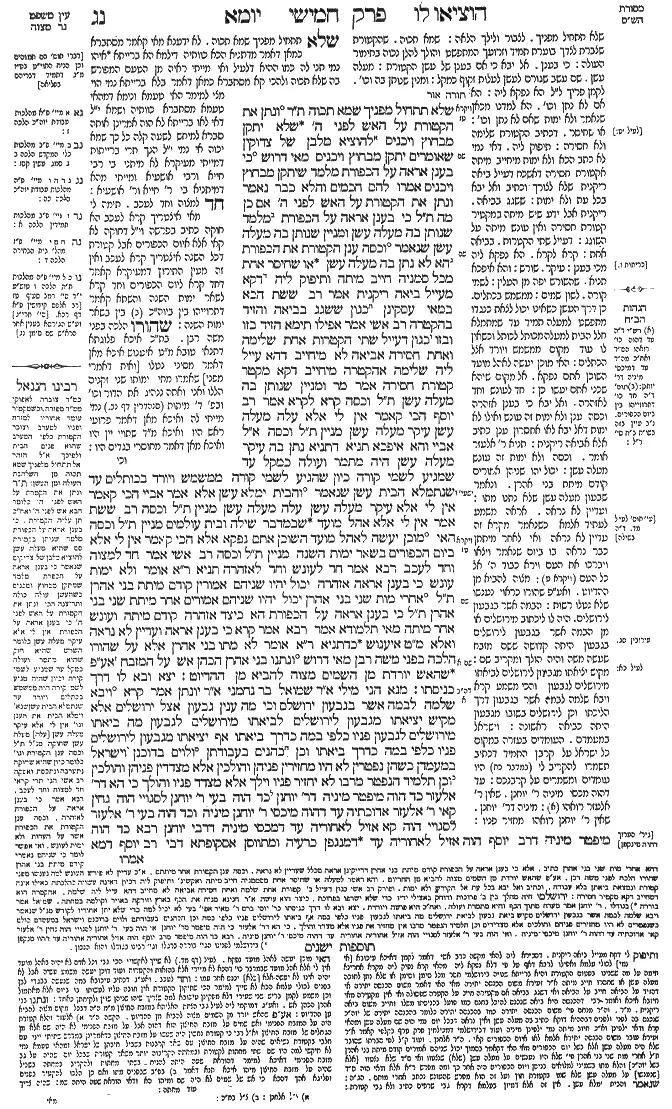
Yoma 53a - Guemara
שלא תתחיל מפניך שמא תכוה ת"ר (ויקרא טז, יג) ונתן את הקטורת על האש לפני ה' שלא יתקן מבחוץ ויכניס להוציא מלבן של צדוקין שאומרים יתקן מבחוץ ויכניס מאי דרוש (ויקרא טז, ב) כי בענן אראה על הכפורת מלמד שיתקן מבחוץ ויכניס אמרו להם חכמים והלא כבר נאמר ונתן את הקטורת על האש לפני ה' אם כן מה ת"ל כי בענן אראה על הכפורת מלמד שנותן בה מעלה עשן ומניין שנותן בה מעלה עשן שנאמר (ויקרא טז, יג) וכסה ענן הקטורת את הכפורת הא לא נתן בה מעלה עשן או שחיסר אחת מכל סמניה חייב מיתה ותיפוק ליה דקא מעייל ביאה ריקנית אמר רב ששת הכא במאי עסקינן כגון ששגג בביאה והזיד בהקטרה רב אשי אמר אפילו תימא הזיד בזו ובזו כגון דעייל שתי הקטרות אחת שלימה ואחת חסירה אביאה לא מיחייב דהא עייל ליה שלימה אהקטרה מיחייב דקא מקטר קטורת חסירה אמר מר ומניין שנותן בה מעלה עשן ת"ל וכסה קרא לקרא אמר רב יוסף הכי קאמר אין לי אלא עלה מעלה עשן עיקר מעלה עשן מניין ת"ל וכסה א"ל אביי והא איפכא תניא דתניא נתן בה עיקר מעלה עשן היה מתמר ועולה כמקל עד שמגיע לשמי קורה כיון שהגיע לשמי קורה ממשמש ויורד בכותלים עד שנתמלא הבית עשן. שנאמר (ישעיהו ו, ד) והבית ימלא עשן אלא אמר אביי הכי קאמר אין לי אלא עיקר מעלה עשן עלה מעלה עשן מניין ת"ל וכסה רב ששת אמר אין לי אלא אהל מועד שבמדבר שילה ובית עולמים מניין ת"ל וכסה האי (ויקרא טז, טז) מוכן יעשה לאהל מועד השוכן אתם נפקא אלא הכי קאמר אין לי אלא ביום הכפורים בשאר ימות השנה מניין ת"ל וכסה רב אשי אמר חד למצוה וחד לעכב רבא אמר חד לעונש וחד לאזהרה תניא ר"א אומר ולא ימות עונש כי בענן אראה אזהרה יכול יהיו שניהם אמורין קודם מיתת בני אהרן ת"ל (ויקרא טז, א) אחרי מות שני בני אהרן יכול יהיו שניהם אמורים אחר מיתת שני בני אהרן ת"ל כי בענן אראה על הכפורת הא כיצד אזהרה קודם מיתה ועונש אחר מיתה מאי תלמודא אמר רבא אמר קרא כי בענן אראה ועדיין לא נראה ואלא מ"ט איענוש כדתניא ר"א אומר לא מתו בני אהרן אלא על שהורו הלכה בפני משה רבן מאי דרוש ( ויקרא א, ז) ונתנו בני אהרן הכהן אש על המזבח אע"פ שהאש יורדת מן השמים מצוה להביא מן ההדיוט יצא ובא לו דרך כניסתו מנא הני מילי א"ר שמואל בר נחמני א"ר יונתן אמר קרא (דברי הימים ב א, יג) ויבא שלמה לבמה אשר בגבעון ירושלם וכי מה ענין גבעון אצל ירושלים אלא מקיש יציאתו מגבעון לירושלים לביאתו מירושלים לגבעון מה ביאתו מירושלים לגבעון פניו כלפי במה כדרך ביאתו אף יציאתו מגבעון לירושלים פניו כלפי במה כדרך ביאתו וכן כהנים בעבודתן ולוים בדוכנן וישראל במעמדן כשהן נפטרין לא היו מחזירין פניהן והולכין אלא מצדדין פניהן והולכין וכן תלמיד הנפטר מרבו לא יחזיר פניו וילך אלא מצדד פניו והולך כי הא דר' אלעזר כד הוה מיפטר מיניה דר' יוחנן כד הוה בעי ר' יוחנן לסגויי הוה גחין קאי ר' אלעזר אדוכתיה עד דהוה מיכסי ר' יוחנן מיניה וכד הוה בעי ר' אלעזר לסגויי הוה קא אזיל לאחוריה עד דמכסי מיניה דרבי יוחנן רבא כד הוה מיפטר מיניה דרב יוסף הוה אזיל לאחוריה עד דמנגפן כרעיה ומתווסן אסקופתא דבי רב יוסף דמא
Comments from Rashi on Masechet Yoma Page 53a
שלא תתחיל מפניך . לצבור ולילך הלאה: שמא תכוה . שהקטורת שצברת לצדך בוערת תמיד וזרועך המתפשט והולך להלן נכוה בתימור העולה: כי בענן . אל יבא כי אם בענן של עשן הקטורת: מעלה עשן . שם עשב שגורם לעשן לעלות זקוף כמקל: ומנין שנותן בה וכו' . לקמן פריך ל"ל הא נפקא ליה: הא אם לא נתן וכו' . הא למדנו מכאן שנאמר ולא ימות שאם לא נתן וכו': או שחיסר . דכתיב הקטורת שלימה ולא חסירה: תיפוק ליה . דאי נמי לא כתב הכא ולא ימות מיחייב מיתה אקטורת חסירה דאשכח דעייל ביאה ריקנית שלא לצורך וכתיב ואל יבא בכל עת ולא ימות: ששגג בביאה . ריקנית אבל ידע שיש מיתה במקטיר קטורת חסירה ואין עונש מיתה על השוגג: דעייל שתי הקטרות . בביאה אחת: קרא לקרא . הא נפקא ליה מכי בענן: עיקר . שורש: והא איפכא תניא . שהשורש יפה מן העלין: לשמי קורה . לשון שמים: ממשמש בכתלים . כן דרך העשן כשאינו יכול לצאת כנגדו מתפשט למעלה תמיד עד שמתמלא חלל הבית למעלה מכותל לכותל וכשאין לו עוד מקום ממשמש ויורד אצל הכתלים: האי מוכן יעשה לאהל מועד . השוכן אתם נפקא. אל מקום שיהא שכני אתם יעשו כן: חד לעונש וחד לאזהרה . ואל יבא כי בענן אזהרה וכסה ענן ולא ימות זה עונש ואילו לא ימות דאל יבא לאו אחסרון ענן כתיב אלא אביאה ריקנית: תניא ר' אלעזר אומר . וכסה ולא ימות זה עונש מעלה עשן: יכול יהיו שניהן אמורים קודם מיתת בני אהרן . ונאמר שבעון מעלה עשן שלא נתנו מתו: ועדיין לא נראה . אראה משמע לעתיד אלמא כשנאמר מקרא זה עדיין לא נראה ואי לאחר מיתתן כבר נראה בו ביום שנאמר ויצאו ויברכו את העם וירא כבוד ה' אל כל העם (ויקרא ט): מצוה להביא מן ההדיוט . ואע"פ שהורו כראוי נענשו שלא נטלו רשות: הבמה אשר בגבעון לירושלים . היה לו ליכתוב מירושלים או מן הבמה אשר בגבעון לירושלים בגבעון היתה קדושה ששם מזבח שעשה משה והיה הולך ומקריב שם: מקיש יציאתו מגבעון לירושלים לביאתו מירושלים לגבעון . והכי משמע קרא ויבא שלמה לבמה אשר בגבעון דרך הליכתו וכן לירושלים בשובו מגבעון היתה כביאה ראשונה: וישראל במעמדם . העומדים בעזרה במקום כל ישראל על קרבן התמיד דכתיב תשמרו להקריב לי (במדבר כת) היו עומדים ומשמרים על קרבנכם: מיניה דר' יוחנן . שאין ר' יוחנן רואהו מחזיר פניו: עד דהוה מכסי מיניה ר' יוחנן . שאין ר' אלעזר רואהו:
Comments from Tosafot - Yoma 53a
שלא תתחיל מפניך שמא תכוה . לא ידענא מאי קאמר מסתברא כמאן דאמר מדתניא הכא כוותיה דילמא הא ברייתא איהו נמי תני לה כמו ההיא דלעיל ואי מייתי ראיה מן הטעם המפורש בה שלא תכוה ולהכי קא מסתברא כמאן דאמר בלא ברייתא נמי הוי מצי למימר האי טעמא ונימא דמהאי טעמא מסתברא כוותיה ושמא י"ל דאי לאו ברייתא לא הוה אמרינן אותה סברא למיחש לשעה קלה כל כך שמא יכוה אי נמי י"ל הנך תרי ברייתות דמייתי מעיקרא לא מיתני בי רבי חייא ורבי אושעיא ומייתי מהא דמיתניא בי ר' חייא ור' אושעיא: חד למצוה וחד לעכב . תימה לי מאי איצטריך קרא לעכב הא חוקה כתיב בפרשה וי"ל דחוקה לא קאי אלא איום הכפורים אבל קטורת דכל השנה איצטריך קרא לעכב ואין זה מעין התירוץ דמעיקרא קאמר דחד קרא ליום הכפורים וחד קרא לשאר ימות השנה והשתא קאמר דתרוייהו בין ביוה"כ בין בשאר ימות השנה: שהורו הלכה בפני משה רבן . בת"כ איכא פלוגתא דתנאי טובא מ"ט איענוש איכא מאן דאמר מסיני נטלו [ואית דאמרי מפני] שאמרו מתי ימותו שני זקנים הללו ואני ואתה ננהיג את הדור וכו' ובפ' ד' מיתות (סנהדרין דף נב.) נמי מייתי לה ואיכא מאן דאמר פרועי ראש היו ואיכא מ"ד שתויי יין היו ואיכא מאן דאמר מחוסרי בגדים היו:
Yoma 53a - Mishnah translated into english
not to begin piling the incense in front of you, i.e., from the side closest to you, lest you be burned. If the priest were to place the incense on the side directly in front of him and then proceed to spread it toward the Ark, his hands would pass over the incense that is already burning and he might burn himself.
§ The Sages taught in a baraita: “And he shall put the incense upon the fire before the Lord” (Leviticus 16:13); this means that he should not prepare by placing the incense outside, in the Sanctuary, and bring into the Holy of Holies a coal pan holding the burning incense. This was emphasized in order to exclude the opinion of the Sadducees, who say that he should prepare the incense outside and then bring it in.
The Gemara asks: What did the Sadducees interpret; what verse do they cite as the basis for their opinion? The Gemara answers that it was the verse: “For I will appear in a cloud upon the Ark cover” (Leviticus 16:2), which the Sadducees say teaches that he should prepare it outside, so there would already be a cloud of incense, and only then should he bring it inside the Holy of Holies.
The Sages said to them: Wasn’t it already stated explicitly: “And he shall put the incense upon the fire before the Lord” (Leviticus 16:13), which indicates that the High Priest should present the incense only when he stands before God in the Holy of Holies? If so, what is the meaning when the verse states: “For I will appear in a cloud upon the Ark cover” (Leviticus 16:2)? This verse does not mean that there should already be an incense cloud before he enters.
Instead, this verse is referring to the shape of the incense cloud, and it teaches that he includes a smoke-raiser in its spices, a plant that causes the smoke to rise straight up like a staff. And from where is it derived that he includes a smoke-raiser in its spices? As it is stated: “And the incense cloud shall cover the Ark cover” (Leviticus 16:13). Therefore, if he did not include a smoke-raiser, or if he omitted any one of its spices, he is liable to receive the death penalty.
The Gemara analyzes this last halakha: Why does one incur the death penalty for omitting one of the spices? And let the tanna derive the fact that he incurs the death penalty for a different action, as his entry into the Holy of Holies is for no purpose. It is prohibited to enter the Holy of Holies unless one is performing a mitzva. If the incense lacks an ingredient, the High Priest is not truly performing the mitzva, and therefore he has entered the Holy of Holies for no purpose. Consequently, he incurs the death penalty on account of his entry, even without burning the incense.
Rav Sheshet said: With what are we dealing here? We are dealing with a case where he acted unwittingly with regard to the entry, i.e., he was unaware that entering for no reason renders him liable, or he did not mean to enter the Holy of Holies at all; and he acted intentionally with regard to the burning, knowing that one who burns incense that lacks an ingredient incurs the death penalty. In that case, he is liable to receive the death penalty only for burning incomplete incense.
Rav Ashi said a different explanation: Even if you say that he acted intentionally with regard to both this and that, i.e., he knew full well that he would be liable to receive the death penalty both for burning incomplete incense and for entering the Holy of Holies for no purpose, it is nevertheless possible that he is not liable to receive the death penalty for his entry. And Rav Ashi explains that this is the halakha in a case where he brought two sets of incense into the Holy of Holies, one complete with all the spices and one incomplete, both of which he burned. For his entry to the Holy of Holies he is not liable to be put to death, as he brought in a coal pan with complete incense and thereby fulfilled the mitzva. However, for burning he is liable to receive the death penalty, as he burns incomplete incense.
§ The Gemara analyzes the above baraita. The Master said in the baraita: And from where is it derived that he includes a smoke-raiser in its spices? The verse states: “And it shall cover” (Leviticus 16:13). The Gemara expresses surprise at this statement: One verse for another verse? The requirement of a smoke-raiser was already proven from the verse: “For I will appear in a cloud upon the Ark cover” (Leviticus 16:2); why cite a second verse in support of the first one?
Rav Yosef said: This is what the baraita said; this is how to understand the matter: I have derived nothing other than the obligation to bring a leaf of a smoke-raising plant. From where is it derived that he must also bring a root of a smoke-raiser? The verse states: “And it shall cover,” which indicates the requirement for more of the smoke-raiser than might have been supposed from the other verse.
Abaye said to Rav Yosef: Your interpretation indicates that the leaf of the smoke-raiser raises smoke better than its root, as the requirement for a root is merely considered an addition. But wasn’t the opposite taught in a baraita? As it was taught in a baraita: He put into the incense a root of a smoke-raiser, and the smoke would rise in a column like a staff until it reached the Temple ceiling. When it reached the ceiling there was nowhere for the smoke to exit the building, and therefore it slowly descended the walls until the entire House was filled with smoke, as it is stated: “And the House was filled with smoke” (Isaiah 6:4). This baraita indicates that the root of the smoke-raiser raises smoke better than its leaf.
Rather, Abaye said that this is what the baraita said; this is how it should be understood: I have derived nothing other than the obligation to bring a root of a smoke-raising plant. From where is it derived that he must also bring a leaf of a smoke-raiser? The verse states: “And it shall cover.”
Rav Sheshet said that the baraita means the following: I have derived nothing other than the inclusion of a smoke-raiser amongst the other spices in the Tent of Meeting that was in the wilderness; from where is it derived that this obligation extends to the Tabernacle at Shiloh and in the eternal Temple in Jerusalem? The verse states: “And it shall cover,” which indicates that wherever the High Priest enters the Holy of Holies to burn incense, he must include a smoke-raiser in its ingredients.
The Gemara raises a difficulty with regard to this interpretation: This halakha is derived from the verse: “And so shall he do for the Tent of Meeting that dwells with them” (Leviticus 16:16). This verse teaches that this rite must be performed not only that first time in the wilderness, but wherever the Divine Presence dwells.
Rather, this is what the baraita said: I have derived nothing other than the obligation to include a smoke-raiser in the spices of the incense offered on Yom Kippur in the Holy of Holies; from where is it derived that this obligation applies to the incense offered on the rest of the days of the year in the Sanctuary? The verse states: “And it shall cover,” to teach that every incense burned in the Temple must include a smoke-raiser.
Rav Ashi said: One verse teaches us the mitzva itself, and one verse teaches that this requirement is indispensable, i.e., the rite is invalid if one omits this ingredient. Rava said: One verse teaches that the omission of the smoke-raiser renders one liable to receive the punishment of death, and one verse serves as a warning that it is prohibited to omit it, as the Torah does not require punishment without issuing a warning.
§ It was taught in a baraita that Rabbi Eliezer says: “Speak to Aaron your brother that he should not come at all times into the sacred place within the curtain, before the Ark cover that is upon the Ark; that he not die” (Leviticus 16:2). This verse teaches the punishment for the omission of the smoke-raiser from the spices of the incense. With regard to the verse: “For I will appear in a cloud upon the Ark cover” (Leviticus 16:2); this is the warning that it is prohibited to omit the smoke-raiser, which causes the cloud to rise.
One might have thought that both verses were said before the deaths of Aaron’s sons, who died upon entering the sacred place. Therefore, the verse states: “After the deaths of the two sons of Aaron” (Leviticus 16:1). One might have thought that both of them, the punishment and the warning, were said after the deaths of Aaron’s two sons. Therefore, the verse states: “For I will appear in a cloud upon the Ark cover.” How so; how should these verses be understood? The warning was said before the death of Aaron’s sons, and the punishment associated with it was stated after the death of his sons.
The Gemara expresses puzzlement at Rabbi Eliezer’s statement: What is the biblical derivation? How does Rabbi Eliezer learn from the phrase “I will appear” that the warning was stated earlier? Rava said that the verse states: “For I will appear in a cloud”; the future tense indicates that the cloud over the Ark cover had not yet appeared, as the Tabernacle had not been built, which means that this command was issued before Aaron’s sons entered and died. The Gemara asks: Rather, what is the reason that Aaron’s sons were punished with death, if the punishment had not been stated? The Torah does not punish one who is unaware of the sin’s punishment.
The Gemara answers: They were not punished for their entry into the sacred place but for a different reason, as it was taught in a baraita that Rabbi Eliezer says: Aaron’s sons died only because they taught a halakha before Moses their teacher; they should have asked him for his ruling, but they neglected to do so. The Gemara asks: What did they interpret from the verse that led them to enter the sacred place with fire? The verse states: “And the sons of Aaron the priest shall put fire upon the altar” (Leviticus 1:7), which indicates that although fire descends from the heavens, it is a mitzva to bring man-made fire. To fulfill this mitzva, Aaron’s sons entered and brought fire to the altar. Although their ruling was in accordance with the halakha, they incurred the death penalty for failing to ask Moses.
§ The mishna teaches that the High Priest exits and comes out the way that he entered, i.e., he does not turn around, but walks backward with his face toward the Ark. The Gemara asks: From where are these matters derived; what is the source in the Torah for this halakha? Rabbi Shmuel bar Naḥmani said that Rabbi Yonatan said that the verse states: “And Solomon came to the high place that was at Gibeon, Jerusalem” (II Chronicles 1:13). Now, what does Gibeon have to do with Jerusalem? Either he came to Gibeon or to Jerusalem; these are two different places.
Rather, the verse compares his exit from Gibeon to Jerusalem to his arrival from Jerusalem to Gibeon. Just as in the case of his arrival from Jerusalem to Gibeon his face was necessarily turned toward the high place, in the usual manner of a person’s arrival, so too, upon his exit from Gibeon to Jerusalem his face was still turned toward the high place, in the manner of his arrival. This teaches that one does not turn his face away from a sacred place; rather, he must walk backward.
And likewise, with regard to priests in their service; and Levites on their platform in the Temple, where they recited songs; and Israelites at their watches, where they observed the sacrifice of the daily offering: When they departed from the sacred place, they would not turn their faces and walk but would turn their faces sideways and walk, so as not to turn their backs on the sacred place.
And likewise, a student who takes leave of his teacher should not turn his face and walk but turn his face sideways and walk. This is in accordance with that practice of Rabbi Elazar when he took leave of his teacher, Rabbi Yoḥanan. When Rabbi Yoḥanan wanted to leave him, Rabbi Elazar would bend down and stand in his place as a sign of respect and humility, until Rabbi Yoḥanan disappeared from his sight; only then would Rabbi Elazar turn to leave.
And when Rabbi Elazar wanted to leave, he would walk backward until he disappeared from Rabbi Yoḥanan’s sight, and only then would he walk normally, so as not to turn his back on his teacher. The Gemara further relates: When Rava took leave of Rav Yosef, he would walk backward, paying no attention to the obstacles in his path, until his legs were bruised and the threshold of Rav Yosef’s house was bloodied from Rava’s wounds.
Traduction : The William Davidson digital edition of the Koren Noé Talmud, with commentary by Rabbi Adin Even-Israel Steinsaltz.