 Talmud Bavli
Menachot 78b : Youtube
Daf TubeYoutube
2 video classes :
Menachot Page 78b
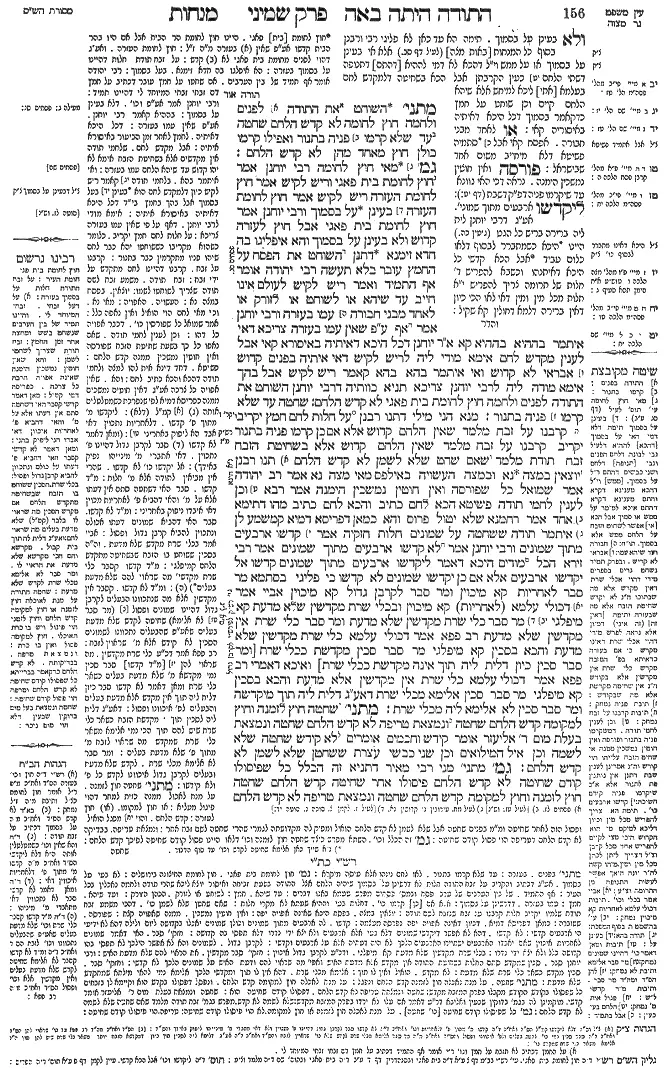
Menachot 78b - Guemara
מתני׳ השוחט את התודה לפנים ולחמה חוץ לחומה לא קדש הלחם שחטה עד שלא קרמו פניה בתנור ואפילו קרמו כולן חוץ מאחד מהן לא קדש הלחם:
גמ׳ מאי חוץ לחומה רבי יוחנן אמר חוץ לחומת בית פאגי וריש לקיש אמר חוץ לחומת העזרה ריש לקיש אמר חוץ לחומת העזרה בעינן על בסמוך ורבי יוחנן אמר חוץ לחומת בית פאגי אבל חוץ לעזרה קדוש ולא בעינן על בסמוך והא איפליגו בה חדא זימנא דתנן השוחט את הפסח על החמץ עובר בלא תעשה רבי יהודה אומר אף התמיד ואמר ריש לקיש לעולם אינו חייב עד שיהא או לשוחט או לזורק או לאחד מבני חבורה עמו בעזרה ורבי יוחנן אמר אף על פי שאין עמו בעזרה צריכא דאי איתמר בההיא בההיא קא אמר ר' יוחנן דכל היכא דאיתיה באיסורא קאי אבל לענין מקדש לחם אימא מודי ליה לריש לקיש דאי איתיה בפנים קדוש אבראי לא קדוש ואי איתמר בהא בהא קאמר ריש לקיש אבל בהך אימא מודה ליה לרבי יוחנן צריכא תניא כוותיה דרבי יוחנן השוחט את התודה לפנים ולחמה חוץ לחומת בית פאגי לא קדש הלחם:
שחטה עד שלא קרמו פניה בתנור:
מנא הני מילי דתנו רבנן (ויקרא ז, יג) על חלות לחם חמץ יקריב קרבנו על זבח מלמד שאין הלחם קדוש אלא אם כן קרמו פניה בתנור יקריב קרבנו על זבח מלמד שאין הלחם קדוש אלא בשחיטת הזבח זבח תודת מלמד שאם שחט שלא לשמן לא קדש הלחם תנו רבנן יוצאין במצה נא ובמצה העשויה באילפס מאי מצה נא אמר רב יהודה אמר שמואל כל שפורסה ואין חוטין נמשכין הימנה אמר רבא וכן לענין לחמי תודה פשיטא הכא לחם כתיב והכא לחם כתיב מהו דתימא אחד אמר רחמנא שלא יטול פרוס והא כמאן דפריסא דמיא קמשמע לן איתמר תודה ששחטה על שמונים חלות חזקיה אמר קדשו ארבעים מתוך שמונים ורבי יוחנן אמר לא קדשו ארבעים מתוך שמונים אמר רבי זירא הכל מודים היכא דאמר ליקדשו ארבעים מתוך שמונים קדשו אל יקדשו ארבעים אלא אם כן יקדשו שמונים לא קדשו כי פליגי בסתמא מר סבר לאחריות קא מיכוין ומר סבר לקרבן גדול קא מיכוין אביי אמר דכולי עלמא (לאחריות) קא מיכוין ובכלי שרת מקדשין שלא מדעת קא מיפלגי מר סבר כלי שרת מקדשין שלא מדעת ומר סבר כלי שרת אין מקדשין שלא מדעת רב פפא אמר דכולי עלמא כלי שרת מקדשין שלא מדעת והכא בסכין קא מיפלגי מר סבר סכין מקדשת ככלי שרת [ומר סבר סכין כיון דלית ליה תוך אינה מקדשת ככלי שרת] ואיכא דאמרי רב פפא אמר דכולי עלמא כלי שרת אין מקדשין אלא מדעת והכא בסכין קא מיפלגי מר סבר סכין אלימא מכלי. שרת דאף על גב דלית ליה תוך מיקדשה ומר סבר סכין לא אלימא ליה מכלי שרת:
מתני׳ שחטה חוץ לזמנה וחוץ למקומה קדש הלחם שחטה ונמצאת טריפה לא קדש הלחם שחטה ונמצאת בעלת מום ר' אליעזר אומר קידש וחכמים אומרים לא קידש שחטה שלא לשמה וכן איל המילואים וכן שני כבשי עצרת ששחטן שלא לשמן לא קדש הלחם:
גמ׳ מתניתין מני רבי מאיר דתניא זה הכלל כל שפיסולו קודם שחיטה לא קדש הלחם פיסולו אחר שחיטה קדש הלחם שחטה חוץ לזמנה וחוץ למקומה קדש הלחם שחטה ונמצאת טריפה לא קדש הלחם
Comments from Rashi on Masechet Menachot Page 78b
חוץ לחומת [בית] פאגי . היינו חוץ לחומת הר הבית אבל אם היו בהר הבית קדשו אע"פ שאין בעזרה מ"ה ז"ל: חוץ לחומת העזרה . ואע"ג דהוי לפנים מחומת בית פאגי לא קדש: על זבח תודת . חלות דהיינו על בסמוך בעזרה: הא איפלגו בה חדא זימנא . בעל בסמוך: רבי יהודה אומר אף תמיד של בין הערבים . אם שחטו על חמץ עובר דכתיב על חמץ דם זבחי זבחי המיוחד לי דהיינו תמיד: ורבי יוחנן אמר אע"פ וכו' . דלא בעינן על בסמוך: בההיא קאמר רבי יוחנן . אע"פ שאין עמו בעזרה: דכל היכא דאיתיה . לחמץ לאחר זמן הביעור באיסורא איתיה: אבל מקדש לחם . שלחמי תודה אין מקדשים אלא בשחיטת הזבח אימא לא יהו קדוש עד שיהא הלחם עמו בעזרה: ואי איתמר בהא . בלחמי תודה קאמר ריש לקיש כיון דלמקדש לחם הוא בעינן בעל בסמוך אבל בהך בחמץ בי"ד דכל היכא דאיתיה באיסורא איתיה: אימא מודי לרבי יוחנן . דאף על פי שאין עמו בעזרה צריכא: על חלות לחם חמץ יקריב . כלומר כשהוא מקריבו כששוחטו יהא כבר לחם שיהו פניו מתקרמין כבר בתנור: קרבנו על זבח . קרבנו דהיינו לחם מתקדש על ידי זבח: זבח תודה . משמע זבח לשם תודה שצריך לשוחטו לשמו: יוצאין . בפסח במצה נא: העשויה . האפויה: מאי נא . וכי מאי לחם הוי הואיל ואין נאפה כלל: אמר שמואל כל שפורסין כו' . דכבר אפויה כל דהו: וכן לענין לחמי תודה . שאם נאפו כל כך בשעת שחיטת הזבח שפורסה ואין חוטין נמשכין ממנה קדש הלחם: פשיטא . דחד דינא אית להו למצה ולחמי תודה דהכא והכא כתיב לחם: והא . שאין אפויה כל צרכה אע"ג דאין חוטים נמשכים ממנה כפריסא דמיא לפי שנפרכת כשמטלטלים אותה קמ"ל (דלא): ליקדשו מ' מתוך פ' קדשו . דלאחריות נתכוין דאי אבד הא ליפוק באחריני: (ומאן דאמר לא קדשו סבר לקרבן גדול דהיינו פ' נתכוין. דאי אתברי מ' מינייהו נפיק באידך): אל יקדשו כו' לא קדשו . שהרי אין מביאין לתודה אלא מ' חלות: מ"ד קדשו . סבר האי דשחטה סתם אין דעתו אלא על מ' והאי דהביא פ' לאחריות מכוין דאי איבדו ניפוק באחריני: ומ"ד לא קדשו . סבר האי דהביא שמונים דעתו אכולם ונתכוין להביא קרבן גדול ופסול: אביי אמר בכלי שרת מקדש שלא מדעת . וה"ה בסכין ששוחט בו הזבח שבשחיטה מתקדש הלחם קמיפלגי: מ"ד קדשו קסבר כלי שרת מקדשי' מה שראוי להם שלא מדעת בעלים: ומ"ד לא קדשו . קסבר אין מקדשין אלא מה שנתכוונו הבעלים לקרבן גדול דהיינו שמונים ופסול (מר סבר לא אלימא) שחיטה לקדש שלא מדעת בעלים שאע"פ שהבעלים נתכוונו לשמונים הסכין לא קידש אלא מ' שראוין לזבח: רב פפא אמר דכ"ע כלי שרת מקדשין . מה שראוי להן [מ"ד קדשו] סבר סכין נמי מקדשא מ' שלא מדעת בעלים כשאר כלי שרת ומאן דאמר לא קדשו סבר כיון דלית ליה תוך אין מקדש אלא מדעת בעלים והבעלים לפ' איכוונו ופסול: דאע"ג דלית ליה לסכין תוך . מקדשת הזבח כשאר כלי שרת שיש להם תוך הכי נמי אלימא משאר כלי שרת שמקדש מה שראוי לזבח מ' מתוך פ' שלא מדעת בעלים: ומר סבר לא אלימא מכלי שרת . לקדש שלא מדעת ובעלים לקרבן גדול איכוונו לקדש כל פ' ולא קידשו: מתני' שחטה חוץ לזמנה . על מנת לאכול ממנה כזית למחר דהוי פיגול מעליא: או חוץ למקומו . (או) חוץ לעזרה: קדש הלחם . והוי מפגל הואיל ופסול הוה לאחר שחיטה ומ"מ בפנים שחטה אבל שלא לשמן לא קדש הלחם הואיל ומפיק לה מקדושתה לגמרי שהרי שחטה לשם זבח אחר: ונמצאת טריפה . בבדיקה לא קדש הלחם דטריפה הוי פסול קודם שחיטה: גמ' זה הכלל וכו' . השתא מפרש כיצד שחטה חוץ לזמנה וכו' דלאו היינו פסול קודם שחיטה לפיכך קדש הלחם:
Comments from Tosafot - Menachot 78b
ולא בעינן על בסמוך. תימה הא עד כאן לא פליגי רבי ורבנן בסוף כל המנחות [באות מצה] (לעיל מנחות דף סב.) אלא אי בעינן על בסמוך או על ממש וי"ל דהכא לא דמי לההיא [דהתם] דתנופה דשתי הלחם כעין הקרבתן אבל הכא בשחיטה דלמקדש לחם בעלמא [אתי] ליכא למיחש אלא שיהא הלחם קיים וכן שוחט על חמץ כדקאמר בסמוך דכל היכא דאיתיה באיסוריה קאי: או לאחד מבני חבורה. אפסח קאי אבל סתמיה פשיטא דלא מיחייב משום אחד שבישראל: פורסה ואין חוטין נמשכין הימנה. נראה דכי האי גוונא עד שיקרמו פניה דפ"ק דשבת (דף יט:): ליקדשו ארבעים מתוך שמוני'. אע"ג דרבי יוחנן לית ליה ברירה בריש כל הגט (גיטין כה.) היינו היכא כשמתברר לבסוף דלאו כלום עביד אבל הכא קדשי כל היכא דאיתנהו וכשבא להפריש ד' חלות של תרומה צריך להפריש י"א חלות מכל מין ומין דאי לאו הכי כיון דאין ברירה דלמא דחולין קא שקיל:
Menachot 78b - Mishnah translated into english
MISHNA: In the case of one who slaughters the thanks offering in its proper place inside the Temple courtyard, and at that time its forty loaves were outside the wall, the loaves were not consecrated. Likewise, if he slaughtered the thanks offering before the surface of the loaves formed a crust in the oven, and even if the surface of all the loaves formed a crust except for one of them, the loaves were not consecrated.
GEMARA: The Gemara clarifies: What is meant by outside the wall? Rabbi Yoḥanan says that it means outside the wall of Beit Pagei in Jerusalem. And Reish Lakish says that it means outside the wall of the Temple courtyard.
The Gemara elaborates: Reish Lakish says that it means outside the wall of the Temple courtyard, because the verse states with regard to the loaves of the thanks offering: “Then he shall sacrifice with [al] the thanks offering unleavened cakes mingled with oil” (Leviticus 7:12). And we require that the thanks offering be slaughtered strictly “with [al]” the accompanying loaves, i.e., with the loaves nearby. If the loaves are outside the wall of the Temple courtyard, they are not considered nearby.
And Rabbi Yoḥanan says: If the loaves were outside the wall of Beit Pagei, they are not consecrated, because it is prohibited to eat the loaves outside the wall of Beit Pagei. Since if they were taken outside the wall of Beit Pagei, they would be disqualified because they were removed from their permitted area, they cannot be consecrated if they are there. But if they were merely outside the Temple courtyard, where they may be eaten, they are consecrated. And we do not require that the thanks offering be slaughtered strictly “with” the accompanying loaves, i.e., nearby.
The Gemara objects: Why is it necessary for Rabbi Yoḥanan and Reish Lakish to disagree with regard to a case where the loaves were situated outside the wall when the thanks offering was slaughtered? But didn’t they already disagree with regard to this matter one other time?
This is as we learned in a mishna (Pesaḥim 63a) with regard to the slaughtering of the Paschal offering: One who slaughters the Paschal offering with leavened bread still in his possession transgresses a prohibition, as the verse states: “You shall not sacrifice the blood of My offering with [al] leavened bread; neither shall the offering of the festival of Passover be left until the morning” (Exodus 34:25). Rabbi Yehuda says: Even one who slaughters the daily afternoon offering on Passover eve with leavened bread in his possession transgresses the prohibition. And Reish Lakish says: Actually, one is not liable unless the leavened bread is in the possession of the one who slaughters the offering, or the one who sprinkles its blood, or one of the members of the group, and the leavened bread is with that person in the Temple courtyard. And Rabbi Yoḥanan says: One is liable even if the leavened bread is not with that person in the Temple courtyard. Evidently, they already disagree with regard to the meaning of the word “al.”
The Gemara replies: It is necessary to state the dispute concerning both matters. As, if their disagreement were stated only with regard to that matter of the Paschal offering, one might think that only with regard to that matter Rabbi Yoḥanan said that one is liable even if the leavened bread is not inside the Temple courtyard, since wherever there is leavened bread, its owner stands in violation of the prohibition against owning leavened bread at that time. But with regard to the matter of the consecration of the loaves of the thanks offering, one could say that he concedes to Reish Lakish that if the loaves are inside the Temple courtyard when the thanks offering is slaughtered, they are consecrated, but if they are outside, they are not consecrated.
And if their disagreement were stated only with regard to this matter of the loaves of the thanks offering, one might think that only with regard to this matter Reish Lakish says that the loaves are consecrated only if they were within the walls of the Temple courtyard. But with regard to that matter of the Paschal offering, one could say that he concedes to Rabbi Yoḥanan that one is liable for slaughtering the Paschal offering while in possession of leavened bread even if it was not with him inside the Temple courtyard, as wherever there is leavened bread, its owner stands in violation of the prohibition against owning leavened bread at that time. Therefore, it is necessary to state the dispute concerning both matters.
The Gemara notes: It is taught in a baraita in accordance with the opinion of Rabbi Yoḥanan: In the case of one who slaughters the thanks offering inside the Temple courtyard, and at that time its loaves were outside the walls of Beit Pagei, the loaves were not consecrated.
§ The mishna teaches: If he slaughtered the thanks offering before the surface of the loaves formed a crust in the oven, the loaves were not consecrated. The next mishna also teaches: If one slaughtered the thanks offering not for its sake, the loaves were not consecrated.
The Gemara seeks to clarify: From where are these matters derived? As the Sages taught: The verse states with regard to the loaves accompanying the thanks offering: “With cakes of leavened bread he shall present his offering with the sacrifice of his peace offerings for thanks” (Leviticus 7:13). This teaches that the loaves are not consecrated unless the surface of the loaves formed a crust in the oven, as only then can they be considered “cakes of leavened bread.” The phrase “he shall present his offering with the sacrifice” teaches that the loaves are consecrated only upon the slaughtering of the offering. The phrase “the sacrifice of his peace offerings for thanks” teaches that if one slaughtered the offering not for its sake, the loaves were not consecrated.
§ On a similar note, the Sages taught: One fulfills the obligation to eat matza on Passover with half-done, i.e., not fully baked, matza, and with matza made in a stewpot [ilpas] rather than baked in an oven. The Gemara asks: What constitutes half-done matza? Rav Yehuda says that Shmuel says: It is any matza that is sufficiently baked such that if one breaks it, threads of dough are not drawn from it.
Rava said: And so this is the halakha with regard to the matter of the loaves of the thanks offering, i.e., if the loaves were already half-done at the time of the slaughter of the thanks offering, they are consecrated. The Gemara asks: Why is it necessary for Rava to state this? Isn’t it obvious? Here, with regard to matza, the term “bread” is written (Deuteronomy 16:3), and here, with regard to the loaves of the thanks offering, the term “bread” is written.
The Gemara responds: Lest you say that since the Merciful One states with regard to the loaves of the thanks offering: “And of it he shall present one out of each offering for a gift unto the Lord” (Leviticus 7:14), this indicates that one may not take sliced bread for the thanks offering, and this half-done bread is considered like one that is sliced, as it will break apart upon being lifted, and it should consequently be disqualified for the bread of the thanks offering, therefore Rava teaches us that once it is baked to that point, it is considered as one loaf and it is valid for the thanks offering.
§ It was stated that there is a dispute among the amora’im with regard to a thanks offering that one slaughtered accompanied by eighty loaves rather than the required forty. Ḥizkiyya says: Forty of the eighty loaves are consecrated, and Rabbi Yoḥanan says: Not even forty of the eighty loaves are consecrated.
With regard to this dispute, Rabbi Zeira says: Everyone, even Rabbi Yoḥanan, concedes that in a case where the individual bringing the offering said: Let forty of the eighty loaves be consecrated, that forty are consecrated. Likewise, everyone concedes that where he said: Forty should not be consecrated unless eighty will be consecrated, that they were not consecrated. They disagree when one brings eighty loaves without specification. One Sage, Ḥizkiyya, holds: He intends to consecrate only forty of them, but he brought eighty in order to guarantee that there will be sufficient loaves. And one Sage, Rabbi Yoḥanan, holds: He intends to bring a large offering of eighty loaves; consequently, none of the loaves are consecrated.
Abaye offered another explanation of the dispute and said: Everyone agrees that he intends to guarantee that there will be sufficient loaves, and they disagree with regard to whether service vessels consecrate the appropriate measure without the intention of the one bringing the offering. One Sage, Ḥizkiyya, holds that service vessels consecrate items without intention. Accordingly, the knife that slaughters the thanks offering and consecrates its accompanying loaves consecrates forty of the eighty. And one Sage, Rabbi Yoḥanan, holds that service vessels do not consecrate items without intention.
Rav Pappa offered another explanation of the dispute and said: Everyone agrees that service vessels consecrate items without intention, and here they disagree with regard to whether this is also the halakha with regard to the slaughtering knife. One Sage, Ḥizkiyya, holds that the knife consecrates items as a service vessel does. And one Sage, Rabbi Yoḥanan, holds that since the knife has no inside, it does not consecrate items as a service vessel does.
And there are those who say that Rav Pappa said: Everyone agrees that service vessels consecrate items only with intention, and here they disagree with regard to the ability of the slaughtering knife to consecrate without intention. One Sage, Ḥizkiyya, holds that the power of the knife to consecrate items is stronger than that of other service vessels, as even though it has no inside it consecrates items, and therefore it also consecrates items without intention. And one Sage, Rabbi Yoḥanan, holds that the power of the knife to consecrate items is not stronger than that of other service vessels, and like all service vessels, it does not consecrate items without intention.
MISHNA: If one slaughtered the thanks offering with the intent to partake of it or to burn the sacrificial portions beyond its designated time or outside its designated area, and the offering was rendered piggul or was disqualified, respectively, the loaves were consecrated and either rendered piggul or disqualified. If one slaughtered the thanks offering and it was discovered that it was an animal with a wound that would have caused it to die within twelve months [tereifa], the loaves were not consecrated, as the cause of the animal’s disqualification preceded its slaughter.
If one slaughtered the thanks offering and it was discovered that it is a blemished animal that may not be sacrificed ab initio but if it ascended the altar it may be sacrificed, Rabbi Eliezer says: He has consecrated the loaves, since if the offering ascends the altar it is sacrificed. And the Rabbis say: He has not consecrated the loaves, since it may not be sacrificed ab initio.
If one slaughtered the thanks offering not for its sake but for the sake of another offering, and likewise, if one slaughtered the ram of inauguration not for its sake, and likewise, if one slaughtered the communal peace offering of two sheep that accompany the two loaves on Shavuot not for their sake, the loaves were not consecrated.
GEMARA: The mishna teaches that if one slaughtered the thanks offering with the intent to partake of it beyond its designated time or outside its designated area, the loaves become consecrated. The mishna also teaches that if the thanks offering was slaughtered and it was discovered that it was a tereifa, the loaves were not consecrated, but if it was discovered to have a blemish, Rabbi Eliezer says that the loaves were consecrated, and the Rabbis say that they were not. The Gemara asks: Whose opinion is expressed in the mishna? It is the opinion of Rabbi Meir.
As it is taught in a baraita: This is the principle: Any instance in which the disqualification of the thanks offering preceded its slaughter, the loaves were not consecrated, and any instance in which its disqualification came into existence after its slaughter, the loaves were consecrated. Therefore, if one slaughtered the thanks offering with the intent to partake of it or to burn the sacrificial portions beyond its designated time or outside its designated area, the loaves were consecrated, as the offering remained fit until after its slaughter. But if one slaughtered the thanks offering and it was discovered that it was a tereifa, the loaves were not consecrated, as the cause of the animal’s disqualification preceded its slaughter.
Traduction : The William Davidson digital edition of the Koren Noé Talmud, with commentary by Rabbi Adin Even-Israel Steinsaltz.