 Talmud Bavli
Menachot 73a : Youtube
Daf TubeYoutube
2 video classes :
Menachot Page 73a
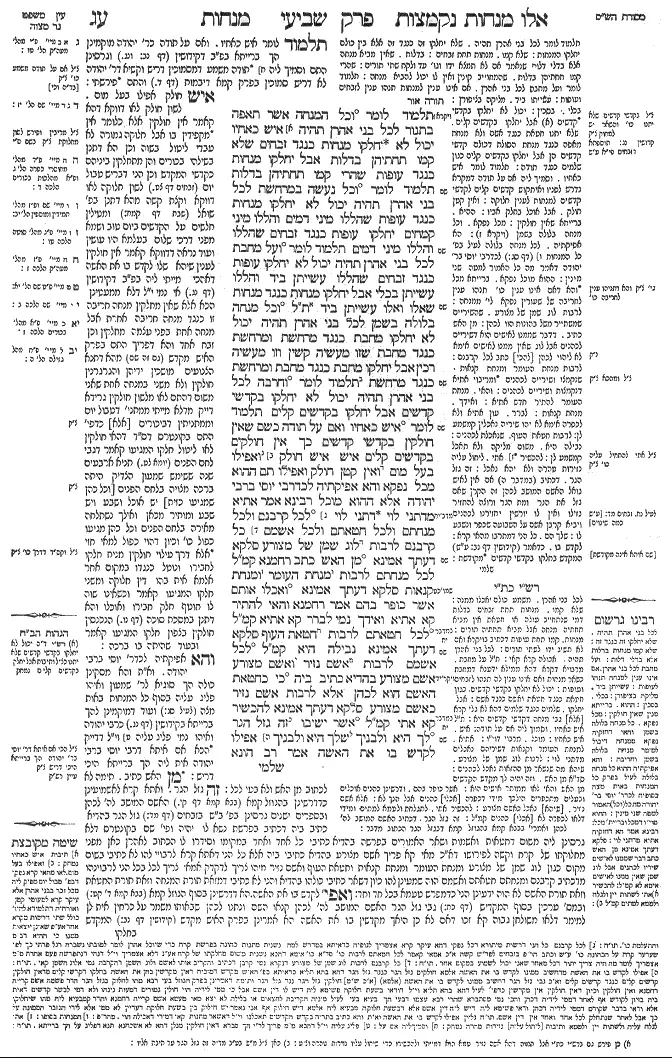
Menachot 73a - Guemara
תלמוד לומר (ויקרא ז, ט) וכל המנחה אשר תאפה בתנור לכל בני אהרן תהיה איש כאחיו יכול לא חלקו מנחות כנגד זבחים שלא קמו תחתיהן בדלות אבל יחלקו מנחות כנגד עופות שהרי קמו תחתיהן בדלות תלמוד לומר (ויקרא ז, ט) וכל נעשה במרחשת לכל בני אהרן תהיה יכול לא יחלקו מנחות כנגד עופות שהללו מיני דמים והללו מיני קמחים יחלקו עופות כנגד זבחים שהללו והללו מיני דמים תלמוד לומר (ויקרא ז, ט) ועל מחבת לכל בני אהרן תהיה יכול לא יחלקו עופות כנגד זבחים שהללו עשייתן ביד והללו עשייתן בכלי אבל יחלקו מנחות כנגד מנחות שאלו ואלו עשייתן ביד תלמוד לאמר (ויקרא ז, י) וכל מנחה בלולה בשמן לכל בני אהרן תהיה יכול לא יחלקו מחבת כנגד מרחשת ומרחשת כנגד מחבת שזו מעשיה קשין וזו מעשיה רכין אבל יחלקו מחבת כנגד מחבת ומרחשת כנגד מרחשת תלמוד לומר (ויקרא ז, י) וחרבה לכל בני אהרן תהיה יכול לא יחלקו בקדשי קדשים אבל יחלקו בקדשים קלים תלמוד לומר (ויקרא ז, י) איש כאחיו ואם על תודה כשם שאין חולקין בקדשי קדשים כך אין חולקים בקדשים קלים איש איש חולק ואפילו בעל מום ואין קטן חולק ואפילו תם ההוא מכל נפקא והא אפיקתיה לכדרבי יוסי ברבי יהודה אלא ההוא מוכל רבינא אמר אתיא מדתני לוי דתני לוי (במדבר יח, ט) לכל קרבנם ולכל מנחתם ולכל חטאתם ולכל אשמם כל קרבנם לרבות לוג שמן של מצורע סלקא דעתך אמינא (במדבר יח, ט) מן האש כתב רחמנא קמ"ל לכל מנחתם לרבות מנחת העומר ומנחת קנאות סלקא דעתך אמינא (שמות כט, לג) ואכלו אותם אשר כופר בהם אמר רחמנא והאי להתיר קא אתיא ואידך נמי לברר קא אתיא קמ"ל (במדבר יח, ט) לכל חטאתם לרבות חטאת העוף סלקא דעתך אמינא נבילה היא קמ"ל (במדבר יח, ט) לכל אשמם לרבות אשם נזיר ואשם מצורע אשם מצורע בהדיא כתיב ביה (ויקרא יד, יג) כי כחטאת האשם הוא לכהן אלא לרבות אשם נזיר כאשם מצורע סלקא דעתך אמינא להכשיר קא אתי קמ"ל (במדבר יח, ט) אשר ישיבו זה גזל הגר (במדבר יח, ט) לך היא ולבניך שלך היא ולבניך אפילו לקדש בו את האשה אמר רב הונא
Comments from Rashi on Masechet Menachot Page 73a
תלמוד לומר לכל בני אהרן תהיה . שלא יחלקו זה כנגד זה אלא בין כולם יחלקו המנחות: שלא קמו . מנחות תחת זבחים: בדלות . שאין מביא מנחה אלא בדלי דלות שנאמר אם לא תמצא ידו וגו' עד ולקח שתי תורים: שהרי קמו תחתיהן בדלות . שהמחוייב קינין ואין לו יכול להביא מנחה: תלמוד לומר ועל מחבת לכל בני אהרן . אם אינו ענין למנחות תנהו ענין לזבחים ועופות: עשייתו ביד . מליקה בציפורן: בכלי . בסכין: יכול לא יחלקו בקדשי קדשים אבל יחלקו בקדשים קלים . שלא יתנו חטאת כנגד אשם ולא מנחת מאפה כנגד מנחת הסולת דכולם קדשי קדשים הן אבל יחלקו בקדשים קלים כגון שלמים כנגד תודה: תלמוד לומר איש כאחיו . וסמיך ליה אם על תודה דמקרא נדרש לפניו ואיתקוש קדשים קלים לקדשי קדשים למנחות לענין חלוקה: ואין קטן חולק . אבל אוכל בחלק אביו: ההיא . ברייתא שאין חולקין: מכל נפקא . וכל מנחה בלולה בשמן (ויקרא ז): הא אפיקתיה . לכל מנחה בלולה לעיל בפ' כל המנחות (מנחות דף סג:) לכדרבי יוסי בר' יהודה דאמר מה כל האמור למטה שני מינין: ההוא מוכל נפקא . ברייתא מכל והא דאם אינו ענין כו' תנהו ענין לחריבה של שעורין נפקא לי' ממנחה: לרבות לוג שמן של מצורע . שהשיריים שמשתייר משל בהונות הוו לכהן: מן האש כתיב . דדבר שממנו לאישים הוא דשיריים לכהנים אבל לוג שאין ממנו לאישים אימא לא ליהוי לכהן [להכי] כתב לכל קרבנם: לרבות מנחת העומר ומנחת קנאות . שנקמצו ושיריים לכהנים ומריבוי אתיא דנקמצות ושיריים לכהנים: והאי . מנחת העומר להתיר חדש אתיא: ואידך . מנחת קנאות: לברר . עון אתיא ולא לכפרה אימא לא יהו שיריה נאכלין קמשמע לן: לרבות חטאת העוף . שנאכלת לכהנים: נבילה היא . משום מליקה ולא תאכל קמשמע לן: להכשיר אתי . ליחול עליה נזירות טהרה ולא יהא נאכל: זה גזל הגר . דכתיב (במדבר ה) אם אין לאיש גואל האשם המושב לכהן זה הקרן שאם גזל את הגר ומת הגר ורוצה להחזיר גזילו ואין לו יורשין יחזירנו לכהנים ויביא קרבן אשם על השבועה שכפר ונשבע לו: שלך הם . כל הני דמתרבו מהאי קרא: לקדש בו . כדאמר (קידושין דף נב: ע"ש) המקדש בחלקו בקדשי קדשים מקודשת:
Comments from Tosafot - Menachot 73a
תלמוד לומר איש כאחיו. ואם על תודה כר' יהודה מוקמינן הך ברייתא בפ"ב דקידושין (דף נב: ונג.) וגרסינן התם וסמיך ליה תודה משמע דמסמוכין דריש וקשיא דר' יהודה לא דריש סמוכין בפרק קמא דיבמות (דף ד.) והתם פירשתי: איש חולק אפילו בעל מום. לשון חולק לאו דווקא דהא קאמר אין חולקין אלא כלומר אין מקפידין בו אבל חלוקה גמורה לא עבדי ליטול בשוה וכן הא דתנן בשילהי בכורים והן מתחלקין ביניהם כקדשי המקדש וכן הני דבריש טבול יום (זבחים דף צט.) לשון חלוקה לאו דווקא וקצת קשה מהא דתנן בפ' שואל (שבת דף קמח:) ומטילין חלשים על הקדשים ביום טוב ושמא מפני דרכי שלום בעלמא היו עושין ועוד נראה דדווקא קאמר אין חולקין לענין שיהא שלו לקדש בו את האשה דאהכי מייתי ליה בפ"ב דקידושין (דף נג.) אי נמי י"ל דלא ממעטינן הכא אלא שאין מחלקין מנחה חריבה זו כנגד מנחה חריבה אחרת אבל מנחה אחת בפני עצמה מחלקין וכן זבח אחד והא דפריך התם בפרק האיש מקדש (גם זה שם) מהא דתנא הצנועים מושכין ידיהן והגרגרנין חולקין ולא משני במנחה אחת שאני משום דהתם לאו מלשון חולקין גרידא דייק מדלא מייתי ממתני' דטבול יום וממתניתין דביכורים [אלא] כדפי' התם בקונטרס דס"ד דהאי חולקין לאו ליטול חלקו המגיעו קאמר דגבי לחם הפנים (יומא לט.) תניא ארבעים שנה ששימש שמעון הצדיק היתה ברכה מצויה בלחם הפנים [וכל כהן שמגיעו כזית] יש אוכל ושבע ויש שבע ומותיר מכאן ואילך נשתלחה מאירה בלחם הפנים וכל כהן מגיעו כפול כו' וכיון דהוי כפול למאי חזי אלא דרך עילוי חולקין מניח חלקו לחבירו ונוטל כנגדו במקום אחר אלמא אית בהו דין חלוקה ומשני חלקו המגיעו קאמר וכשאינו שוה לו חוטף חלק חבירו ואוכלו והא דתנן במסכת סוכה (דף נו.) הנכנסין חולקין בצפון חלקו המגיעו קאמר ובעוד שהיתה בו ברכה: והא אפיקתיה לכדר' יוסי ברבי יהודה. וא"ת והא מסקינן כולה הך סוגיא לר' שמעון ואיהו פליג עליה בסוף כל המנחות באות מצה (לעיל מנחות סג:) ועוד דמוקמינן להך ברייתא בקידושין (דף נג.) כרבי יהודה ואיהו נמי פליג עליה וי"ל דדייק הכא אם איתא דרבי יוסי ברבי יהודה אית ליה הך ברייתא היכי דריש: מן האש כתיב. תימה לא לכתוב מן האש ולא בעי לכל: זה גזל הגר. ואתא קרא לאשמועינן כדדרשינן בהגוזל קמא (בבא קמא דף קי.) האשם המושב לה' לכהן ובספרים ישנים גרסינן בפ' ב"ש בזבחים (דף מד:) גזל הגר בהדיא כתיב ביה דכתיב בפרשת נשא לו יהיה ופי' שם בקונטרס דלא גרסינן ליה משום דחטאות ואשמות ושאר האמורים בפרשה בהדיא כתיבי כל אחד ואחד במקומו וסידרו לו הכתוב לאהרן כאן מפני מחלוקתו של קרח וקשה לפירושו דא"כ מאי קא פריך אשם מצורע בהדיא כתיבי ביה אלא כל הני דאתא קרא לרבויי להו לא כתיבי בשום מקום כגון לוג שמן של מצורע ומנחת העומר ומנחת קנאות וחטאת העוף ואשם נזיר מיהו צריך לדקדק אמאי צריך לכל בכל הני לרבוינהו מדכתיב קרבנם ומנחתם חטאתם ואשמם הוה שמעינן להו כיון דשאר כתיבי כולהו בהדיא והני לא כתיבי דמזאת תורת המנחה וזאת תורת החטאת וזאת תורת האשם לא הוה ידעינן הני כדמפרש טעמא בכל חד וחד: ואפי' לקדש בו את האשה. הא דדרשינן בסוף הגוזל קמא (בבא קמא ד' קט:) ובמס' ערכין בסוף המקדיש (דף כח:) גבי גזל הגר האשם המושב לה' לכהן קנאו השם ונתנו לכהן שבאותו משמר על כרחין אית לן למימר דלאו משולחן גבוה קא זכו דאם לא כן היאך מקדשין בו את האשה הא אמרינן בפרק האיש מקדש (קידושין דף נב:) המקדש בחלקו בין בקדשי קדשים בין בקדשים קלים אינה מקודשת דמשולחן גבוה קא זכו אלא לענין אחר קאמר דאין יכול ליתנו לכל כהן שירצה ומיהו הא מילתא דריש התם מדכתיב מלבד איל הכיפורים ושמא אתא קרא לאשמועינן דמועלין בו עד שיבא ליד כהן כדאמר גבי חרמים בסוף המקדיש (ערכין דף כט.) כל זמן שהם ביד בעלים הרי הן כהקדש לכל דבריהם נתנן לכהן הרי הן כחולין ומדקרייה רחמנא אשם לא הוה ידענא הך מילתא דלא הוה מסתבר לאוקמי הכי וא"ת והיאך מקדשין בו את האשה הא לאו ממון כהן הוא כדמשמע בסוף הגוזל קמא (בבא קמא דף קי.) דמחזירין בלילה והחזירה חצאין לא יצא דאשם קרייה רחמנא ועוד מסיק התם (דף קי:) דאין חולקין גזל הגר כנגד גזל הגר משום דאשם קריי' רחמנא וי"ל דהנ"מ קודם חלוקה אבל לאחר שיגיע לכל אחד חלקו נעשה ממון כהן:
Menachot 73a - Mishnah translated into english
The verse states: “And every meal offering that is baked in the oven…shall all the sons of Aaron have, each man like the other” (Leviticus 7:9–10). This verse emphasizes that the sons of Aaron must divide the meal offering equally among themselves, without exchanging it for a portion of any other offering.
The baraita continues: One might have thought that they may not receive a share of meal offerings in exchange for portions of animal offerings since they do not substitute for them in the case of poverty. One who is too poor to afford to bring an animal offering, e.g., in the case of a sin offering determined on a sliding scale, does not bring a meal offering in its stead. Since meal offerings are not brought in place of animal offerings, there is clearly no connection between them. But perhaps they may receive a share of meal offerings in exchange for portions of bird offerings, since they do substitute for them in the case of poverty. If one is so destitute that he cannot afford to bring a bird offering he brings a meal offering. Therefore, the same verse states: “And all that is prepared in the deep pan…shall all the sons of Aaron have,” again emphasizing that all must have an equal share in that meal offering.
The baraita continues: One might have thought that they may not receive a share of meal offerings in exchange for portions of bird offerings since these, i.e., bird offerings, are types of offerings that involve blood sprinkled on the altar, and those, i.e., meal offerings, are types of offerings made of flour. But perhaps they may receive a share of portions of bird offerings in exchange for portions of animal offerings, since both categories are types of offerings that involve blood sprinkled on the altar. Therefore, the same verse states: “And on a pan…shall all the sons of Aaron have,” a seemingly superfluous phrase, which teaches that one may not receive a share even of bird offerings in exchange for portions of animal offerings.
The baraita continues: One might have thought that they may not receive a share of bird offerings in exchange for portions of animal offerings because with regard to these, i.e., the birds, their processing, i.e., killing, is executed by hand, by pinching the nape of the neck, and with regard to those, i.e., the animals, their processing, i.e., killing, is executed with a utensil, by slaughtering with a knife. But perhaps they may receive a share of meal offerings in exchange for portions of other meal offerings, since the processing of both these and those are carried out by hand. Therefore, the next verse states: “And every meal offering mixed with oil…shall all the sons of Aaron have” (Leviticus 7:10).
The baraita continues: One might have thought that they may not receive a share of a meal offering prepared on a pan in exchange for portions of a meal offering prepared in a deep pan, or portions of a meal offering prepared in a deep pan in exchange for portions of a meal offering prepared on a pan, since the actions with this pan result in a hard product, and the actions with that deep pan result in a soft product. But perhaps they may receive a share of a meal offering prepared on a pan in exchange for the portions of a different meal offering prepared on a pan, or a share of a meal offering prepared in a deep pan in exchange for portions of a different meal offering prepared in a deep pan. Therefore, the same verse states: “Or dry, shall all the sons of Aaron have” (Leviticus 7:10).
The baraita continues: One might have thought that they may not receive a share of offerings of the most sacred order, e.g., meal offerings, in exchange for a portion of another similar offering, but they may receive a share of offerings of lesser sanctity in exchange for a portion of another similar offering. Therefore, the same verse states with regard to meal offerings: “Shall all the sons of Aaron have, one as well as another” (Leviticus 7:10), and near it appears the verse: “If he offers it for a thanks offering” (Leviticus 7:12), from which is derived: Just as one may not receive a share of one offering in exchange for a portion of another similar offering in the case of offerings of the most sacred order, so too, one may not receive a share of one offering in exchange for a portion of another similar offering in the case of offerings of lesser sanctity, e.g., a thanks offering.
The baraita further expounds this verse: It states: “One as well as another [ish ke’aḥiv],” which teaches that with regard to priests, a man [ish] who is an adult receives a share even if he is blemished, but a priest who is a minor may not receive a share even if he is unblemished. This baraita evidently interprets the verse: “And every meal offering, mixed with oil, or dry, shall all the sons of Aaron have, one as well as another” (Leviticus 7:10), as referring to the prohibition against priests exchanging shares of offerings. If so, how does Ḥizkiyya state that this verse is referring to the priests’ eating of the remainder of the omer offering and the meal offering of a sota?
The Gemara answers: With regard to the prohibition against exchanging priestly shares, that is derived from the term: “Every meal offering.” By contrast, Ḥizkiyya derives his principle with regard to these two meal offerings from the rest of the verse. The Gemara asks: But haven’t you already derived from the word “every” that which Rabbi Yosei, son of Rabbi Yehuda, states, that when one vows to offer a meal offering baked in an oven, all the baked items must be of a uniform type, either loaves or wafers (see 63b)? The Gemara answers: Rather, that halakha concerning the exchange of shares of offerings is derived from the addition of the word “and,” in the term: “And every [vekhol] meal offering.”
§ Ravina said: According to the opinion of Rabbi Shimon, the source for the halakha that the omer offering and the meal offering of a sota are eaten comes from the baraita that Levi teaches, as Levi teaches: The verse states with regard to the priestly gifts: “This shall be yours of the most sacred items, reserved from the fire: Every offering of theirs, and every meal offering of theirs, and every sin offering of theirs, and every guilt offering of theirs, which they may restore to Me, shall be most holy for you and for your sons” (Numbers 18:9). The word “every” in each clause includes a number of additional offerings that are eaten by the priests.
The Torah states: “Every offering of theirs,” to include the log of oil that accompanies the guilt offering of a recovered leper, teaching that it is also eaten by the priests. As, it might enter your mind to say that since the Merciful One writes in this verse: “From the fire,” this would exclude this oil, which is not brought onto the altar. Therefore, the verse teaches us: “Every offering,” to include the leper’s oil.
The baraita continues expounding the verse: “And every meal offering of theirs,” serving to include the omer meal offering, and the meal offering of jealousy brought by a sota, teaching that they are also eaten by the priests. As, it might enter your mind to say that since the Merciful One states: “And they shall eat those wherewith atonement was made” (Exodus 29:33), the verse thereby indicates that the priests may eat only those offerings that help the owner achieve atonement. And this omer comes to permit eating from the new grain (see Leviticus 23:9–14), not to achieve atonement; and concerning the other offering, i.e., the meal offering of a sota, as well, it comes to clarify whether or not the accused woman is guilty of adultery, but not to achieve atonement. Therefore, the verse teaches us: “Every meal offering,” to teach that these two meal offerings are included.
The baraita continues to expound the verse. The verse states: “And every sin offering of theirs,” to include a bird sin offering, teaching that it is also eaten by the priests. As, it might enter your mind to say: The priests may not eat it because it is an unslaughtered animal carcass, as it is killed by pinching the nape of the neck (see Leviticus 5:8), not by conventional slaughter. Therefore, the verse teaches us: “Every sin offering,” teaching that bird sin offerings are included.
The baraita continues to expound the verse. The Torah states: “And every guilt offering of theirs,” to include the guilt offering of the nazirite who has become ritually impure (see Numbers 6:12) and the guilt offering of the leper, teaching that they are also eaten by the priests. The Gemara objects: With regard to the guilt offering of the leper, it is explicitly written with regard to it: “For as the sin offering is the priest’s, so is the guilt offering” (Leviticus 14:13), which already teaches that it is eaten by the priests.
The Gemara answers: Rather, the verse serves to include the guilt offering of the nazirite, stating that its status is like the guilt offering of the leper. As, it might enter your mind to say: The guilt offering of the nazirite is not sacrificed for atonement, but rather it comes to prepare the nazirite to begin his period of naziriteship anew, and therefore its meat would not be eaten by the priests. Therefore, the verse teaches us: “Every guilt offering,” teaching that the guilt offering of the nazirite is included.
The baraita concludes: “This shall be yours of the most sacred items…which they may restore”; this is referring to an item stolen from a convert who has no heirs and subsequently dies. In this case, the stolen item is given to the priests together with an additional one-fifth of its worth. The phrase “for you and for your sons” means that it is yours and your sons’ personal property, and it may be used even to betroth a woman with it, and it does not belong to the Temple treasury.
§ Rav Huna said:
Traduction : The William Davidson digital edition of the Koren Noé Talmud, with commentary by Rabbi Adin Even-Israel Steinsaltz.
Menachot 73a : Significance
Next step
Finished studying Menachot 73a? Carry on with the rest of the tractate.
Study Menachot 73bFrequently asked questions: Menachot 73a
Where is Menachot 73a in tractate Menachot?
Menachot 73a is page 143 of 217 in tractate Menachot (Seder Kodashim).
When is daf 73 of Menachot studied in Daf Yomi?
Daf Yomi covers one daf a day, both sides. Daf 73 of Menachot will be studied on August 26, 2033.
Is there a video class on Menachot 73a?
Yes, by Daf Tube, Rabbi Dr. Moshe Weisblum. These classes were published on YouTube by their authors and are gathered on this site.
What is tractate Menachot about?
The Masechet Menahot is the second tractate of the Seder Kodashim. The Gemara Menahot is the study of the laws concerning the preparation and presentation of offerings of flour, grain, oil and drink. As well as the meal offering that was burnt on the altar and the rest that was to be consumed by the cohanim. The Menahot tractate has 13 chapters.
Your study is also dedicated to them
- L'ilui Nishmat Rav Chlomo Ben Jamilla
- For the success of Elyahou ben H'anna & family
- L'ilui Nishmat Chemouel Eliezer ben Batcheva