 Talmud Bavli
The learning on the whole site is dedicated : L'ilui Nishmat Jamila bat Chlomo Abensour
The learning on the whole site is dedicated : L'ilui Nishmat Jacques Isaac Ben Amram Loubaton
The learning on the whole site is dedicated : L'ilui Nishmat Amram ben Itshak Loubaton
Menachot 89a : Youtube
Daf TubeYoutube
2 video classes :
Menachot Page 89a
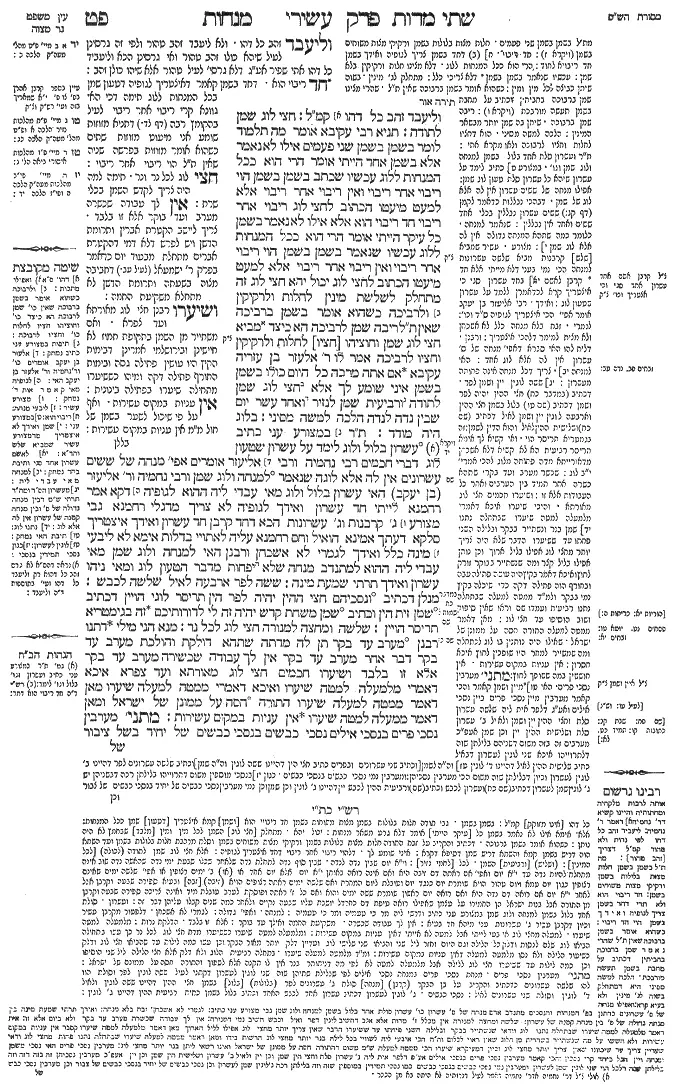
Menachot 89a - Guemara
וליעבד זהב כל דהו קא משמע לן:
חצי לוג שמן לתודה:
תניא רבי עקיבא אומר מה תלמוד לומר בשמן בשמן שני פעמים אילו לא נאמר אלא בשמן אחד הייתי אומר הרי הוא ככל המנחות ללוג עכשיו שכתב בשמן בשמן הוי ריבוי אחר. ריבוי ואין ריבוי אחר ריבוי אלא למעט מיעטו הכתוב לחצי לוג ריבוי אחר ריבוי חד ריבוי הוא אלא אילו לא נאמר בשמן כל עיקר הייתי אומר הרי הוא ככל המנחות ללוג עכשיו שנאמר בשמן בשמן הוי ריבוי אחר ריבוי ואין ריבוי אחר ריבוי אלא למעט מיעטו הכתוב לחצי לוג יכול יהא חצי לוג זה מתחלק לשלשת מינין לחלות ולרקיקין ולרביכה כשהוא אומר בשמן ברביכה שאין תלמוד לאמר ריבה שמן לרביכה הא כיצד מביא חצי לוג שמן וחוציהו [חציו] לחלות ולרקיקין וחציו לרביכה אמר לו ר' אלעזר בן עזריה עקיבא אם אתה מרבה כל היום כולו בשמן בשמן איני שומע לך אלא חצי לוג שמן לתודה ורביעית שמן לנזיר ואחד עשר יום שבין נדה לנדה הלכה למשה מסיני:
בלוג היה מודד:
תנו רבנן מצורע עני כתיב (ויקרא יד, כא) עשרון בלול ולוג לימד על עשרון שטעון לוג דברי חכמים רבי נחמיה ורבי אליעזר אומרים אפילו מנחה של ששים עשרונים אין לה אלא לוגה שנאמר (ויקרא יד, כא) למנחה ולוג שמן ורבי נחמיה ור' אליעזר (בן יעקב) האי עשרון בלול ולוג מאי עבדי ליה ההוא לגופיה דקא אמר רחמנא לייתי חד עשרון ואידך לגופיה לא צריך מדגלי רחמנא גבי מצורע ג' קרבנות וג' עשרונות הכא דחד קרבן חד עשרון ואידך איצטריך סלקא דעתך אמינא הואיל וחס רחמנא עליה לאתויי בדלות אימא לא ליבעי מינה כלל ואידך לגמרי לא אשכחן ורבנן האי למנחה ולוג שמן מאי עבדי ליה ההוא למתנדב מנחה שלא יפחות מדבר הטעון לוג ומאי ניהו עשרון ואידך תרתי שמעת מינה:
ששה לפר ארבעה לאיל שלשה לכבש:
מנלן דכתיב (במדבר כח, יד) ונסכיהם חצי ההין יהיה לפר הין תריסר לוגי הויין דכתיב (שמות ל, כד) שמן זית הין וכתיב (שמות ל, לא) שמן משחת קדש יהיה זה לי לדורותיכם זה בגימטריא תריסר הויין:
שלשה ומחצה למנורה חצי לוג לכל נר:
מנא הני מילי דתנו רבנן (שמות כז, כא) מערב עד בקר תן לה מדתה שתהא דולקת והולכת מערב עד בקר דבר אחר מערב עד בקר אין לך עבודה שכשירה מערב עד בקר אלא זו בלבד ושיערו חכמים חצי לוג מאורתא ועד צפרא איכא דאמרי מלמעלה למטה שיערו ואיכא דאמרי ממטה למעלה שיערו מאן דאמר ממטה למעלה שיערו התורה חסה על ממונן של ישראל ומאן דאמר ממעלה למטה שיערו אין עניות במקום עשירות:
מתני׳ מערבין נסכי פרים בנסכי אילים נסכי כבשים בנסכי כבשים של יחיד בשל ציבור
Comments from Rashi on Masechet Menachot Page 89a
וליעבד זהב כל דהו . לאותם פי נרות ולא ליבעו זהב טהור קא משמע לן דצריך זהב טהור: מת"ל בשמו בשמן שני פעמים . חלות מצות בלולות בשמן ורקיקי מצות משוחים בשמן (ויקרא ז): חד ריבוי . דחד בשמן צריך לגופיה ואידך בשמן חד ריבויא לחוד: הרי הוא ככל המנחות ללוג . דלא מצינו חלות ורקיקין בלא שמן: עכשיו שנאמר בשמן בשמן . דלא צריכי כלל: מתחלק לג' מינין . בשוה שיתן כביצה לכל מין ומין: כשהוא אומר בשמן ברבוכה שאין ת"ל . שהרי מצינו שמן ברבוכה בחביתין דכתיב על מחבת בשמן תעשה מורבכת (ויקרא ו): ריבה שמן ברבוכה . שיתן בה שמן יותר מבשאר המינין: הלכה למשה מסיני . הוא דחציו לחלות וחציו לרבוכה ולאו מקרא אתי: ת"ר ועשרון סלת אחד בלול בשמן למנחה ולוג שמן וגו' . במצורע כתיב לימד על עשרון שיהא כל עשרון סלת טעון לוג שמן: אפילו מנחה של ששים עשרון אין לה אלא לוג של שמן . דבהכי נבללות כדאמר לקמן (מנחות דף קג:) ששים עשרון נבללין בכלי אחד ששים ואחד אין נבללין: שנאמר למנחה . כלומר כמה שתהא המנחה גדולה אין לה אלא לוג שמן: מצורע . עשיר שמביא [שלש] קרבנות מביא שלשה עשרונות למנחה הכי נמי בעני דלא מייתי אלא חד קרבן לאשם בחד עשרון סגי כי איצטריך קרא לכדאמרן ללמד על עשרון שטעון לוג: ואידך . רבי אליעזר בן יעקב אומר אפי' הכי איצטריך לגופיה ס"ד וכו': לגמרי . זבח בלא מנחה כלל לא אשכחן ולא מצית למימר דלהכי איצטריך: ורבנן . דלית להו האי סברא דאפי' מנחה של ס' עשרון אין לה אלא לוג אחד: האי למנחה . צריך דכל מנחה אינה פחותה מעשרון: ששה לוגין יין ושמן לפר . דכתיב (במדבר כח) חצי ההין יהיה לפר ושמן דכתיב (שם טו) בלול בשמן חצי ההין וארבעה לוגין יין ושמן לאיל דכתיב (שם כח) ושלישית ההין לאיל והוא הדין לשמן: זה בגמטריא תריסר הוי . ואי קשיא לך אימא תריסר רביעית הא לא קשיא דלא אשכחן מדאורייתא מדה פחותה מלוג להכי אמרי' י"ב לוג: שכשר מערב ועד בקר . שתהא כשרה אחר תמיד בין הערבים ואחר כל העבודות אלא זו: ושיערו חכמים חצי לוג מאורתא . והיכי שיערו איכא דאמרי מלמעלה למטה שיערו שבתחלה נתנו שמן בנר ונשתייר בבקר ובלילה השני פחתו עד ששיערו הדבר שלא היה צריך יותר מחצי לוג אפילו בליל ארוך וכן נותן אפילו בליל קצר ומה שנשתייר בבוקר זורק לחוץ ואיכא דאמר בקיץ היה עושה פתילה עבה ובחורף הוה פתילה דקה כדי שיכלה בקיץ נמי בבקר ולמ"ד ממטה למעלה שבתחלה נתנו רביעית ועמדו שם וראו שאין סיפוק ושוב הוסיפו עד חצי לוג: מאן דאמר ממטה למעלה התורה חסה על ממונן של ישראל . שאילו היה נותנין בו לוג לכתחלה ומה שמשייר למחר היו שופכין לחוץ איכא חסרון: אין עניות במקום עשירות . אין חוששין במה ששופך לחוץ: מתני' מערבין נסכי פרים . האי מיין ושמן קאמר והכי קאמר מערבין מיין נסכי פרים ביין נסכי אילים ואע"ג דלפר אית ליה שלשה עשרון סלת וחצי ההין יין ושמן ולאיל ב' עשרון סלת ושלישית ההין יין וכן שמן אעפ"כ מערבים זה בזה משום דשניהם בלילתן שוה דלתרוייהו איכא שני לוגין לעשרון דבאיל כתיב שלישית ההין לאיל דהיינו ד' לוגין וה"ה לשמן [וכתיב שני עשרונים ובפרים כתיב חצי הין דהיינו ששה לוגין וה"ה שמן] וכתיב שלשה עשרונים לפר דהיינו ב' לוגין לעשרון וכיון דבלילתן שוה משום הכי מערבין נסכיהן: ומערבין נמי נסכי כבשים בנסכי כבשים . כגון בנסכי מוספין משום דתרוייהו בלילתן רכה דבשניהן יש ג' לוגין שמן לעשרון דכתיב (שם כח) ועשרון לכבש וכתיב (שם) ורביעית ההין לכבש יין דהיינו ג' לוגין וכן שמן וכן נמי מערבין נסכי כבשים של יחיד בנסכי כבשים של צבור וכן נמי מערבין נסכי כבשים של היום בנסכי כבשים של אמש כדאמרינן (לעיל מנחות דף טו:) מביא אדם זבחו היום ונסכיו מכאן עד י' ימים:
Comments from Tosafot - Menachot 89a
וליעבד זהב כל דהו. ולא ליעבד זהב טהור ולפי זה גרסינן לעיל שיהא כולו זהב טהור ואי גרסינן הכא וליעביד כל דהו אתי שפיר אע"ג דלא גרסי' לעיל טהור אלא שיהו כולן זהב: חד ריבוי הוא. דחד בשמן קאמר דאיצטריך לגופיה דטעון שמן בכל המנחות ללוג תימה דכי האי גוונא קרי ריבוי אחר ריבוי לעיל בהקומץ רבה (מנחות דף לד.) דתניא מזוזות שומע אני מיעוט מזוזות שתים כשהוא אומר מזוזות בפרשה שניה שאין ת"ל הוי ריבוי אחר ריבוי: חצי לוג לכל נר ונר. תימה למה היה צריך לקדש השמן בכלי שרת: אין לך עבודה שכשרה מערב ועד בוקר אלא זו בלבד. צריך ליישב הקטרת אברין ותרומת הדשן ויש לפרש דלא דמי דהקטרת אברים מתחלת מבעוד יום כדאמר בפרק ר' ישמעאל (לעיל מנחות עב.) דחביבה מצוה בשעתה ותרומת הדשן לא מתחלא משקיעת החמה: ושיערו רבנן חצי לוג מאורתא ועד צפרא. ואם משתייר מן השמן בתקופת תמוז לא חיישינן ובירושלמי אמרינן דבימות הקיץ היו עושין פתילה גסה ובימות החורף פתילה דקה ומיהו כששיערו מתחילה שיערו בפתילה בינונית: אין עניות במקום עשירות. ואף על פי שיכול לשער בשמן של חול מ"מ אין עניות במקום עשירות:
Menachot 89a - Mishnah translated into english
and consequently, let the mouth of the lamps be fashioned from gold of any quality, not necessarily from pure gold. Therefore, the baraita teaches us that even the mouth of the lamps must be fashioned from pure gold.
§ The mishna teaches: A half-log of oil was used to measure oil for the thanks offering. The thanks offering was accompanied by four different types of loaves; three types were unleavened and one was leavened, as the verse states: “If he offers it for a thanks offering, then he shall offer with the sacrifice of thanks offering: Unleavened loaves mixed with oil; and unleavened wafers spread with oil; and poached fine flour, loaves mixed with oil. With loaves of leavened bread he shall present his offering, with the sacrifice of his peace offerings for a thanks offering” (Leviticus 7:12–13).
It is taught in a baraita: Rabbi Akiva says: Why must the verse state: “With oil,” “with oil,” writing it twice; why was the first time not sufficient? Because were the term “with oil” stated only once, I would have said that, with regard to the amount of oil required, the meal offerings that accompany the thanks offerings are like all other meal offerings to the extent that they require one log of oil. Now that the verse wrote “with oil,” “with oil,” it constitutes one amplification following another amplification, and the principle is that one amplification following another amplification serves only to restrict the extent of the halakha. Accordingly, in this case the verse restricted the amount of oil used in the three types of unleavened meal offerings to a half-log for all of them together.
The Gemara interjects the citation of the baraita to ask: Is this a case of one amplification following another amplification? It would appear that there is only one amplification, as according to the baraita the first mention of the term “with oil” is necessary to teach the basic requirement that the meal offerings of the thanks offering require oil, like other meal offerings. How then can it be considered an amplification?
Rather, Rabbi Akiva’s statement should be emended, as follows: Were the term “with oil,” not written at all, I would still have said that the thanks offering meal offerings are like all other meal offerings to the extent that they require one log of oil. Now that the verse wrote “with oil,” “with oil,” it constitutes one amplification following another amplification, and the principle is that one amplification following another amplification serves only to restrict the extent of the halakha. Accordingly, in this case the verse restricted the amount of oil used in the three types of unleavened meal offerings to a half-log for all three together.
The Gemara resumes its citation of the baraita: Once it has been established that the meal offerings require only a half-log of oil, one might have thought that this half-log should be equally divided between the three types of unleavened meal offerings, i.e., one-sixth of a log for the loaves, one-sixth for the wafers, and one-sixth for the poached loaves. When the verse states: “With oil,” with regard to the poached loaves, that is seemingly superfluous, as there is no need for the verse to state the requirement to use part of the half-log of oil, being that this requirement has already been established. It must therefore serve to amplify the amount of oil used for a poached loaf as opposed to the other two types. How so? One brings a half-log of oil and divides it equally into two. Half of it is further divided and used both for the ten regular loaves and for the ten wafers, and the other half of it is used entirely for the ten poached loaves.
Rabbi Elazar ben Azarya said to Rabbi Akiva: Akiva, even if you were to amplify halakhot the entire day from the terms “with oil,” “with oil,” I would not listen to you and accept your claims. Rather, the halakha that a half-log of oil is required for the thanks offering, and similarly, the halakha that a quarter-log of oil is required for the loaves of a nazirite, and the halakha that a woman who experiences an emission of blood during the eleven days that are between one seven-day period of menstruation and the next period of menstruation is a zava, each of these is a halakha transmitted to Moses from Sinai; they are not derived from verses.
§ The mishna states that with the vessel of one log one would measure the oil for all the standard meal offerings. It then cites a dispute between the Rabbis, who hold that one log of oil is required for each tenth of an ephah of flour used, and Rabbi Eliezer ben Ya’akov, who holds that each meal offering, irrespective of its size, requires only one log of oil.
The Sages taught in a baraita: With regard to a poor leper, who cannot afford the standard offerings that are required as part of the purification process and is instead required to bring one lamb as a guilt offering and a tenth of an ephah of flour as a meal offering, it is written: “And a tenth-part of an ephah of fine flour mixed with oil for a meal offering, and a log of oil” (Leviticus 14:21). The verse juxtaposes the need for a log of oil with the fact the offering is made of a tenth of an ephah of flour. Accordingly, it teaches about each tenth of an ephah of flour that it requires one log of oil; this is the statement of the Rabbis.
Rabbi Neḥemya and Rabbi Eliezer say: Each meal offering, irrespective of its size, and even a meal offering of sixty tenths of an ephah of flour, requires only its single log of oil, as it is stated with regard to offering of a leper: “And a tenth of an ephah of fine flour mixed with oil for a meal offering, and a log of oil.” The juxtaposition of “a meal offering” with “a log of oil” teaches a principle for all meal offerings: Each offering requires only one log of oil.
The Gemara asks: And as for Rabbi Neḥemya and Rabbi Eliezer ben Ya’akov, what do they do with this verse: “And a tenth-part of an ephah of fine flour mixed with oil for a meal offering and a log of oil,” which links the need for a log of oil with the fact the offering is made of a tenth of an ephah of flour? The Gemara explains: That verse is required to teach the matter itself, as the Merciful One states: Let a poor leper bring an offering of just a tenth of an ephah of flour. Accordingly, it cannot be used to teach a principle about meal offerings.
The Gemara asks: And as for the other, i.e., the Rabbis, how do they respond to this claim? They maintain that it is not necessary to teach the matter itself, as from the fact that the Merciful One revealed with regard to a leper who is not poor that he must bring three animal offerings and a meal offering of three-tenths of an ephah as part of his purification process, it may be inferred that here, with regard to a poor leper, who brings only one offering, that he similarly brings a meal offering of only a tenth of an ephah. Accordingly, the fact that the verse mentions that his offering is only a tenth of an ephah is superfluous and can teach a principle for all meal offerings.
The Gemara continues to ask: And as for the other, Rabbi Neḥemya and Rabbi Eliezer, how would they respond to this claim? They maintain that it was necessary for the verse to state the size of his meal offering, as otherwise it might enter your mind to say that since the Merciful One spared the money of the poor leper by allowing him to bring an offering affordable in poverty, one might say that the Merciful One does not require from him to bring any meal offering at all. The Gemara asks: And as for the other, the Rabbis, how would they respond to this? They claim that we do not find that the Torah entirely exempts a poor person from the offerings of the purification process, only that it provides a less expensive way to complete that process.
The Gemara asks: And as for the Rabbis, what do they do with the juxtaposition in the end of this verse: “For a meal offering and a log of oil,” from which Rabbi Neḥemya and Rabbi Eliezer derive the principle that each meal offering requires only one log of oil? The Gemara explains: The Rabbis maintain that the juxtaposition teaches about one who donates a meal offering, without specifying its size, that he should not bring less than an amount of flour that requires one log. And what is this amount? A tenth of an ephah. The Gemara asks: And as for the other, Rabbi Neḥemya and Rabbi Eliezer, from where do they derive that halakha, as they maintain the verse teaches the principle for all meal offerings? The Gemara explains: They maintain that two halakhot can be derived from this verse.
§ The mishna lists the quantities of oil and wine that were required for the meal offerings and libations that accompanied the sacrifice of an animal. Six log, i.e., one-half of a hin, for those of a bull; and four log, i.e., one-third of a hin, for those of a ram; and three log, i.e., one-quarter of a hin, for those of a lamb. The Gemara asks: From where do we derive these quantities? We derive them from a verse, as it is written: “And their libations shall be one-half of a hin of wine for a bull, and one-third of a hin for the ram, and one-quarter of a hin for a lamb” (Numbers 28:14).
The Gemara elaborates: Now, one hin is twelve log, as it is written: “And of olive oil a hin” (Exodus 30:24), and it is written afterward in the same verse: “Sacred anointing oil, this [zeh] shall be for Me, throughout your generations.” The numerical value [gimatriyya] of zeh is twelve. Once it is established that one hin is twelve log, it is possible to calculate how may log are in one-half, one-third, and one-quarter of a hin.
§ The mishna teaches: Three and a half log of oil were required for the Candelabrum, as there were seven lamps and a half-log was required for each lamp. The Gemara asks: From where are these matters derived? They are derived from a verse, as the Sages taught in a baraita: The verse states with regard to the Candelabrum: “Aaron and his sons shall arrange it from evening to morning, before the Lord” (Exodus 27:21). This indicates that you shall put into each lamp its required quantity of oil so that it will continue burning from evening until morning. Alternatively, the phrase “from evening to morning” indicates that the mitzva is fulfilled throughout the night, and you have no other rite that is valid from evening until morning except for this one alone. And the Sages calculated that a half-log of oil for each lamp is necessary to ensure that they continue burning from evening until morning.
How did the Sages reach the conclusion that a half-log of oil is needed? There are those who say that the Sages calculated it by initially using a large quantity of oil, more than necessary to burn throughout the night, and then decreasing the quantity by a small amount each night until they saw that at the end of the night there was no oil remaining. And there are those who say that they calculated it by initially using a small quantity of oil and then increasing the quantity each night until they saw that the quantity was sufficient to allow the lamps to burn throughout the night.
The Gemara elaborates: The one who said that they calculated it by increasing the quantity each night holds that they did so in accordance with the principle that the Torah spared the money of the Jewish people, so the Sages wished to minimize the financial cost of their experimentation. And the one who said that they calculated it by decreasing the quantity each night holds that in the Temple one’s actions should not be motivated by a concern for the financial cost, as in a place of wealth there is no poverty.
MISHNA: Many animal offerings are brought together with a meal offering and a wine libation. These additions are collectively referred to as libations. One may mix together the libations of bulls with the libations of rams; the meal offerings may be mixed as they both share the same ratio of flour to oil, i.e., two log of oil for each tenth of an ephah of flour. Likewise, one may mix together the libations of lambs with the libations of other lambs, as the meal offerings both share the same ratio of three log of oil for each tenth of an ephah of flour. And one may mix together the libations of the offering of an individual with those of a communal offering.
Traduction : The William Davidson digital edition of the Koren Noé Talmud, with commentary by Rabbi Adin Even-Israel Steinsaltz.