 Talmud Bavli
The learning on the whole site is dedicated : L'ilui Nishmat Chemouel Eliezer ben Batcheva
The learning on the whole site is dedicated : For the success of Elyahou ben H'anna & family
The learning on the whole site is dedicated : L'ilui Nishmat Nissim ben Barukh Malka
Menachot 88a : Youtube
Daf TubeYoutube
2 video classes :
Menachot Page 88a
Menachot 88a - Guemara
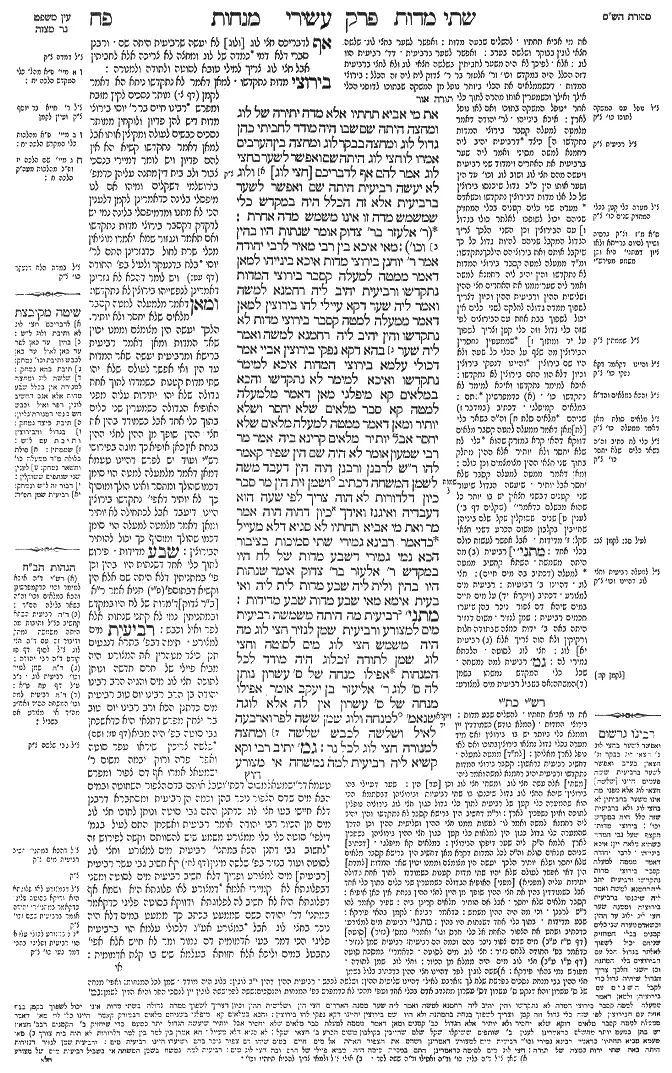
את מי אביא תחתיו אלא מדה יתירה של לוג ומחצה היתה שם שבו היה מודד לחביתי כהן גדול לוג ומחצה בבקר לוג ומחצה בין הערבים אמרו לו חצי לוג היתה שם ואפשר לשער בחצי לוג אמר להם אף לדבריכם [חצי לוג] ולוג לא יעשה רביעית היתה שם ואפשר לשער ברביעית אלא זה הכלל היה במקדש כלי שמשמש מדה זו אינו משמש מדה אחרת:
ר' אלעזר בר' צדוק אומר שנתות היו בהין וכו':
מאי איכא בין רבי מאיר לרבי יהודה אמר ר' יוחנן בירוצי מדות איכא בינייהו למאן דאמר ממטה למעלה קסבר בירוצי המדות נתקדשו ורביעית יהיב ליה רחמנא למשה ואמר ליה שער דקא עיילי להו בירוצין למאן דאמר ממעלה למטה קסבר בירוצי מדות לא נתקדשו והין יהיב ליה רחמנא למשה ואמר ליה שער בהא דקא נפקי בירוצין אביי אמר דכולי עלמא בירוצי המדות איכא למימר נתקדשו ואיכא למימר לא נתקדשו והכא במלאים קא מיפלגי מאן דאמר מלמעלה למטה קא סבר מלאים שלא יחסר ושלא יותיר ומאן דאמר ממטה למעלה מלאים שלא יחסר אבל יותיר מלאים קרינא ביה אמר מר רבי שמעון אומר לא היה שם הין שפיר קאמר להו רבי שמעון לרבנן ורבנן הוה הין דעבד משה לשמן המשחה דכתיב (שמות ל, כד) ושמן זית הין מר סבר כיון דלדורות לא הוה צריך לפי שעה הוא דעבדיה ואיגנז ואידך כיון דהוה הוה אמר מר ואת מי אביא תחתיו לא סגיא דלא מעייל כדאמר רבינא גמירי שתי סמיכות בציבור הכא נמי גמירי דשבע מדות של לח היו במקדש ר' אלעזר בר' צדוק אומר שנתות היו בהין ולית ליה שבע מדות לית ליה ואי בעית אימא מאי שבע מדות שבע מדידות:
מתני׳ רביעית מה היתה משמשת רביעית מים למצורע ורביעית שמן לנזיר חצי לוג מה היה משמש חצי לוג מים לסוטה וחצי לוג שמן לתודה ובלוג היה מודד לכל המנחות אפילו מנחה של ס' עשרון נותן לה ס' לוג ר' אליעזר בן יעקב אומר אפילו מנחה של ס' עשרון אין לה אלא לוגה שנאמר (ויקרא יד, כא) למנחה ולוג שמן \ ששה לפר וארבעה לאיל ושלשה לכבש שלשה ומחצה למנורה חצי לוג לכל נר:
גמ׳ יתיב רבי וקא קשיא ליה רביעית למה נמשחה אי מצורע
Comments from Rashi on Masechet Menachot Page 88a
את מי אביא תחתיו . להשלים שבעה מדות: ואפשר לשער בחצי לוג . שלשה חצאי לוגין בבוקר ושלשה בערב: ואפשר לשער ברביעית . דד' רביעית הוו לוג: אלא . לפיכך לא היה משער לחביתין בשלשה חצאי לוג ולא לחצי ברביעית דזה הכלל היה במקדש וכו' ור' אלעזר בר ר' צדוק לית ליה זה הכלל: בירוצי המדות . דכשממלאים את הכלי ביותר נופל מן המשקה שבתוכו לדופני הכלי אילך ואילך וכשמערין אותו מהרה לתוך כלי אחר נופל המשקה בתוכו ואם לאו נופל לארץ: איכא בינייהו . לר' יהודה דאמר מלמטה למעלה קסבר בירוצי המדות נתקדשו כיצד דרביעית יהיב ליה רחמנא למשה מסיני ואמר ליה שער ברביעית את האחרים וימדוד שני רביעית ויעשה מהם חצי לוג ושוב לוג וכו' עד הין ושער אותו הין כ"כ גדול שיכנסו בירוצין של כל אלו מדות דבירוצין נתקדשו וכשאדם מערה שני כלים קטנים בכלי המחזיק שניהם יכול לשופכו לאלתר כולו בגדול עם הבירוצין וכן השני הלכך צריך הגדול המקבל שניהם להיות גדול כל כך שיקבל אותם ואת בירוציהם הילכך נתקדשו: ומ"ד ממעלה למטה קסבר בירוצי המדות לא נתקדשו . והין יהיב ליה רחמנא למשה ואמר ליה שער ממנו את האחרים חצי ההין ושלישית ההין ורביעית ההין וכיון דצריך לשפוך ממדה גדולה לחלקם לשני כלים אין יכול לשפוך בבת אחת עם הבירוצים לפי שזה כלי גדול וזה כלי קטן וצריך לשפוך על יד ומתוך שממעטין נחסרין הבירוצין מה שצף על הכלי כל שעה ולא היו שם בירוצין והיינו דנפקי בירוצין וכיון דלא הוו התם בירוצין לא נתקדשו: איכא למימר נתקדשו ואיכא למימר לא נתקדשו כו' . כדמפרשינן התם: במלאים קמיפלגי . דכתיב (במדבר ז) שניהם מלאים סלת וה"ה בשאר כלי [לח] מאן דאמר ממעלה למטה קסבר מלאים דווקא דהאי קרא במזרק שהוא כלי לח שלא יחסר ולא יותיר אלא ההין מחלק בתוך שני חצאי ההין מצומצמים וכן כולם: ומאן דאמר ממטה למעלה קסבר שלא יחסר אבל יותיר . שיעשה הגדול שיעור שני קטנים דבשני חצאין יש בו יותר כל שהוא מבשלם כדאמרי' (שקלים דף ב.) לענין שנים ששוקלין שקל שלם ביניהן שחייבין בקלבון משום הכרע דשני חצאי שקל: ז' מדידות . אבל אפשר לעשות כולם בכלי אחד: מתני' רביעית מה היתה משמשת . השתא קחשיב ממטה למעלה (דכתיב בה מים חיים): רביעית מים למצורע . דכתיב (ויקרא יד) על מים חיים במים שיהא דם צפור ניכר בהן שיערו חכמים רביעית: שמן לנזיר . משום דנזיר היתה באה ב' ידות כמצה שבתודה חלות ורקיקין ולא הוה צריך אלא רביעית לוג: חצי לוג . דהיינו ב' רביעיות: חצי לוג לסוטה . הלכתא גמירי לה: גמ' רביעית למה נמשחה . שכל כלי המקדש נמשחו בשמן המשחה: אם בשביל רביעית מים למצורע:
Comments from Tosafot - Menachot 88a
אף לדבריכם חצי לוג [ולוג] לא יעשה שרביעית היתה שם. ורבנן סברי דלא דמי כמדה של לוג ומחצה לא צריכה אלא לחביתין אבל חצי לוג צריך למילי טובא לסוטה ולתודה ולמנורה: בירוצי מדות נתקדשו. למאן דאמר לא נתקדשו ניחא הא דאמר לקמן (מנחות דף צ.) מותר נסכים לקיץ מזבח ומפרש רבינו חיים בר ר' יוסי בירוצי מדות דיש להן פדיון ולוקחין ממותר נסכים כבשים לעולה ומקיצין אותו אבל למאן דאמר נתקדשו קשיא הא אין להם פדיון ויש לומר דמיירי בנסכי צבור ולב בית דין מתנה עליהן כדמפ' בירושלמי דשקלים ומיהו אם לנו מיפסלי בלינה כדאמרינן לקמן דלענין הכי לא מתנו ומדמיפסלי בלינה נמי יש לדקדק דקסבר בירוצי מדות נתקדשו ואם תאמר ונגזור שמא יאמרו מוציאין מכלי שרת לחול כדגזרינן התם לר' יוסי בלח בדנעקר ולעיל בפ' התודה (מנחות דף עט:) ויש לומר דהכא לא גזרינן דאמרינן לנפשייהו בירוצין לא נתקדשו: ומאן דאמר מלמעלה למטה קסבר מלאים שלא יחסר ולא יותיר. הלכך יעשה הין מצומצם וממנו יכוין שאר המדות ומאן דאמר רביעית ברישא ומרביעית יעשה שאר המדות עד הין ואי אפשר לעולם שלא יהו שתי מדות קטנות כשמדדו לתוך אחת גדולה שלא יהו יתירות עליה מפני האופיא הגדולה כשמערין שני כלים בתוך כלי אחד אבל כשמודד בהין את חצי ההין שופך מן ההין לחצי ההין בנחת אין כאן אופיא כך מוגה בפירושי רש"י ועוד יש לפרש דהיינו טעמא דמאן דאמר מלמעלה למטה הוי סימן דכמו שהולך ומחסר ואינו הולך ומוסיף כך לא יותיר דאפי' נתקדשו בירוצין היינו דיעבד אבל לכתחילה לא יותיר ומאן דאמר מלמטה למעלה הוי סימן דכמו שהולך ומוסיף כך יכול להותיר הבירוצין: שבע מדידות. פירוש לתוך כלי אחד דשנתות היו בהין וכן פי' במתניתין דלא היתה שם אלא הין וקשיא דבתוספ' (פ"י) תניא אמר ר"א [ב"ר צדוק] ד' מדות של לח היו במקדש ובמתניתין נמי לא קתני שנתות אלא לפר ואיל וכבש: רביעית מים למצורע. תימה דבפ' בתרא דנגעים תנן כיצד מטהרין את המצורע היה מביא פיילי של חרס חדשה ונותן לתוכה חצי לוג מים והגיה הרב רבינו יהודה בן הרב רבינו יום טוב רביעית מים כדתנן הכא ורב רבינו יום טוב בר יצחק מפרש דתנאי היא כדאשכחן גבי סוטה בפ' היה מביא (דף טז: ושם) שלשה צריכין שיראו עפר סוטה ואפר פרה ורוק יבמה משום ר' ישמעאל אמרו אף דם צפור ומפרש טעמא דר' ישמעאל משום דכתי' וטבל אותם בדם הצפור השחוטה ובמים הבא מים שדם הצפור ניכר בהן וכמה הן רביעית ומסתברא דרבנן דלא חיישי בעו חצי לוג כדתנן התם גבי סוטה ונותן לתוכו חצי לוג מים מן הכיור רבי יהודה אומר רביעית ואשכחן התם לעיל בגמ' דילפי' סוטה כלי כלי ממצורע משמע שיש להשוותם וקשה לפירוש זה לחשוב גבי דתנן הכא במתני' רביעית מים למצורע וחצי לוג לסוטה ועוד בנזיר בפ' שלשה מינין (דף לח.) קא חשיב גבי עשר רביעית [רביעית] מים למצורע ופריך דלא חשיב רביעית מים לסוטה ומשני דבפלוגתא לא קמיירי אלמא דמצורע לאו פלוגתא היא ושמא אף דפלוגתא היא לא חשיב לה לפלוגתא ודווקא בסוטה פליגי כדקאמר במתני' דר' יהודה כשם שממעט בכתב כך ממעט במים דלא היה ניכר בחצי לוג אבל במצורע אע"ג דלכולי עלמא הוי ברביעית פליגי הכי דמר בעי אדמומית דם גמור ומר לא חייש אלא אפי' נתבטל במים וליכא אלא חזותא בעלמא שיש בו קצת אדמומית:
Menachot 88a - Mishnah translated into english
If so, which size vessel shall I bring in its stead to complete the tally of seven vessels? Rather, there was an additional measuring vessel of one and a half log there in the Temple, with which one would measure the oil used for the griddle-cake offering of the High Priest; one and a half log were used in the morning and one and a half log in the afternoon.
The Rabbis said to Rabbi Shimon: There is no need for a dedicated vessel for the one and a half log for the High Priest’s offering, as there was a vessel of one-half of a log there, in the Temple, and it is possible to calculate the required one and a half log by using the vessel of one-half of a log three times.
Rabbi Shimon said to them: But according to your statement as well, one should not fashion a vessel of one-half of a log or of one log, as there was a vessel of one-quarter of a log there, and it is possible to calculate whatever quantity is required by repeatedly using the vessel of one-quarter of a log. Rather, this was the principle with regard to measuring vessels in the Temple: A measuring vessel that was used for measuring this quantity was not used to measure a different quantity.
The baraita concludes with an opinion that is also stated in the mishna: Rabbi Elazar, son of Rabbi Tzadok, says: There were graduations on the vessel that held one hin, indicating the respective quantities needed for the bull, the ram, and the lamb.
The Gemara analyzes the baraita. What difference is there between the opinions of Rabbi Meir and Rabbi Yehuda? They both list the same seven vessels, but in a different order. Rabbi Yoḥanan said: The practical difference between them concerns whether the vessels consecrate the overflow [beirutzei] of the measuring vessels, i.e., the liquid that flows down over the outer walls of the vessel when it is filled beyond capacity.
According to the one who said that the vessels should be listed in ascending order of size, i.e., Rabbi Yehuda, he holds that the overflow of measuring vessels is consecrated. His reasoning is as follows: When Moses was commanded to fashion these vessels, the Merciful One initially gave Moses a measuring vessel of one-quarter of a hin and said to him: With this vessel calculate the various quantities needed and fashion vessels accordingly. So, for example, to calculate one-half of a hin, Moses would twice fill up the vessel of one-quarter of a hin, each time pouring it into a larger vessel. When pouring from a small vessel into a larger one, the overflow also enters the larger one and so it is included in the calculation. Evidently, the overflow is also consecrated.
According to the one who said that the vessels should be listed in descending order of size, i.e., Rabbi Meir, he holds that the overflow of measuring vessels is not consecrated. His reasoning is as follows: When Moses was commanded to fashion these vessels for the Temple, the Merciful One initially gave Moses a measuring vessel of one hin and said to him: With this vessel calculate the various quantities needed and fashion vessels accordingly. So, for example, to calculate one-half of a hin, Moses filled the vessel of one hin and divided it equally into two vessels. Then, to calculate one-quarter of a hin, he would equally divide the liquid in one of those vessels into another two vessels. When pouring from a large vessel into a smaller one, the overflow on the outer walls of the larger vessel does not enter the smaller vessel but instead falls to the ground. Therefore, the overflow is excluded from the calculation. Accordingly, there is no basis to say that the overflow is consecrated.
Abaye said: Everyone, both Rabbi Yehuda and Rabbi Meir, agrees that with regard to the overflow of measuring vessels, one could say that they are consecrated and one could say that they are not consecrated, i.e., their dispute is unrelated to this issue. But here they disagree with regard to the meaning of the term “full” in the verse: “And his offering was one silver dish, its weight was one hundred and thirty shekels, one silver basin of seventy shekels, after the shekel of the Sanctuary; both of them full of fine flour mixed with oil for a meal offering” (Numbers 7:13).
The one who said that the vessels should be listed in descending order of size, i.e., Rabbi Meir, holds that the term “full” indicates that the size of each vessel should be exact, i.e., that it should hold neither less nor more than the prescribed amount. If one calculates the various sizes by first filling a vessel of the largest size, one hin, and then dividing its contents carefully between two smaller vessels and so on, one will arrive at accurate measurements. By contrast, if one starts with the smallest size and uses it multiple times to calculate larger quantities, then each time one pours he includes the overflow of the smaller vessel, and so the quantities calculated are slightly larger than prescribed.
And the one who said that the vessels should be listed in ascending order of size, i.e., Rabbi Yehuda, holds that the intention of the term “full” is that the size of each vessel should not hold less than the prescribed amount, but if it holds more, that is still called full. Accordingly, the various quantities can be calculated by starting with the smallest vessel.
In the mishna and the baraita cited above the Master said that in contrast to the opinion of the Rabbis, Rabbi Shimon says: There was no vessel there in the Temple that held one hin, as what purpose could a one-hin vessel serve? That volume of liquid was never used in an offering. The Gemara comments: Rabbi Shimon is saying well to the Rabbis, i.e., this is a reasonable objection. And what would the Rabbis say? Why is there a measuring vessel of one hin? The Gemara answers: It was the vessel of one hin that Moses fashioned in the wilderness for measuring the anointing oil with which the Tabernacle, its vessels, and the priests were anointed, as it is written: “And of olive oil a hin. And you shall make it a holy anointing oil” (Exodus 30:24–25).
The Gemara explains the dispute between Rabbi Shimon and the Rabbis. One Sage, Rabbi Shimon, holds that since there was no further need for the vessel of one hin in future generations, Moses fashioned it only for the sake of that time, and then afterward it was sequestered. And the other Sage, the Rabbis, holds that since it was fashioned and used in the time of Moses, it was kept in the Temple despite the fact there was no longer a need for it.
The Master said in the baraita that after claiming that there was no vessel of one hin, Rabbi Shimon asked: If so, which size vessel shall I bring in its stead to complete the tally of seven vessels? The Gemara asks: Is it not possible to simply not include a seventh vessel? What compels him to list a seventh? The Gemara explains: It is just as Ravina said with regard to a different matter: It is learned as a tradition that there are two instances in which placing hands on the head of the offering is required for communal offerings. Here too, one must say that it is learned as a tradition that there were seven measuring vessels for liquids in the Temple.
The mishna teaches: Rabbi Elazar, son of Rabbi Tzadok, says: It was not necessary to have separate vessels for the meal offerings and libations of each type of animal. Rather, there were graduations on the vessel that held one hin indicating the measures for the various offerings. The Gemara asks: But doesn’t Rabbi Eliezer, son of Rabbi Tzadok, have the tradition that there were seven measuring vessels? The Gemara concedes: He does not have that tradition. And if you wish, say instead that he has that tradition, but he understands that what is meant by seven measuring vessels? It means that seven fixed ways of measuring should exist, but not that there must be seven different vessels.
MISHNA: What purpose did the quarter-log measuring vessel serve? It was used to measure a quarter-log of water for the purification of the leper, and a quarter-log of oil for the wafers and loaves that the nazirite brings on the day that his term of naziriteship ends.
What purpose did the half-log measuring vessel serve? It was used to measure a half-log of water for the rite of the sota and a half-log of oil for the three types of loaves of matza accompanying the thanks offering.
And with the vessel of one log, one would measure the oil for all the standard meal offerings.
Each tenth of an ephah of flour requires one log of oil. Accordingly, even if one brings a meal offering of sixty tenths of an ephah of flour, one adds to it sixty log of oil. Rabbi Eliezer ben Ya’akov says: Each meal offering, irrespective of its volume, even a meal offering of sixty tenths of an ephah of flour, requires only its single log of oil, as it is stated with regard to the offering brought by a poor leper on the day of his purification: “And a tenth of an ephah of fine flour mixed with oil for a meal offering, and a log of oil” (Leviticus 14:21). The juxtaposition of “a meal offering” with “a log of oil” teaches a principle for all meal offerings: Each offering requires only one log of oil.
The mishna lists the quantities of oil and wine that were required for the meal offerings and libations that accompanied the sacrifice of an animal. Six log, i.e., one-half of a hin, for those of a bull; and four log, i.e., one-third of a hin, for those of a ram; and three log, i.e., one-quarter of a hin, for those of a lamb.
In addition, three and a half log of oil were required for the Candelabrum, as there were seven lamps and a half-log was required for each lamp.
GEMARA: Rabbi Yehuda HaNasi was sitting in study and posed a difficulty: For what purpose was the quarter-log measuring vessel anointed with the anointing oil, thereby consecrating it a service vessel? If you suggest it was necessary in order to measure the water used in the purification of a leper,
Traduction : The William Davidson digital edition of the Koren Noé Talmud, with commentary by Rabbi Adin Even-Israel Steinsaltz.