 Talmud Bavli
Menachot 11a : Youtube
Daf TubeYoutube
2 video classes :
Menachot Page 11a
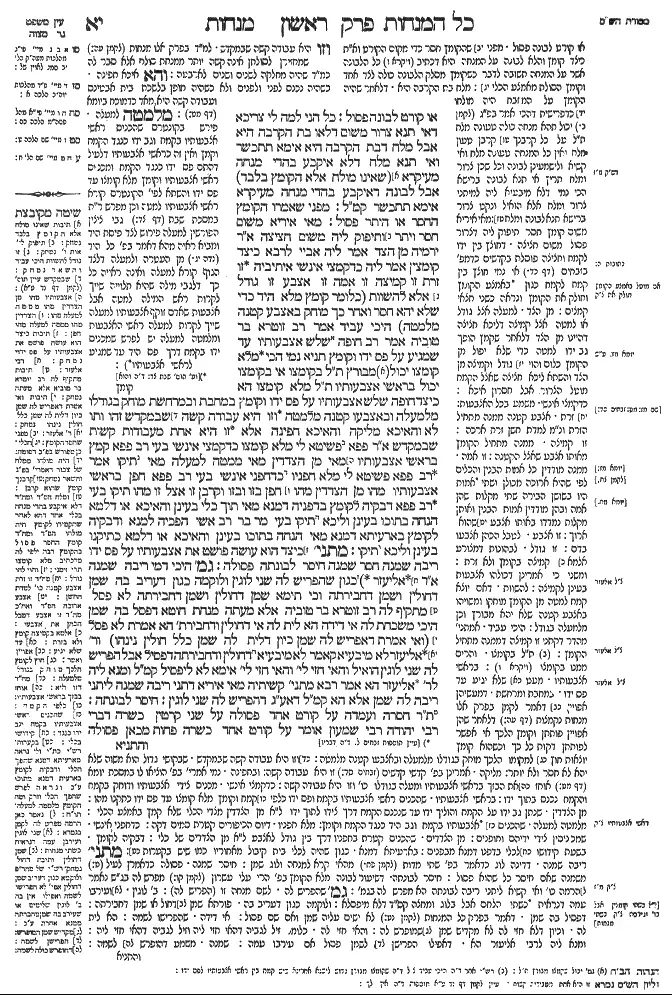
Menachot 11a - Guemara
או קורט לבונה פסול:
כל הני למה לי צריכא דאי תנא צרור משום דלאו בת הקרבה היא אבל מלח דבת הקרבה היא אימא תתכשר ואי תנא מלח דלא איקבע בהדי מנחה מעיקרא (שאינו מולח אלא הקומץ בלבד) אבל לבונה דאיקבע בהדי מנחה מעיקרא אימא תתכשר קמ"ל:
מפני שאמרו הקומץ החסר או היתר פסול:
מאי איריא משום חסר ויתר ותיפוק ליה משום חציצה א"ר ירמיה מן הצד אמר ליה אביי לרבא כיצד קומצין אמר ליה כדקמצי אינשי איתיביה זו זרת זו קמיצה זו אמה זו אצבע זו גודל אלא להשוות (כלומר קומץ מלא היד כדי שלא יהא חסר ואחר כך מוחק באצבע קטנה מלמטה) היכי עביד אמר רב זוטרא בר טוביה אמר רב חופה שלש אצבעותיו עד שמגיע על פס ידו וקומץ תניא נמי הכי מלא קומצו יכול מבורץ ת"ל בקומצו אי בקומצו יכול בראשי אצבעותיו ת"ל מלא קומצו הא כיצד חופה שלש אצבעותיו על פס ידו וקומץ במחבת ובמרחשת מוחק בגודלו מלמעלה ובאצבעו קטנה מלמטה וזו היא עבודה קשה שבמקדש זהו ותו לא והאיכא מליקה והאיכא חפינה אלא זו היא אחת מעבודות קשות שבמקדש א"ר פפא פשיטא לי מלא קומצו כדקמצי אינשי בעי רב פפא קמץ בראשי אצבעותיו מאי מן הצדדין מאי ממטה למעלה מאי תיקו אמר רב פפא פשיטא לי מלא חפניו כדחפני אינשי בעי רב פפא חפן בראשי אצבעותיו מהו מן הצדדין מהו חפן בזו ובזו וקרבן זו אצל זו מהו תיקו בעי רב פפא דבקיה לקומץ בדפניה דמנא מאי תוך כלי בעינן והאיכא או דלמא הנחה בתוכו בעינן וליכא תיקו בעי מר בר רב אשי הפכיה למנא ודבקיה לקומץ בארעיתא דמנא מאי הנחה בתוכו בעינן והאיכא או דלמא כתיקנו בעינן וליכא תיקו:
מתני׳ כיצד הוא עושה פושט את אצבעותיו על פס ידו ריבה שמנה חסר שמנה חיסר לבונתה פסולה:
גמ׳ היכי דמי ריבה שמנה א"ר אליעזר כגון שהפריש לה שני לוגין ולוקמה כגון דעריב בה שמן דחולין ושמן דחבירתה וכי תימא שמן דחולין ושמן דחבירתה לא פסל מתקיף לה רב זוטרא בר טוביה אלא מעתה מנחת חוטא דפסל בה שמן היכי משכחת לה אי דידה הא לית לה אי דחולין ודחבירת' הא אמרת לא פסל (ואי אמרת דאפריש לה שמן כיון דלית לה שמן כלל חולין נינהו) ור' אליעזר לא מיבעיא קאמר לא מיבעיא דחולין ודחבירתה דפסיל אבל הפריש לה שני לוגין הואיל והאי חזי לי' והאי חזי לי' אימא לא ליפסיל קמ"ל ומנא ליה לר' אליעזר הא אמר רבא מתני' קשיתיה מאי איריא דתני ריבה שמנה ליתני ריבה לה שמן אלא הא קמ"ל דאע"ג דהפריש לה שני לוגין:
חיסר לבונתה:
ת"ר חסרה ועמדה על קורט אחד פסולה על שני קרטין כשרה דברי רבי יהודה רבי שמעון אומר על קורט אחד כשרה פחות מכאן פסולה
Comments from Rashi on Masechet Menachot Page 11a
או קורט לבונה פסול . מפני שהקומץ חסר כדי מקום הקורט וא"ת כיצד קומץ והלא לבונה על המנחה היא דכתיב (ויקרא ו) כל הלבונה אשר על המנחה תשובה לדבר כשקומץ מסלק הלבונה כולה לצד אחד וקומץ הסולת מאמצע הכלי: מלח בת הקרבה היא . דלאחר שהיה הקומץ על המזבח היה מולחו כדפרישית דהכי אמר בפ"ג (לקמן מנחות כ.) יכול תהא מנחה כולה טעונה מלח ת"ל על כל קרבנך קרבן טעון מלח ואין כל המנחה טעונה מלח ואי קשיא ולישמעינן לבונה וכל שכן צרור ומלח תריץ אי תנא לבונה ברישא הכי נמי דלא מיבעיא ליה למיתני צרור ומלח אלא הואיל ונקט צרור ברישא תנא לבונה ומלח: מאי איריא משום קומץ חסר תיפוק ליה דצרור פסול משום חציצה . דחוצץ בין ידו לקמח וחציצה פוסלת בקדשים כדמפ' בזבחים (דף כד.) אי נמי חוצץ בין קמח לקמח כגון באמצע הקומץ וחולק את הקומץ ונראה כשני חצאי קמצים: מן הצד . למעלה אצל גודל או למטה אצל קמיצה דליכא חציצה דהיינו מן הצד דלאחר שקמץ הופך גב ידו למטה כדי שלא יפול מן הקומץ כלום והוי גודל וקמיצה מן הצד והשתא ליכא חציצה שאצל הקמח מוטל הצרור אבל חסרון איכא: כדקמצי אינשי . משמע בכל האצבעות: זרת . אצבע קטנה ממנה מתחיל הזרת ונ"מ למדת חשן זרת ארכה: זו קמיצה . ממנה מתחיל הקומץ מאותו אצבע שאצל הקטנה: זו אמה . ממנה מודדין כל אמות הבנין והכלים לפי שהיא ארוכה מכולן ושתי אמות היו בשושן הבירה שתי מקלות שהן אמה ובהן מודדין אמות הבנין ואותן מקלות נמדדו באותו אצבע שהוא ארוך: זו אצבע . לטבל הכהן אצבעו בדם: זו גודל . לבהונות דמצורע אלמא קמיצה בקומץ ולא זרת: ומשני כי אמרינן דכולהו אצבעות בעינן לקמיצה להשוות . דאם יוצא קמח למטה מן הקומץ מוחקו ומשויהו באצבע קטנה שלא יהא מבורץ וכן מלמעלה בגודל: היכי עביד . אמתני' מהדר דקתני זו קמיצה דממנה מתחיל הקומץ: ת"ל בקומצו . והרים ממנו בקומצו (ויקרא ו): בראשי אצבעותיו . מעט שלא יגיע עד פס ידו: במחבת ומרחשת . דמעשיהן אפויין דאמר לקמן בפרק אלו מנחות נקמצות (מנחות דף עה:) דלאחר שהן אפויין פותתן וקומץ הלכך אי אפשר לפותתן דקות כל כך וכשהוא קומץ יוצאות חוץ למקומו הלכך מוחק בגודלו מלמעלה ובאצבעו קטנה מלמטה: וזו היא עבודה קשה שבמקדש . שבקושי גדול הוא משוה שלא יהא לא חסר ולא יותר: מליקה . אמרינן בפ' קדשי קדשים (זבחים סד:) זו היא עבודה קשה: ובחפינה . נמי אמרי' בפ' הוציאו לו במסכת יומא (דף מט:) אוחז את הבזך בראשי אצבעותיו ומעלה בגודלו כו' וזו היא עבודה קשה: כדקמצי אינשי . מכניס צידי אצבעותיו ודוחק בקמח והקמח נכנס בתוך ידו: בראשי אצבעותיו . שהכניס ראשי אצבעותיו בקמח ופס ידו כלפי קמח וקומץ מלא קומצו עד פס ידו כתקנו מהו: מן הצדדין . שנתן גב ידו על הקמח והוליך ידו עד שנכנס הקמח דרך צידו לתוך ידו ל"א מן הצדדין מצדי הכלי שלא קמץ באמצע הכלי: מלמטה למעלה . שהכניס אצבעותיו בקמח וגב היד כנגד הקמח וקומץ: מלא חפניו . דיום הכיפורים קטרת סמים דקה: כדחפני אינשי . שמכניסין צידי ידיהם וחופנים: מן הצדדים . שהכניס קטרת בחפניו דרך בין גודל לאצבע ל"א מן הצדדים של כלי: דבקיה לקומץ . בשעת קידושו לכלי בדפנו דמנא מבפנים: בארעיתא דמנא . כגון שהיה לכלי בית קיבול מאחוריו כמו שיש בקערות: מתני' ריבה שמנה . דדינה לוג כדאמר בפ' שתי מדות (לקמן מנחות פח.) מהאי קרא למנחה ולוג שמן: חיסר שמנה . פסולה כדאמרן לעיל (מנחות ט:) משמנה שאם חיסר כל שהוא פסול: חיסר לבונתה . דשיעור לבונה מלא הקומץ בפ' הרי עלי עשרון (לקמן מנחות קו:) מפרש לה בג"ש נאמר הרמה כו' ואי קשיא ליתני ריבה לבונתה הא מפרש לה בגמ': גמ' שהפריש לה . לשם מנחה זו (הפריש לה): ב' לוגין . ועירבו עמה דנראית כשתי הלחם אבל בלוג ומחצה קס"ד דלא מיפסלא: ולוקמה כגון דעריב בה . פורתא שמן דחול או שמן דחבירתה: דפסיל בה שמן . דאמר בפרק כל המנחות (לקמן מנחות נט:) לא ישים עליה שמן ואם שם פסול: אי דידה . שהפרישו לשמה: הא לית לה . וכיון דלא חזי לה לא מקדיש שמן שמופרש לה: והאי חזי לה . כלומר זיל לגביה דהאי חזי ליה וזיל לגביה דהאי חזי ליה: ומנא ליה לרבי אליעזר הא . דאפילו הפרישן לשמן פסול אם עירבו עמה: שמנה . משמע דהופרש לשמה:
Comments from Tosafot - Menachot 11a
וזו היא עבודה קשה שבמקדש. למ"ד בפרק אלו מנחות (לקמן מנחות עה:) שמחזירן לסולתן אינה קשה יותר ממנחת סולת אלא סבר לה כמ"ד שהיה מחלקה לשנים ושנים לארבעה: והא איכא חפינה. כשהיה נכנס לפני ולפנים ולא כשהיה חופן בלשכת בית אבטינס ועבודה קשה היא מאד כדמוכח ביומא (דף מט:): מלמטה למעלה. פירש בקונטרס שהכניס ראשי אצבעותיו בקמח וגבי ידו כנגד הקמח וקמץ ואין זה כראשי אצבעותיו דלעיל דהתם פס ידו כנגד הקמח ומכניס ראשי אצבעותיו וקומץ מלא קומצו עד פס ידו והשתא לפי' הקונטרס קורא ראשי אצבעותיו למטה וכן מפרש ר"ת במסכת שבת (דף צד:) גבי ציצין הפורשין למעלה פירוש לצד פיסת היד ומביא ראיה מהא דאמר בפ' כל היד (נדה יג.) מן העטרה ולמעלה דלצד הגוף קורא למעלה ואינה ראייה כל כך דלגבי מילה שהיא תלוייה שייך לקרות ראש המילה למטה אבל אצבעות שאדם זוקף אצבעותיו למעלה שייך לקרות למעלה ראשי האצבעות ומלמטה למעלה יש לפרש שמכניס ידו בקמח דרך פס היד עד שמגיע לראשי אצבעותיו:
Menachot 11a - Mishnah translated into english
or a pinch of frankincense emerged in his hand, the meal offering is unfit, as the handful lacks a full measure on account of these items. The Gemara asks: Why do I need all these examples? Any one of them would convey the fact that the handful must contain a full measure.
The Gemara explains: All of the cases are necessary. Because if the mishna had taught only the example of a stone, it might have been thought that only a stone diminishes the measure of the handful, because it is not fit for sacrifice. But with regard to salt, which is fit for sacrifice, as the priest places salt on the handful before burning it upon the altar, one might say that the handful should be fit, as the salt should not subtract from the handful’s measure.
And if the mishna had taught only the example of salt, it might have been thought that the salt diminishes the handful’s measure as it was not initially fixed together with the entire meal offering. The reason is that the priest salts the handful alone. But with regard to the frankincense, which was initially fixed together with the entire meal offering, i.e., it is placed upon the meal offering before the priest removes a handful from it, one might say that the handful should be fit and the frankincense should not diminish from the handful’s measure. Therefore, the mishna teaches us that in any of these instances the meal offering is unfit.
§ The mishna teaches that if a stone, or a grain of salt, or a pinch of frankincense emerged in the priest’s hand together with the handful, the meal offering is unfit due to the fact that the Sages said: The handful that is lacking or that is outsized is unfit. The Gemara asks: Why does the tanna explain that the offering is not valid specifically because it is lacking or outsized? But let the tanna derive that such a handful is not valid due to the fact that there is an interposition between the priest’s hand and the handful. Rabbi Yirmeya says: Since there are certain instances where these items do not interpose between one’s hand and the handful, e.g., when they are located on the side of the handful, the mishna teaches that they disqualify the handful due to the fact that they reduce its measure.
§ Abaye said to Rava: How do the priests properly remove the handful from a meal offering? Rava said to him: They remove it as people normally remove handfuls, by folding all of their fingers over the palm of the hand. Abaye raised an objection to Rava from a baraita discussing the mitzva function of each of the fingers: This small finger is for measuring a span (see Exodus 28:16), i.e., the distance between the thumb and the little finger. This fourth finger is used for removal of a handful from the meal offering, i.e., the measurement of a handful begins from this finger, as the priest removes a handful by folding the middle three fingers over his palm.
Furthermore, this middle finger is used for measuring a cubit, the distance from the elbow to the tip of the middle finger. This forefinger, next to the thumb, is the finger used to sprinkle the blood of offerings on the altar. And finally, this thumb is the one on which the blood and oil is placed during the purification ritual of a leper (see Leviticus 14:17). Evidently, the little finger is not used in the removal of a handful.
The Gemara responds: The little finger is used only for the purposes of leveling the handful, that is to say, the priest first removes a handful with a full hand, i.e., all of his fingers, so that it should not be lacking in measure, and then he wipes away the protruding flour with his little finger from the bottom, and with his thumb from the top.
The Gemara asks: How is the removal of the handful performed? Rav Zutra bar Toviyya says that Rav says: When the priest places his hand in the meal offering, he bends his middle three fingers until the tips of his fingers reach over the palm of his hand, and he then removes the handful.
The Gemara notes that this is also taught in a baraita. From the verse that states: “And he shall remove from there his handful” (Leviticus 2:2), one might have thought that the handful should be overflowing. Therefore, another verse states: “And he shall take up from it with his handful [bekumtzo]” (Leviticus 6:8). The prefix that means “with” can also mean: In, indicating that the proper measure of a handful is that which is contained within one’s fingers alone.
The baraita continues: If the measurement of a handful is determined by the term “with his handful,” one might have thought that the priest removes a handful with his fingertips, i.e., that a handful consists of that which the priest removes by folding his fingers onto themselves. Therefore, the verse states: “His handful,” indicating that the handful must be full and not merely that which is contained within his fingers. How so? He scoops by closing his three fingers over the palm of his hand, and in this way takes a handful from the flour of the meal offering.
The baraita continues: In the case of a pan meal offering and that of a deep-pan meal offering, when the flour was fried before being scooped and was therefore hard, the priest wipes away with his thumb any flour that was overflowing above his handful, and with his little finger he wipes away the flour that was pushing out below. And this precise taking of the handful of a meal offering is the most difficult sacrificial rite in the Temple, as the priest must wipe away any protruding elements without removing any flour from the handful itself.
The Gemara asks: This one is the hardest sacrificial rite, and no other? But isn’t there pinching the nape of the neck of a bird offering, which is also considered extremely difficult to perform, and isn’t there the scooping of the handful of incense by the High Priest on Yom Kippur, another rite that is extremely difficult to perform? Rather, the baraita means that this taking of the handful of a meal offering is one of the most difficult sacrificial rites in the Temple.
Rav Pappa said: It is obvious to me that the term “his handful” means that the removal of the handful from a meal offering should be performed ab initio in the manner that people usually remove a handful, with their fingertips angled to the side. Rav Pappa raises a dilemma: What is the halakha if the priest removed a handful with his fingertips, i.e., if he placed his hand horizontally over the meal offering and filled his palm with flour by closing his fingers to his palm? Does this disqualify the taking of the handful or not?
Similarly, if the priest took a handful from the sides, by passing the back of his hand back and forth over the flour in the vessel so that the flour collected in his palm by way of the side of his palm, what is the halakha? Furthermore, if he took the handful with the back of his hand placed downward in the vessel, and with his fingers he collected the flour upward into his palm, what is the halakha? Are the handfuls removed in this manner fit for sacrifice? The Gemara states: These dilemmas shall stand unresolved.
Rav Pappa said: It is obvious to me that when the Torah states: “His handful” (Leviticus 16:12), in the context of the scooping of handfuls of incense by the High Priest on Yom Kippur, it means in the manner that people usually scoop a handful, by placing the backs of their hands into the vessel and bringing their hands together. Rav Pappa raises a dilemma: What is the halakha if the High Priest scooped a handful with his fingertips? What is the halakha if he took a handful from the sides? What is the halakha if he scooped a handful with this hand and with that hand separately and then brought them together? The Gemara states: These dilemmas shall stand unresolved.
Rav Pappa raises yet another dilemma: If the priest took the handful from the vessel containing the meal offering and stuck the handful onto the side of the second vessel in order to sanctify it, i.e., the handful was not placed directly into the vessel, what is the halakha? Do we require that the handful be inside the vessel, and that is the case here? Or perhaps we require that the handful be placed properly inside the vessel, and that is not the case in this instance. No answer is found, and the Gemara concludes: The dilemma shall stand unresolved.
Mar bar Rav Ashi raises a similar dilemma: If the priest overturned the vessel and stuck the handful to the underside of the vessel, in a case where there was an indentation on the underside, what is the halakha? Do we require that the handful be placed inside the vessel, and that requirement is fulfilled here, as the handful is within the indentation? Or perhaps we require that it be placed properly in the vessel, and that is not the case here. The Gemara states: The dilemma shall stand unresolved.
MISHNA: How does the priest perform the removal of a handful? He extends his fingers onto the palm of his hand. If one increased its oil, decreased its oil, or decreased its frankincense, beyond the appropriate measures, the meal offering is unfit.
GEMARA: What are the circumstances of a case where the meal offering is disqualified due to the fact that one increased its oil? Rabbi Eliezer says: The circumstances are a case where he separated two log of oil for the meal offering instead of one log, and mixed them into a tenth of an ephah of flour. The Gemara raises a difficulty: And let Rabbi Eliezer interpret the mishna as referring to a case where he mixed non-sacred oil or the oil of another meal offering into the meal offering.
And if you would say that non-sacred oil and the oil of another meal offering do not disqualify a meal offering, Rav Zutra bar Toviyya objects to this claim: If that is so, then with regard to the meal offering of a sinner, of which it is stated (59b) that oil disqualifies it, how can you find the circumstances where it is in fact disqualified?
Rav Zutra bar Toviyya elaborates: If you suggest that he mixed its own oil into the flour, such a case does not exist, as the meal offering of a sinner does not have any oil. If he mixed non-sacred oil or that of another meal offering into the flour, the meal offering should not be disqualified, as you said that such oil does not disqualify a meal offering. And if you would say that he designated oil for his meal offering and mixed it into the flour despite the Torah prohibition against mixing oil into it, I say that since the meal offering of a sinner does not have oil at all, any oil that he separates and mixes into it is considered non-sacred, and you have already said that non-sacred oil does not disqualify a meal offering.
The Gemara responds: In fact, non-sacred oil and the oil of another meal offering do disqualify a meal offering, and Rabbi Eliezer is speaking utilizing the style of: It is not necessary, as follows: It is not necessary to say that non-sacred oil and the oil of another meal offering disqualify a meal offering. But in a case where one separated two log for his meal offering, since this first log is fit for the meal offering, and that second log is also fit for it, one might say that even when he mixes both log into the meal offering, it should not disqualify the meal offering. Therefore, Rabbi Eliezer teaches us that the meal offering is disqualified in this case as well.
The Gemara asks: And from where does Rabbi Eliezer derive this conclusion? Rava said: The terminology of the mishna posed a difficulty for him, as one can ask: Why does the tanna specifically teach that the meal offering is disqualified if he increased its oil, which indicates that he increased it with oil belonging to the offering itself? Let the mishna teach simply: He increased the oil. Rather, this is what the mishna teaches us: That even though he initially separated two log of oil for the meal offering, its own oil disqualifies the offering when there is too much.
§ The mishna teaches that if one decreased its frankincense beyond its appropriate measure, the meal offering is unfit. Concerning this, the Sages taught in a baraita: If one decreased its frankincense to the point that the amount stood at only one pinch, it is disqualified, but if the decreased amount stood at two pinches, it is fit; this is the statement of Rabbi Yehuda. Rabbi Shimon says: If the decreased amount stood at one pinch, it is fit; less than that, it is disqualified.
Traduction : The William Davidson digital edition of the Koren Noé Talmud, with commentary by Rabbi Adin Even-Israel Steinsaltz.