 Talmud Bavli
The learning on the whole site is dedicated : L'ilui Nishmat Rav Chlomo Ben Jamilla
The learning on the whole site is dedicated : For the success of Elyahou ben H'anna & family
The learning on the whole site is dedicated : L'ilui Nishmat אליעזר בן רחל
Menachot 91a : Youtube
Daf TubeYoutube
2 video classes :
Menachot Page 91a
Menachot 91a - Guemara
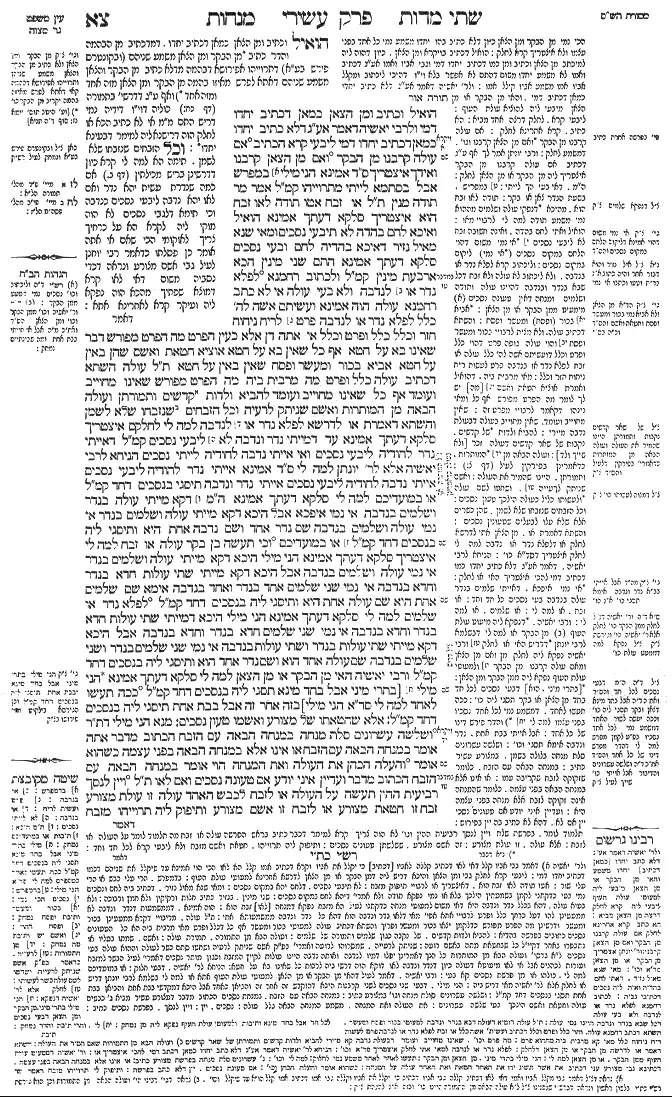
הואיל וכתיב ומן הצאן כמאן דכתיב יחדו דמי ולרבי יאשיה דאמר אף על גב דלא כתיב יחדו כמאן דכתיב יחדו דמי ליבעי קרא הכתיב (ויקרא א, ג) אם עולה קרבנו מן הבקר (ויקרא א, י) ואם מן הצאן קרבנו ואידך איצטריך סלקא דעתך אמינא הני מילי במפרש אבל בסתמא לייתי מתרוייהו קמ"ל אמר מר תודה מנין תלמוד לאמר או זבח אטו תודה לאו זבח הוא איצטריך סלקא דעתך אמינא הואיל ואיכא לחם בהדה לא תיבעי נסכים ומאי שנא מאיל נזיר דאיכא בהדיה לחם ובעי נסכים סלקא דעתך אמינא התם שני מינין הכא ארבעת מינין קמ"ל ולכתוב רחמנא (במדבר טו, ג) לפלא נדר או לנדבה ולא בעי עולה אי לא כתב רחמנא עולה הוה אמינא ועשיתם אשה לה' כלל לפלא נדר או לנדבה פרט לריח ניחוח חזר וכלל כלל ופרט וכלל אי אתה דן אלא כעין הפרט מה הפרט מפורש דבר שאינו בא על חטא אף כל שאין בא על חטא אוציא חטאת ואשם שהן באין על חטא אביא בכור ומעשר ופסח שאין באין על חטא תלמוד לאמר עולה השתא דכתיב עולה כלל ופרט מה מרבית ביה מה הפרט מפורש שאינו מחוייב ועומד אף כל שאינו מחוייב ועומד להביא ולדות קדשים ותמורתן ועולה הבאה מן המותרות ואשם שניתק לרעיה וכל הזבחים שנזבחו שלא לשמן והשתא דאמרת או לדרשא לפלא נדר או לנדבה למה לי לחלקם איצטריך סלקא דעתך אמינא עד דמייתי נדר ונדבה לא ליבעי נסכים קמ"ל דאייתי נדר לחודיה ליבעי נסכים ואי אייתי נדבה לחודיה לייתי נסכים הניחא לרבי יאשיה אלא לר' יונתן למה לי סלקא דעתך אמינא אייתי נדר לחודיה ליבעי נסכים אייתי נדבה לחודיה ליבעי נסכים אייתי נדר ונדבה תיסגי בנסכים דחד קמ"ל או במועדיכם למה לי סלקא דעתך אמינא הני מילי דקא מייתי עולה בנדר ושלמים בנדבה אי נמי איפכא אבל היכא דקא מייתי עולה ושלמים בנדר אי נמי עולה ושלמים בנדבה שם נדר אחד ושם נדבה אחת היא ותיסגי ליה בנסכים דחד קמ"ל או במועדיכם (במדבר טו, ח) וכי תעשה בן בקר עולה או זבח למה לי איצטריך סלקא דעתך אמינא הני מילי היכא דקא מייתי עולה ושלמים בנדר אי נמי עולה ושלמים בנדבה אבל היכא דקא מייתי שתי עולות חדא בנדר וחדא בנדבה אי נמי שני שלמים אחד בנדר ואחד בנדבה אימא שם שלמים אחת היא שם עולה אחת היא ותיסגי ליה בנסכים דחד קמ"ל (במדבר טו, ח) לפלא נדר או שלמים למה לי סלקא דעתך אמינא הני מילי היכא דמייתי שתי עולות חדא בנדר וחדא בנדבה אי נמי שני שלמים חדא בנדר וחדא בנדבה אבל היכא דקא מייתי. שתי עולות בנדר ושתי עולות בנדבה אי נמי שני שלמים בנדר ושני שלמים בנדבה שם עולה אחד הוא ושם נדר אחד הוא ותיסגי ליה בנסכים דחד קמ"ל ורבי יאשיה האי מן הבקר או מן הצאן למה לי סלקא דעתך אמינא הני מילי [בתרי מיני אבל בחד מינא תסגי ליה בנסכים דחד קמ"ל (במדבר טו, יב) ככה תעשו לאחד למה לי סלקא דעתך אמינא הני מילי] בזה אחר זה אבל בבת אחת תיסגי ליה בנסכים דחד קמ"ל:
אלא שחטאתו של מצורע ואשמו טעון נסכים:
מנא הני מילי דתנו רבנן (ויקרא יד, י) ושלשה עשרונים סלת מנחה במנחה הבאה עם הזבח הכתוב מדבר אתה אומר במנחה הבאה עם הזבח או אינו אלא במנחה הבאה בפני עצמה כשהוא אומר (ויקרא יד, כ) והעלה הכהן את העולה ואת המנחה הוי אומר במנחה הבאה עם הזבח הכתוב מדבר ועדיין איני יודע אם טעונה נסכים ואם לאו תלמוד לאמר (במדבר טו, ה) ויין לנסך רביעית ההין תעשה על העולה או לזבח לכבש האחד עולה זו עולת מצורע זבח זו חטאת מצורע או לזבח זו אשם מצורע ותיפוק ליה תרוייהו מזבח
Comments from Rashi on Masechet Menachot Page 91a
הואיל דכתיב בויקרא ומן הצאן . כיון דהוה ליה למיכתב מן הצאן וכתיב ומן כמו דכתיב יחדו דמי וגבי אביו ואמו אע"ג דכתיב ואמו לא משמע יחדו משום דהתם לא אפשר בלא וי"ו דהיכי ליכתוב ומקלל אביו אמו משמע אביו קילל אמו: ולר' יאשיה דאמר אע"ג דלא כתיב יחדו כמאן דכתיב דמי . והאי מן הבקר או מן הצאן מיבעי ליה להוציא עולת העוף: ליבעי קרא . לחלק דרצה אחד מביא: הא כתיב . קרא אחרינא לחלק: אם עולה קרבנו מן הבקר ואם מן הצאן קרבנו וגו' . דמשמע לחלק: ורבי יונתן אמר לך אף ע"ג דכתיב אם עולה קרבנו מן הבקר איצטריך ליה מן הבקר או מן הצאן לחלק: ה"מ . דאי בעי הך לייתי: במפריש . בשעת הנדר צאן או בקר: תודה לאו זבח הוא . מהיכא דנפקי עולה ושלמים מההוא נמי משמע תודה למה לי לרבויי מאו: הואיל ואתי לחם בהדה . ואינה חשובה זבח לא ליבעי נסכים אי נמי משום דהוי הלחם במקום נסכים (אי נמי) ליקום במקום נסכים: וליכתוב קרא לפלא נדר או בנדבה . ולא ליכתוב לא עולה ולא זבח דכל שבא בנדר ובנדבה דהיינו עולה ותודה ושלמים ומנחה דאין טעונה נסכים מימעיט ממן הבקר או מן הצאן: אביא בכור (ופסח) ומעשר ופסח: והשתא דכתיב עולה . ולא מצית לרבויי בכור ומעשר ופסח והוי עולה גופה פרט דהוי כלל ופרט וכלל דועשיתם אשה לה' כלל עולה או זבח לפלא נדר או בנדבה פרט לעשות ריח ניחוח חזר וכלל: מאי מרבית ביה . דהואיל ואמרת אוציא חטאת ואשם יש לך לומר מה הפרט מפורש אף כל ומאי נינהו דקאמר לרבויי מפרט זה: שאין מחוייב ועומד . שאין מחוייב בעולה דבעולת נדבה מיירי: להביא ולדות של קדשים . נקבות של שאר קדשים דעולה זכר [ולא שייך ולד]: ועולה הבאה מן המותרות . כדאמרינן בפירקין לעיל (מנחות דף צ:): ותמורתן . היינו שהמיר את העולה: ואשם שניתק לרעייה . ושחטו לשם עולה ולעשותו כליל כעולה הילכך טעון נסכים: וכל הזבחים שנזבחו שלא לשמן . שהן כשרים אלא שלא עלו לבעלים שטעונין נסכים: והשתא דאמרת או . מן הצאן אתי לדרשא לחלק או דלפלא נדר או נדבה למה לי לחלק איצטריך דסד"א כו': הניחא לרבי יאשיה . דאמר אע"ג דלא כתיב יחדו כמו דכתיב דמי להכי איצטריך האי או לחלק: אי נמי איפכא . דאייתי שלמים בנדר עולה בנדבה בעי נסכים כל חד וחד: או זבח . או למה לי: או שלמים . או למה לי: ורבי יאשיה . דנפקא ליה מיעוט עולת העוף מן הבקר או למה לי דבשלמא לרבי יונתן דדריש האי או לחלק ורבי יאשיה נפקא ליה לחלק מן ואם מן הצאן ומאם עולה קרבנו מן הבקר ולמעוטי עולת העוף נפקא ליה ממן הבקר ומן הצאן: [בתרי מיני . הוא] דבעי נסכים לכל חד בחד מן הצאן או בקר תסגי ליה כו': ככה תעשו לאחד . דמשמע נמי לכל אחד נסכיו בפני עצמו למה לי והדר פירש דינו של כל אחד: אבל אייתי בבת אחת . נדר ונדבה אימא תסגי וכו': ושלשה עשרונים סלת מנחה בלולה בשמן . במצורע עשיר כתיב: במנחה הבאה עם הזבח . כלומר שזקוקה לזבח שקריבה עמו: או אינו אלא במנחה הבאה בפני עצמה . כלומר שהמנחה אינה זקוקה לזבח אלא מנחה בפני עצמה היא: ועדיין איני יודע אם טעונים נסכי יין אם לא . דהא לא כתיב בה יין בפירוש: תלמוד לומר . בפרשת שלח ויין לנסך רביעית ההין וגו' לא הוה צריך קרא למימר דכבר כתיב בראש הפרשה עולה או זבח מה תלמוד לומר על העולה או לזבח: אלא עולה . זו עולת מצורע: זה אשם מצורע . ששלשתן טעונים נסכים: ותיפוק ליה תרוייהו . חטאת ואשם מזבח ולא ליבעי קרא לכל חד וחד:
Comments from Tosafot - Menachot 91a
הואיל וכתיב ומן הצאן כמאן דכתיב יחדו. דמדכתיב מן הבהמה והדר כתיב מן הבקר ומן הצאן משמע שניהם (ובקונטרס פירש בע"א) דתרוייהו אפירושא דבהמה מדלא כתיב מן הבקר והצאן משמע שניהם דאתא לפרש מאיזו בהמה מן הבקר ומן הצאן מזה אחד ומזה אחד ואף ע"ג דדרשי' בתמורה (דף כח:) כוליה דוי"ו דידיה נמי דריש התם מ"מ אי לא כתיב הכא או לחלק הוה דרישנא ליה למימר דבעינא יחדו: וכל הזבחים שנזבחו שלא לשמן. תימה הא למה לי קרא כיון דדרשינן בריש מכילתין (דף ב.) אם כמה שנדרת עשית יהא נדר ואם לאו יהא נדבה ליבעי נסכים כנדבה וכי תימא דלגבי נסכים לא הוה מוקי ליה לקרא הא על כרחיך צריך לאוקומי הכי שאם אי אתה אומר כן פסלתו כדאמר רבי יוחנן לעיל גבי אשם מצורע ונראה דכדי נסביה משום דאי לאו קרא דמוצא שפתיך מהכא הוה נפקא ליה ועיקר קרא לאחרינא אתא:
Menachot 91a - Mishnah translated into english
Since in Leviticus 1:2 it is written: “And of the flock,” and not merely: Of the flock, it is as though the word: Together, was written in the verse. Therefore, the verse in Numbers 15, which does state: “Or of the flock,” is necessary to teach that this is not the case.
The Gemara asks: And according to the opinion of Rabbi Yoshiya, who said that even though it is not explicitly written in the verse: Together, it is as though it is written: Together, i.e., it is presumed that the halakha is fulfilled only when both details are realized, a verse should be required. Yet, in the baraita, Rabbi Yoshiya expounds the phrase “of the herd or of the flock” to teach a different halakha. From where, then, does he derive that one who takes a vow to bring a burnt offering does not need to bring both types of animals?
The Gemara explains: Isn’t it written: “If his offering is a burnt offering of the herd” (Leviticus 1:3), and then in a separate verse it states: “And if his offering is of the flock” (Leviticus 1:9)? The fact that these possibilities are presented in two disjointed verses is an explicit indication that the burnt offering can be brought from even just one of these animals. Therefore, even Rabbi Yoshiya concedes that there is no reason to presume a burnt offering must be brought from both types there.
The Gemara asks: And as for the other tanna, Rabbi Yonatan, why does he require a verse at all? The Gemara explains: It was necessary to have a verse to teach this, because otherwise it might enter your mind to say: These statements, i.e., the verses that indicate it is sufficient to bring just one type of animal, concern a case where one specifies in his vow that he intends to bring just one animal, and the verses indicate that it is valid to bring just one. But if one vowed without specification, one might say: Let him bring burnt offerings from both of them. Therefore the phrase “of the herd or of the flock” teaches us that even in that case, it is sufficient to bring just one type of animal.
§ The Gemara continues to analyze the baraita. The Master said in the baraita: From where is it derived that a peace offering requires libations? The verse states: “A sacrifice.” From where is it derived that a thanks offering requires libations? The verse states: “Or a sacrifice.” The superfluous word “or” includes thanks offerings. The Gemara asks: Is that to say that a thanks offering is not referred to as a sacrifice? It certainly is. Why, then, is it only included through the word “or”? The Gemara answers: An independent inclusion was necessary, as it might enter your mind to say: Since in any event there is bread brought together with the thanks offering, it should not require libations.
The Gemara raises a question concerning this explanation: But in what way is a thanks offering different from a nazirite’s ram, as there is bread brought together with it also, and yet it requires libations? The verse states with regard to the ram of a nazirite: “And one unblemished ram for a peace offering, and a basket of unleavened bread, cakes of fine flour mixed with oil, and unleavened wafers spread with oil, and their meal offering, and their libations” (Numbers 6:13–15).
The Gemara answers: It might enter your mind to say that one should differentiate between the thanks offering and a nazirite’s ram as there, together with the nazirite’s ram, he brings only two types of bread, i.e., loaves and wafers, whereas, here, together with the thanks offering, one brings four types of bread. Therefore, one might have concluded that since there are many types of loaves it does not require libations. For that reason it is necessary to have an independent derivation that teaches us that it does require libations.
The Gemara analyzes another one of the derivations of the baraita. The verse states: And you will make a fire offering to the Lord, a burnt offering, or a sacrifice, in fulfillment of a vow clearly uttered, or as a gift.” This teaches that an offering that comes in fulfillment of a vow or as a gift offering requires libations. The Gemara challenges: But if that is the halakha, then let the Merciful One write only: “In fulfillment of a vow clearly uttered, or as a gift,” and it would be unnecessary to write: “A burnt offering,” as a burnt offering is a type of offering that can be brought as a vow or gift offering.
The Gemara explains: Had the Merciful One not written “a burnt offering,” I would say that the verse should be expounded as follows: “And you will make a fire offering to the Lord” is a generalization, indicating that all offerings require libations. But then it states: “In fulfillment of a vow clearly uttered, or as a gift,” which is a detail, indicating that the requirement applies only to offerings brought in fulfillment of a vow or as a gift. But with “to make a pleasing aroma to the Lord” it then generalized. If so, this is a generalization, and a detail, and a generalization, and according to the principles of exegesis you may deduce that the verse is referring only to items similar to the detail: Just as the detail is explicit in referring to an offering that does not come to atone for a sin, but comes to fulfill a vow or as a gift, so too any offering that does not come to atone for a sin requires libations.
Accordingly, I would exclude a sin offering and a guilt offering from the requirement to have libations, as they come to atone for a sin, and I would include the firstborn offering, the animal tithe offering, and the Paschal offering, as they do not come to atone for a sin. In order to preclude the possibility of expounding the verses in this way, the verse states: “Burnt offering,” as an additional detail, which serves to further exclude offerings that are brought only in fulfillment of an obligation.
The Gemara asks: Now that it is written: “Burnt offering,” what do you include through the generalization and detail and generalization in this verse? The Gemara explains: Just as the detail of a burnt offering is explicit in referring to an offering that one had not always been obligated to bring, as it is referring to a burnt offering brought in fulfillment of a vow, which one became obligated to bring only once the vow was taken, so too, any offering that one had not always been obligated to bring requires libations.
This serves to include in the requirement for libations the offspring of consecrated animals, e.g., of a female peace offering; and substitutes of consecrated animals, i.e., a non-sacred animal with regard to which one stated that it should be a substitute for a consecrated animal, in which case the result is that both animals are consecrated and must be sacrificed; and a burnt offering that comes from the proceeds of having sold surpluses of items donated to the Temple that were not needed.
And this also serves to include a guilt offering whose owner either died or achieved atonement through sacrificing another animal and which was therefore consigned to grazing until it developed a blemish, at which point it should be sold and the proceeds used to purchase supplementary offerings for the altar. If instead, the guilt offering itself was sacrificed as a burnt offering, it is valid. In such a case, the offering requires libations. And this also serves to include all offerings that were slaughtered not for their own sake. Such offerings were brought to fulfill the owner’s obligation. Since they were not sacrificed for the sake of that purpose, the owner does not fulfill his obligation, but nevertheless the offerings are valid. In such a case, these offerings also require libations.
The Gemara asks: And now that you have said that the word “or” in the phrase “or a sacrifice” is necessary for the derivation that teaches that the thanks offering requires libations, I can similarly ask why do I need the word “or” in the phrase “in fulfillment of a vow clearly uttered or as a gift,” to separate between them? The Gemara explains: It was necessary to write “or” in that phrase, as it might enter your mind to say that until one brings both a vow offering and a gift offering together they do not require libations. The word “or” teaches us otherwise, that even if one brings a vow offering by itself it requires libations, and if one brings a gift offering by itself he must bring libations.
The Gemara challenges: This works out well according to the opinion of Rabbi Yoshiya, as he holds that whenever the Torah does not explicitly separate between two details stated with regard to a halakha, it is presumed that the halakha is fulfilled only when both details are realized. But according to the opinion of Rabbi Yonatan, who holds that in general it is presumed that either detail is sufficient, why do I need the word “or”? The Gemara explains: Were it not for this word, it might enter your mind to say that although the halakha is that if one brings a vow offering by itself it requires libations, and if one brings a gift offering by itself it requires libations, nevertheless, if one brings both a vow offering and a gift offering together, it would be sufficient to bring libations for just one of them. Therefore, the word “or” teaches us that libations are required for each offering.
The Gemara asks: Why do I need the word “or” in the phrase “or on your Festivals”? The Gemara answers: It was necessary, as it might enter your mind to say that this matter, that even when two offerings are brought together libations are required for each of them, applies only when they are distinct both in the type of offering and in the nature of the obligation to bring them, such as where one brings a burnt offering in fulfillment of a vow and a peace offering as a gift offering, or vice versa.
But where one brings a burnt offering and a peace offering both in fulfillment of a vow, or alternatively, a burnt offering and a peace offering both as gift offerings, one might have said that since in the former case both offerings are of a single type of commitment, i.e., a vow, and in the latter case both are of a single type of commitment, i.e., a gift offering, therefore it would be sufficient to bring libations for just one of them. Consequently, the word “or” in the phrase “or on your Festivals” teaches us that even if they are distinct only in the type of offering, libations are required for each offering.
The Gemara continues its analysis: Why do I need the word “or” in the verse: “And when you prepare a young bull for a burnt offering or for a sacrifice” (Numbers 15:9)? The Gemara explains: It was necessary, as it might enter your mind to say that this matter, that when two offerings are brought together libations are required for each of them, applies only when the two offerings are distinct in the type of offering, such as where one brings a burnt offering and a peace offering both in fulfillment of a vow, or alternatively, a burnt offering and a peace offering both as a gift offering.
But where one brings two burnt offerings, one in fulfillment of a vow and one as a gift offering, or alternatively, two peace offerings, one in fulfillment of a vow and one as a gift offering, I would say that since in the former case both offerings are of a single type of offering, i.e., a peace offering, and in the latter case both offerings are of a single type of offering, i.e., a burnt offering, therefore it would be sufficient to bring libations for just one of them. Consequently, the word “or” teaches us that even if they are distinct only in the nature of the commitment to bring them, libations are required for each offering.
The Gemara continues: Why do I need the word “or” in the verse: “In fulfillment of a vow clearly uttered or for peace offerings” (Numbers 15:8)? The Gemara answers: It was necessary, as it might enter your mind to say that this matter, that when two offerings are brought together libations are required for each of them, applies only where two offerings are distinct from each other either in the nature of the commitment to bring them or in the type of offering, such as where one brings two burnt offerings, one in fulfillment of a vow and one as a gift offering, or alternatively, two peace offerings, one in fulfillment of a vow and one as a gift offering.
But where one brings two burnt offerings, both in fulfillment of a vow, or two burnt offerings, both as a gift offering, or alternatively, two peace offerings, both in fulfillment of a vow, or two peace offerings, both as a gift offering, I might have said with regard to the first of these cases that since both offerings are of a single type of offering, i.e., a burnt offering, and of a single type of commitment, i.e., a vow, and likewise with regard to the other cases, therefore, it would be sufficient to bring libations for just one of them. Consequently, the word “or” teaches us that even if the offerings are not distinct from each other at all, libations are nevertheless required for each one.
The baraita teaches that according to Rabbi Yonatan, the word “or” in the phrase “of the herd or of the flock” teaches that one who takes a vow to bring a burnt offering fulfills his obligation even if he brings only one animal, either from the herd or from the flock. The Gemara asks: And as for Rabbi Yoshiya, why do I need the word “or” in this phrase “of the herd or of the flock”? Although the baraita explains that he expounds the phrase to teach that one does not bring libations with a bird offering, it does not explain what he derives from the word “or.”
The Gemara explains: The word “or” is necessary, as otherwise it might enter your mind to say that this matter, that when two offerings are brought together libations are required for each of them, applies only where one brings two kinds of animals, i.e., one from the flock and one from the herd; but where both animals are of a single kind, it would be sufficient for him to bring libations for just one of them. Therefore, the word “or” teaches us that even if the offerings are of the same kind of animal, libations are nevertheless required for each one.
Later in the passage concerning libations it states: “So shall be done for each young bull, or for each ram, or for each of the lambs, or of the goats. According to the number that you may prepare, so you shall do for each one according to their number” (Numbers 15:11–12). The Gemara asks: Why do I need this verse? The Gemara explains: It is necessary, as it might enter your mind to say that this matter, that when two offerings are brought together libations are required for each of them, applies only where the offerings were consecrated one after the other. But if they were consecrated at the same time, it would be sufficient for him to bring libations for just one of them. Therefore, the verse teaches us that in all cases, one must bring separate libations for each animal.
§ The mishna teaches that in general sin offerings and guilt offerings do not require libations. But the exception is that the sin offering of a leper and his guilt offering require libations. The Gemara asks: From where are these matters derived? They are derived from a verse, as the Sages taught in a baraita concerning the following verse, which details the offerings a leper is required to bring as part of his purification process: “And on the eighth day he shall take two unblemished male lambs, and one unblemished female lamb in its year, and three-tenths of fine flour for a meal offering, mixed with oil, and one log of oil” (Leviticus 14:10). The baraita explains: It is with regard to a meal offering that comes with an animal offering that the verse speaks, and so it is stating that each of the three offerings mentioned requires libations.
The baraita continues: Do you say that it is with regard to a meal offering that comes with an animal offering that the verse speaks? Or perhaps it is only with regard to a meal offering that comes by itself. When the verse states, in the continuation of that passage: “And the priest shall sacrifice the burnt offering and the meal offering” (Leviticus 14:20), which demonstrates that the meal offering accompanies the burnt offering, you must say that in the earlier verse as well it is with regard to a meal offering that comes with an animal offering that the verse speaks.
But still, I do not know whether this meal offering requires wine libations or whether it does not. Therefore, the verse states: “And wine for pouring a libation, a quarter-hin, you shall prepare with the burnt offering or for the sacrifice, for the one lamb” (Numbers 15:5). The verse is expounded as referring to each of the leper’s offerings: “The burnt offering”; this is referring to the burnt offering of a leper. “The sacrifice”; this is referring to the sin offering of a leper. And as for the word “or” in the phrase “or for the sacrifice,” this is referring to the guilt offering of a leper.
The Gemara suggests: And let the tanna derive both the sin offering and the guilt offering from the word “sacrifice” alone, without relating to the word “or.”
Traduction : The William Davidson digital edition of the Koren Noé Talmud, with commentary by Rabbi Adin Even-Israel Steinsaltz.