 Talmud Bavli
The learning on the whole site is dedicated : L'ilui Nishmat Rav Chlomo Ben Jamilla
The learning on the whole site is dedicated : L'ilui Nishmat Avraham Ben Simha
The learning on the whole site is dedicated : L'ilui Nishmat Yaakov ben Myriam
Menachot 14a : Youtube
Daf TubeYoutube
2 video classes :
Menachot Page 14a
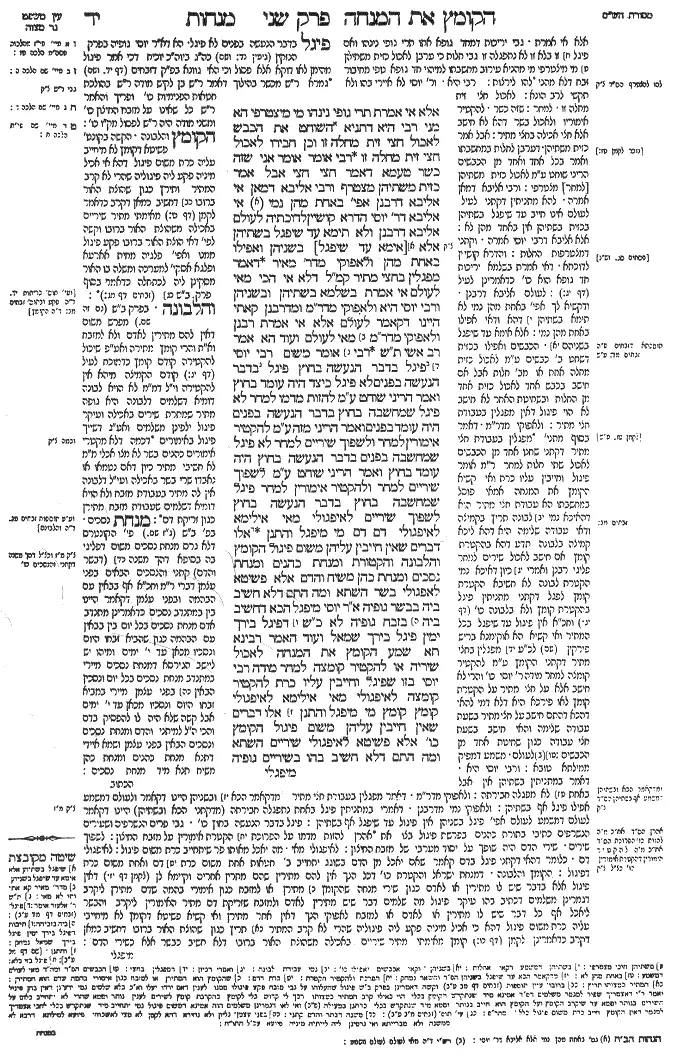
Menachot 14a - Guemara
אלא אי אמרת תרי גופי נינהו מי מיצטרפי הא מני רבי היא דתניא השוחט את הכבש לאכול חצי זית מחלה זו וכן חבירו לאכול חצי זית מחלה זו רבי אומר אומר אני שזה כשר טעמא דאמר חצי חצי אבל אמר כזית משתיהן מצטרף ורבי אליבא דמאן אי אליבא דרבנן אפי' באחת מהן נמי אי אליבא דר' יוסי הדרא קושיין לדוכתיה לעולם אליבא דרבנן ולא תימא עד שיפגל בשתיהן אלא [אימא עד שיפגל] בשניהן ואפילו באחת מהן ולאפוקי מדר' מאיר דאמר מפגלין בחצי מתיר קמ"ל דלא אי הכי מאי לעולם אי אמרת בשלמא בשתיהן ובשניהן ורבי יוסי היא ולאפוקי מדר"מ ומדרבנן קאתי היינו דקאמר לעולם אלא אי אמרת רבנן ולאפוקי מדר"מ מאי לעולם ועוד הא אמר רב אשי ת"ש רבי אומר משום רבי יוסי פיגל בדבר הנעשה בחוץ פיגל בדבר הנעשה בפנים לא פיגל כיצד היה עומד בחוץ ואמר הריני שוחט ע"מ להזות מדמו למחר לא פיגל שמחשבה בחוץ בדבר הנעשה בפנים היה עומד בפנים ואמר הריני מזה ע"מ להקטיר אימורין למחר ולשפוך שיריים למחר לא פיגל שמחשבה בפנים בדבר הנעשה בחוץ היה עומד בחוץ ואמר הריני שוחט ע"מ לשפוך שיריים למחר ולהקטיר אימורין למחר פיגל שמחשבה בחוץ בדבר הנעשה בחוץ לשפוך שיריים לאיפגולי מאי אילימא לאיפגולי דם דם מי מיפגל והתנן אלו דברים שאין חייבין עליהן משום פיגול הקומץ והלבונה והקטורת ומנחת כהנים ומנחת נסכים ומנחת כהן משיח והדם אלא פשיטא לאפגולי בשר השתא ומה התם דלא חשיב ביה בבשר גופיה א"ר יוסי מיפגל הכא דחשיב ביה בזבח גופיה לא כ"ש דפיגל בירך ימין פיגל בירך שמאל ועוד האמר רבינא תא שמע הקומץ את המנחה לאכול שיריה או להקטיר קומצה למחר מודה רבי יוסי בזו שפיגל וחייבין עליו כרת להקטיר קומצה לאיפגולי מאי אילימא לאיפגולי קומץ קומץ מי מיפגל והתנן אלו דברים שאין חייבין עליהן משום פיגול הקומץ כו' אלא פשיטא לאיפגולי שיריים השתא ומה התם דלא חשיב בהו בשיריים גופיה
Comments from Rashi on Masechet Menachot Page 14a
אלא אי אמרת . גבי יריכות דמחד גופא אתו תרי גופי נינהו ואם פיגל זו בלא זו לא נתפגלה זו גבי חלות כי ערבן לאכול כזית משתיהן מי מיצטרפי מי מהניא עירוב מחשבתו למיהוי חד גופא טפי מחיבור זבח דלא מהני להו לירצות: רבי היא . ור' יוסי לא איירי בהו ולא תקשי לרב הונא: לאכול חצי זית מחלה זו . למחר: שזה כשר . להקטיר אימוריו ולאכול בשר דהא לא חישב אלא חצי אכילה בחצי מתיר: אבל אמר כזית משתיהן . דערבן לחלות במחשבתו ואמר בכל אחד ואחד מן הכבשים הריני שוחט ע"מ לאכול כזית משתיהן [למחר] מצטרפי: ורבי אליבא דמאן אמרה . להא מתניתין דקתני לעיל לעולם אינו חייב עד שיפגל בשתיהן בכזית בשתיהן אין באחד מהן לא: אלא אליבא דרבי יוסי אמרה . וקתני דמצטרפות החלות: והדרא קושיין לדוכתא . דאי אמרת בשלמא יריכות חד גופא הוא כו' כדאמרינן לעיל (מנחות דף יג:): לעולם אליבא דרבנן . ודקשיא לך אפי' באחת מהן נמי לא תימא בשתיהן דהא ודאי אפילו באחת מהן נמי: אלא אימא עד שיפגל בשניהם . הכבשים ואפילו בכזית דשחט ב' כבשים ע"מ לאכול כזית מחלה אחת או מב' חלות אבל אם חישב בכבש אחד לאכול כזית אחד מן החלות ובשחיטת האחר לא חישב לא הוי פיגול דאין מפגלין בעבודת חצי מתיר: ולאפוקי מדר"מ . דאמר בסוף מתני' מפגלין בעבודת חצי מתיר דקתני שחט אחד מן הכבשים לאכול שתי חלות למחר ר"מ אומר פיגול וחייבין עליו כרת ואי קשיא הקומץ את המנחה אמאי פוסל במחשבתו הא עבודת חצי מתיר הוא דהאיכא נמי לבונה תריץ בקמיצה ודאי עבודה שלימה היא דהא ליכא קמיצה בלבונה תדע דהא בהקטרת קומץ אם חישב לאכול שירים למחר פליגי רבנן ואמרי כיון דאיכא נמי הקטרת לבונה לא חשיבא הקטרת קומץ לפגל דקתני מתניתין פיגל בהקטרת קומץ ולא בלבונה כו' (דף יג.) וחכ"א אין פיגול עד שיפגל בכל המתיר ואי קשיא הא אוקימנא בריש פירקין (שם) לכ"ע מפגלין בחצי מתיר דקתני הקומץ ע"מ להקטיר קומצה למחר מודה ר' יוסי כו' והרי לא חישב אלא על חצי מתיר על הקטרת קומץ לאו פירכא היא דלא דמי להאי דהכא דהתם חישב על חצי מתיר בשעת עבודה שלימה והאי חישב בשעת חצי עבודה כגון שחיטת אחד מן הכבשים: לעולם . משמע דמפיק ממילתא טובא: ורבי יוסי היא . דאמר במתניתין בשתיהן אין אבל באחת לא מפגלה חבירתה: ולאפוקי מדר"מ . דאמר מפגלין בעבודת חצי מתיר מדקאמר הכא ובשניהן היינו דקאמר ולעולם דמשמע אפילו פיגל אף בשתיהן: ולאפוקי נמי מדרבנן . דאמרי במתניתין פיגל באחת נתפגלה חבירתה (מדקתני הכא ובשתיהן) היינו דקאמר לעולם דמשמע לעולם אפי' פיגל בשניהן אין פיגול עד שיפגל אף בשתיהן: פיגל בדבר הנעשה בחוץ כו' . גבי פרים הנשרפים ושעירים הנשרפים כתיבי בתורת כהנים בפרשת פיגול בצו את אהרן להזות מדמו על הפרוכת הקטרת אימורין על מזבח החיצון: לשפוך שירים . שירי הדם היה שופך על יסוד מערבי של מזבח החיצון: לאיפגולי מאי . מה יאכל מאותו פר שיתחייב כרת משום פיגול: לאיפגולי דם . כלומר דהאי דקתני פיגל בדם קאמר שאם יאכל מן הדם בשוגג יתחייב ב' חטאות אחת משום כרת דם ואחת משום כרת דפיגול: הקומץ והלבונה . דמנחת ישראל והקטרת כו' דכל הנך אין להם מתירין שהם מתרין אחרים וקיימא לן (לקמן מנחות דף יז.) דאין פיגול אלא בדבר שיש לו מתירין או לאדם כגון שירי מנחה שהקומץ מתירן או למזבח כגון אימורי בהמה שדם מתירן ליקרב דגמרינן משלמים דכתיב בהו עיקר פיגול מה שלמים דבר שיש מתירין לאדם ולמזבח שזריקת דם מתיר האימורין ליקרב והבשר ליאכל אף כל דבר שיש לו מתירין או לאדם או למזבח לאפוקי הנך דאין אחר מתירן ואי קשיא פשיטא דקומץ לא מיחייבי עליה כרת משום פיגול דהא כי אכיל מיניה פקע ליה פיגוליה שהרי לא קרב המתיר תריץ כגון שהוצת האור ברובו דחשיב כמאן דקרב כדאמרינן לקמן (מנחות דף כו:) קומץ מאימתי מתיר שיריים באכילה משהוצת האור ברובו דלא חשיב כבשר אלא כשירי הדם: לאיפגולי מאי . כלומר מי יתפגל במחשבה זו שיהיו חייבין כרת באכילתו:
Comments from Tosafot - Menachot 14a
פיגל בדבר הנעשה בפנים לא פיגל. הא דא"ר יוסי גופיה בפרק הנזקין (גיטין נד: ושם) כה"ג ביוה"כ יוכיח דכי אמר פיגול מהימן לאו דוקא אלא פסול וכי האי גוונא בפ"ק דזבחים (דף יד. ושם) גמרא ר"ש מכשר בהילוך דאמר ר"ש בן לקיש מודה ר"ש בהולכת חטאות הפנימיות כו' ופריך והאמר ר"ש כל שאינו על מזבח החיצון כו' ומשני מודה היה ר"ש לפסול מק"ו כו': הקומץ והלבונה. הקשה בקונט' פשיטא דקומץ לא מיחייב עליה כרת משום פיגול דהא אי אכיל מיניה פקע ליה פיגוליה שהרי לא קרב המתיר ותירץ כגון שהוצת האור ברובו דחשיב כמאן דקרב כדאמר לקמן (מנחות דף כו:) מאימתי מתיר שיריים באכילה משהוצת האור ברובו וקשה לפי' דאי הוצת האור ברובו פקע פיגול ממנו ואפי' פלגיה מחית אארעא ופלגא אסקי' למערכה ומשלה בו האור מסקינן ליה לכתחלה כדאמר בסוף פרק ב"ש (זבחים דף מג:): והלבונה. בפרק ב"ש (גם זה שם.) מפרש משום דאין להם מתירין לאדם ולא למזבח וא"ת והרי קומץ מתירה ואע"פ שיכול להקטירה קודם קומץ כדמוכח לעיל (מנחות דף יג:) קודם הקמיצה מיהא אין להקטירה וי"ל דמ"מ לא הויא לבונה דומיא דשלמים דלבונה היא גופה מתיר שמתרת שירים באכילה ועיקר פיגול ילפינן משלמים ואע"ג דשייך פיגול באימורים דכמה דלא מקטרי אימורים כהנים בשר לא מצו אכלי מ"מ לא חשיבי מתיר כיון דאם נטמאו או נאבדו שרי בשר באכילה ועי"ל דלבונה אין לה מתיר בעבודת מזבח ולא הויא דומיא דשלמים שעבודת מזבח מתירן כגון זריקת דם: מנחת נסכים. בפ' ב"ש (ג"ז שם.) פי' הקונטרס דלא גרס מנחת נסכים משום דפליגי בה בסיפא דהך משנה (דבשר והדם) קתני והנסכים הבאים בפני עצמן דברי ר"מ וחכ"א אף בבאין עם הבהמה ובפני עצמן דקאמר היינו בין במתנדב נסכים כדאמרינן מתנדב אדם מנחת נסכים בכל יום בין בבאין עם הבהמה כגון שהביא זבחו היום ונסכיו מכאן עד י' ימים ומיהו יש ליישב הגירסא דמנחת נסכים מיירי במתנדב מנחת נסכים בכל יום ונסכין הבאין בפני עצמן מיירי במביא זבחו היום ונסכיו מכאן עד י' ימים אבל קשה שלא היה לו להפסיק בדם והכי ה"ל למיתני והדם ומנחת נסכים ונסכים הבאין בפני עצמן ושמא איידי דתנא מנחת כהנים ומנחת כהן משיח תנא מיד מנחת נסכים:
Menachot 14a - Mishnah translated into english
But if you say that Rabbi Yosei holds that the right and left thighs of an offering are considered two distinct bodies, and therefore piggul intent with regard to one does not render the other piggul, then in the case of the two loaves, would the intentions concerning both loaves combine to render them both piggul?
Rav Huna responds: One cannot infer anything from this baraita with regard to the opinion of Rabbi Yosei, as in accordance with whose opinion is this baraita? It is in accordance with the opinion of Rabbi Yehuda HaNasi, as it is taught in another baraita: With regard to one who slaughters one of the lambs brought as peace offerings on Shavuot with the intent to consume half an olive-bulk from this loaf the next day, and similarly, he slaughtered the other lamb with the intent to consume half an olive-bulk from that second loaf the next day, Rabbi Yehuda HaNasi says: I say that this offering is valid, as his intentions do not combine.
Rav Huna continues: It may be inferred that the reason why the priest’s intentions do not combine is that his intent was said with regard to a half and a half, i.e., he slaughtered each lamb with the intent to consume half an olive-bulk from one loaf the next day. But if he said during the slaughter of each of the lambs that he is slaughtering it with the intent to consume an olive-bulk from both of them, then the halves combine to render the offering piggul.
The Gemara asks: And as for Rabbi Yehuda HaNasi, who says that the two loaves are piggul only if he has intent with regard to an amount equal to an olive-bulk from both of them combined, in accordance with whose opinion is his statement? If it is in accordance with the opinion of the Rabbis of the mishna, who hold that piggul intent with regard to one loaf renders both loaves piggul, then even if his intent was with regard to only one of them, both loaves should be piggul. And if it is in accordance with the opinion of Rabbi Yosei, who holds that piggul intent with regard to one loaf does not render the second loaf piggul, then our difficulty returns to its place: If Rabbi Yosei holds that the right and left thighs are considered two distinct bodies, how can intentions with regard to two halves of an olive-bulk combine to render both loaves piggul?
The Gemara responds: Actually, Rabbi Yehuda HaNasi’s statement is in accordance with the opinion of the Rabbis. And do not say that the baraita states: It is not piggul unless one has the intent of piggul with regard to both of them [bishteihen], in the feminine form, whereby the baraita would be referring to the loaves. Rather, the baraita states: With regard to both of them [bishneihen], in the masculine form, i.e., unless he slaughters both lambs with piggul intent, and in such a case, even if his intent was with regard to only one of the loaves, the offering is piggul.
The Gemara adds: And this baraita serves to exclude the opinion of Rabbi Meir, who says in the mishna on 16a: One renders an offering piggul by means of intent during the sacrifice of half a permitting factor, e.g., if one slaughtered one of the lambs with the intent to consume the two loaves the next day, the loaves are piggul. This baraita teaches us that this is not the halakha.
The Gemara asks: If so, then what is the meaning of the emphasis in the baraita: There is never liability? Granted, this phrase is understandable if you say that the baraita means that the loaves are not piggul unless he has intent with regard to both of the loaves and both of the lambs, i.e., they are piggul only if he slaughters both lambs with the intention to partake of both loaves the next day. In that case the baraita is in accordance with the opinion of Rabbi Yosei, and it comes to exclude the statements of both Rabbi Meir and the Rabbis, and this is the reason that the baraita states: There is never liability, to emphasize that Rabbi Yosei disagrees with both of these opinions.
But if you say that the baraita is in accordance with the opinion of the Rabbis and that it serves to exclude only the opinion of Rabbi Meir, for what reason does the baraita stress: There is never liability? The tanna would not use such a word to exclude merely one opinion. Rather, it must be that the baraita is in accordance with the opinion of Rabbi Yosei. If so, then the difficulty raised against Rav Huna, who says that piggul intent concerning the right thigh does not render the left one piggul, remains unresolved.
And furthermore, didn’t Rav Ashi say: Come and hear a refutation of the opinion of Rav Huna from a baraita: Rabbi Yehuda HaNasi says in the name of Rabbi Yosei that if, while performing the sacrificial rites for the bulls or goats which are burned as an offering, the priest had an intention that can render the offering piggul with regard to a matter that is performed outside the Sanctuary, i.e., in the Temple courtyard, he has rendered the offering piggul. If his intention was with regard to a matter that is performed inside the Sanctuary or the Holy of Holies, he has not rendered the offering piggul.
The baraita elaborates: How so? If he was standing outside when slaughtering the animal and said: I hereby slaughter the animal with the intention of sprinkling its blood tomorrow inside the Sanctuary, he has not rendered the offering piggul. The reason is that when one has an intention outside with regard to a matter that is performed inside, he has not rendered the offering piggul. Likewise, if he was standing inside when sprinkling, and said: I hereby sprinkle the blood of the sin offering in order to burn its sacrificial portions on the external altar tomorrow and to pour out its remainder on the base of the altar tomorrow, he has not rendered the offering piggul, as he had an intention inside with regard to a matter that is performed outside.
But if he was standing outside and said: I hereby slaughter the animal with the intention to pour out the remainder of its blood tomorrow, or to burn its sacrificial portions tomorrow, he has rendered the offering piggul, as he had an intention outside with regard to a matter that is performed outside.
The Gemara analyzes this baraita: With regard to the case where one slaughtered the offering with the intent to pour the remaining blood the next day, what could be rendered piggul? If we say the blood could be rendered piggul, one can ask: Does blood become piggul? But didn’t we learn in a mishna (Zevaḥim 42b): These are the items for which one is not liable to receive karet due to the prohibition of piggul: The handful; the frankincense; the incense; the meal offering of priests; the meal offering accompanying the libations brought with an animal offering; the meal offering of the anointed priest; and the blood?
Rather, it is obvious that the baraita means that it is the meat of the offering that could be rendered piggul. Now consider: And if there, in the baraita, where he did not have intent with regard to the meat itself, as his intention was not to partake of the meat the next day but to pour the remaining blood the next day, and yet Rabbi Yosei said that the meat is rendered piggul; then here, where he has intent to partake of the right thigh the next day, which is part of the offering itself, is it not all the more so that if he had intent of piggul with regard to the right thigh, he has rendered the left thigh piggul as well?
And furthermore, doesn’t Ravina say: Come and hear a refutation of the statement of Rav Huna from the mishna (13a): In the case of one who removes a handful from the meal offering with the intent to partake of its remainder or to burn its handful on the next day, Rabbi Yosei concedes in this instance that he has rendered the offering piggul and he is liable to receive karet for partaking of it.
Ravina continues: When one removes the handful with the intent to burn its handful, what could be rendered piggul? If we say that the handful could be rendered piggul, does the handful become piggul? But didn’t we learn in a mishna (Zevaḥim 42b): These are the items for which one is not liable to receive karet due to the prohibition of piggul: The handful, etc. Rather, it is obvious that the remainder could be rendered piggul. Now consider: And if there, in the mishna, where he did not have intent with regard to the remainder itself, i.e., to partake of the remainder the next day,
Traduction : The William Davidson digital edition of the Koren Noé Talmud, with commentary by Rabbi Adin Even-Israel Steinsaltz.