 Talmud Bavli
Menachot 45a : Youtube
Daf TubeYoutube
2 video classes :
Menachot Page 45a
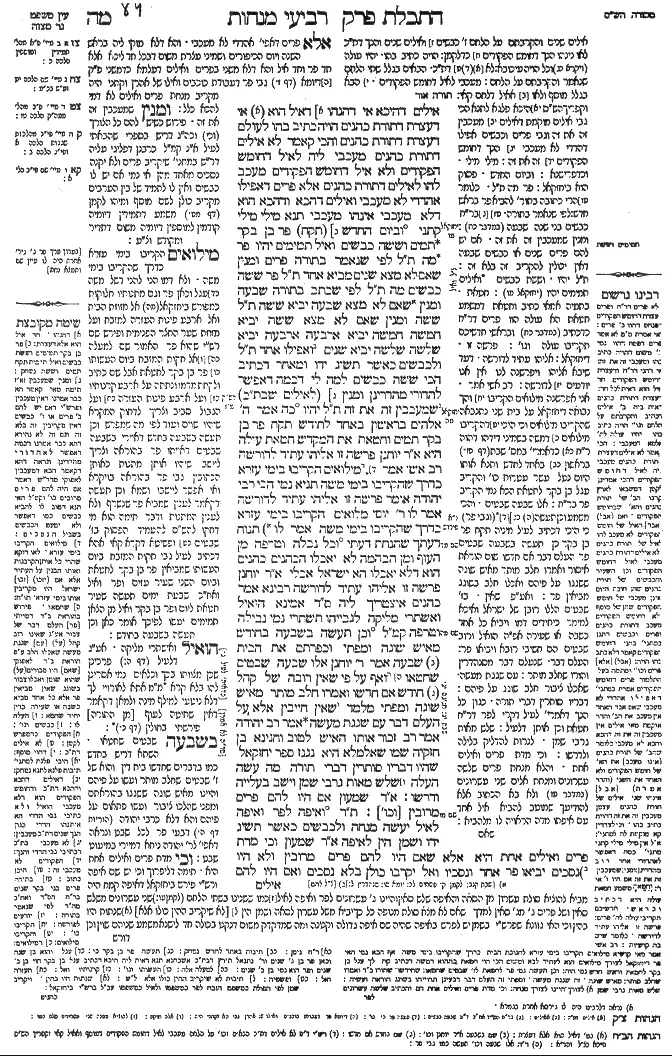
Menachot 45a - Guemara
אילים דהיכא אי דהנהו דאיל הוא אי דעצרת דתורת כהנים הויה כתיב בהו לעולם דעצרת דתורת כהנים והכי קאמר לא אילים דתורת כהנים מעכבי ליה לאיל דחומש הפקודים ולא איל דחומש הפקודים מעכב להו לאילים דתורת כהנים אלא פרים דאפילו אהדדי לא מעכבי ואילים דהכא ודהכא הוא דלא מעכבי אינהו מעכבי תנא מילי מילי קתני (יחזקאל מו, א) וביום החדש (תקח) פר בן בקר תמים וששה כבשים ואיל תמימים יהיו פר מה ת"ל לפי שנאמר בתורה פרים ומנין שאם לא מצא שנים מביא אחד ת"ל פר ששה כבשים מה ת"ל לפי שכתב בתורה שבעה ומנין שאם לא מצא שבעה יביא ששה ת"ל ששה ומנין שאם לא מצא ששה יביא חמשה חמשה יביא ארבעה ארבעה יביא שלשה שלשה יביא שנים ואפילו אחד ת"ל ולכבשים כאשר תשיג ידו ומאחר דכתיב הכי ששה כבשים למה לי דכמה דאפשר להדורי מהדרינן ומנין (לאילים שבת"כ) שמעכבין זה את זה ת"ל יהיו (יחזקאל מה, יח) כה אמר ה' אלהים בראשון באחד לחודש תקח פר בן בקר תמים וחטאת את המקדש חטאת עולה היא א"ר יוחנן פרשה זו אליהו עתיד לדורשה רב אשי אמר מילואים הקריבו בימי עזרא כדרך שהקריבו בימי משה תניא נמי הכי רבי יהודה אומר פרשה זו אליהו עתיד לדורשה אמר לו ר' יוסי מלואים הקריבו בימי עזרא כדרך שהקריבו בימי משה אמר לו תנוח דעתך שהנחת דעתי (יחזקאל מד, לא) וכל נבלה וטרפה מן העוף ומן הבהמה לא יאכלו הכהנים כהנים הוא דלא יאכלו הא ישראל אכלי א"ר יוחנן פרשה זו אליהו עתיד לדורשה רבינא אמר כהנים איצטריך ליה ס"ד אמינא הואיל ואשתרי מליקה לגבייהו תשתרי נמי נבילה וטרפה קמ"ל (יחזקאל מה, כ) וכן תעשה בשבעה בחודש מאיש שוגה ומפתי וכפרתם את הבית שבעה אמר ר' יוחנן אלו שבעה שבטים שחטאו ואף על פי שאין רובה של קהל חודש אם חדשו ואמרו חלב מותר מאיש שוגה ומפתי מלמד שאין חייבין אלא על העלם דבר עם שגגת מעשה אמר רב יהודה אמר רב זכור אותו האיש לטוב וחנינא בן חזקיה שמו שאלמלא הוא נגנז ספר יחזקאל שהיו דבריו סותרין דברי תורה מה עשה העלה שלש מאות גרבי שמן וישב בעלייה ודרשו:
א"ר שמעון אם היו להם פרים מרובין [וכו']:
ת"ר (יחזקאל מו, ז) ואיפה לפר ואיפה לאיל יעשה מנחה ולכבשים כאשר תשיג ידו ושמן הין לאיפה א"ר שמעון וכי מדת פרים ואילים אחת היא אלא שאם היו להם פרים מרובין ולא היו נסכים יביאו פר אחד ונסכיו ואל יקרבו כולן בלא נסכים ואם היו להם
Comments from Rashi on Masechet Menachot Page 45a
דהני . דר"ח ועצרת שכתובים בחומש הפקודים: אלא דעצר' גריד' קתני מת"כ דכתיב באמור אל הכהנים אילים שנים והקרבתם על הלחם ז' כבשים ואילים שנים והנך דת"כ לאו נינהו הנך דחומש הפקודים כדלקמן: הויה כתיב בהו . יהיו עולה (ויקרא כג) וכל הויה עיכובא: לא דת"כ . הבאים בגלל שתי הלחם שנאמר והקרבתם על הלחם: מעכבי לאיל דחומש הפקודים . הבא בגלל מוסף ולאו אאיל דלחם קאי: וקפריך הש"ס היכא פלגא לתנא הכי גבי אילים מוקמת דאילים מעכבין זה את זה וגבי פרים וכבשים אפילו דהדדי לא מעכבי הנך דחומש הפקודים זה את זה: מילי מילי . וכדפרישנא: וביום החדש . פסוק הוא ביחזקאל: פר מה ת"ל . כלומר הרי כתובה בתור' להביא פר בראש חדש: לפי שנאמר בתורה . בר"ח כבשים בני שנה שבעה (במדבר כח): ומנין שמעכבין זה את זה . אם יש להם פרים שנים או כבשים שבעה דאין יכולין להקריב זה בלא זה: ת"ל יהיו . וששת כבשים ואילים תמימים יהיו (יחזקאל מו): חטאת . בתמיה אמאי כתיב וחטאת דמשמע חטאת הא עולה הוו פרים דר"ח כדכתיב (במדבר כח) ובראשי חדשיכם תקריבו עולה וגו': פרשה זו . דיחזקאל: אליהו עתיד לדורשה . דעד שיבא אליהו ויפרשנה לנו אין אנו יודעים לדורשה: רב אשי אמר . אני אפרשנה מילואים הקריבו והך נבואה דיחזקאל על בית שני נתנבאה שהקריבו מילואים וכי היכי דהקריבו מילואים דמשה בשמיני דידהו דהוה ר"ח כדאמרי' במס' שבת (דף פז.) בראשון באחד לחדש ותנא אותו היום נטל עשר עטרות כו' והקריב עגל בן בקר לחטאת הכא נמי הקריב פר בר"ח: אלו שבעה שבטים . והכי משמע וכן תעשה (וגבי פר) כי היכי דכתיב לעיל מיניה תקח פר בן בקר כן תעשה בשבעה שבטים פר העלם דבר אם חדשו שום הוראת איסור ואמרו חלב מותר מאיש שוגה ששגגו על פיהם ואכלו חלב בשוגג מביאין פר: ואע"פ שאין . בז' שבטים הללו רובן של ישראל ואיכא למימר כיחידים דמו ויביא כל אחד כשבה או שעירה אפ"ה הואיל ורוב שבטים הם חשיבי רובא ויביאו פר: העלם דבר . שנעלם דבר מסנהדרין והורו שחלב מותר: עם שגגת מעשה . שאכלו ציבור חלב שוגג על פיהם: דבריו סותרין דברי תורה . כגון כל הנך דאמרי' לעיל דקרי לפר דר"ח חטאת וכן אותן דלעיל: שלש מאות גרבי שמן . לנרות להדליק בלילה ולדרשו: וכי מדת פרים ואילים אחת . והלא מנחת פרים שלשה עשרונים ומנחת אלים שני עשרונים (במדבר טו) ולא בא הכתוב אלא להודיעך שמוטב להביא איל אחד עם איפתו מדה הראויה לו מלהביא: שאם היו להם פרים מרובים . כלומר דמים לקנות פרים ואילים כדי צרכן: ולא היו להם נסכים . כלומר אם יקנו מן הדמים אילים ופרים לא יהא בידם דמים לקנות נסכים: יביאו פר אחד ונסכים כו':
Comments from Tosafot - Menachot 45a
אלא פרים דאפי' אהדדי לא מעכבי. והא דלא מוקי ליה בראש השנה ויום הכיפורים ושמיני עצרת משום דבכל חד ליכא אלא חד פר וחד איל והא דלא משני בפרים ואילים דעלמא כדמשני פ"ק דיומא (דף ז.) גבי פר דעבודת כוכבים ואילו של אהרן וקתני היה מקריב מנחת פרים ואילים לא דמי להכא כלל: ומנין שמעכבין זה את זה. פירוש כשיש להם כל הצורך (וכי) וכה"ג דריש בספרי שהבאתי לעיל א"נ קמ"ל כרבנן דפליגי עליה דר"ש במתני' שיקריב פרים ולא יקנה נסכים מאחד מהן אי נמי אם יש לו כבשים ואין לו לתמיד של בין הערבים מקריב כולן לשם מוסף ומיהו לקמן (מנחות דף מט.) משמע דתמידין דיומיה קודמין למוספין דיומיה משום דתדיר ומקודש וצ"ע: מילואים הקריבו בימי עזרא כדרך שהקריבו בימי משה. ולא דמו הני להני דשל משה עגל וכאן פר וגם מתנותיו חלוקות כמפורש ביחזקאל (מה) אל מזוזת הבית ואל ארבע פינות העזרה למזבח ועל מזוזת שער החצר הפנימית ופירש שם רש"י שהוא פר האמור שם למעלה אל חקות המזבח ביום העשותו פר בן בקר לחטאת אבל שם כתיב ולקחת מדמו ונתתה על ארבע קרנותיו ועל ארבע פינות העזרה ועל הגבול סביב וצריך לדחוק המקרא שיהיו שוים ועוד לפי מה שמפרש וכן תעשה בשבעה בחדש דאיירי בשבעה שבטים דאייתו פר בהוראה וצריך ליישב שיהיו אותן מתנות כאותן הכתובין גבי פר בהוראה בויקרא ואי אפשר ליישבו ושמא וכן תעשה דקאמר לענין שמביא פר שנשרף ולא לענין המתנות ודבר תימה הוא מי דחקו להש"ס להעמיד הפסוק בז' שבטים ופשיטא דקרא קאי אהא דכתיב לעיל גבי חקות המזבח ביום העשותו שמביאין פר בן בקר לחטאת וביום השני שעיר עזים ופר ואיל ואח"כ שבעת ימים תעשה שעיר חטאת ליום ופר בן בקר ואיל מן הצאן תמימים יעשו לפיכך אומר כאן וכן תעשה בשבעה בחודש: הואיל ואישתרי מליקה. אע"ג דלעיל (מנחות דף ה:) פרכינן שכן מצוותו בכך וכלאים נמי אסרינן להו בלא קרא מ"מ אתא לאורויי לך דלא ניטעי למילף מינה ולמאן דקאמר דאין שחיטה לעוף [מן התורה] פירשתי בחולין (דף כ.): בשבעה שבטים שחטאו. השתא דריש בחדש כמו בדברים שחדשו בית דין והוא של ז' שבטים שחלב מותר ועשו על פיהם והיינו מאיש שוגה ששגגו בהוראתם ומפני שהלכו ציבור ועשו פתאום על פיהם והא דלא כרבי יהודה (הוריות דף ה.) דבעי פר לכל שבט ונראה דאפי' לר' יהודה ניחא דמיירי במיעוט שבט: וכי מדת פרים ואילים אחת היא. תימה דליפרוך וכי יש שם איפה ורש"י פירש ביחזקאל דאיפה קמח היה מביא להוציא סולת עשרון מן הסאה והאיפה שלש סאין והיינו ג' עשרונים לפר ואיפה לאיל כמו ששנינו בשתי הלחם (לקמן מנחות עו:) שני עשרונים משלש סאין ושל פרים ג' מג' סאין למדך שאם לא מצא סולת מנופה כל כך יביא משל עשרון לסאה ושמן הין [לא שיקריב ההין כולו אלא] שנתות היו בהין וכי האי גוונא שפרש"י בשמן יש לפרש באיפה שהיה שם איפה גדולה וקטנה ומה שמדקדק משום דנקט בכולה חד לישנא משמע שניהם שוין וכן דורש בספרי בפרשת כי תצא דא"ר חנינא בן חזקיה בן גרון וכי מדת פרים אילים וכבשים אחת היא והלא כבר נאמר שלשה עשרונים לפר וגו' אלא מלמד שאיפה גדולה ואיפה קטנה קרויה איפה:
Menachot 45a - Mishnah translated into english
The Gemara asks: The mishna mentioned rams, in plural; on which festival are multiple rams offered? If the mishna is referring to the additional offerings sacrificed on those days of the new moon and Shavuot as prescribed in the book of Numbers, these offerings include only one ram and not two. And if it is referring to the two rams of Shavuot that accompany the two loaves, as prescribed in Leviticus, a term of being is written about them in the verse: “They shall be a burnt offering to the Lord” (Leviticus 23:18). This term indicates that the offerings must be sacrificed exactly as prescribed in order to be valid. Consequently, one may not sacrifice fewer than two rams.
The Gemara answers: Actually, it is referring to the two rams of Shavuot that are prescribed in Leviticus, and this is what the mishna is saying: Failure to sacrifice the rams that accompany the two loaves, as prescribed in Leviticus, does not prevent the sacrifice of the ram of the additional offering prescribed in the book of Numbers. Similarly, failure to sacrifice the ram of the additional offering, prescribed in the book of Numbers, does not prevent the sacrifice of the rams that accompany the two loaves, as prescribed in Leviticus.
The Gemara challenges: But if that is the explanation, then when the mishna mentions bulls and sheep it means that even the bulls or sheep of the additional offering prescribed in the book of Numbers do not prevent each other from being sacrificed, i.e., the inability to sacrifice one of the bulls or sheep does not prevent one from sacrificing the rest. But when the mishna mentions rams, it is the rams mentioned here in Leviticus that do not prevent sacrifice of the rams mentioned there, in Numbers, and vice versa; but the failure to sacrifice one of those rams in Leviticus does prevent sacrifice of the other. Consequently, although the mishna mentions bulls, rams, and sheep together, the halakha is not the same with regard to these different animals.
The Gemara responds: The tanna of the mishna teaches each statement individually, i.e., the halakha applies to each of the animals listed in a different manner.
§ The Gemara cites a baraita with regard to the offerings sacrificed on the New Moon: The verse states: “And on the day of the new moon, a young bull without blemish; and six lambs, and a ram; they shall be without blemish” (Ezekiel 46:6) The baraita asks: Why does the verse state “a bull” when the verse in the Torah requires two bulls, as it is stated: “And on your New Moons you shall present a burnt offering to the Lord: Two young bulls, and one ram, seven lambs of the first year without blemish” (Numbers 28:11)?
The baraita answers: Since it is stated in the Torah with regard to the offering of the New Moon: “Two young bulls,” one might think that it is not acceptable to bring fewer than two bulls under any circumstances. From where is it derived that if one did not find two bulls, he brings one? Therefore, the verse states: “A young bull,” in the singular, to teach that even if one has only one bull it should be sacrificed.
The baraita discusses the continuation of the verse in Ezekiel, which mentions “six lambs.” Why does the verse state only six lambs when the verse in the Torah requires seven? The baraita answers: Since it is stated in the Torah with regard to the offering of the New Moon: “Seven lambs,” one might think that it is not acceptable to bring fewer than seven lambs under any circumstances. From where is it derived that if one did not find seven lambs, he should bring six? Therefore, the verse in Ezekiel states: “Six lambs,” to teach that in the absence of all seven lambs one should sacrifice six.
And from where is it derived that if he did not find six lambs, he should bring five; and that if he did not find five lambs, he should bring four; and that if he did not find four lambs, he should bring three; and that if he did not find three lambs, he should bring two; and that if he could not find even two lambs, he should bring even one lamb? Therefore, the next verse in Ezekiel states: “And for the lambs as his means suffice” (Ezekiel 46:7), indicating that one should bring however many lambs one is able to bring.
The Gemara asks: But once this is written, why do I need the previous verse to state “six lambs,” indicating that if one does not have seven lambs he should bring six? The Gemara answers: It teaches that although the minimal obligation is satisfied with even one lamb, nevertheless, to the degree that it is possible to seek more lambs, we seek them.
The Gemara presents another halakha derived from these verses: And from where is it derived that failure to slaughter some of the required two bulls and seven sheep of the additional offering on Shavuot prevents fulfillment of the mitzva with the others? The Gemara answers that the verse states: “They shall be” (Numbers 28:31); the term “they shall be” indicates that the offerings must be brought precisely as prescribed.
§ The Gemara discusses the meaning of another difficult verse in Ezekiel: “So says the Lord God: In the first month, on the first day of the month, you shall take a young bull without blemish; and you shall purify [veḥitteita] the Sanctuary” (Ezekiel 45:18). The Gemara asks: Since this verse speaks of the first of Nisan, which is a New Moon, why does it state “you shall purify [ḥitteita],” which indicates the sacrifice of a sin offering [ḥatat], when in fact each of the two bulls sacrificed on the New Moon is a burnt offering (see Numbers 28:11)? Rabbi Yoḥanan says: This passage is indeed difficult, and in the future Elijah the prophet will interpret it.
Rav Ashi says: It is possible to explain that this verse is not referring to the additional offerings sacrificed on the New Moon but rather to the offerings of the inauguration that they sacrificed later in the days of Ezra, similar to the offerings that were sacrificed during the period of inauguration of the Tabernacle in the days of Moses. When the Temple service was restored in the Second Temple, the Jewish people observed eight days of inauguration, initiating the priests in the Temple service, from the twenty-third of Adar through the New Moon of Nisan. During these eight days, they offered a bull for a sin offering in addition to the offerings of the inauguration, just as had been done at the inauguration of the Tabernacle (see Leviticus 9:2).
The Gemara comments that this discussion with regard to the interpretation of the verse in Ezekiel is also taught in a baraita: Rabbi Yehuda says: This passage is indeed difficult, but in the future Elijah the prophet will interpret it. Rabbi Yosei said to Rabbi Yehuda: This verse is referring to the offerings of the inauguration that they sacrificed later in the days of Ezra, similar to the offerings that were sacrificed during the period of inauguration in the days of Moses. Rabbi Yehuda said to Rabbi Yosei: May your mind be at ease, as you have put my mind at ease with this interpretation of the verse.
§ The Gemara discusses the meaning of another difficult verse in Ezekiel: “The priests shall not eat of anything that dies of itself, or is torn, whether it be fowl or beast” (Ezekiel 44:31). The Gemara asks: Is it only the priests who may not eat an unslaughtered animal carcass or an animal that was torn and now has a wound that will cause it to die within twelve months [tereifa], but an ordinary Jew may eat them? In fact, these items are prohibited for consumption by all. Rabbi Yoḥanan says: This passage is indeed difficult, but in the future Elijah the prophet will interpret it.
Ravina said that it was necessary for the verse to emphasize that these prohibitions apply to priests for the following reason: It might enter your mind to say that since pinching is permitted with regard to priests, therefore an animal carcass or a tereifa should also be permitted for them. A bird sin offering is killed by a priest pinching the nape of its neck. This is not a valid method of slaughter and would generally render a bird or animal an unslaughtered carcass, yet the priests are permitted to partake of the bird sin offering. Consequently, one might think that the prohibitions against eating an animal carcass or a tereifa in general do not apply to priests. Therefore, the verse teaches us that these prohibitions apply to priests as well.
§ The Gemara discusses the meaning of another difficult verse in Ezekiel: “And so shall you do on the seventh of the month for every one that errs, and for him that is simple; so shall you make atonement for the house” (Ezekiel 45:20). The Gemara asks: What is the meaning of the expression “on the seventh of the month”? There are no special offerings that are sacrificed on the seventh day of any month.
Rabbi Yoḥanan says: The verse must be reinterpreted as referring to the bull for an unwitting communal sin, which is brought when the majority of the Jewish people have sinned as a result of following a mistaken ruling of the Sanhedrin. These seven alluded to in the verse are seven tribes who sinned. In such a case, a bull for an unwitting communal sin is brought even though the number of individuals who sinned are not the majority of the congregation. Because the majority of the individuals in the majority of the tribes have sinned, it is considered a sin of the congregation and not sins of many individuals.
Similarly, the word “month [ḥodesh]” is to be interpreted as meaning that a bull for an unwitting communal sin is brought if the court innovated [ḥiddeshu] a new halakha contradicting the Torah, e.g., if they said that eating forbidden fat is permitted. The continuation of the verse: “For every one that errs, and for him that is simple,” teaches that the Sanhedrin is liable to sacrifice the bull for unwitting communal sin only for a matter that was hidden from the Sanhedrin, i.e., about which the Sanhedrin issued a mistaken ruling, and accompanied by unwitting action by the majority of the community, who relied on the mistaken ruling.
The Gemara concludes the discussion of specific difficult verses in Ezekiel with the following general statement: Rav Yehuda says that Rav says: That man is remembered for good, and Ḥanina ben Ḥizkiyya is his name. As were it not for him, the book of Ezekiel would have been suppressed and not included in the biblical canon, because various details of its contents appear to contradict statements of the Torah. What did Ḥanina ben Ḥizkiyya do? He brought up to his upper story three hundred jugs [garbei] of oil for light so that he could study even at night, and he sat isolated in the upper story and did not move from there until he homiletically interpreted all of those verses in the book of Ezekiel that seemed to contradict verses in the Torah.
§ The mishna teaches that Rabbi Shimon says: If the Temple treasurers had sufficient funds for the numerous bulls that are required to be sacrificed on that day but they did not also have sufficient funds for the accompanying libations, they should rather bring one bull and its libations, and they should not sacrifice all of them without libations.
Concerning this, the Sages taught in a baraita: The verse states: “And he shall prepare a meal offering, an ephah for the bull, and an ephah for the ram, and for the lambs as his means suffice, and a hin of oil to an ephah” (Ezekiel 46:7). Rabbi Shimon says: Is the measure of the meal offering accompanying bulls and rams the same, as stated in this verse that it is an ephah for each? In fact, this is not the halakha, as the meal offering accompanying a bull is three-tenths of an ephah of fine flour (see Numbers 15:9), whereas the meal offering accompanying a ram is only two-tenths of an ephah (see Numbers 15:6).
Rather, the verse teaches that if the Temple treasurers had sufficient funds for the numerous bulls that are required to be sacrificed on that day but they did not also have sufficient funds for the accompanying libations, they should bring one bull and its libations, and they should not sacrifice all of them without libations. And similarly, if the Temple treasurers had sufficient funds for
Traduction : The William Davidson digital edition of the Koren Noé Talmud, with commentary by Rabbi Adin Even-Israel Steinsaltz.
Menachot 45a : Significance
Next step
Finished studying Menachot 45a? Carry on with the rest of the tractate.
Study Menachot 45bFrequently asked questions: Menachot 45a
Where is Menachot 45a in tractate Menachot?
Menachot 45a is page 87 of 217 in tractate Menachot (Seder Kodashim).
When is daf 45 of Menachot studied in Daf Yomi?
Daf Yomi covers one daf a day, both sides. Daf 45 of Menachot will be studied on July 29, 2033.
Is there a video class on Menachot 45a?
Yes, by Daf Tube, Rabbi Dr. Moshe Weisblum. These classes were published on YouTube by their authors and are gathered on this site.
What is tractate Menachot about?
The Masechet Menahot is the second tractate of the Seder Kodashim. The Gemara Menahot is the study of the laws concerning the preparation and presentation of offerings of flour, grain, oil and drink. As well as the meal offering that was burnt on the altar and the rest that was to be consumed by the cohanim. The Menahot tractate has 13 chapters.
Your study is also dedicated to them
- For the success of Elyahou ben H'anna & family
- L'ilui Nishmat רינה בת לדיסיה
- L'ilui Nishmat יוסף בן מושה