 Talmud Bavli
Menachot 73b : Youtube
Daf TubeYoutube
2 video classes :
Menachot Page 73b
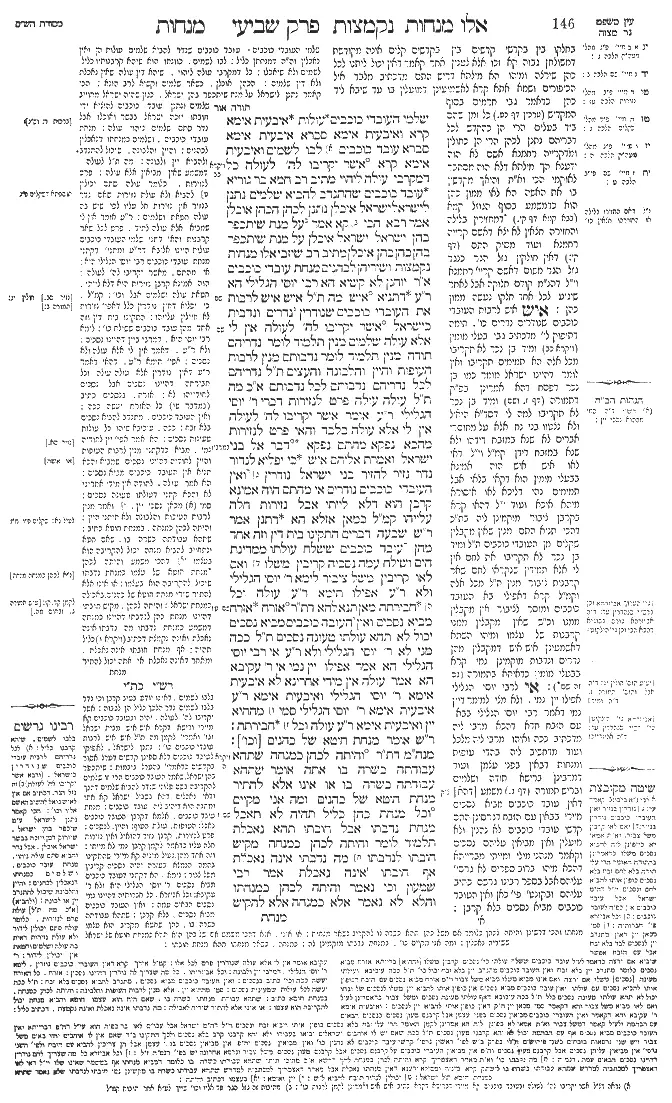
Menachot 73b - Guemara
שלמי העובדי כוכבים עולות איבעית אימא קרא ואיבעית אימא סברא איבעית אימא סברא עובד כוכבים לבו לשמים ואיבעית אימא קרא (ויקרא כב, יח) אשר יקריבו לה' לעולה כל דמקרבי עולה ליהוי מתיב רב חמא בר גוריא עובד כוכבים שהתנדב להביא שלמים נתנן לישראל ישראל אוכלן נתנן לכהן הכהן אוכלן אמר רבא הכי קא אמר על מנת שיתכפר בהן ישראל ישראל אוכלן על מנת שיתכפר בהן כהן כהן אוכלן מתיב רב שיזבי אלו מנחות נקמצות ושיריהן לכהנים מנחת עובדי כוכבים א"ר יוחנן לא קשיא הא רבי יוסי הגלילי הא רבי עקיבא דתניא (ויקרא כב, ג) איש מה תלמוד לאמר איש איש לרבות את העובדי כוכבים שנודרין נדרים ונדבות כישראל (ויקרא כב, יח) אשר יקריבו לה' לעולה אין לי אלא עולה שלמים מנין תלמוד לומר נדריהם תודה מנין תלמוד לומר נדבותם מנין לרבות העופות והיין והלבונה והעצים תלמוד לאמר נדריהם לכל נדריהם נדבותם לכל נדבותם אם כן מה תלמוד לאמר עולה עולה פרט לנזירות דברי ר' יוסי הגלילי רבי עקיבא אומר אשר יקריבו לה' לעולה אין לי אלא עולה בלבד והאי פרט לנזירות מהכא נפקא מהתם נפקא (במדבר ו, ב) דבר אל בני ישראל ואמרת אליהם איש כי יפליא לנדור נדר נזיר להזיר בני ישראל נודרין ואין העובדי כוכבים נודרים אי מהתם הוה אמינא קרבן הוא דלא לייתי אבל נזירות חלה עלייהו קמ"ל כמאן אזלא הא דתנן אמר ר"ש שבעה דברים התקינו בית דין וזה אחד מהן עובד כוכבים ששלח עולתו ממדינת הים ושילח עמה נסכיה קריבין משלו ואם לאו קריבין משל ציבור לימא ר' יוסי הגלילי ולא רבי עקיבא אפילו תימא רבי עקיבא עולה וכל חבירתה מאן תנא להא דתנו רבנן (במדבר טו, יג) אזרח אזרח מביא נסכים ואין העובד כוכבים מביא נסכים יכול לא תהא עולתו טעונה נסכים תלמוד לאמר ככה מני לא ר' יוסי הגלילי ולא רבי עקיבא אי רבי יוסי הגלילי הא אמר אפילו יין נמי אי ר' עקיבא הא אמר עולה אין מידי אחרינא לא איבעית אימא ר' יוסי הגלילי ואיבעית אימא רבי עקיבא איבעית אימא ר' יוסי הגלילי סמי מההיא יין ואיבעית אימא רבי עקיבא עולה וכל חבירתה:
רבי שמעון אומר מנחת חוטא של כהנים [וכו']:
מנא הני מילי דתנו רבנן (ויקרא ה, יג) והיתה לכהן כמנחה שתהא עבודתה כשרה בו אתה אומר שתהא עבודתה כשרה בו או אינו אלא להתיר מנחת חוטא של כהנים ומה אני מקיים (ויקרא ו, טז) וכל מנחת כהן כליל תהיה לא תאכל מנחת נדבתו אבל חובתו תהא נאכלת תלמוד לומר והיתה לכהן כמנחה מקיש חובתו לנדבתו מה נדבתו אינה נאכלת אף חובתו אינה נאכלת אמר רבי שמעון וכי נאמר והיתה לכהן כמנחתו והלא לא נאמר אלא כמנחה אלא להקיש
Comments from Rashi on Masechet Menachot Page 73b
שלמי העובדי כוכבים . עובד כוכבים שנדר להביא שלמים עולות הן ואין נאכלין וה"ה דמנחתן כליל: לבו לשמים . כוונתו הוא שיהא קרבנותיו כליל לשמים ולא שיאכלו: כל דמקרבי עולה ליהוי . שיהא דין עולה שאין נאכלת ולא דין שלמים: הכהן אוכלן . כשאר שלמים וקשיא לרב הונא: הכי קאמר נתנן לישראל על מנת שיתכפר בהן ישראל . כגון שהיה ישראל מחוייב שלמים ונתנן עובד כוכבים להוציא ידי חובתו יזכה ישראל בבשר ואוכלו אבל נדר סתם שלמים ניהוי עולה: מנחת עובדי כוכבים . ושלמים כמנחתו דנאכלין לכהנים: והיין והלבונה . שיכול להתנדב ולהביא יין ולבונה: מה ת"ל לעולה . דמשמע שאין מביאין אלא עולה: פרט לנזירות . כלומר עולה סתם יכולין להביא ולא עולת נזירות שאם נדר בנזיר אין נזירות חל עליו לפי שיש בה עולה חטאת ושלמים: ר"ע אומר אין לי שמביא אלא עולה לחוד . פרט לכל שאר קרבנות והאי דתני שלמי העובדי כוכבים עולות היינו אליבא דר"ע ומתני' דקתני מנחת עובדי כוכבים רבי יוסי הגלילי היא: אי מהתם . מאשר יקריבו לה' לעולה: הוה אמינא קרבן נזירות הוא דלא לייתי . חטאת עולה ושלמים אבל וכו': קמ"ל . כי יפליא דאין נודרין כלל דאפי' נזירות לא חיילין עלייהו: התקינו בית דין וזה אחד מהן עובד כוכבים ששילח כו' לימא רבי יוסי היא . דמרבי ביין דהיינו נסכים: ולא ר"ע . דאמר אין לי אלא עולה ולא נסכים: אפי' תימא ר"ע . דהאי דאמר ר"ע דאין נודרין אלא עולה עולה וכל חבירתה דהיינו נסכים אבל נסכים לחודייהו לא: אזרח . בנסכים כתיב (במדבר טו) כל האזרח יעשה ככה: ואין העובד כוכבים . מתנדב להביא נסכים בלא זבח: ככה . עיכובא שיהו כל עולות טעונות נסכים: הא אמר אפי' יין לחודיה נמי . מביא כדקתני מנין לרבות העופות והיין לחודיה דהיינו נסכים שמביא והכא תניא אין העובד כוכבים מביא נסכים: הא אמר עולה . לחודה אין מידי אחריני לא והכא קתני דעולתו טעונה נסכים: סמי מכאן נסכי יין . ואמר מנין לרבות העופות והלבונה ולא תיתני היין: והיתה לכהן כמנחה . במנחת חוטא כתיב: שתהא עבודתה כשרה בו . שאם חטא ונתחייב להביא מנחה יכול להקריבה הוא בעצמו דהכי משמע והיתה לכהן מנחת חוטא של עצמו כמנחת נדבתו שיכול להקריבה הוא בעצמו: או אינו אלא להתיר שירי מנחת חוטא של כהנים . באכילה כמנחת ישראל: והיתה לכהן . מקיש חובתו דהיינו מנחת כהן לנדבתו דהיינו כמנחה דמשמע כמנחת נדבתו מה נדבתו אינה נאכלת ואינה נקמצת דכתיב (ויקרא ו) כליל תהיה: אף מנחת חובתו אינה נאכלת . ומאחר דאינה נאכלת אי אתה יכול להתיר מנחת מנחת חוטא של כהנים אלא שתהא עבודה כשרה בו: אלא כמנחה . דמשמע כמנחת חוטא של ישראל דאילו נאמר כמנחתו הוה משתמע כדקאמרת מקיש חובתו לנדבתו (והלא לא נאמר כו'):
Comments from Tosafot - Menachot 73b
איש איש לרבות העובדי כוכבים שנודרים נדרים כו'. תימה דתיפוק לי' מדכתיב גבי בעלי מומין (ויקרא כב) ומיד בן נכר לא תקריבו מכל אלה הא תמימים תקריבו ואין לומר דהיינו ישראל מומר כמו בן נכר דפסח דהא אמרינן בפ"ק דתמורה (דף ז. ושם) ומיד בן נכר לא תקריבו למה לי דסד"א הואיל ולא נצטוו בני נח אלא על מחוסרי אברים לא שנא במזבח דידהו ולא שנא במזבח דידן קמ"ל וי"ל דאי לאו איש איש הוה אמינא בבעלי מומין הוא דקאי בלאו אבל תמימים נהי דליכא לאו איסורא מיהא איכא ועוד י"ל דהאי קרא בקרבן ציבור מוקמינן ליה בת"כ דהכי תניא התם מנין שאין מקבלין שקלים מן העובדי כוכבים ת"ל ומיד בן נכר לא תקריבו את לחם אין לי אלא תמידין שנקראו לחם שאר קרבנות ציבור מנין ת"ל מכל אלה וקמ"ל קרא דאפילו בא העובד כוכבים ומוסר לציבור אין מקבלין ממנו וכ"ש שאין מקבלין ממנו קרבנות של עצמו ומיהו השתא דאשמעינן איש איש דמקבלין מהן נדרים ונדבות מוקמינן נמי קרא בבעלי מומין כדאיתא בתמורה (גם זה שם): אי לרבי יוסי הגלילי אפילו יין נמי. ולא מצי למימר דיין נמי דאמר רבי יוסי הגלילי בבא עם הזבח חדא דהכא מרבי ליה מדכתיב ככה ואיהו מרבי ליה מלכל ועוד מדחשיב ליה בהדי עופות ומנחות דבאין בפני עצמן ועוד דמרבינן ברישא תודה ושלמים ובריש תמורה (דף ג.) משמע [דהא] דאין עובד כוכבים מביא נסכים מיירי בבאין עם הזבח דגרסינן התם קדשי עובדי כוכבים לא נהנין ולא מועלין ואין מביאין עליהם נסכים וקאמר מנהני מילי ומייתי מברייתא דהכא מיהו ברוב ספרים לא גרסי' עליהם אבל בספר רבינו גרשם כתוב עליהם ובקונט' פי' כאן ואין העובד כוכבים מביא נסכים בלא קרבן:
Menachot 73b - Mishnah translated into english
Peace offerings volunteered by gentiles are sacrificed as burnt offerings, which are burned completely upon the altar. With regard to the source for this halakha, if you wish, cite a verse; and if you wish, propose a logical argument. If you wish, propose a logical argument: Concerning a gentile who volunteers an offering, the intent of his heart is that the offering should be entirely sacred to Heaven, and he does not intend for any of it to be eaten.
And if you wish, cite a verse: “Any man [ish ish] who is of the house of Israel, or of the strangers in Israel, that brings his offering, whether it be any of their vows, or any of their gift offerings, which they will offer to the Lord as a burnt offering” (Leviticus 22:18). The doubled term ish ish teaches that the offerings of a gentile are accepted, and the verse thereby teaches that any offering that gentiles volunteer to be sacrificed should be a burnt offering.
Rav Ḥama bar Gurya raises an objection from a baraita: With regard to a gentile who volunteered to bring a peace offering, if he gave it to an Israelite, the Israelite eats it; if he gave it to a priest, the priest eats it. Evidently, the gentile’s peace offering is eaten, like the peace offering of a Jew.
To answer the challenge to Rav Huna’s statement, Rava said: This is what the baraita is saying: If a gentile volunteered a peace offering in order to achieve atonement on behalf of an Israelite who is already obligated to bring a peace offering, then the Israelite eats of the offering. If the gentile volunteered it in order to achieve atonement on behalf of a priest who is already obligated to bring a peace offering, then the priest eats of the offering. By contrast, Rav Huna’s statement teaches that when a gentile volunteers his own peace offering, it is treated as a burnt offering.
Rav Sheizevi raises an objection from the mishna: These are the meal offerings from which a handful is removed and their remainder is eaten by the priests…the meal offering of gentiles. If the priests may eat the remainder of the meal offerings of gentiles, it is logical that the peace offerings of gentiles should also be given to the priests to eat, as the right of the priests to eat from meal offerings and peace offerings is identical. To resolve this objection, Rabbi Yoḥanan said: This is not difficult. This statement in the mishna that the priests eat the meal offerings of gentiles is the opinion of Rabbi Yosei HaGelili, and that ruling of Rav Huna that the peace offerings of gentiles are not eaten is the opinion of Rabbi Akiva.
As it is taught in a baraita: The verse cited previously states: “Any man [ish ish] who is of the house of Israel, or of the strangers in Israel, that brings his offering, whether it be any of their vows, or any of their gift offerings, which they will offer to the Lord as a burnt offering.” The verse is now analyzed: The verse could have stated: A man [ish]. Why does the verse state the double expression “ish ish”? This serves to include the gentiles, demonstrating that they can vow to bring vow offerings and gift offerings like a Jew can.
When the verse states: “Which they will offer to the Lord as a burnt offering,” I have derived only that a gentile can vow to bring a burnt offering. From where is it derived that a gentile can vow to bring a peace offering? The verse states: “Their vows.” From where is it derived that he can bring a thanks offering? The verse states the seemingly superfluous clause: “Their gift offerings.”
The baraita continues: From where is it derived that the verse means to include that a gentile can bring birds as burnt offerings, and wine libations, and the frankincense, and the wood for the arrangement upon the altar? The verse states not only: “Their vows,” but also the more comprehensive term: “Any of their vows”; and the verse states not only: “Their gift offerings,” but also the more comprehensive term: “Any of their gift offerings.”
The baraita asks: If so, what is the meaning when the verse states: “They will offer to the Lord as a burnt offering”? The baraita answers: This teaches that a gentile can bring a standard burnt offering, to the exclusion of a burnt offering of naziriteship. Since a gentile is unable to assume the status of a nazirite, he is also unable to bring the offerings of a nazirite. This is the statement of Rabbi Yosei HaGelili. Rabbi Akiva says: When the verse states: “Which they will offer to the Lord as a burnt offering,” it indicates that nothing other than a burnt offering alone may be brought by a gentile.
With regard to the analysis of Rabbi Yosei HaGelili, the Gemara asks: And this exclusion of a burnt offering of naziriteship, is it derived from here, in the verse cited? Is it not derived from there: “Speak to the children of Israel, and say to them: When a man…shall clearly utter a vow, the vow of a nazirite” (Numbers 6:2); this is interpreted to mean that the children of Israel can vow to become nazirites, but the gentiles cannot vow to become nazirites? Therefore, the exclusion of gentiles from bringing the burnt offering of a nazirite is not learned from the term “a burnt offering.”
The Gemara answers: If the exclusion was derived from there, i.e., the verse in Leviticus, which is referring to offerings, I would say: It is the offering of nazirites that the gentiles cannot bring, but naziriteship takes effect upon them if they vow to become a nazirite. Therefore, the exclusion of naziriteship by the verse in Numbers teaches us that a gentile cannot become a nazirite at all.
§ The Gemara discusses a related matter. In accordance with whose opinion is that which we learned in a mishna (Shekalim 7:6): Rabbi Shimon said: The court instituted seven ordinances with regard to the financial aspects of offerings and consecrations. And this ordinance, namely, that the cost of the libations accompanying the sacrifice of a found sacrificial animal is borne by the public, is one of them. These are the other ordinances: If a gentile sent his burnt offering from a country overseas, and he sent with it money for the purchase of the libations that must accompany it, the libations are offered at his expense. And if the gentile did not cover the cost of the libations, it is a condition of the court that the libations are sacrificed at the public’s expense, with funds taken from the Temple treasury. Evidently, a gentile can offer libations as well as burnt offerings.
The Gemara suggests: Let us say that this mishna rules in accordance with the opinion of Rabbi Yosei HaGelili and not in accordance with the opinion of Rabbi Akiva. The Gemara rejects this assumption: You may even say that this mishna is in accordance with the opinion of Rabbi Akiva, and he holds that a gentile can bring a burnt offering and all its accessories, including the libations.
The Gemara asks: Who is the tanna who taught that which the Sages taught in a baraita: The verse states with regard to libations: “All who are home born shall do these things after this manner” (Numbers 15:13), which teaches that those who are home born, i.e., Jews, can bring libations as a separate offering, but a gentile cannot bring such libations. One might have thought that a gentile’s burnt offering should not require the standard accompanying libations. Therefore, the verse states: “So it shall be done for one bull” (Numbers 15:11), which indicates that every offering requires libations. Whose opinion is this? It is not that of Rabbi Yosei HaGelili and not that of Rabbi Akiva.
The Gemara explains the question: If it is in accordance with the opinion of Rabbi Yosei HaGelili, doesn’t he say that a gentile may even bring wine by itself, and not only as a libation? If it is in accordance with the opinion of Rabbi Akiva, doesn’t he say that with regard to a burnt offering, yes, a gentile may bring it, but with regard to something else other than the offering itself, no, a gentile may not bring it?
The Gemara answers: If you wish, say it is in accordance with the opinion of Rabbi Yosei HaGelili; and if you wish, say that it is in accordance with the opinion of Rabbi Akiva. If you wish, say it is in accordance with the opinion of Rabbi Yosei HaGelili, and omit from that baraita that the tanna allows gentiles to bring wine, as he holds that gentiles cannot bring wine by itself. And if you wish, say that it is in accordance with the opinion of Rabbi Akiva, and interpret his opinion to be that a gentile may bring a burnt offering and all its accessories.
§ The mishna teaches: Rabbi Shimon says: With regard to the meal offering of a sinner brought by one of the priests, a handful is removed, and the entire offering is sacrificed upon the altar. The Gemara asks: From where is this matter derived?
The Gemara answers: It is derived as the Sages taught in a baraita. The verse states with regard to the meal offering of a sinner: “And he shall bring it to the priest, and the priest shall take his handful of it as the memorial of it, and burn it on the altar…it is a sin offering. And the priest shall make atonement for him for his sin that he has sinned in any of these matters, and he shall be forgiven; and the remainder shall be the priest’s, as the meal offering” (Leviticus 5:12–13). Since the phrase “And the remainder shall be the priest’s, as the meal offering” is seemingly unnecessary, as these verses are discussing a meal offering, it therefore teaches that its sacrificial rite would be valid even when performed by a priest who has brought the offering for his own sin.
The baraita discusses the matter: Do you say that this verse teaches that the rite of the meal offering of a sinner would be valid when performed by him? Or is it only necessary to permit the eating of the remainder of the meal offering of a sinner brought by one of the priests? And if so, how do I realize the meaning of the verse that states: “And every meal offering of the priest shall be offered in its entirety; it shall not be eaten” (Leviticus 6:16)? Perhaps that is referring to his voluntary meal offering, but his obligatory meal offering may be eaten.
Therefore, the verse states: “And it shall be the priest’s as the meal offering.” In this way, the verse compares the priest’s obligatory offering to his voluntary offering: Just as his voluntary offering is not eaten, so too, his obligatory offering is not eaten. In disagreeing with the previous interpretation, Rabbi Shimon said: Is it stated: And it shall be the priest’s, as his meal offering? But it states only: “As the meal offering,” referring to the meal offering of a non-priest. Rather, this verse serves to compare and render the halakha of
Traduction : The William Davidson digital edition of the Koren Noé Talmud, with commentary by Rabbi Adin Even-Israel Steinsaltz.