 Talmud Bavli
Menachot 49b : Youtube
Daf TubeYoutube
2 video classes :
Menachot Page 49b
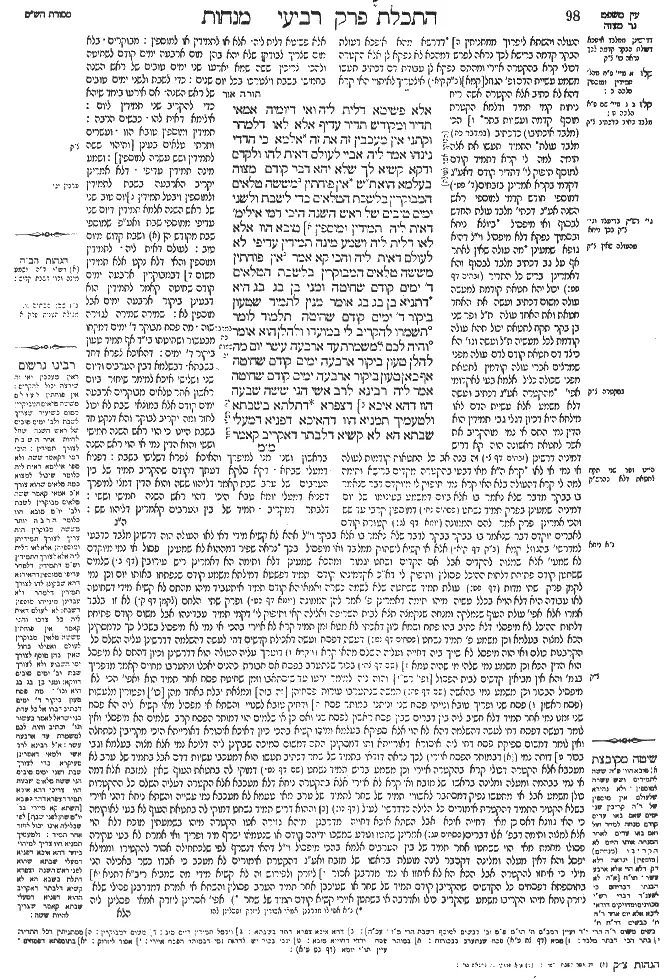
Menachot 49b - Guemara
אלא פשיטא דלית ליה ואי דיומיה אמאי תדיר ומקודש תדיר עדיף אלא לאו דלמחר וקתני אין מעכבין זה את זה אלמא כי הדדי נינהו אמר ליה אביי לעולם דאית להו ולקדם ודקא קשיא לך שלא יהא דבר קודם מצוה בעלמא הוא ת"ש אין פוחתין מששה טלאים המבוקרין בלשכת הטלאים כדי לשבת ולשני ימים טובים של ראש השנה היכי דמי אילימ' דאית ליה תמידין ומוספין טובא הוו אלא לאו דלית ליה ושמע מינה תמידין עדיפי לא לעולם דאית ליה והכי קא אמר אין פוחתין מששה טלאים המבוקרין בלשכת הטלאים ד' ימים קודם שחיטה ומני בן בג בג היא דתניא בן בג בג אומר מנין לתמיד שטעון ביקור ד' ימים קודם שחיטה תלמוד לומר (במדבר כח, ב) תשמרו להקריב לי במועדו ולהלן הוא אומר (שמות יב, ו) והיה לכם למשמרת עד ארבעה עשר יום מה להלן טעון ביקור ארבעה ימים קודם שחיטה אף כאן טעון ביקור ארבעה ימים קודם שחיטה אמר ליה רבינא לרב אשי הני ששה שבעה הוו דהא איכא דצפרא דתלתא בשבתא ולטעמיך תמניא הוו דהאיכא דפניא דמעלי שבתא הא לא קשיא דלבתר דאקריב קאמר
Comments from Rashi on Masechet Menachot Page 49b
אלא פשיטא דלית ליה . אלא או לתמידין או למוספין: מבוקרים . בלא מום שצריך לבודקן שלא יהא בהן מום ארבעה ימים קודם לשחיטה ולהכי צריכין ששה שמא יארעו שני ימים טובים של ראש השנה בחמישי בשבת ויצטרכו בכל יום שנים: כדי לשבת ולשני ימים טובים של ראש השנה . אם אירעו ביחד שיהא כדי להקריב שני תמידין ליום: אילימא דאית להו . כבשים הרבה: תמידין ומוספין טובא הוו . ועשרים ותרתי טלאים בעינן [ותיהוי ששה לתמידין ושש עשרה למוספין]: ושמע מינה תמידין עדיפי . דלא אמרינן יקריב הארבעה בשבת לתמידין ולמוספין ויבטל תמידין יום טוב שני של ראש השנה אלמא תמידין דיום שני עדיפי ממוספי שבת ואע"פ שמוספי שבת מקודש הן ושבת קדוש מיום טוב: לעולם דאית ליה . לתמידין ומוספין והאי דלא נקט אלא תמידין משום דבמבוקרין ארבעה ימים קודם שחיטה קאמר לתמידין הוא דבעינן ביקור ארבעה ימים אבל מוספין לא: שמירה שמירה לגזירה שוה . מה פסח מבוקר ד' ימים דמקחו מבעשור ושחיטתו בי"ד אף תמיד טעון ביקור ד' ימים: דהאיכא צפרא דחד בשבתא . דבשלמא דבין הערבים ודיום שני ושלישי איכא למימר שיחזר ביום ראשון אחר טלאים מבוקרים ארבעה ימים קודם אלא במוצאי שבת לא יכול לחזר ומה יקריב לבוקר והא דנקט חד בשבת היינו כי הוי ראש השנה חמישי וששי והוא הדין נמי אי הוי ראש השנה בראשון ושני מצי למיפרך והאיכא צפרא דשלישי בשבת: דפניא דמעלי שבתא . דקא סלקא דעתך דקודם שהקריב תמיד של בין הערבים של ערב שבת קאמר דליהוו ששה והוא הדין דמצי למיפרך דפניא דמעלי יומא טבא היכי דהוי ראש השנה חמישי וששי: דלבתר דמקריב . תמיד של בין הערבים קאמרינן דליהוו שש:
Comments from Tosafot - Menachot 49b
אית דגרסי הא איכא צפרא דתלתא בשבתא וחלו שני ימים טובים של ר"ה אחר השבת ופריך וליטעמיך תמניא הוו דהאיכא דפניא דמעלי שבתא וכסבור היה שבאמצע היום היה מדבר ואית דגרסי הא איכא צפרא דחד בשבתא ומונה הב' ימים טובים לפני השבת ובתר הכי נגרוס דפניא דמעלי יומא טבא:
Menachot 49b - Mishnah translated into english
Rather, it is obvious that the mishna is referring to a case where he does not have a sufficient number of animals for both offerings. And if it is referring to the offerings of that day, why does the mishna say that failure to sacrifice one does not prevent sacrifice of the other? Since the daily offering is more frequent and it is sanctified, and the additional offerings are sanctified but are less frequent than the daily offering, the frequent offering is given preference. Consequently, failure to sacrifice the daily offering should prevent the sacrifice of the additional offerings.
Rather, is it not referring to a case where the Temple treasury does not have enough animals for both the additional offerings of today and the daily offering of tomorrow, and yet the mishna teaches that failure to sacrifice one does not prevent one from sacrificing the other? Evidently, they are equal and he may sacrifice whichever offering he chooses. This would resolve Rabbi Ḥiyya bar Avin’s dilemma.
Abaye said to Rav Ḥisda: That is not a valid resolution of the dilemma, as one can claim that actually, the mishna is referring to a case where they have enough animals for all the offerings, and the mishna is referring to the issue of sacrificing one before the other. And with regard to that which poses a difficulty for you based upon the baraita that states that no sacrifice should precede the sacrifice of the daily offering of the morning, that baraita is merely stating the mitzva ab initio.
The Gemara suggests: Come and hear a resolution to Rabbi Ḥiyya bar Avin’s dilemma based upon a mishna (Arakhin 13a): One maintains no fewer than six lambs that have been inspected and found to be unblemished in the Chamber of the Lambs, sufficient for Shabbat and for the two festival days of Rosh HaShana that in some years occur adjacent to it.
The Gemara clarifies: What are the circumstances of this case? If we say that it is referring to a case where the Temple treasury has enough animals for all of the offerings that should be brought, six lambs are not enough, as there are many lambs sacrificed for daily offerings and additional offerings on those three days. In total, twenty-two lambs are required: Two each day for the daily offerings, two for the additional offering of Shabbat, seven for the additional offering of Rosh HaShana, and seven for the additional offering of the New Moon.
Rather, is it not that the mishna is referring to a case where the Temple treasury does not have enough animals for all of the offerings, and it is teaching that the animals that he does have are utilized for the daily offerings of all three days rather than for the additional offering of Shabbat on the first of the three days? Consequently, one may conclude from it that the daily offerings of tomorrow are given preference over the additional offerings of today.
The Gemara replies: No, this is not a valid proof, as one can claim that actually, the mishna is referring to a case where the Temple treasury has enough animals for all of the offerings of the three days, and this is what the mishna is saying when it mentions six lambs: One maintains for use as daily offerings no fewer than six lambs that have been inspected and found to be unblemished in the Chamber of the Lambs four days prior to their slaughter. Lambs sacrificed as other offerings do not have to be inspected four days prior to being slaughtered. And in accordance with whose opinion is this mishna? It is in accordance with the opinion of ben Bag Bag.
As it is taught in a baraita that ben Bag Bag says: From where is it derived that the daily offering requires inspection four days prior to its slaughter? The verse states with regard to the daily offering: “You shall observe [tishmeru] to sacrifice to Me in its due season” (Numbers 28:2), and elsewhere, with regard to the Paschal offering, the verse states: “On the tenth day of this month they shall take for them every man a lamb…and you shall keep it [mishmeret] until the fourteenth day of this month” (Exodus 12:3–6).
Consequently, it is derived by means of a verbal analogy that just as in the verse there, the Paschal offering requires inspection four days prior to its slaughter, from the tenth of the month to the fourteenth, so too here, the daily offering requires inspection four days prior to its slaughter. This is not a requirement that pertains to all offerings; it is stated specifically with regard to the Paschal offering and extended by means of a verbal analogy to the daily offering.
§ The Gemara cites a discussion pertaining to the mishna cited earlier. Ravina said to Rav Ashi: With regard to these six inspected lambs that must always be kept in the Chamber of Lambs, there ought to be seven, as there is a need for another lamb for the daily offering of the morning of the third day of the week, since it cannot be inspected on Shabbat or the subsequent festival days of Rosh HaShana, and therefore should be inspected and kept beforehand.
Rav Ashi responded to Ravina: According to your reasoning the correct number is not seven, but rather it is eight; as there is also the daily offering of the afternoon of Shabbat eve that should also be counted.
Ravina replied: That is not difficult, because the mishna is saying that after he sacrificed the daily offering of the afternoon there must be six inspected lambs.
Traduction : The William Davidson digital edition of the Koren Noé Talmud, with commentary by Rabbi Adin Even-Israel Steinsaltz.
Menachot 49b : Significance
Next step
Finished studying Menachot 49b? Carry on with the rest of the tractate.
Study Menachot 50aFrequently asked questions: Menachot 49b
Where is Menachot 49b in tractate Menachot?
Menachot 49b is page 96 of 217 in tractate Menachot (Seder Kodashim).
When is daf 49 of Menachot studied in Daf Yomi?
Daf Yomi covers one daf a day, both sides. Daf 49 of Menachot will be studied on August 2, 2033.
Is there a video class on Menachot 49b?
Yes, by Daf Tube, Rabbi Dr. Moshe Weisblum. These classes were published on YouTube by their authors and are gathered on this site.
What is tractate Menachot about?
The Masechet Menahot is the second tractate of the Seder Kodashim. The Gemara Menahot is the study of the laws concerning the preparation and presentation of offerings of flour, grain, oil and drink. As well as the meal offering that was burnt on the altar and the rest that was to be consumed by the cohanim. The Menahot tractate has 13 chapters.
Your study is also dedicated to them
- L'ilui Nishmat Jamila bat Chlomo Abensour
- L'ilui Nishmat Reuven ben Rivka SEBBAG
- L'ilui Nishmat Rav Chlomo Ben Jamilla