 Talmud Bavli
Berakhot 63b : Youtube
Daf TubeYoutube
2 video classes :
Berakhot Page 63b
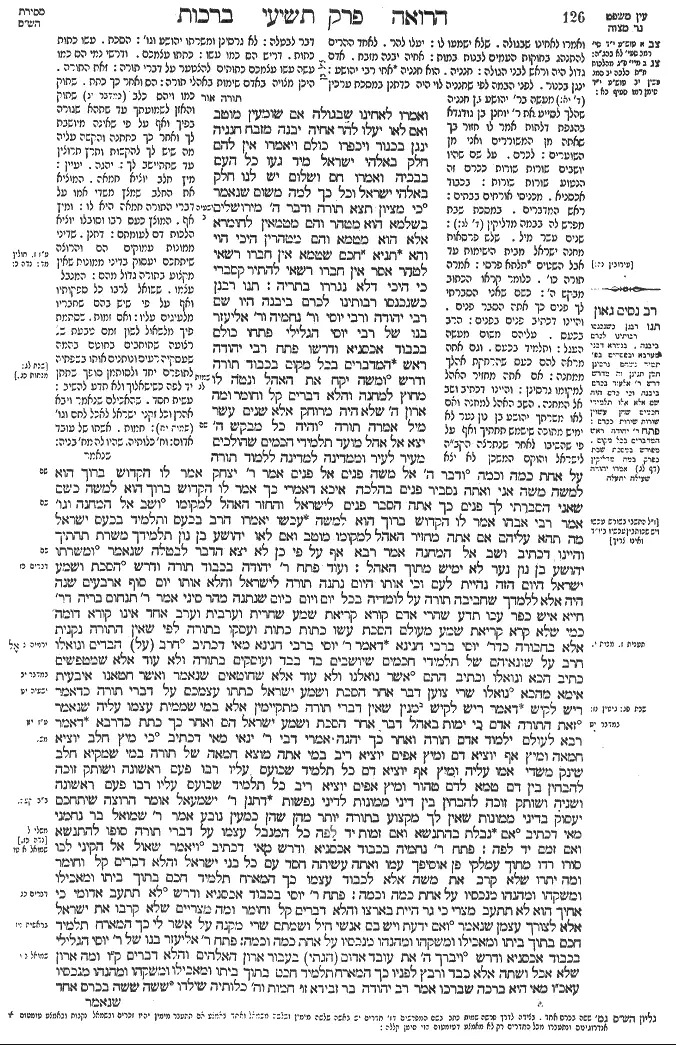
Berakhot 63b - Guemara
ואמרו לאחינו שבגולה אם שומעין מוטב ואם לאו יעלו להר אחיה יבנה מזבח חנניה ינגן בכנור ויכפרו כולם ויאמרו אין להם חלק באלהי ישראל מיד געו כל העם בבכיה ואמרו חס ושלום יש לנו חלק באלהי ישראל וכל כך למה משום שנאמר (ישעיהו ב ג) כי מציון תצא תורה ודבר ה' מירושלים בשלמא הוא מטהר והם מטמאין לחומרא אלא הוא מטמא והם מטהרין היכי הוי והא תניא חכם שטמא אין חברו רשאי לטהר אסר אין חברו רשאי להתיר קסברי כי היכי דלא נגררו בתריה:
תנו רבנן כשנכנסו רבותינו לכרם ביבנה היו שם רבי יהודה ורבי יוסי ור' נחמיה ור' אליעזר בנו של רבי יוסי הגלילי פתחו כולם בכבוד אכסניא ודרשו פתח רבי יהודה ראש המדברים בכל מקום בכבוד תורה ודרש (שמות לג ז) ומשה יקח את האהל ונטה לו מחוץ למחנה והלא דברים קל וחומר ומה ארון ה' שלא היה מרוחק אלא שנים עשר מיל אמרה תורה (שמות לג ז) והיה כל מבקש ה' יצא אל אהל מועד תלמידי חכמים שהולכים מעיר לעיר וממדינה למדינה ללמוד תורה על אחת כמה וכמה (שמות לג יא) ודבר ה' אל משה פנים אל פנים אמר ר' יצחק אמר לו הקדוש ברוך הוא למשה משה אני ואתה נסביר פנים בהלכה איכא דאמרי כך אמר לו הקדוש ברוך הוא למשה כשם שאני הסברתי לך פנים כך אתה הסבר פנים לישראל והחזר האהל למקומו (שמות לג יא) ושב אל המחנה וגו' אמר רבי אבהו אמר לו הקדוש ברוך הוא למשה עכשו יאמרו הרב בכעס ותלמיד בכעס ישראל מה תהא עליהם אם אתה מחזיר האהל למקומו מוטב ואם לאו יהושע בן נון תלמידך משרת תחתיך והיינו דכתיב ושב אל המחנה אמר רבא אף על פי כן לא יצא הדבר לבטלה שנאמר (שמות לג יא) ומשרתו יהושע בן נון נער לא ימיש מתוך האהל:
ועוד פתח ר' יהודה בכבוד תורה ודרש (דברים כז ט) הסכת ושמע ישראל היום הזה נהיית לעם וכי אותו היום נתנה תורה לישראל והלא אותו יום סוף ארבעים שנה היה אלא ללמדך שחביבה תורה על לומדיה בכל יום ויום כיום שנתנה מהר סיני אמר ר' תנחום בריה דר' חייא איש כפר עכו תדע שהרי אדם קורא קריאת שמע שחרית וערבית וערב אחד אינו קורא דומה כמי שלא קרא קריאת שמע מעולם הסכת עשו כתות כתות ועסקו בתורה לפי שאין התורה נקנית אלא בחבורה כדר' יוסי ברבי חנינא דאמר ר' יוסי ברבי חנינא מאי דכתיב (ירמיהו נ לו) חרב (על) הבדים ונואלו חרב על שונאיהם של תלמידי חכמים שיושבים בד בבד ועוסקים בתורה ולא עוד אלא שמטפשים כתיב הכא ונואלו וכתיב התם (במדבר יב יא) אשר נואלנו ולא עוד אלא שחוטאים שנאמר ואשר חטאנו איבעית אימא מהכא (ישעיהו יט יג) נואלו שרי צוען דבר אחר הסכת ושמע ישראל כתתו עצמכם על דברי תורה כדאמר ריש לקיש דאמר ריש לקיש מנין שאין דברי תורה מתקיימין אלא במי שממית עצמו עליה שנאמר (במדבר יט יד) זאת התורה אדם כי ימות באהל דבר אחר הסכת ושמע ישראל הס ואחר כך כתת כדרבא דאמר רבא לעולם ילמוד אדם תורה ואחר כך יהגה אמרי דבי ר' ינאי מאי דכתיב (משלי ל לג) כי מיץ חלב יוציא חמאה ומיץ אף יוציא דם ומיץ אפים יוציא ריב במי אתה מוצא חמאה של תורה במי שמקיא חלב שינק משדי אמו עליה ומיץ אף יוציא דם כל תלמיד שכועס עליו רבו פעם ראשונה ושותק זוכה להבחין בין דם טמא לדם טהור ומיץ אפים יוציא ריב כל תלמיד שכועס עליו רבו פעם ראשונה ושניה ושותק זוכה להבחין בין דיני ממונות לדיני נפשות דתנן ר' ישמעאל אומר הרוצה שיתחכם יעסוק בדיני ממונות שאין לך מקצוע בתורה יותר מהן שהן כמעין נובע אמר ר' שמואל בר נחמני מאי דכתיב (משלי ל לב) אם נבלת בהתנשא ואם זמות יד לפה כל המנבל עצמו על דברי תורה סופו להתנשא ואם זמם יד לפה:
פתח ר' נחמיה בכבוד אכסניא ודרש מאי דכתיב (שמואל א טו ו) ויאמר שאול אל הקיני לכו סורו רדו מתוך עמלקי פן אוסיפך עמו ואתה עשיתה חסד עם כל בני ישראל והלא דברים קל וחומר ומה יתרו שלא קרב את משה אלא לכבוד עצמו כך המארח תלמיד חכם בתוך ביתו ומאכילו ומשקהו ומהנהו מנכסיו על אחת כמה וכמה:
פתח ר' יוסי בכבוד אכסניא ודרש (דברים כג ח) לא תתעב אדומי כי אחיך הוא לא תתעב מצרי כי גר היית בארצו והלא דברים קל וחומר ומה מצריים שלא קרבו את ישראל אלא לצורך עצמן שנאמר (בראשית מז ו) ואם ידעת ויש בם אנשי חיל ושמתם שרי מקנה על אשר לי כך המארח תלמיד חכם בתוך ביתו ומאכילו ומשקהו ומהנהו מנכסיו על אחת כמה וכמה:
פתח ר' אליעזר בנו של ר' יוסי הגלילי בכבוד אכסניא ודרש (שמואל ב ו יא) ויברך ה' את עובד אדום (הגתי) בעבור ארון האלהים והלא דברים קו ומה ארון שלא אכל ושתה אלא כבד ורבץ לפניו כך המארח תלמיד חכם בתוך ביתו ומאכילו ומשקהו ומהנהו מנכסיו עאכו מאי היא ברכה שברכו אמר רב יהודה בר זבידא זו חמות וח' כלותיה שילדו ששה ששה בכרס אחד
Comments from Rashi on Masechet Berakhot Page 63b
ואמרו לאחינו שבגולה . שלא ישמעו לו: יעלו להר . לאחד ההרים להתנהג בחוקות העמים לבנות במות: אחיה יבנה מזבח . אדם גדול היה וראש לבני הגולה: חנניה . הוא חנניה אחי רבי יהושע: ינגן בכנור . לפני הבמה לפי שחנניה לוי היה כדתנן במסכת ערכין (ד' יא:) מעשה ברב יהושע בן חנניה שהלך לסייע את רב יוחנן בן גודגדא בהגפת דלתות אמר לו חזור בך שאתה מן המשוררים ואני מן השוערים: לכרם . על שם שהיו יושבים שורות שורות ככרם זה הנטוע שורות שורות: בכבוד אכסניא . מכניסי אורחים בבתים: ראש המדברים . במסכת שבת מפרש לה בבמה מדליקין (ד' לג:): שנים עשר מיל . שלש פרסאות מחנה ישראל מבית הישימות עד אבל השטים תלתא פרסי: אמרה תורה כו' . כלומר קראו הכתוב מבקש ה': כשם שאני הסברתי לך פנים כך אתה הסבר פנים . והיינו דכתיב פנים בפנים: הרב בכעס . עליהם משום מעשה העגל: ותלמיד בכעס . וגם אתה מראה להם כעס שהרחקת אהלך ממחנה: אם אתה מחזיר האהל למקומו גרסינן: והיינו דכתיב ושב אל המחנה . השב האהל למחנה ואם לאו משרתך יהושע בן נון נער לא ימיש מתוכה שישמש תחתיך ואף על פי שהשיבו לאחר שנתרצה הקב"ה לישראל והוקם המשכן לא יצא דבר לבטלה: לא גרסינן ומשרתו יהושע וגו': הסכת . עשו כתות כתות. דריש הס כמו עשו: כתתו עצמכם . ודרשי נמי הם כמו עשה עשו עצמכם כתותים להצטער על דברי תורה: זאת התורה . היכן מצויה באדם שימות באהלי תורה: הם ואחר כך כתת . שתוק כמו ויהס כלב (במדבר יג) שתוק והאזן לשמועתך עד שתהא שגורה בפיך ואף על פי שאינה מיושבת לך ואחר כך כתתנה והקשה עליה מה שיש לך להקשות ותרץ תרוצין עד שתתיישב לך: יהגה . יעיין: מיץ חלב יוציא חמאה . המוציא את החלב שמצץ משדי אמו על דברי התורה חמאה היא לו: ומיץ אף . המוצץ כעס רבו וסובלו יוציא הלכות דם לעומתם: ומיץ אף . המוצץ כעס רבו וסובלו יוציא הלכות דם לעומתם: דתנן . שדיני ממונות עמוקים הם והרוצה שיתחכם יעסוק בדיני ממונות שאין מקצוע בתורה גדול מהם: המנבל עצמו . ששואל לרבו כל ספקותיו ואף על פי שיש בהם שחבריו מלעיגים עליו: ואם זמות . שסתמת פיך מלשאול לשון זמם טבעת של רצועה שתוחבים בחוטם בהמה שעסקיה רעים ונותנים אותו בשפתיה לתופרם יחד ולסותמן סופך שתתן יד לפה כשישאלוך ולא תדע להשיב: עשית חסד . שהאכילם שנאמר ויבא אהרן וכל זקני ישראל לאכל לחם וגו' (שמות יח): חמות . אשתו של עובד אדום: וח' כלותיה . שהיו לה מח' בניה:
Berakhot 63b - Mishnah translated into english
And in order to underscore this, tell our brethren in exile: If they obey the Sages of Eretz Yisrael to excommunicate Ḥanina, fine; and if they do not obey us, it is as if they are seceding from the Jewish people. They should climb a mountain; Aḥiya, one of the leaders of the Babylonian Jewish community, will build an altar, Ḥananya, son of Rabbi Yehoshua’s brother, who was a Levite, will play the lute, and all will proclaim heresy and say that they have no portion in the God of Israel.
This message had a profound impact on the people, and immediately the entire nation burst into tears, saying: God forbid. We do have a portion in the God of Israel. They reconsidered their plans to establish Babylonia as the center of the Jewish people.
The Gemara asks: Why did the Sages of Eretz Yisrael go to that extent to stop Ḥanina? The Gemara answers: Because it is stated: “For out of Zion shall go forth the Torah, and the word of the Lord from Jerusalem” (Isaiah 2:3).
The Gemara considers the details of this event: Granted, Ḥanina would rule an item pure and the Sages from Eretz Yisrael would rule it impure; they ruled stringently. But in a case where he ruled an item impure and they ruled it pure, what are the circumstances? How could they rule pure that which he ruled impure? Was it not taught in a baraita: If a Sage ruled an item impure, his colleague is not permitted to rule it pure; if he prohibited it, his colleague may not permit it? The Gemara explains: They held that they must do so in this case, so that people would not be drawn after him; due to the exigencies of the time they overturned his rulings.
The Sages taught: When our Rabbis, the Sages of the Mishna, entered the vineyard, the academy, in Yavne, Rabbi Yehuda, Rabbi Yosei, Rabbi Neḥemya, and Rabbi Eliezer, son of Rabbi Yosei HaGelili, were there presiding over the Sages. They all began to speak in honor of their hosts, the local population hosting them and their students as guests, and they taught.
Rabbi Yehuda, head of the speakers in every place, opened his speech in honor of Torah, and taught: It is stated: “Now Moses used to take the tent and pitch it outside the camp, far off from the camp; and he called it the Tent of Meeting. And it came to pass, that every seeker of God went out unto the Tent of Meeting, which was outside the camp” (Exodus 33:7). He said: Isn’t this an a fortiori inference? Just as the Torah says of the ark of God, which was only twelve mil from the camp: “Every seeker of God went out unto the Tent of Meeting”; all the more so should Torah scholars, who wander great distances and go from city to city and country to country to study Torah, be called seekers of God.
The Gemara continues: It is stated: “And the Lord spoke unto Moses, face to face” (Exodus 33:11). Rabbi Yitzḥak said: The Holy One, Blessed be He, said to Moses: Moses, you and I will show cheerful faces in the study of halakha to those who come to study. Some say that the Holy One, Blessed be He, told Moses: Just as I showed you a cheerful face, so too you will show Israel a cheerful face and restore the tent to its place in the camp.
It is said: “And he would return into the camp; but his minister, Joshua bin-Nun, a young man, departed not out of the Tent” (Exodus 33:11). Rabbi Abbahu said: The Holy One, Blessed be He, told Moses: Now, they will say: The Master, God, is angry and the student, Moses, is also angry, and what will happen to Israel? Rather, you must restore the tent to its place among the people. If you restore the tent to its place, fine; and if not, Joshua bin-Nun, your student, will serve as Israel’s leader in your place.
And that is what is written: “And he would return into the camp; but his minister, Joshua bin-Nun, a young man, departed not out of the Tent.” Rava said: Nevertheless, though Moses obeyed and restored the tent, the statement written with regard to the role of Joshua was not uttered for naught. Joshua bin-Nun remained as deputy to Moses, and ultimately served in his place, as it is stated: “But his minister, Joshua bin-Nun, a young man, departed not out of the Tent.”
And Rabbi Yehuda again began to speak in honor of Torah and taught: When Moses took leave of Israel on his last day in this world, he said: “Keep silence [hasket] and hear, Israel; this day you have become a people unto the Lord your God” (Deuteronomy 27:9). This is surprising: Was the Torah given to Israel on that day? Wasn’t that day at the end of forty years since the Torah was given? Rather, it comes to teach that each and every day the Torah is as dear to those who study it, as it was on the day it was given from Mount Sinai.
Rabbi Tanḥum, son of Rabbi Ḥiyya, of the village of Akko, said: Know that the Torah is indeed beloved, as one who recites Shema, morning and evening, for his entire life, and does not recite it one evening, it is as if he never recited Shema. He cannot compensate for what he missed.
The Gemara interprets the word hasket in this verse homiletically, as an acronym of the words as, make, and kat, group. Form [asu] many groups [kitot] and study Torah, for the Torah is only acquired through study in a group. This is in accordance with the opinion of Rabbi Yosei, son of Rabbi Ḥanina; as Rabbi Yosei, son of Rabbi Ḥanina, said: What is the meaning of that which is written: “A sword is upon the boasters [habaddim], and they shall become fools [noalu]” (Jeremiah 50:36)? This verse can be interpreted homiletically: A sword upon the enemies of Torah scholars, a euphemism for the Torah scholars themselves, who sit alone [bad bevad] and study Torah. And furthermore, those who study alone grow foolish, as it is written here, noalu, and elsewhere it is written that after Miriam was afflicted with leprosy, Aaron told Moses: “For that we have done foolishly [noalnu]” (Numbers 12:11). And furthermore, they sin due to that ignorance, as at the end of that same verse it is stated: “For that we have done foolishly, and for that we have sinned.”
If you wish, say instead that it is derived from here: “The princes of Tzoan are become fools [noalu]” (Isaiah 19:13).
The Gemara offers an alternative explanation of this verse: “Keep silence [hasket] and hear, Israel”; break [kattetu] yourselves over words of the Torah. This is in accordance with the opinion of Reish Lakish, as Reish Lakish said: From where is it derived that matters of Torah are only retained by one who kills himself over it? As it is stated: “This is the Torah: When one dies in a tent” (Numbers 19:14); true Torah study demands the total devotion of one who is willing to dedicate his life in the tent of Torah.
The Gemara offers yet another alternative explanation of this verse: “Keep silence [hasket] and hear, Israel”; first be silent [has] and listen and then study intensively in order to analyze [kattet] and clarify the details. This is in accordance with the opinion of Rava, as Rava said: One must always study Torah and gain expertise in it, and only then analyze and delve into it.
In the school of Rabbi Yannai they said: What is the meaning of that which is written: “For the churning of milk brings forth curd, and the wringing of the nose [af] brings forth blood, so the forcing of wrath [appayim] brings forth strife” (Proverbs 30:33)?
With regard to the beginning of the verse: For the churning of milk brings forth curd; in whom do you find the cream of Torah? With one who spits out the milk that he nursed from his mother’s breasts over it; one who struggles with all his might to study Torah.
With regard to: And the wringing of the nose brings forth blood, any student whose rabbi is angry [af] with him the first time and he is silent and does not react, will merit to be able to distinguish between blood that is ritually impure and blood that is ritually pure.
As for: And the forcing of wrath [appayim] brings forth strife; any student whose rabbi is angry with him for the first and second times, appayim being the plural of af, and he is silent, merits to distinguish between monetary cases, strife, and capital cases, as that is the highest level of learning. As we learned in a mishna: Rabbi Yishmael says: One who seeks to become wise should engage in monetary laws, as there is no greater discipline in Torah, as they are like a flowing well in which innovations constantly spring forth.
Similarly, Rabbi Shmuel bar Naḥmani said: What is the meaning of that which is written: “If you have done foolishly in lifting up yourself, or if you have planned devices [zamota], lay your hand over your mouth” (Proverbs 30:32)? Anyone who abases himself over matters of Torah, asking questions despite the shame he feels for his ignorance, will ultimately be exalted. And if he muzzles [zamam] himself due to embarrassment, he will end up with his hand over his mouth, unable to answer.
The Gemara returns to the homilies offered by the Sages in the vineyard of Yavne. Rabbi Neḥemya began to speak in honor of the hosts and taught: What is the meaning of that which is written: “And Saul said unto the Kenites: Go, depart, get you down from among the Amalekites lest I destroy you with them, for you showed kindness to all the Children of Israel when they came up out of Egypt” (I Samuel 15:6)? Isn’t this an a fortiori inference: Just as Jethro, the forbearer of the Kenite tribe, who only befriended Moses for his own honor, is treated in this way and rewarded that his merit would protect his descendants; all the more so should one who hosts a Torah scholar in his home, providing him with food and drink and availing him of his possessions, be rewarded with that protection.
Rabbi Yosei began to speak in honor of the hosts, and taught: It is said: “You shall not abhor an Edomite, for he is your brother; you shall not abhor an Egyptian, because you were a stranger in his land” (Deuteronomy 23:8). Isn’t this an a fortiori inference: Just as the Egyptians, who only befriended Israel, even when they hosted them, for their own benefit, as Pharaoh said to Joseph, as it is stated: “And if you know any able men among them, then make them rulers over my cattle” (Genesis 47:6), are treated this way, all the more so should one who hosts a Torah scholar in his home, providing him with food and drink and availing him of his possessions without concern for personal gain, be treated this way.
Rabbi Eliezer, son of Rabbi Yosei HaGelili, began to speak in honor of the hosts, and taught: It is stated: “The Lord has blessed the house of Oved-edom…because of the ark of God” (II Samuel 6:12). Isn’t this an a fortiori inference: Just as in reward for honoring the ark, which neither ate nor drank, but before which Oved-edom simply swept and sprinkled water to settle the dust, he was treated this way and merited a blessing, all the more so should one who hosts a Torah scholar in his home, providing him with food and drink and availing him of his possessions without concern for his personal gain, be rewarded with such a blessing.
The Gemara asks: What is that blessing with which Oved-edom was blessed? Rav Yehuda bar Zevida said: This is Ḥamot and her eight daughters-in-law, each of whom bore six in a single womb,
Traduction : The William Davidson digital edition of the Koren Noé Talmud, with commentary by Rabbi Adin Even-Israel Steinsaltz.