 Talmud Bavli
Berakhot 36a : Youtube
Daf TubeYoutube
2 video classes :
Berakhot Page 36a
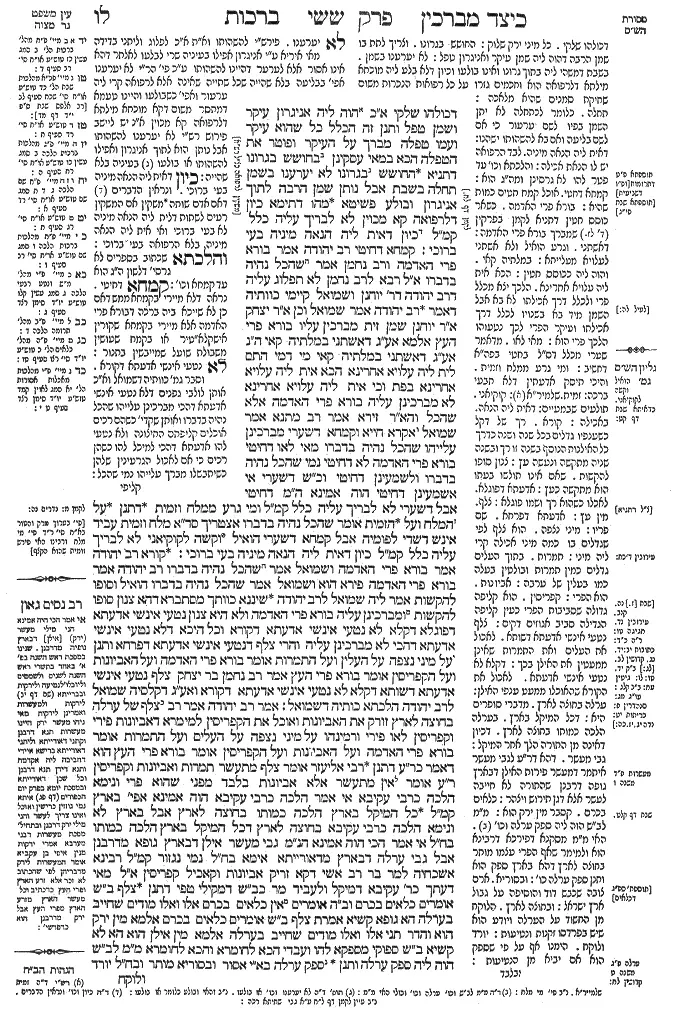
Berakhot 36a - Guemara
דכולהו שלקי אכ הוה ליה אניגרון עיקר ושמן טפל ותנן זה הכלל כל שהוא עיקר ועמו טפלה מברך על העיקר ופוטר את הטפלה הכא במאי עסקינן בחושש בגרונו דתניא החושש בגרונו לא יערענו בשמן תחלה בשבת אבל נותן שמן הרבה לתוך אניגרון ובולע פשיטא מהו דתימא כיון דלרפואה קא מכוין לא לבריך עליה כלל קמל כיון דאית ליה הנאה מיניה בעי ברוכי:
קמחא דחיטי רב יהודה אמר בורא פרי האדמה ורב נחמן אמר שהכל נהיה בדברו אל רבא לרב נחמן לא תפלוג עליה דרב יהודה דר' יוחנן ושמואל קיימי כוותיה דאמר רב יהודה אמר שמואל וכן אר יצחק אר יוחנן שמן זית מברכין עליו בורא פרי העץ אלמא אעג דאשתני במלתיה קאי הנ אעג דאשתני במלתיה קאי מי דמי התם לית ליה עלויא אחרינא הכא אית ליה עלויא אחרינא בפת וכי אית ליה עלויא אחרינא לא מברכינן עליה בורא פרי האדמה אלא שהכל והאר זירא אמר רב מתנא אמר שמואל אקרא חייא וקמחא דשערי מברכינן עלייהו שהכל נהיה בדברו מאי לאו דחיטי בורא פרי האדמה לא דחיטי נמי שהכל נהיה בדברו ולשמעינן דחיטי וכש דשערי אי אשמעינן דחיטי הוה אמינא המ דחיטי אבל דשערי לא לבריך עליה כלל קמל ומי גרע ממלח וזמית דתנן על המלח ועל הזמית אומר שהכל נהיה בדברו אצטריך סדא מלח וזמית עביד אינש דשדי לפומיה אבל קמחא דשערי הואיל וקשה לקוקיאני לא לבריך עליה כלל קמל כיון דאית ליה הנאה מיניה בעי ברוכי:
קורא רב יהודה אמר בורא פרי האדמה ושמואל אמר שהכל נהיה בדברו רב יהודה אמר בורא פרי האדמה פירא הוא ושמואל אמר שהכל נהיה בדברו הואיל וסופו להקשות אמר ליה שמואל לרב יהודה שיננא כוותך מסתברא דהא צנון סופו להקשות ומברכינן עליה בורא פרי האדמה ולא היא צנון נטעי אינשי אדעתא דפוגלא דקלא לא נטעי אינשי אדעתא דקורא וכל היכא דלא נטעי אינשי אדעתא דהכי לא מברכינן עליה והרי צלף דנטעי אינשי אדעתא דפרחא ותנן על מיני נצפה על העלין ועל התמרות אומר בורא פרי האדמה ועל האביונות ועל הקפריסין אומר בורא פרי העץ אמר רב נחמן בר יצחק צלף נטעי אינשי אדעתא דשותא דקלא לא נטעי אינשי אדעתא דקורא ואעג דקלסיה שמואל לרב יהודה הלכתא כותיה דשמואל:
אמר רב יהודה אמר רב צלף של ערלה בחוצה לארץ זורק את האביונות ואוכל את הקפריסין למימרא דאביונות פירי וקפריסין לאו פירי ורמינהו על מיני נצפה על העלים ועל התמרות אומר בורא פרי האדמה ועל האביונות ועל הקפריסין אומר בורא פרי העץ הוא דאמר כרע דתנן רבי אליעזר אומר צלף מתעשר תמרות ואביונות וקפריסין רע אומר אין מתעשר אלא אביונות בלבד מפני שהוא פרי ונימא הלכה כרבי עקיבא אי אמר הלכה כרבי עקיבא הוה אמינא אפי' בארץ קמל כל המיקל בארץ הלכה כמותו בחוצה לארץ אבל בארץ לא ונימא הלכה כרבי עקיבא בחוצה לארץ דכל המיקל בארץ הלכה כמותו בחל אי אמר הכי הוה אמינא הנמ גבי מעשר אילן דבארץ גופא מדרבנן אבל גבי ערלה דבארץ מדאורייתא אימא בחל נמי נגזור קמל רבינא אשכחיה למר בר רב אשי דקא זריק אביונות וקאכיל קפריסין אל מאי דעתך כר' עקיבא דמיקל ולעביד מר כבש דמקילי טפי דתנן צלף בש אומרים כלאים בכרם ובה אומרים אין כלאים בכרם אלו ואלו מודים שחייב בערלה הא גופא קשיא אמרת צלף בש אומרים כלאים בכרם אלמא מין ירק הוא והדר תני אלו ואלו מודים שחייב בערלה אלמא מין אילן הוא הא לא קשיא בש ספוקי מספקא להו ועבדי הכא לחומרא והכא לחומרא ממ לבש הוה ליה ספק ערלה ותנן ספק ערלה באי אסור ובסוריא מותר ובחל יורד
Comments from Rashi on Masechet Berakhot Page 36a
דכולהו שלקי . כל מיני ירק שלוק: החושש בגרונו . וצריך לתת בו שמן הרבה דהוה ליה שמן עיקר ואניגרון טפל: לא יערענו בשמן . בשבת דמשהי ליה בתוך גרונו ואינו בולעו וכיון דלא בלע ליה מוכחא מילתא דלרפואה הוא וחכמים גזרו על כל רפואות הנכרות משום שחיקת סמנים שהיא מלאכה: תחלה . כלומר לכתחלה לא יתן השמן בפיו לשם ערעור כי אם לשם בליעה ואם בא להשהותו ישהנו: דאית ליה הנאה מיניה . לבד הרפואה יש לו הנאת אכילה: והלכתא וכו' עד פטר להו לא גרסינן ומה"ג הוא: קמחא דחטי . אוכל קמח חטים כמות שהיא: בורא פרי האדמה . כשאר כוסס חטין דתניא לקמן בפרקין (ברכות ד' לז.) שמברך בורא פרי האדמה: דאשתני . וגרע הואיל ולא אשתני לעלויא מעלייתא: במלתיה קאי . והוה ליה ככוסס חטין: הכא אית ליה עילויא אחרינא . הלכך יצא מכלל פרי ולכלל דרך אכילתו לא בא אבל השמן מיד בא בשנויו לכלל דרך אכילתו ועיקר הפרי לכך נטעוהו הלכך פרי הוא: מאי לאו . מדאמר שערי מכלל דס"ל בחטי בפה"א דחשיב: ומי גרע ממלח וזמית . והיכי תיסק אדעתין דלא תבעי ברכה: זמית . שלמיר"א: קוקיאני . תולעים שבמעיים: דאית ליה הנאה . באכילה: קורא . רך של דקל כשענפיו גדלים בכל שנה ושנה כדרך כל האילנות הנוסף בשנה זו רך ובשנה שניה מתקשה ונעשה עץ: צנון סופו להקשות . שאם אינו תולשו בעתו הוא מתקשה כעץ: אדעתא דפוגלא . לאכלו כשהוא רך ושמו פוגלא: צלף . מין עץ: אדעתא דפרחא . שם פריו: מיני נצפה . הוא צלף לפי שגדלים בו כמה מיני אכילה קרי ליה מיני: תמרות . בתוך העלים גדלים כמין תמרות ובולטין בעלה כמו בעלין של ערבה: אביונות . הוא הפרי: קפריסין . הוא קליפה גדולה שסביבות הפרי כעין קליפה הגדילה סביב אגוזים דקים: צלף נטעי אינשי אדעתא דשותא . לאכול את העלים ואת התמרות שאינן ממעטין את האילן בכך: דקלא לא נטעי אינשי אדעתא . לאכול את הקורא שהאוכלו ממעט ענפי האילן: והלכתא וכו' . עד פטר להו לא גרסינן ומה"ג הוא: ערלה בחוצה לארץ . מדברי סופרים היא: דכל המיקל בארץ . בערלה הלכה כמותו בחוצה לארץ. דכיון דאינה מן התורה הלך אחר המיקל: גבי מעשר . דהא דר"ע לגבי מעשר איתמר דמעשר פירות האילן דבארץ גופה דרבנן שהתורה לא חייבה לעשר אלא דגן תירוש ויצהר: כלאים בכרם . קסבר מין ירק הוא: מ"מ לב"ש הוה ליה ספק ערלה וכו' . האי מ"מ מסקנא דפירכא דרבינא הוא ולמימר שאף הפרי עצמו מותר בחוצה לארץ דהא בארץ ספק הוא ותנן ספק ערלה כו': ובסוריא . ארם צובה שכבש דוד והוסיפה על גבול ארץ ישראל: ובחוצה לארץ . הלוקח מן החשוד על הערלה ויודע הוא שיש בפרדסו זקנות ונטיעות: יורד ולוקח . הימנו אף על פי שספק הוא אם יביא מן הנטיעות:
Comments from Tosafot - Berakhot 36a
לא יערענו . פירש"י להשהותו וא"ת א"כ לפלוג וליתני בדידה מאי איריא ע"י אניגרון אפילו בעיניה שרי לבלעו לאלתר דהא אינו אסור אלא לערער דהיינו להשהותו ע"כ פי' הר"י לא יערענו אפי' בבליעה בלא שהייה שכל שתייה שאינה אלא לרפואה קרי ליה ערעור ואפי' כשבולעו והיינו טעמא דמתסר משום דקא מוכחא מילתא דלרפואה קא מכוין א"נ יש ליישב פירוש רש"י לא יערענו להשהותו אבל נותן הוא לתוך אניגרון ואפילו להשהותו או בולעו בעיניה בלא שהייה: כיון דאית ליה הנאה מיניה בעי ברוכי . ונראין הדברים דאם אדם שותה משקין אם המשקין רעים לשתות דלית ליה הנאה מיניה לא בעי ברוכי ואי אית ליה הנאה מיניה בלא הרפואה בעי ברוכי: והלכתא שכתוב בספרים לא גרסי' דלשון ה"ג הוא עד קמחא וכו': קמחא דחיטי . נראה דלא מיירי בקמחא ממש דאם כן לא שייכא ביה ברכה דבורא פרי האדמה אלא מיירי בקמחא שקורין אישקלא"טיר או בקמח שעושין משבולת שועל שמייבשין בתנור: לא נטעי אינשי אדעתא דקורא . וסבר גמ' כוותיה דשמואל וא"כ אותן לולבי גפנים דלא נטעי אינשי אדעתא דהכי מברכינן עלייהו שהכל נהיה בדברו ואותן שקדי' כשהם רכים אוכלים קליפתם החיצונה ולא נטעי להו אדעתא דהכי למיכל להו כשהן רכים כי אם לאכול הגרעינין שלהן כשיתבשלו מברך עלייהו נמי שהכל:
Berakhot 36a - Mishnah translated into english
in which all boiled vegetables were boiled. A certain amount of oil is added to anigeron.
However, if so, here too, anigeron is primary and oil is secondary, and we learned in a mishna: This is the principle: Any food that is primary, and it is eaten with food that is secondary, one recites a blessing over the primary food, and that blessing exempts the secondary from the requirement to recite a blessing before eating it. One need recite a blessing only over the anigeron.
The Gemara reconciles: With what are we dealing here? With one who has a sore throat, which he is treating with oil. As it was taught in a baraita: One who has a sore throat should not, ab initio, gargle oil on Shabbat for medicinal purposes, as doing so would violate the decree prohibiting the use of medicine on Shabbat. However, he may, even ab initio, add a large amount of oil to the anigeron and swallow it. Since it is common practice to swallow oil either alone or with a secondary ingredient like anigeron for medicinal purposes, in this case one recites: Who creates fruit of the tree.
The Gemara challenges: This is obvious that one must recite a blessing. The Gemara responds: Lest you say: Since he intends to use it for medicinal purposes, let him not recite a blessing over it at all, as one does not recite a blessing before taking medicine. Therefore, it teaches us that, since he derived pleasure from it, he must recite a blessing over it.
The Gemara clarifies: If one was eating plain wheat flour, what blessing would he recite? Rav Yehuda said that one recites: Who creates fruit of the ground, and Rav Naḥman said that one recites: By Whose word all things came to be.
Rava said to Rav Naḥman: Do not disagree with Rav Yehuda, as Rabbi Yoḥanan and Shmuel hold in accordance with his opinion, even though they addressed another topic. As Rav Yehuda said that Shmuel said, and so too Rabbi Yitzḥak said that Rabbi Yoḥanan said: One recites the blessing: Who creates fruit of the tree, over olive oil. Consequently, even though the olive has changed into olive oil, the formula of the blessing remains as it was. This too, even though the wheat has changed into flour, its blessing remains as it was: Who creates fruit of the ground.
The Gemara responds: Is it comparable? There, the olive oil has no potential for additional enhancement, while here, the flour has the potential for additional enhancement as bread. Since oil is the olive’s finished product, one should recite the same blessing over it as over the tree itself. Wheat flour, on the other hand, is used to bake bread, so the flour is a raw material for which neither the blessing over wheat nor the blessing over bread is appropriate. Only the blessing: By Whose word all things came to be is appropriate.
The Gemara asks: When it has a potential for additional enhancement, one does not recite: Who creates fruit of the ground; rather one recites: By Whose word all things came to be? Didn’t Rabbi Zeira say that Rav Mattana said that Shmuel said: Over a raw gourd and over barley flour, one recites the blessing: By Whose word all things came to be. What, is that not to say that over wheat flour one recites: Who creates fruit of the ground? Over barley flour, which people do not typically eat, it is appropriate to recite: By Whose word all things came to be. Over wheat flour, it is appropriate to recite: Who creates fruit of the ground.
This argument is rejected: No, one also recites: By Whose word all things came to be, over wheat flour.
The Gemara asks: Then let the Sages teach us that this halakha applies with regard to wheat flour, and all the more so regarding barley flour as well.
The Gemara responds: It was necessary to teach us that one must recite a blessing even before eating barley flour. Had the Sages taught us this halakha with regard to wheat, I would have said: This applies only with regard to wheat flour, but over barley flour, let one not recite a blessing at all. Therefore, it teaches us that one recites a blessing over barley flour.
The Gemara challenges this explanation. How could one have considered that possibility? Is it inferior to salt and salt water [zamit]? As we learned in a mishna that over salt and salt water one recites: By Whose word all things came to be, and all the more so it should be recited over barley flour. This question is rejected: Nevertheless, it was necessary to teach the halakha regarding barley flour, as it might enter your mind to say: Although one occasionally places salt or salt water into his mouth, barley flour, which is damaging to one who eats it and causes intestinal worms, let one recite no blessing over it at all. Therefore, it teaches us, since one derives pleasure from it, he must recite a blessing.
Another dispute over the appropriate blessing is with regard to the heart of palm [kura], which is a thin membrane covering young palm branches that was often eaten. Rav Yehuda said that one should recite: Who creates fruit of the ground. And Shmuel, Rav Yehuda’s teacher, said that one should recite: By Whose word all things came to be.
Rav Yehuda said: Who creates fruit of the ground; it is a fruit. And Shmuel said: By Whose word all things came to be, since it will ultimately harden and it is considered part of the tree, not a fruit.
Shmuel said to Rav Yehuda: Shinnana. It is reasonable to rule in accordance with your opinion, as a radish ultimately hardens if left in the ground; nevertheless, one who eats it while it is soft recites over it: Who creates fruit of the ground. In any case, despite this praise, the Gemara states: That is not so; people plant a radish with the soft radish in mind. However, people do not plant palm trees with the heart of palm in mind and therefore it cannot be considered a fruit.
In response to this, the Gemara asks: And whenever people do not plant with that result in mind, one does not recite a blessing over it? What of the caper-bush that people plant with their fruit in mind, and we learned in a mishna that with regard to the parts of the caper-bush [nitzpa], over the leaves and young fronds, one recites: Who creates fruit of the ground, and over the berries and buds he recites: Who creates fruit of the tree. This indicates that even over leaves and various other parts of the tree that are secondary to the fruit, the blessing is: Who creates fruit of the ground, and not: By Whose word all things came to be.
Rav Naḥman bar Yitzḥak said that there is still a difference: Caper-bushes, people plant them with their leaves in mind; palm trees, people do not plant them with the heart of palm in mind. Therefore, no proof may be brought from the halakha in the case of the caper-bush to the halakha in the case of the of the palm. The Gemara concludes: Although Shmuel praised Rav Yehuda, the halakha is in accordance with the opinion of Shmuel.
Incidental to this discussion, the Gemara cites an additional halakha concerning the caper-bush. Rav Yehuda said that Rav said: A caper-bush during the first three years of its growth [orla] outside of Eretz Yisrael, when its fruits are prohibited by rabbinic and not Torah law, one throws out the berries, the primary fruit, but eats the buds. The Gemara raises the question: Is that to say that the berries are fruit of the caper, and the bud is not fruit? The Gemara raises a contradiction from what we learned in the mishna cited above: With regard to the parts of the caper-bush [nitzpa], over the leaves and young fronds, one recites: Who creates fruit of the ground, and over the berries, and buds he recites: Who creates fruit of the tree. Obviously, the buds are also considered the fruit of the caper-bush.
The Gemara responds: Rav’s statement is in accordance with the opinion of Rabbi Akiva, as we learned in a mishna that Rabbi Eliezer says: A caper-bush is tithed from its component parts, its young fronds, berries and buds, as all these are considered its fruit. And Rabbi Akiva says: Only the berries alone are tithed, because it alone is considered fruit. It was in accordance with this opinion, that Rav prohibited only the eating of the berries during the caper-bush’s years of orla.
The Gemara asks: If this is the case, why did Rav issue what seemed to be an independent ruling regarding orla? He should have simply said: The halakha is in accordance with the opinion of Rabbi Akiva, from which we could have drawn a practical halakhic conclusion regarding orla as well. The Gemara responds: Had Rav said: The halakha is in accordance with the opinion of Rabbi Akiva, I would have said that the halakha is in accordance with his opinion even in Eretz Yisrael. Therefore, he teaches us by stating the entire halakha, that there is a principle: Anyone who is lenient in a dispute with regard to the halakhot of orla in Eretz Yisrael, the halakha is in accordance with his opinion outside of Eretz Yisrael, but not in Eretz Yisrael.
The Gemara questions this: If so, then let Rav say: The halakha is in accordance with the opinion of Rabbi Akiva outside of Eretz Yisrael as anyone who is lenient in a dispute with regard to the halakhot of orla in Eretz Yisrael, the halakha is in accordance with his opinion outside of Eretz Yisrael. The Gemara answers: Had he said that, I would have said: That only applies with regard to the tithing of trees, which even in Eretz Yisrael itself is an obligation by rabbinic law; but with regard to orla, which is prohibited in Eretz Yisrael by Torah law, say that we should issue a decree prohibiting orla even outside of Eretz Yisrael. Therefore, he teaches us that even with regard to orla, the halakha is in accordance with the opinion of Rabbi Akiva.
On this topic, the Gemara relates: Ravina found Mar bar Rav Ashi throwing away the berries and eating the buds of an orla caper-bush. Ravina said to Mar bar Rav Ashi: What is your opinion, that you are eating the buds? If it is in accordance with the opinion of Rabbi Akiva, who is lenient, then you should act in accordance with the opinion of Beit Shammai, who are even more lenient. As we learned in a mishna with regard to the laws of forbidden mixtures of diverse kinds that Beit Shammai say: A caper-bush is considered a diverse kind in the vineyard, as it is included in the prohibition against planting vegetables in a vineyard. Beit Hillel say: A caper-bush is not considered a diverse kind in a vineyard. Nevertheless, these and those, Beit Shammai and Beit Hillel, agree that the caper-bush is obligated in the prohibition of orla.
Before dealing with the problem posed by Ravina to Mar bar Rav Ashi, the Gemara notes an internal contradiction in this mishna. This mishna itself is problematic: You said that Beit Shammai say: A caper-bush is considered a diverse kind in a vineyard; apparently, they hold that it is a type of vegetable bush, and then you taught: These and those, Beit Shammai and Beit Hillel, agree that the caper-bush is obligated in the prohibition of orla; apparently, it is a type of tree.
The Gemara responds: This is not difficult; Beit Shammai are uncertain whether the caper-bush is a vegetable bush or a tree, and here, regarding diverse kinds, they act stringently and here, regarding orla, they act stringently. In any case, according to Beit Shammai the caper-bush has the status of uncertain orla, and we learned the consensus halakha in a mishna: Uncertain orla in Eretz Yisrael is forbidden to eat, and in Syria it is permitted, and we are not concerned about its uncertain status. Outside of Eretz Yisrael, the gentile owner of a field may go down into his field
Traduction : The William Davidson digital edition of the Koren Noé Talmud, with commentary by Rabbi Adin Even-Israel Steinsaltz.