 Talmud Bavli
Berakhot 28a : Youtube
Daf TubeYoutube
2 video classes :
Berakhot Page 28a
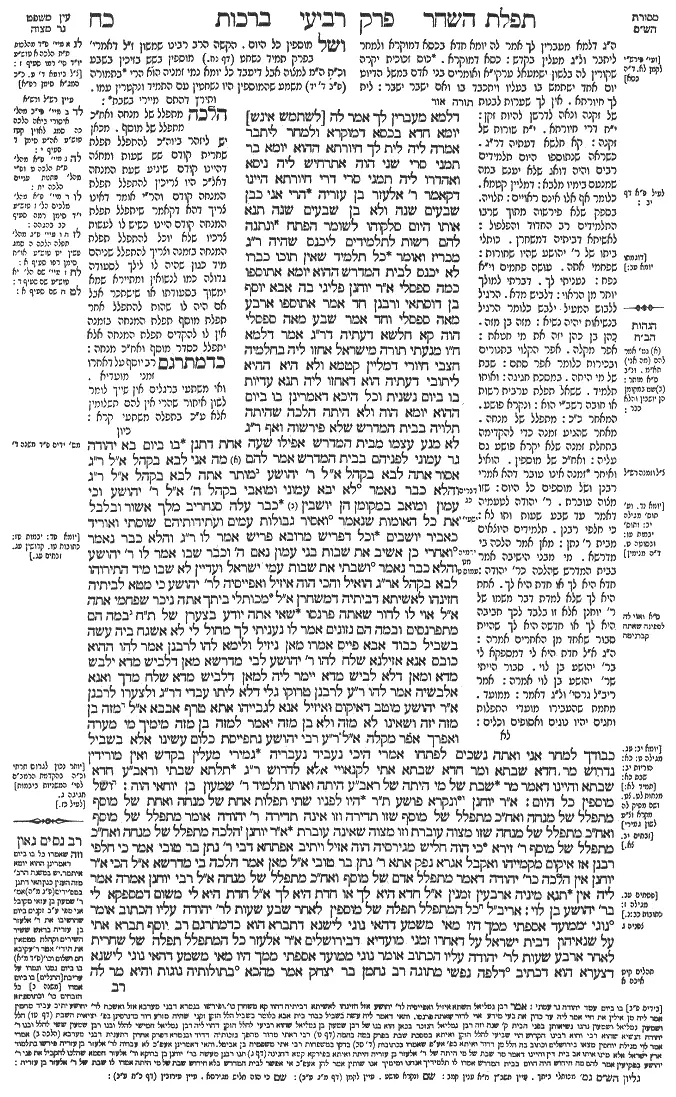
Berakhot 28a - Guemara
דלמא מעברין לך אמר לה [לשתמש אינש] יומא חדא בכסא דמוקרא ולמחר ליתבר אמרה ליה לית לך חיורתא ההוא יומא בר תמני סרי שני הוה אתרחיש ליה ניסא ואהדרו ליה תמני סרי דרי חיורתא היינו דקאמר ר' אלעזר בן עזריה הרי אני כבן שבעים שנה ולא בן שבעים שנה תנא אותו היום סלקוהו לשומר הפתח ונתנה להם רשות לתלמידים ליכנס שהיה רג מכריז ואומר כל תלמיד שאין תוכו כברו לא יכנס לבית המדרש ההוא יומא אתוספו כמה ספסלי אר יוחנן פליגי בה אבא יוסף בן דוסתאי ורבנן חד אמר אתוספו ארבע מאה ספסלי וחד אמר שבע מאה ספסלי הוה קא חלשא דעתיה דרג אמר דלמא חו מנעתי תורה מישראל אחזו ליה בחלמיה חצבי חיורי דמליין קטמא ולא היא ההיא ליתובי דעתיה הוא דאחזו ליה תנא עדיות בו ביום נשנית וכל היכא דאמרינן בו ביום ההוא יומא הוה ולא היתה הלכה שהיתה תלויה בבית המדרש שלא פירשוה ואף רג לא מנע עצמו מבית המדרש אפילו שעה אחת דתנן בו ביום בא יהודה גר עמוני לפניהם בבית המדרש אמר להם מה אני לבא בקהל אל רג אסור אתה לבא בקהל אל ר' יהושע מותר אתה לבא בקהל אל רג והלא כבר נאמר (דברים כג ד) לא יבא עמוני ומואבי בקהל ה' אל ר' יהושע וכי עמון ומואב במקומן הן יושבין כבר עלה סנחריב מלך אשור ובלבל את כל האומות שנאמר (ישעיהו י יג) ואסיר גבולות עמים ועתידותיהם שוסתי ואוריד כאביר יושבים וכל דפריש מרובא פריש אמר לו רג והלא כבר נאמר (ירמיהו מט ו) ואחרי כן אשיב את שבות בני עמון נאם ה' וכבר שבו אמר לו ר' יהושע והלא כבר נאמר (עמוס ט יד) ושבתי את שבות עמי ישראל ועדיין לא שבו מיד התירוהו לבא בקהל ארג הואיל והכי הוה איזיל ואפייסיה לר' יהושע כי מטא לביתיה חזינהו לאשיתא דביתיה דמשחרן אל מכותלי ביתך אתה ניכר שפחמי אתה אל אוי לו לדור שאתה פרנסו שאי אתה יודע בצערן של תח במה הם מתפרנסים ובמה הם נזונים אמר לו נעניתי לך מחול לי לא אשגח ביה עשה בשביל כבוד אבא פייס אמרו מאן ניזיל ולימא להו לרבנן אמר להו ההוא כובס אנא אזילנא שלח להו ר' יהושע לבי מדרשא מאן דלביש מדא ילבש מדא ומאן דלא לביש מדא יימר ליה למאן דלביש מדא שלח מדך ואנא אלבשיה אמר להו רע לרבנן טרוקו גלי דלא ליתו עבדי דרג ולצערו לרבנן אר יהושע מוטב דאיקום ואיזיל אנא לגבייהו אתא טרף אבבא אל מזה בן מזה יזה ושאינו לא מזה ולא בן מזה יאמר למזה בן מזה מימיך מי מערה ואפרך אפר מקלה אל רע רבי יהושע נתפייסת כלום עשינו אלא בשביל כבודך למחר אני ואתה נשכים לפתחו אמרי היכי נעביד נעבריה גמירי מעלין בקדש ואין מורידין נדרוש מר חדא שבתא ומר חדא שבתא אתי לקנאויי אלא לדרוש רג תלתא שבתי וראבע חדא שבתא והיינו דאמר מר שבת של מי היתה של ראבע היתה ואותו תלמיד ר' שמעון בן יוחאי הוה:
ושל מוספין כל היום:
אר יוחנן ונקרא פושע תר היו לפניו שתי תפלות אחת של מנחה ואחת של מוסף מתפלל של מנחה ואחכ מתפלל של מוסף שזו תדירה וזו אינה תדירה ר' יהודה אומר מתפלל של מוסף ואחכ מתפלל של מנחה שזו מצוה עוברת וזו מצוה שאינה עוברת אר יוחנן הלכה מתפלל של מנחה ואחכ מתפלל של מוסף ר' זירא כי הוה חליש מגירסיה הוה אזיל ויתיב אפתחא דבי ר' נתן בר טובי אמר כי חלפי רבנן אז איקום מקמייהו ואקבל אגרא נפק אתא ר' נתן בר טובי אל מאן אמר הלכה בי מדרשא אל הכי אר יוחנן אין הלכה כר' יהודה דאמר מתפלל אדם של מוסף ואחכ מתפלל של מנחה אל רבי יוחנן אמרה אמר ליה אין תנא מיניה ארבעין זמנין אל חדא היא לך או חדת היא לך אל חדת היא לי משום דמספקא לי בר' יהושע בן לוי:
אריבל כל המתפלל תפלה של מוספין לאחר שבע שעות לר' יהודה עליו הכתוב אומר (צפניה ג יח) נוגי ממועד אספתי ממך היו מאי משמע דהאי נוגי לישנא דתברא הוא כדמתרגם רב יוסף תברא אתי על שנאיהון דבית ישראל על דאחרו זמני מועדיא דבירושלים אר אלעזר כל המתפלל תפלה של שחרית לאחר ארבע שעות לר' יהודה עליו הכתוב אומר נוגי ממועד אספתי ממך היו מאי משמע דהאי נוגי לישנא דצערא הוא דכתיב (תהלים קיט כח) דלפה נפשי מתוגה רב נחמן בר יצחק אמר מהכא (איכה א ד) בתולותיה נוגות והיא מר לה
Comments from Rashi on Masechet Berakhot Page 28a
מעברין לך . יורידוך מן הנשיאות בשביל אחר: ה"ג דלמא מעברין לך אמר לה יומא חדא בכסא דמוקרא ולמחר ליתבר ול"ג מעלין בקדש: כסא דמוקרא . כוס זכוכית יקרה שקורין לה בלשון ישמעאל ערקי"א ואומרים בני אדם במשל הדיוט יום אחד ישתמש בו בעליו ויתכבד בו ואם ישבר ישבר: לית לך חיורתא . אין לך שערות לבנות של זקנה ונאה לדרשן להיות זקן: י"ח דרי חיורתא . י"ח שורות של זקנה: קא חלשא דעתיה דר"ג . כשראה שנתוספו היום תלמידים רבים והיה דואג שלא יענש במה שמנעם בימיו מלבא: דמליין קטמא . כלומר אף אלו אינם ראויים: תלויה . בספק שלא פירשוה מתוך שרבו התלמידים רב החדוד והפלפול: לאשיתא דביתיה דמשחרן . כותלי ביתו של ר' יהושע שהיו שחורות: שפחמי אתה . עושה פחמים וי"א נפח: נעניתי לך . דברתי למולך יותר מן הראוי: ולואי . שיהא כמורא בשר ודם שאם כן תחדלו מעבירות הרבה: דלביש מדא . הרגיל ללבוש המעיל ילבש כלומר הרגיל בנשיאות יהיה נשיא: מזה בן מזה . כהן בן כהן יזה את מי חטאת: אפר מקלה . אפר הקלוי בתנורים ובכירות כלומר אפר סתם: שבת של מי היתה . במסכת חגיגה: ואותו תלמיד . ששאל תפלת ערבית רשות או חובה רשב"י הוא: ונקרא פושע . המאחר כ"כ: מתפלל של מנחה . מאחר שהגיע זמנה כדי להקדימה בתחלת זמנה שלא יקרא פושע גם עליה: ואח"כ של מוספין . הואיל ואיחר זמנה אינו עובר דהא אמרי רבנן ושל מוספים כל היום: שזו מצוה עוברת . ר' יהודה לטעמיה דאמר עד שבע שעות ותו לא: כי חלפי רבנן . תלמידים היוצאים מבית ר' נתן: מאן אמר הלכה בי מדרשא . מי מבני הישיבה אמר בבית המדרש שהלכה כר' יהודה: חדא היא לך או חדת היא לך . אחת היא לך שלא למדת דבר משמו של ר' יוחנן אלא זו בלבד לכך חביבה היא לך או חדשה היא לך שהיית סבור שאחד מן האחרים אמרה: ה"ג א"ל חדת היא לי דמספקא לי בר' יהושע בן לוי . סבור הייתי שרבי יהושע בן לוי אמרה: אמר ריב"ל גרסי' ול"ג דאמר: ממועד . מחמת שהעבירו מועדי התפלות וחגים יהיו נוגים ואסופים וכלים:
Comments from Tosafot - Berakhot 28a
ושל מוספין כל היום . הקשה הרב רבינו שמשון ז"ל דאמרי' בפרק תמיד נשחט (דף נח.) מוספין בשש בזיכין בשבע וכ"ת ה"מ למצוה אבל דיעבד כל יומא נמי זמניה הוא הרי בתמורה (פ"ב ד' יד) משמע שהמוספין היו נשחטין עם התמיד ונקטרין עמו. ותירץ דהתם מיירי בשבת: הלכה מתפלל של מנחה ואח"כ מתפלל של מוסף . מכאן יש ליזהר ביוה"כ להתפלל תפלת שחרית קודם שש שעות ומחצה דהיינו קודם שיגיע שעת המנחה דאל"כ היו צריכין להתפלל תפלת המנחה קודם והר"י אומר דאינו צריך דהא דקאמר שיתפלל תפלת המנחה קודם היינו כשיש לו לעשות צרכיו שלא יוכל להתפלל תפלת המנחה בזמנה וצריך להתפלל שניהם מיד כגון שהיה לו לילך לסעודה גדולה כמו לנשואין ומתיירא שמא ימשוך בסעודתו או שישתכר אבל אם היה לו שהות להתפלל אחר תפלת מוסף תפלת המנחה בזמנה אין לו להקדים תפלת המנחה אלא יתפלל כסדר מוסף ואח"כ מנחה: כדמתרגם רב יוסף על דאחרו זמני מועדיא . ואי משתעי ברגלים אין שייך לומר לשון איחור שהרי אין להם תשלומין אלא ע"כ בתפלה משתעי קרא:
Berakhot 28a - Mishnah translated into english
There is room for concern. Perhaps they will remove you from office just as they removed Rabban Gamliel. He said to her, based on the folk saying: Let a person use an expensive goblet one day and let it break tomorrow. In other words, one should take advantage of an opportunity that presents itself and he need not concern himself whether or not it will last. She said to him: You have no white hair, and it is inappropriate for one so young to head the Sages. The Gemara relates: That day, he was eighteen years old, a miracle transpired for him and eighteen rows of hair turned white. The Gemara comments: That explains that which Rabbi Elazar ben Azarya said: I am as one who is seventy years old and he did not say: I am seventy years old, because he looked older than he actually was.
It was taught: On that day that they removed Rabban Gamliel from his position and appointed Rabbi Elazar ben Azarya in his place, there was also a fundamental change in the general approach of the study hall as they dismissed the guard at the door and permission was granted to the students to enter. Instead of Rabban Gamliel’s selective approach that asserted that the students must be screened before accepting them into the study hall, the new approach asserted that anyone who seeks to study should be given opportunity to do so. As Rabban Gamliel would proclaim and say: Any student whose inside, his thoughts and feelings, are not like his outside, i.e., his conduct and his character traits are lacking, will not enter the study hall.
The Gemara relates: On that day several benches were added to the study hall to accommodate the numerous students. Rabbi Yoḥanan said: Abba Yosef ben Dostai and the Rabbis disputed this matter. One said: Four hundred benches were added to the study hall. And one said: Seven hundred benches were added to the study hall. When he saw the tremendous growth in the number of students, Rabban Gamliel was disheartened. He said: Perhaps, Heaven forbid, I prevented Israel from engaging in Torah study. They showed him in his dream white jugs filled with ashes alluding to the fact that the additional students were worthless idlers. The Gemara comments: That is not the case, but that dream was shown to him to ease his mind so that he would not feel bad.
It was taught: There is a tradition that tractate Eduyyot was taught that day. And everywhere in the Mishna or in a baraita that they say: On that day, it is referring to that day. There was no halakha whose ruling was pending in the study hall that they did not explain and arrive at a practical halakhic conclusion. And even Rabban Gamliel did not avoid the study hall for even one moment, as he held no grudge against those who removed him from office and he participated in the halakhic discourse in the study hall as one of the Sages.
As we learned in a mishna: On that day, Yehuda, the Ammonite convert, came before the students in the study hall and he said to them: What is my legal status in terms of entering into the congregation of Israel, i.e., to marry a Jewish woman?
Rabban Gamliel said to him: You are forbidden to enter into the congregation. Rabbi Yehoshua said to him: You are permitted to enter into the congregation. Rabban Gamliel said to Rabbi Yehoshua: Wasn’t it already stated: “An Ammonite and a Moabite shall not enter into the congregation of the Lord; even to the tenth generation shall none of them enter into the congregation of the Lord forever” (Deuteronomy 23:4)? How can you permit him to enter the congregation? Rabbi Yehoshua said to Rabban Gamliel: Do Ammon and Moab reside in their place? Sennacherib already came and, through his policy of population transfer, scrambled all the nations and settled other nations in place of Ammon. Consequently, the current residents of Ammon and Moab are not ethnic Ammonites and Moabites, as it is stated in reference to Sennacherib: “I have removed the bounds of the peoples, and have robbed their treasures, and have brought down as one mighty the inhabitants” (Isaiah 10:13). And although it is conceivable that this particular convert is an ethnic Ammonite, nevertheless, there is no need for concern due to the halakhic principle: Anything that parts from a group parts from the majority, and the assumption is that he is from the majority of nations whose members are permitted to enter the congregation.
Rabban Gamliel said to Rabbi Yehoshua: But wasn’t it already stated: “But afterward I will bring back the captivity of the children of Ammon, says the Lord” (Jeremiah 49:6) and they have already returned to their land? Therefore, he is an ethnic Ammonite and he may not convert.
Rabbi Yehoshua said to Rabban Gamliel: That is no proof. Wasn’t it already stated in another prophecy: “And I will turn the captivity of My people Israel and they shall build the waste cities, and inhabit them; and they shall plant vineyards, and drink the wine thereof; they shall also make gardens, and eat the fruit of them” (Amos 9:14), and they have not yet returned? In rendering the ruling, only proven facts may be taken into consideration. They immediately permitted him to enter the congregation. This proves that Rabban Gamliel did not absent himself from the study hall that day and participated in the halakhic discourse.
Rabban Gamliel said to himself: Since this is the situation, that the people are following Rabbi Yehoshua, apparently he was right. Therefore, it would be appropriate for me to go and appease Rabbi Yehoshua. When he reached Rabbi Yehoshua’s house, he saw that the walls of his house were black. Rabban Gamliel said to Rabbi Yehoshua in wonderment: From the walls of your house it is apparent that you are a blacksmith, as until then he had no idea that Rabbi Yehoshua was forced to engage in that arduous trade in order to make a living. Rabbi Yehoshua said to him: Woe unto a generation that you are its leader as you are unaware of the difficulties of Torah scholars, how they make a living and how they feed themselves.
Rabban Gamliel said to him: I insulted you, forgive me. Rabbi Yehoshua paid him no attention and did not forgive him. He asked him again: Do it in deference to my father, Rabban Shimon ben Gamliel, who was one of the leaders of Israel at the time of the destruction of the Temple. He was appeased.
Now that Rabbi Yehoshua was no longer offended, it was only natural that Rabban Gamliel would be restored to his position. They said: Who will go and inform the Sages? Apparently, they were not eager to carry out the mission that would undo the previous actions and remove Rabbi Elazar ben Azarya from his position as Nasi. This launderer said to them: I will go. Rabbi Yehoshua sent to the Sages to the study hall: The one who wears the uniform will continue to wear the uniform, the original Nasi will remain in his position so that the one who did not wear the uniform will not say to the one who wears the uniform, remove your uniform and I will wear it. Apparently, the Sages believed that this emissary was dispatched at the initiative of Rabban Gamliel and they ignored him. Rabbi Akiva said to the Sages: Lock the gates so that Rabban Gamliel’s servants will not come and disturb the Sages.
When he heard what happened, Rabbi Yehoshua said: It is best if I go to them. He came and knocked on the door. He said to them with a slight variation: One who sprinkles pure water on those who are ritually impure, son of one who sprinkles water shall continue to sprinkle water. And it is inappropriate that he who is neither one who sprinkles nor son of one who sprinkles will say to one who sprinkles son of one who sprinkles: Your water is cave water and not the running water required to purify one exposed to ritual impurity imparted by a corpse and your ashes are burnt ashes and not the ashes of a red heifer. Rabbi Akiva said to him: Rabbi Yehoshua, have you been appeased? Everything we did was to defend your honor. If you have forgiven him, none of us is opposed. Early tomorrow you and I will go to Rabban Gamliel’s doorway and offer to restore him to his position as Nasi.
The question arose what to do with Rabbi Elazar ben Azarya? They said: What shall we do? Remove him from his position. That is inappropriate as we learned a halakha through tradition: One elevates to a higher level of sanctity and does not downgrade. Therefore, one who was the Nasi of the Sanhedrin cannot be demoted. Let one Sage lecture one week and the other Sage one week, they will come to be jealous one of another, as they will be forced to appoint one as the acting head of the Sanhedrin. Rather, Rabban Gamliel will lecture three weeks and Rabbi Elazar ben Azarya will lecture as head of the yeshiva one week. That arrangement was adopted and that is the explanation of the exchange in tractate Ḥagiga: Whose week was it? It was the week of Rabbi Elazar ben Azarya. One final detail: That student who asked the original question that sparked this entire incident was Rabbi Shimon ben Yoḥai.
We learned in the mishna: And the additional prayer may be recited all day. Rabbi Yoḥanan said: Nevertheless, one who postpones his prayer excessively is called negligent.
The Rabbis taught in a baraita: If the obligation to recite two prayers was before him, one, the afternoon prayer and one, the additional prayer, he recites the afternoon prayer first and the additional prayer thereafter, because this, the afternoon prayer, is recited on a frequent basis, and this one, the additional prayer, is recited on a relatively infrequent basis. Rabbi Yehuda says: He recites the additional prayer first and the afternoon prayer thereafter, because this, the additional prayer, is a mitzva whose time soon elapses, as it may only be recited until the seventh hour and this, the afternoon prayer, is a mitzva whose time does not soon elapse as one may recite it until the midpoint of the afternoon. Rabbi Yoḥanan said: The halakha is that he recites the afternoon prayer first and the additional prayer thereafter, in accordance with the opinion of the Rabbis.
The Gemara cites additional sources relating to this issue: When Rabbi Zeira would tire of his studies, he would go and sit in the doorway of Rabbi Natan bar Tovi’s study hall. He said to himself: When the entering and exiting Sages pass, I will rise before them and be rewarded for the mitzva of honoring Torah scholars. Rabbi Natan bar Tovi himself emerged and came to where Rabbi Zeira was seated. Rabbi Zeira said to him: Who just stated a halakha in the study hall? Rabbi Natan bar Tovi said to him: Rabbi Yoḥanan just said as follows: The halakha is not in accordance with the opinion of Rabbi Yehuda who said: He recites the additional prayer first and the afternoon prayer thereafter.
Rabbi Zeira said to him: Did Rabbi Yoḥanan himself say this halakha? Rabbi Natan said to him: Yes. He learned this statement from him forty times, etching it into his memory. Rabbi Natan said to him: Is this halakha so dear to you because it is singular for you, as it is the only halakha that you learned in the name of Rabbi Yoḥanan, or is it new to you, as you were previously unaware of this ruling? Rabbi Zeira said to him: It is somewhat new to me, as I was uncertain whether this halakha was said in the name of Rabbi Yoḥanan or in the name of Rabbi Yehoshua ben Levi. Now it is clear to me that this halakha is in the name of Rabbi Yoḥanan.
Rabbi Yehoshua ben Levi said: With regard to anyone who recites the additional prayer after seven hours of the day, according to Rabbi Yehuda, the verse states: “Those who are destroyed [nugei] far from the Festivals, I shall gather from you, they who carried for you the burden of insult” (Zephaniah 3:18). From where may it be inferred that nugei is an expression of destruction? As Rav Yosef translated the verse into Aramaic: Destruction comes upon the enemies of the house of Israel, a euphemism for Israel itself, for they have delayed the times of the Festivals in Jerusalem. This proves both that nugei means destruction and that destruction comes upon those who fail to fulfill a mitzva at its appointed time.
Similarly, Rabbi Elazar said: Regarding anyone who recites the morning prayer after four hours of the day, according to Rabbi Yehuda, the verse states: “Those who are in sorrow [nugei] far from the Festivals, I shall gather from you, they who carried for you the burden of insult” (Zephaniah 3:18). From where may it be inferred that nugei is an expression of sorrow? As it is written: “My soul drips in sorrow [tuga]” (Psalms 119:28). Rav Naḥman bar Yitzḥak said: The proof that nugei indicates suffering is from here: “Her virgins are sorrowed [nugot] and she is embittered” (Lamentations 1:4).
Traduction : The William Davidson digital edition of the Koren Noé Talmud, with commentary by Rabbi Adin Even-Israel Steinsaltz.