 Talmud Bavli
Berakhot 51a : Youtube
Daf TubeYoutube
2 video classes :
Berakhot Page 51a
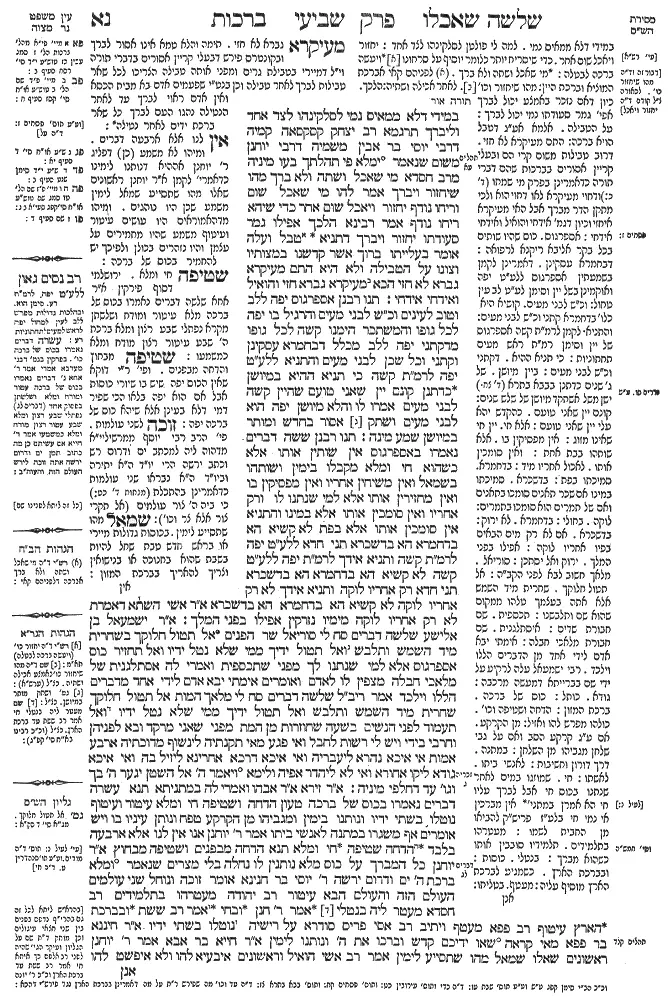
Berakhot 51a - Guemara
במידי דלא ממאיס נמי לסלקינהו לצד אחד וליברך תרגמא רב יצחק קסקסאה קמיה דרבי יוסי בר אבין משמיה דרבי יוחנן משום שנאמר (תהלים עא ח) ימלא פי תהלתך בעו מיניה מרב חסדא מי שאכל ושתה ולא ברך מהו שיחזור ויברך אמר להו מי שאכל שום וריחו נודף יחזור ויאכל שום אחר כדי שיהא ריחו נודף אמר רבינא הלכך אפילו גמר סעודתו יחזור ויברך דתניא טבל ועלה אומר בעלייתו ברוך אשר קדשנו במצותיו וצונו על הטבילה ולא היא התם מעיקרא גברא לא חזי הכא מעיקרא גברא חזי והואיל ואידחי אידחי:
תנו רבנן אספרגוס יפה ללב וטוב לעינים וכש לבני מעים והרגיל בו יפה לכל גופו והמשתכר הימנו קשה לכל גופו מדקתני יפה ללב מכלל דבחמרא עסקינן וקתני וכל שכן לבני מעים והתניא ללעט יפה לרמת קשה כי תניא ההיא במיושן כדתנן קונם יין שאני טועם שהיין קשה לבני מעים אמרו לו והלא מיושן יפה הוא לבני מעים ושתק אסור בחדש ומותר במיושן שמע מינה:
תנו רבנן ששה דברים נאמרו באספרגוס אין שותין אותו אלא כשהוא חי ומלא מקבלו בימין ושותהו בשמאל ואין משיחין אחריו ואין מפסיקין בו ואין מחזירין אותו אלא למי שנתנו לו ורק אחריו ואין סומכין אותו אלא במינו והתניא אין סומכין אותו אלא בפת לא קשיא הא בדחמרא הא בדשכרא תני חדא ללעט יפה לרמת קשה ותניא אידך לרמת יפה ללעט קשה לא קשיא הא בדחמרא הא בדשכרא תני חדא רק אחריו לוקה ותניא אידך לא רק אחריו לוקה לא קשיא הא בדחמרא הא בדשכרא אר אשי השתא דאמרת לא רק אחריו לוקה מימיו נזרקין אפילו בפני המלך:
אר ישמעאל בן אלישע שלשה דברים סח לי סוריאל שר הפנים אל תטול חלוקך בשחרית מיד השמש ותלבש ואל תטול ידיך ממי שלא נטל ידיו ואל תחזיר כוס אספרגוס אלא למי שנתנו לך מפני שתכספית ואמרי לה אסתלגנית של מלאכי חבלה מצפין לו לאדם ואומרים אימתי יבא אדם לידי אחד מדברים הללו וילכד אמר ריבל שלשה דברים סח לי מלאך המות אל תטול חלוקך שחרית מיד השמש ותלבש ואל תטול ידיך ממי שלא נטל ידיו ואל תעמוד לפני הנשים בשעה שחוזרות מן המת מפני שאני מרקד ובא לפניהן וחרבי בידי ויש לי רשות לחבל ואי פגע מאי תקנתיה לינשוף מדוכתיה ארבע אמות אי איכא נהרא ליעבריה ואי איכא דרכא אחרינא ליזיל בה ואי איכא גודא ליקו אחורא ואי לא ליהדר אפיה ולימא (זכריה ג ב) ויאמר ה' אל השטן יגער ה' בך וגו' עד דחלפי מיניה:
אר זירא אר אבהו ואמרי לה במתניתא תנא עשרה דברים נאמרו בכוס של ברכה טעון הדחה ושטיפה חי ומלא עיטור ועיטוף נוטלו בשתי ידיו ונותנו בימין ומגביהו מן הקרקע טפח ונותן עיניו בו ויש אומרים אף משגרו במתנה לאנשי ביתו אמר ר' יוחנן אנו אין לנו אלא ארבעה בלבד הדחה שטיפה חי ומלא תנא הדחה מבפנים ושטיפה מבחוץ אר יוחנן כל המברך על כוס מלא נותנין לו נחלה בלי מצרים שנאמר (דברים לג כג) ומלא ברכת ה' ים ודרום ירשה ר' יוסי בר חנינא אומר זוכה ונוחל שני עולמים העולם הזה והעולם הבא עיטור רב יהודה מעטרהו בתלמידים רב חסדא מעטר ליה בנטלי אמר ר' חנן ובחי אמר רב ששת ובברכת הארץ עיטוף רב פפא מעטף ויתיב רב אסי פריס סודרא על רישיה נוטלו בשתי ידיו אר חיננא בר פפא מאי קראה (תהלים קלד ב) שאו ידיכם קדש וברכו את ה' ונותנו לימין אר חייא בר אבא אמר ר' יוחנן ראשונים שאלו שמאל מהו שתסייע לימין אמר רב אשי הואיל וראשונים איבעיא להו ולא איפשט להו
Comments from Rashi on Masechet Berakhot Page 51a
במידי דלא ממאיס נמי . למה לי פולטן לסלקינהו לצד אחד: מי שאכל ושתה ולא ברך . לפניהם קאי אברכת המוציא וברכת היין: מהו שיחזור וכו' . לאחר אכילה ושתיה: יחזור ויאכל שום אחר . כדי שיסריח יותר כלומר יוסיף על סרחונו ויעשה ברכה לבטלה: הלכך . כיון דאם נזכר באמצע יכול לברך אפי' גמר סעודתו נמי יכול לברך: על הטבילה . אלמא אע"ג דטבל הויא ברכה: התם מעיקרא לא חזי . דרוב טבילות משום קרי הם ובעלי קריין אסורים בברכות שהם דברי תורה כדאמרינן בפרק מי שמתו (ד' כ:) ודחוי מעיקרא לאו דחוי הוא ולכי מתקן הדר מברך אבל האי מעיקרא איחזי וכיון דגמ' אידחי והואיל ואידחי אידחי: אספרגוס . כוס שהיו שותים בכל בקר אליבא ריקנא לרפואה: וכ"ש לבני מעים . קושיא היא כלו' בדחמרא קתני וכ"ש לבני מעים: דבחמרא עסקינן . דאמרינן לקמן בשמעתין אספרגוס ללע"ט יפה ואוקמינן בשל יין וסימן לע"ט לב עין טחול: וכ״ש לבני מעים . קושיא היא כלו' בדחמרא קתני וכ״ש לבני מעים: והתניא . לקמן לרמ"ת קשה אספרגוס של יין וסימן רמ"ת ראש מעים תחתוניות: כי תניא ההיא . דקתני וכ"ש לבני מעים: ביין מיושן . של ג' שנים כדתנן בבבא בתרא (ד' צח.) ישן משל אשתקד מיושן של שלש שנים: קונם יין שאני טועם . כהקדש יהא עלי יין שאני טועם: ביין מיושן . של ג' שנים כדתנן בבבא בתרא (ד' צח.) ישן משל אשתקד מיושן של שלש שנים: אלא חי . יין חי שאינו מזוג: אין מפסיקין בו . אלא שותהו בבת אחת: ואין סומכין אותו . לאכול אחריו מיד: בדחמרא . סמיכתו בפת: בדשכרא . סמיכתו במינו אם שכר תאנים סומכו בתאנים ואם של תמרים הוא סומכו בתמרים: לוקה . בחולי: בדחמרא . לא ירוק: בדשכרא . אם לא רק מים הבאים בפיו אחריו לוקה: אפילו בפני המלך . ירוק ואל יסתכן: סוריאל . מלאך חשוב לבא לפני הקב"ה: אל תטול חלוקך . שחרית מיד השמש אלא אתה בעצמך טלהו ממקום שהוא שם ותלבשנו: תכספית . שם חבורת שדים: איסתלגנית . שם חבורת מלאכי חבלה: אימתי יבא אדם לידי אחד מן הדברים הללו וילכד . רבי ישמעאל עלה לרקיע על ידי שם בברייתא דמעשה מרכבה: גודא . כותל: כוס של ברכה . ברכת המזון: הדחה ושטיפה וכו' . כולהו מפרש להו ואזיל: מן הקרקע . אם ע"ג קרקע הסב ואם על גבי שלחן מגביהו מן השלחן: במתנה . דרך דורון וחשיבות: לאנשי ביתו . לאשתו: חי . שמוזגו במים לאחר שנתנו בכוס חי אבל לברך עליו חי הא אמרן במתני' אין מברכין אי נמי חי בלע"ז פריש"ק להביאו מן החבית לשמו: מעטרהו בתלמידים . תלמידיו סובבין אותו כשהוא מברך: בנטלי . כוסות: ובברכת הארץ . כשמגיע לברכת הארץ מוסיף עליה: מעטף . בטליתו:
Comments from Tosafot - Berakhot 51a
מעיקרא גברא לא חזי . תימה והלא טמא אינו אסור לברך ובקונטרס פירש דבעלי קריין אסורים בדברי תורה וי"ל דמיירי בטבילת גרים ומפני אותה טבילה הצריכו לכל שאר טבילות לברך לאחר טבילה וכן בנט"י שפעמים אדם בא מבית הכסא ואין אדם ראוי לברך עד לאחר הנטילה נהגו העם לברך כל שאר ברכת ידים לאחר נטילה: אין לנו אלא ארבעה דברים . ומיהו לא משמע (כן) דפליג ר' יוחנן אההיא דנותנו לימינו כדאמרי' לקמן א"ר יוחנן ראשונים שאלו מהו שתסייע שמאל לימין משמע שכן היו נוהגים. ומיהו מדהאמוראים היו עושים עיטור ועיטוף משמע שהיו מחמירים על עצמן והיו נזהרים בכולן ולפיכך יש להחמיר בכוס של ברכה: שטיפה חי ומלא . ירושלמי דסוף פירקין א"ר אחא שלשה דברים נאמרו בכוס של ברכה מלא עיטור ומודח ושלשתן מקרא נפתלי שבע רצון ומלא ברכת ה' שבע עיטור רצון מודח ומלא כמשמעו: שטיפה מבחוץ והדחה מבפנים . ופי' ר"י דוקא שאין הכוס יפה שיש בו שיורי כוסות אבל אם הוא יפה בלאו הכי שפיר דמי דלא בעינן אלא שיהא כוס של ברכה יפה: זוכה לשני עולמות . פי' הרב רבי יוסף ממרשיליי"א מדהוה ליה למכתב ים ודרום רש וכתב ירשה הרי יו"ד ה"א יתירה וביו"ד ה"א נבראו שני עולמות כדאמרינן בהתכלת (מנחות ד' כט:) כי ביה ה' צור עולמים (אל תקרי צור אלא צר וכו'): שמאל מהו שתסייע לימין . בכוסות גדולות מיירי או בראש חדש טבת שחל להיות בשבת שהוא בחנוכה או בנישואין וצריך להאריך בברכת המזון:
Berakhot 51a - Mishnah translated into english
The Gemara asks: With regard to a food item that does not become disgusting as well, let him shift it to the side and recite the blessing. Why need he spit it out? Rav Yitzḥak Kaskesa’a explained before Rabbi Yosei bar Avin, in the name of Rabbi Yoḥanan: One spits it out because it is stated: “My mouth will be filled with Your praise” (Psalms 71:8), meaning that one should recite God’s praises with his entire mouth, not merely half.
They raised a dilemma before Rav Ḥisda: One who ate and drank and did not recite a blessing, what is the ruling? Does he return and recite the blessing that he should have recited beforehand before he continues eating or not? In response, Rav Ḥisda said to them an analogy: Should one who ate garlic and the odor on his breath smells return and eat another garlic so that the odor on his breath will smell? That is to say, one must recite a blessing. Should one who committed a transgression and failed to recite a blessing before eating, remedy his situation by continuing to eat without reciting a blessing (Talmidei Rabbeinu Yona)?
Ravina said: Therefore, even if one finished his meal, he must return and recite a blessing. He cites a proof, as it was taught in a baraita with regard to the laws of immersion: One who was ritually impure who immersed himself in a ritual bath and emerged, as he emerges he recites: Blessed…Who has made us holy through His mitzvot and has commanded us about ritual immersion. Evidently, in certain cases, one may recite the blessing after completing the act.
The Gemara rejects the parallel between the cases: That is not so, as there, in the case of immersion, initially, before he immersed himself, the man was unfit to recite the blessing because he was ritually impure; here, in the case where one did not recite a blessing before eating, initially he was fit to recite the blessing, and since he did not recite the blessing before he ate and he concluded his meal and is, therefore, excluded from reciting the blessing, he is completely excluded and has no way to remedy the situation.
Tangential to the laws concerning wine that the Gemara cited earlier, the Sages taught: Asparagus, wine or other alcoholic beverages that they were accustomed to drink early in the morning before eating, is agreeable for the heart and beneficial for the eyes, and all the more so for the intestines. And in extolling the virtues of this drink, the Gemara says: One who is accustomed to drink it, it is agreeable for his entire body. However, one must be careful, as one who drinks excessively and becomes drunk, it is harmful for his entire body.
The Gemara discusses this: From the fact that it was taught that asparagus is agreeable for the heart, it may be inferred that we are dealing with asparagus made from wine, which is known to be agreeable for the heart. And we learned: And all the more so, asparagus is beneficial for the intestines. Wasn’t it taught in a baraita: For L-E-T, which is an acronym for lev, heart; einayim, eyes; teḥol, spleen, it is beneficial, but for R-M-T, rosh, head; me’ayim, intestines; taḥtoniot, hemorrhoids, it is harmful. Apparently, asparagus is harmful for one’s intestines.
The Gemara responds: That baraita, in which it was taught that asparagus is beneficial to one’s intestines, refers to asparagus made with old wine. As we learned in the mishna concerning the laws of vows that one who vowed: Wine is konam for me to taste because it is harmful to the intestines, and those who heard him said to him: But isn’t old wine beneficial to the intestines? If he was silent and did not argue the point, he is forbidden to drink new wine because of his vow, but he is permitted to drink old wine. Conclude from this that old wine is beneficial for the intestines.
The Sages taught: Six things were said with regard to asparagus: One only drinks it undiluted and from a full cup; he receives it from the attendant in his right hand and drinks it with his left hand; one should not converse after drinking it and one does not stop while drinking it, but should drink it all at once; one only returns it to the one who gave it to him; and he spits after drinking it; and one may only supplement it with its own kind, meaning that after drinking asparagus, one should only eat something that is used to make similar beverages, e.g., dates after date beer, etc.
The Gemara challenges: Wasn’t it taught in a baraita that one may only supplement asparagus with bread? The Gemara responds: That is not difficult. This baraita, in which it was taught that one supplements it with bread, refers to asparagus made of wine, while that baraita, in which it was taught that one supplements it with its own kind, refers to asparagus made of beer.
It was taught in one baraita that asparagus is beneficial for L-E-T, heart, eyes, and spleen, and harmful for R-M-T, head, intestines, and hemorrhoids. And it was taught in another baraita that asparagus is beneficial for R-M-T, head, intestines, and hemorrhoids, and harmful for L-E-T, heart, eyes, and spleen. The Gemara responds: That is not difficult. This baraita, in which it was taught that asparagus is beneficial for L-E-T, refers to asparagus made of wine, while that baraita, in which it was taught that asparagus is harmful for L-E-T, refers to asparagus made of beer.
The Gemara resolves a contradiction between two other baraitot in the same manner. It was taught in one baraita that if he spit after drinking asparagus, he suffers an illness. And it was taught in another baraita that if he did not spit after drinking asparagus, he suffers an illness. The Gemara responds: That is not difficult. This baraita, in which it was taught that if he spit after drinking it he suffers an illness, refers to asparagus made of wine, while that baraita, in which it was taught that if he did not spit he suffers an illness, refers to asparagus made of beer.
Rav Ashi said: Now that you said that if he did not spit after drinking it he suffers an illness, its water, the saliva in his mouth after drinking asparagus, may be expelled even when standing before the king, as failure to do so will endanger him.
Rabbi Yishmael ben Elisha said: Suriel, the heavenly ministering angel of the Divine Presence, told me three things from on high: Do not take your cloak in the morning from the hand of your servant and wear it; do not ritually wash your hands from one who has not ritually washed his own hands; and only return a cup of asparagus to the one who gave it to you. Why is this? Because a band of demons and some say a band of angels of destruction lie in wait for a person and say: When will a person encounter one of these circumstances and be captured?
Similarly, the Gemara relates that Rabbi Yehoshua ben Levi said: The Angel of Death told me three things: Do not take your cloak in the morning from the hand of your servant and wear it; do not ritually wash your hands from one who has not ritually washed his own hands; and do not stand before the women when they return from the burial of the deceased, because I dance and come before them and my sword is in hand, and I have license to destroy.
The Gemara asks: And if one encounters women returning from a funeral, what is his remedy? The Gemara answers: Let him jump four cubits from where he stands; if there is a river, let him cross it; if there is another path, let him go down it; if there is a wall, let him stand behind it; and if not, he should turn his face around and recite the verse: “And the Lord said to the Satan: The Lord rebukes you, Satan, the Lord that has chosen Jerusalem rebukes you; is not this man a brand plucked from the fire?” (Zechariah 3:2), until they pass him.
Rabbi Zeira said that Rabbi Abbahu said, and some say that this halakha was taught in a baraita: Ten things were said with regard to a cup of blessing, e.g., the cup of wine over which Grace after Meals is recited: It requires rinsing and washing; it must be undiluted wine, and full; it requires adorning and wrapping; he takes it in his two hands and places it in his right hand, and he lifts it at least one handbreadth from the ground, and when reciting the blessing he fixes his eyes upon it. And some say: He also sends it as a gift to members of his household.
Rabbi Yoḥanan said: We only have four of those ten things: Rinsing, washing, the wine must be undiluted, and the cup must be full. In explanation, it was taught: Rinsing is from the inside of the cup, and washing is from the outside of the cup.
Rabbi Yoḥanan said: Anyone who recites a blessing over a full cup, they give him a boundless inheritance, as it is stated: “And full of the blessing of the Lord, possess the sea and the south” (Deuteronomy 33:23), indicating that one whose cup is full will receive God’s blessing and will inherit from all sides. Rabbi Yosei bar Ḥanina says: He merits and inherits two worlds, this world and the World-to-Come.
The Gemara continues explaining the ten things said with regard to the cup of blessing: The Sages would adorn the cup of blessing in different ways. Rav Yehuda would adorn it with students, as when he recited the blessing he would surround himself with students to accord honor to the blessing. Rav Ḥisda, however, would adorn it with other cups; he would surround the cup of blessing with other cups. Rabbi Ḥanan said: And specifically with undiluted wine. Rav Sheshet said: And in the blessing of the land.
The Sages also had different customs with regard to wrapping. Rav Pappa would wrap himself in his prayer shawl and sit and recite Grace after Meals. Rav Asi spread a cloth on his head as an sign of respect.
With regard to what was said that he takes it in his two hands, Rabbi Ḥinnana bar Pappa said: What is the verse that proves this? As it is stated: “Lift your hands in holiness and bless the Lord” (Psalms 134:2).
As for what was said after he takes it in his two hands: And he places it in his right hand, Rabbi Ḥiyya bar Abba said that Rabbi Yoḥanan said: The early Sages asked: What is the ruling, may the left hand assist the right when taking the cup? Rav Ashi said: Since the early Sages raised this dilemma and it was not resolved for them,
Traduction : The William Davidson digital edition of the Koren Noé Talmud, with commentary by Rabbi Adin Even-Israel Steinsaltz.