 Talmud Bavli
Berakhot 30a : Youtube
Daf TubeYoutube
2 video classes :
Berakhot Page 30a
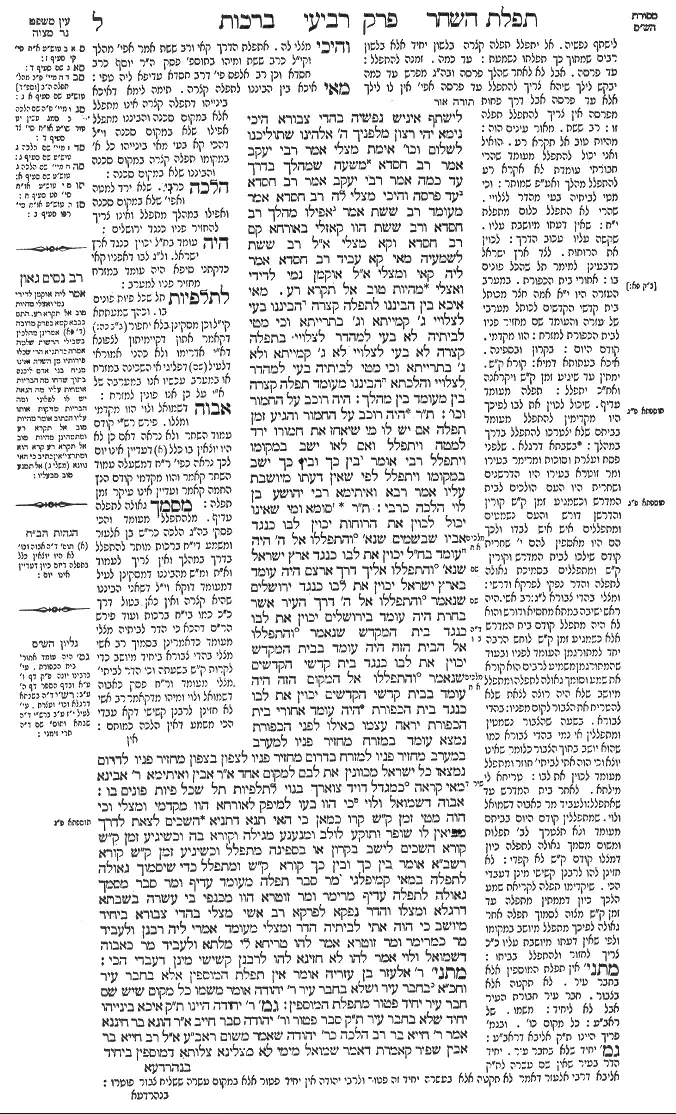
Berakhot 30a - Guemara
לישתף איניש נפשיה בהדי צבורא היכי נימא יהי רצון מלפניך ה' אלהינו שתוליכנו לשלום וכו' אימת מצלי אמר רבי יעקב אמר רב חסדא משעה שמהלך בדרך עד כמה אמר רבי יעקב אמר רב חסדא עד פרסה והיכי מצלי לה רב חסדא אמר מעומד רב ששת אמר אפילו מהלך רב חסדא ורב ששת הוו קאזלי באורחא קם רב חסדא וקא מצלי אל רב ששת לשמעיה מאי קא עביד רב חסדא אמר ליה קאי ומצלי אל אוקמן נמי לדידי ואצלי מהיות טוב אל תקרא רע. מאי איכא בין הביננו לתפלה קצרה הביננו בעי לצלויי ג' קמייתא וג' בתרייתא וכי מטי לביתיה לא בעי למהדר לצלויי בתפלה קצרה לא בעי לצלויי לא ג' קמייתא ולא ג' בתרייתא וכי מטי לביתיה בעי למהדר לצלויי והלכתא הביננו מעומד תפלה קצרה בין מעומד בין מהלך:
היה רוכב על החמור וכו':
תר היה רוכב על החמור והגיע זמן תפלה אם יש לו מי שיאחז את חמורו ירד למטה ויתפלל ואם לאו ישב במקומו ויתפלל רבי אומר בין כך ובין כך ישב במקומו ויתפלל לפי שאין דעתו מיושבת עליו אמר רבא ואיתימא רבי יהושע בן לוי הלכה כרבי:
תר סומא ומי שאינו יכול לכוין את הרוחות יכוין לבו כנגד אביו שבשמים שנא' (מלכים א ח לה) והתפללו אל ה' היה עומד בחל יכוין את לבו כנגד ארץ ישראל שנא' (מלכים א ח מח) והתפללו אליך דרך ארצם היה עומד בארץ ישראל יכוין את לבו כנגד ירושלים שנאמר (מלכים א ח מד) והתפללו אל ה' דרך העיר אשר בחרת היה עומד בירושלים יכוין את לבו כנגד בית המקדש שנאמר (דברי הימים ב ו לב) והתפללו אל הבית הזה היה עומד בבית המקדש יכוין את לבו כנגד בית קדשי הקדשים שנאמר (מלכים א ח לה) והתפללו אל המקום הזה היה עומד בבית קדשי הקדשים יכוין את לבו כנגד בית הכפורת היה עומד אחורי בית הכפורת יראה עצמו כאילו לפני הכפורת נמצא עומד במזרח מחזיר פניו למערב במערב מחזיר פניו למזרח בדרום מחזיר פניו לצפון בצפון מחזיר פניו לדרום נמצאו כל ישראל מכוונין את לבם למקום אחד אר אבין ואיתימא ר' אבינא מאי קראה (שיר השירים ד ד) כמגדל דויד צוארך בנוי לתלפיות תל שכל פיות פונים בו:
אבוה דשמואל ולוי כי הוו בעו למיפק לאורחא הוו מקדמי ומצלי וכי הוה מטי זמן קש קרו כמאן כי האי תנא דתניא השכים לצאת לדרך מביאין לו שופר ותוקע לולב ומנענע מגילה וקורא בה וכשיגיע זמן קש קורא השכים לישב בקרון או בספינה מתפלל וכשיגיע זמן קש קורא רשבא אומר בין כך ובין כך קורא קש ומתפלל כדי שיסמוך גאולה לתפלה במאי קמיפלגי מר סבר תפלה מעומד עדיף ומר סבר מסמך גאולה לתפלה עדיף מרימר ומר זוטרא הוו מכנפי בי עשרה בשבתא דרגלא ומצלו והדר נפקא לפרקא רב אשי מצלי בהדי צבורא ביחיד מיושב כי הוה אתי לביתיה הדר ומצלי מעומד אמרי ליה רבנן ולעביד מר כמרימר ומר זוטרא אמר להו טריחא לי מלתא ולעביד מר כאבוה דשמואל ולוי אמר להו לא חזינא להו לרבנן קשישי מינן דעבדי הכי:
מתני׳ ר' אלעזר בן עזריה אומר אין תפלת המוספין אלא בחבר עיר וחכא בחבר עיר ושלא בחבר עיר ר' יהודה אומר משמו כל מקום שיש שם חבר עיר יחיד פטור מתפלת המוספין:
גמ׳ ר' יהודה היינו תק איכא בינייהו יחיד שלא בחבר עיר תק סבר פטור ור' יהודה סבר חייב אר הונא בר חיננא אמר ר' חייא בר רב הלכה כר' יהודה שאמר משום ראבע אל רב חייא בר אבין שפיר קאמרת דאמר שמואל מימי לא מצלינא צלותא דמוספין ביחיד
Comments from Rashi on Masechet Berakhot Page 30a
לישתף נפשיה . אל יתפלל תפלה קצרה בלשון יחיד אלא בלשון רבים שמתוך כך תפלתו נשמעת: עד כמה . זמנה להתפלל: עד פרסה . אבל לא לאחר שהלך פרסה ובה"ג מפרש עד כמה יבקש לילך שיהא צריך להתפלל עד פרסה אפי' אין לו לילך אלא עד פרסה אבל דרך פחות מפרסה אין צריך להתפלל תפלה זו: רב ששת . מאור עינים הוה: מהיות טוב אל תקרא רע . הואיל ואני יכול להתפלל מעומד שהרי חבורתי עומדת לא אקרא רע להתפלל מהלך ואע"פ שמותר: וכי מטי לביתיה בעי מהדר לצלויי . שהרי לא התפלל כלום מתפלת י"ח: שאין דעתו מיושבת עליו . שקשה עליו עכוב הדרך: לכוין את הרוחות . לצד ארץ ישראל כדבעינן למימר תל שהכל פונים בו: אחורי בית הכפורת . במערב העזרה היו י"א אמה חצר מכותל בית קדשי הקדשים לכותל מערבי של עזרה והעומד שם מחזיר פניו לבית הכפורת למזרח: הוו מקדמי . קודם היום: בקרון ובספינה . איכא בעתותא דמיא: קורא ק"ש . ימתין עד שיגיע זמן ק"ש ויקראנה ואח"כ יתפלל: תפלה מעומד עדיף . שיכול לכוין את לבו לפיכך היו מקדימין להתפלל מעומד בביתם שלא יצטרכו להתפלל בדרך במהלך: בשבתא דרגלא . שלפני פסח ועצרת וסוכות ומרימר בעירו ומר זוטרא בעירו היו הדרשנים ושחרית היו העם הולכים לבית המדרש וכשמגיע זמן ק"ש קורין והדרשן דורש והעם נשמטים ומתפללים איש איש לבדו ולכך הם היו מאספין להם י' שחרית קודם שילכו לבית המדרש וקורין ק"ש ומתפללים בסמיכת גאולה לתפלה והדר נפקי לפרקא ודרשי: ומצלי בהדי צבורא ל"ג: רב אשי . היה ראש ישיבה במתא מחסיא ודורש והוא לא היה מתפלל קודם בית המדרש אלא כשמגיע זמן ק"ש לוחש הרבה יחד למתורגמן העומד לפניו ובעוד שהמתורגמן משמיע לרבים הוא קורא את שמע וסומך גאולה לתפלה ומתפלל מיושב שלא היה רוצה לצאת שלא להטריח את הצבור לקום מפניו: בהדי צבורא . בשעה שהצבור נשמטין ומתפללין אי נמי בהדי צבורא כמו שהוא יושב בתוך הצבור כלומר שאינו יוצא וכי הוה אתי לביתי' חוזר ומתפלל מעומד לכוין את לבו: משמו טריחא לי מילתא . לאחר בית המדרש עד שאתפלל: ולעביד מר כאבוה דשמואל ולוי . שמתפללין קודם היום בביתם מעומד ולא תצטרך לב' תפלות ומשום מסמך גאולה לתפלה כיון דמצלו קודם ק"ש לא קפדי: תפילין מנחנא . והם עדות שממשלת קוני ומשרתו עלי: לא חזינן להו לרבנן קשישי מינן דעבדי הכי . שיקדימו תפלה לקריאת שמע הלכך כיון דממתין מתפלה עד זמן ק"ש מצוה לסמוך תפלה אחר גאולה לפיכך מתפלל מיושב במקומו ולפי שאין דעתו מיושבת עליו כ"כ צריך לחזור ולהתפלל בביתו: מתני' אין תפלת המוספין אלא בחבר עיר . לא תקנוה אלא בצבור. חבר עיר חבורת העיר אבל לא ליחיד: משמו . של ראב"ע: כל מקום כו' . ובגמ' פריך היינו ת"ק אליבא דראב"ע: גמ' יחיד שלא בחבר עיר . יחיד הדר בעיר שאין שם עשרה לת"ק אליבא דרבי אלעזר דאמר לא תקנוה אלא בעשרה יחיד זה פטור ולרבי יהודה אין יחיד פטור אלא במקום עשרה ששליח צבור פוטרו:
Comments from Tosafot - Berakhot 30a
והיכי מצלי לה . אתפלת הדרך קאי ורב ששת אמר אפי' מהלך וקי"ל כרב ששת ומיהו בתוספ' פסק ה"ר יוסף כרב חסדא וכן רב אלפס פי' דרב חסדא עדיפא ליה טפי: מאי איכא בין הביננו לתפלה קצרה . תימה לימא דאיכא בינייהו דתפלה קצרה אינו מתפלל אלא במקום סכנה והביננו מתפלל אפילו שלא במקום סכנה וי"ל דהכי קא בעי מאי בינייהו כל א' במקומו תפלה קצרה במקום סכנה והביננו שלא במקום סכנה: הלכה כרבי . שלא ירד למטה ואפי' שלא במקום סכנה ואפילו במהלך מתפלל ואינו צריך להחזיר פניו כנגד ירושלים: היה עומד בח"ל יכוין כנגד ארץ ישראל . ול"ג לבו דאפניו קאי כדקתני סיפא היה עומד במזרח מחזיר פניו למערב: לתלפיות תל שכל פיות פונים בו . וכהך שמעתתא קי"ל וכן מסקינן בלא יחפור (ב"ב כה:) דקאמר אתון דקיימיתון לצפונא דא"י אדרימו ולא כהני אמוראי דלעיל (שם) דפליגי אי השכינה במזרח או במערב עכשיו אנו במערבה של א"י על כן אנו פונין למזרח: אבוה דשמואל ולוי הוו מקדמי ומצלו . פירש רש"י קודם עמוד השחר ולא נראה דאם כן לא היו יוצאין בו כלל דעדיין אינו יום לכך נראה כפי' ר"ח דמשעלה עמוד השחר קאמר והוו מקדמי קודם הנץ החמה קאמר ועדיין אינו עיקר זמן תפלה: מסמך גאולה לתפלה עדיף . מלהתפלל מעומד והכי פסקי בה"ג הלכה כר"ש בן אלעזר ומשמע די"ח ברכות מותר להתפלל בדרך במהלך ואין צריך לעמוד וא"ת ומ"ש מהביננו דמסקינן לעיל דמעומד דוקא וי"ל דשאני הביננו שהיא קצרה ואין כאן בטול דרך כ"כ כמו בי"ח ברכות ועוד פירש הר"ם דהכא כי הדר לביתיה מצלי מעומד כדאמרינן בסמוך רב אשי מצלי בהדי צבורא ביחיד מיושב כדי לקרות ק"ש בשעתה וכי הדר לביתי' מצלי מעומד ור"ח פסק כאבוה דשמואל ולוי ומיהו מדקאמר רב אשי לא חזינן לרבנן קשישי דקא עבדי הכי משמע דאין הלכה כמותם:
Berakhot 30a - Mishnah translated into english
a person should associate himself with the congregation and should not pray for himself alone. How should he say it? May it be Your will, Lord our God, that You lead us to peace, etc., in the plural.
The Gemara discusses specific details pertaining to this prayer. When does one pray? Rabbi Ya’akov said that Rav Ḥisda said: From when one sets out on his journey, and not before. How long must one’s planned journey be in order to require him to recite this prayer (Ba’al Halakhot Gedolot)? Rabbi Ya’akov said that Rav Ḥisda said: At least a parasang. How does he recite this prayer? Rav Ḥisda said: Only while standing in one place. Rav Sheshet said: Even walking or sitting.
The Gemara relates: Rav Ḥisda and Rav Sheshet were walking along the path, Rav Ḥisda stood and recited the traveler’s prayer. Since he was blind and did not see his colleague, Rav Sheshet asked his servant: What is Rav Ḥisda doing now? His servant said to him: He is standing and praying. Rav Sheshet said to his servant: Stand me up as well and I will pray. Even though Rav Sheshet held that there is no need to stand during this prayer, nevertheless: From being good, do not be called wicked. In other words, one should do better if he is able. Rav Sheshet said that one is not required to stop and stand. He did not say that it is preferable to walk or sit. Since standing in this case required no special effort on his part, as Rav Ḥisda had stopped to stand and pray anyway, why insist on sitting?
The mishna mentioned both a brief prayer recited in times of danger and an abridged prayer, with regard to which there was a dispute between the tanna’im. The Gemara asks: What is the practical halakhic difference between the abridged prayer: Grant us understanding and the brief prayer recited in times of danger? The Gemara answers: One who recites: Grant us understanding is required to recite the first three blessings and the last three blessings of the Amida prayer, and when he reaches his home, he need not pray again. One who recites the brief prayer, however, need recite neither the first three blessings nor the last three blessings of the Amida prayer. However, when he reaches his home, he must pray again. Grant us understanding has the legal status of the Amida prayer, despite its brevity, while the brief prayer is merely recited in place of the Amida prayer in exigent circumstances.
The halakha is: Grant us understanding, as mentioned above, has the legal status of the Amida prayer, and must therefore be recited while standing. The brief prayer, since it does not have that status, may be recited whether one is standing or whether one is walking.
We learned in the mishna: One who was riding on a donkey should dismount and pray. Only in exigent circumstances may he pray while riding, focusing his heart toward Jerusalem and the Holy of Holies. The Sages taught in a Tosefta: One who was riding on a donkey and the time for prayer arrived, if he has someone to hold onto the donkey, he should dismount and pray. If not, he should sit in his place atop the donkey and pray. Rabbi Yehuda HaNasi says: In any case, whether or not there is someone to hold onto the donkey, he should sit in his place atop the donkey and pray, as his mind will not be calm. Since he is hurrying to arrive at his destination, the need to dismount the donkey, stand in prayer, and remount the donkey would delay his journey, and the delay is likely to interfere with his concentration during prayer.
Rava, and some say Rabbi Yehoshua ben Levi, said: The halakha here is in accordance with the opinion of Rabbi Yehuda HaNasi.
The Sages taught in a Tosefta: A blind person and one who is unable to approximate the directions and, therefore, is unable to face Jerusalem in order to pray, may focus his heart towards his Father in Heaven, as it is stated: “And they shall pray to the Lord” (I Kings 8:44).
One who was standing in prayer in the Diaspora should focus his heart toward Eretz Yisrael, as it is stated: “And they shall pray to You by way of their land which You have given to their fathers” (I Kings 8:48).
One who was standing in Eretz Yisrael should focus his heart toward Jerusalem, as it is stated: “And they shall pray to the Lord by way of the city that You have chosen” (I Kings 8:44).
One who was standing in Jerusalem should focus his heart toward the Temple, as it is stated: “And they shall pray toward this house” (II Chronicles 6:32).
One who was standing in the Temple should focus his heart toward the Holy of Holies, as it is stated: “And they shall pray toward this place” (I Kings 8:35).
One who was standing in the Holy of Holies should focus his heart toward the seat of the ark-cover [kapporet], atop the ark, the dwelling place of God’s glory.
One who was standing behind the seat of the ark-cover should visualize himself as if standing before the ark-cover and turn toward it.
Consequently, one standing in prayer in the East turns to face west, and one standing in the West turns to face east. One standing in the South turns to face north, and one standing in the North turns to face south; Consequently, all of the people of Israel focus themselves focusing their hearts toward one place, the Holy of Holies in the Temple.
An allusion to this is found in what Rabbi Avin, and some say Rabbi Avina, said: What verse alludes to this? “Your neck is like the Tower of David, built with turrets [talpiyyot], one thousand shields hang from it, all of the armor of the mighty” (Song of Songs 4:4). He interprets the word talpiyyot as the hill [tel] toward which all mouths [piyyot] turn, i.e., the Temple Mount.
With regard to prayer while traveling, the Gemara relates: When Shmuel’s father and Levi wanted to set out on a journey in the morning, they would pray early before sunrise. When, during their journey, the time to recite Shema would arrive, they recited it.
The Gemara asks: In accordance with whose opinion did they do this? In accordance with this tanna, as it was taught in the Tosefta: One who rose early to set out on his path before the time to recite Shema arrives, they bring him a shofar and he sounds it, if it was Rosh HaShana; a lulav and he takes it on Sukkot; a megilla, the Scroll of Esther, and he reads it on Purim; and when the time comes to recite Shema, he recites it. So too, one who rose early to sit in a wagon or in a boat prays, and when the time comes to recite Shema, he recites it.
Rabbi Shimon ben Elazar, says: In either case, it is preferable to recite Shema and then pray the Amida prayer in the wagon so that he will juxtapose redemption and prayer.
The Gemara explains: Regarding what do they disagree? The Gemara answers: This Sage, the first tanna, holds that prayer while standing is preferable. Therefore, one should pray earlier, at home, while standing. This Sage, Rabbi Shimon ben Elazar, holds that the juxtaposition of redemption and prayer is preferable, even if in doing so one is unable to stand while praying.
On a similar note, the Gemara cites additional circumstances where Sages were forced to make exceptional arrangements to pray. Mareimar and Mar Zutra would gather ten people on the Shabbat of the festival and pray, and set out to deliver their lecture [pirka]. Due to the crowds that gathered to hear the lectures of the Sages on the festival, they were unable to pray at the proper time, so they were forced to pray earlier.
In similar circumstances, Rav Ashi would pray with the congregation individually while seated, so that they would not notice that he was praying. Afterwards, when he would come to his house, he would pray again while standing in order to pray without distraction. The Sages said to him: The Master should do as Mareimar and Mar Zutra do, i.e., gather a prayer quorum at home to pray before the lecture. He said to them: It is burdensome to me to delay the lecture so much. The Sages said to him: The Master should do as Shmuel’s father and Levi did and pray before sunrise. He said to them: I have not seen Sages older than us do that, indicating that this is not the accepted halakha.
MISHNA: Rabbi Elazar ben Azarya says: The additional prayer is only recited in a city where there is a quorum of ten [ḥever ir]. The Rabbis say: One may recite the additional prayer with a ḥever ir or without a ḥever ir. Rabbi Yehuda says another opinion in his name, the name of Rabbi Elazar ben Azarya: Any place where there is a ḥever ir, an individual is completely exempt from reciting the additional prayer.
GEMARA: There is no apparent difference between the opinion of Rabbi Elazar ben Azarya and the opinion cited in his name by Rabbi Yehuda. The Gemara asks: Rabbi Yehuda’s opinion is identical to the opinion of Rabbi Elazar ben Azarya cited by the first tanna. The Gemara answers: There is a practical halakhic difference between them: The case of an individual who is not in a place where there is a ḥever ir. In other words, in a place where there is not a prayer quorum of ten people, the first tanna holds that Rabbi Elazar ben Azarya’s opinion is that the individual is exempt from reciting the additional prayer, as it was only instituted to be recited with a quorum. And Rabbi Yehuda holds that Rabbi Elazar ben Azarya’s opinion is that the individual is obligated to recite the additional prayer, as he is only exempt in a place where there is a prayer quorum, and, therefore, a communal prayer leader fulfills his obligation.
Rav Huna bar Ḥinnana said that Ḥiyya bar Rav said: The halakha is in accordance with the opinion of Rabbi Yehuda, who said it in the name of his mentor, Rabbi Elazar ben Azarya. Rav Ḥiyya bar Avin said to him: You have spoken well, as proven by what Shmuel said: In all my days I have never prayed the additional prayer as an individual
Traduction : The William Davidson digital edition of the Koren Noé Talmud, with commentary by Rabbi Adin Even-Israel Steinsaltz.