 Talmud Bavli
Berakhot 25a : Youtube
Daf TubeYoutube
2 video classes :
Berakhot Page 25a
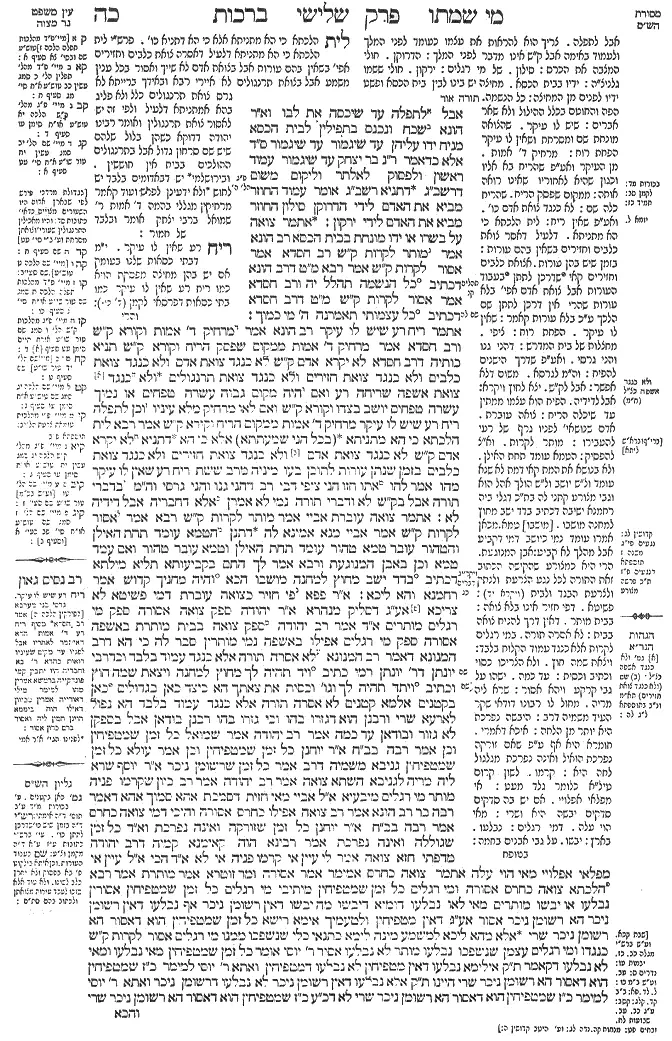
Berakhot 25a - Guemara
אבל לתפלה עד שיכסה את לבו ואר הונא שכח ונכנס בתפילין לבית הכסא מניח ידו עליהן עד שיגמור עד שיגמור סד אלא כדאמר רנ בר יצחק עד שיגמור עמוד ראשון ולפסוק לאלתר וליקום משום דרשבג דתניא רשבג אומר עמוד החוזר מביא את האדם לידי הדרוקן סילון החוזר מביא את האדם לידי ירקון:
אתמר צואה על בשרו או ידו מונחת בבית הכסא רב הונא אמר מותר לקרות קש רב חסדא אמר אסור לקרות קש אמר רבא מט דרב הונא דכתיב (תהלים קנ ו) כל הנשמה תהלל יה ורב חסדא אמר אסור לקרות קש מט דרב חסדא דכתיב (תהלים לה י) כל עצמותי תאמרנה ה' מי כמוך:
אתמר ריח רע שיש לו עיקר רב הונא אמר מרחיק ד' אמות וקורא קש ורב חסדא אמר מרחיק ד' אמות ממקום שפסק הריח וקורא קש תניא כותיה דרב חסדא לא יקרא אדם קש לא כנגד צואת אדם ולא כנגד צואת כלבים ולא כנגד צואת חזירים ולא כנגד צואת תרנגולים ולא כנגד צואת אשפה שריחה רע ואם היה מקום גבוה עשרה טפחים או נמוך עשרה טפחים יושב בצדו וקורא קש ואם לאו מרחיק מלא עיניו וכן לתפלה ריח רע שיש לו עיקר מרחיק ד' אמות ממקום הריח וקורא קש אמר רבא לית הלכתא כי הא מתניתא (בכל הני שמעתתא) אלא כי הא דתניא לא יקרא אדם קש לא כנגד צואת אדם ולא כנגד צואת חזירים ולא כנגד צואת כלבים בזמן שנתן עורות לתוכן בעו מיניה מרב ששת ריח רע שאין לו עיקר מהו אמר להו אתו חזו הני ציפי דבי רב דהני גנו והני גרסי והמ בדברי תורה אבל בקש לא ודברי תורה נמי לא אמרן אלא דחבריה אבל דידיה לא:
אתמר צואה עוברת אביי אמר מותר לקרות קש רבא אמר אסור לקרות קש אמר אביי מנא אמינא לה דתנן הטמא עומד תחת האילן והטהור עובר טמא טהור עומד תחת האילן וטמא עובר טהור ואם עמד טמא וכן באבן המנוגעת ורבא אמר לך התם בקביעותא תליא מילתא דכתיב (ויקרא יג מו) בדד ישב מחוץ למחנה מושבו הכא (דברים כג טו) והיה מחניך קדוש אמר רחמנא והא ליכא:
אר פפא פי חזיר כצואה עוברת דמי פשיטא לא צריכא אעג דסליק מנהרא אר יהודה ספק צואה אסורה ספק מי רגלים מותרים אד אמר רב יהודה ספק צואה בבית מותרת באשפה אסורה ספק מי רגלים אפילו באשפה נמי מותרין סבר לה כי הא דרב המנונא דאמר רב המנונא לא אסרה תורה אלא כנגד עמוד בלבד וכדרבי יונתן דר' יונתן רמי כתיב (דברים כג יג) ויד תהיה לך מחוץ למחנה ויצאת שמה חוץ וכתיב (דברים כג יד) ויתד תהיה לך וגו' וכסית את צאתך הא כיצד כאן בגדולים כאן בקטנים אלמא קטנים לא אסרה תורה אלא כנגד עמוד בלבד הא נפול לארעא שרי ורבנן הוא דגזרו בהו וכי גזרו בהו רבנן בודאן אבל בספקן לא גזור ובודאן עד כמה אמר רב יהודה אמר שמואל כל זמן שמטפיחין וכן אמר רבה בבח אר יוחנן כל זמן שמטפיחין וכן אמר עולא כל זמן שמטפיחין גניבא משמיה דרב אמר כל זמן שרשומן ניכר אר יוסף שרא ליה מריה לגניבא השתא צואה אמר רב יהודה אמר רב כיון שקרמו פניה מותר מי רגלים מיבעיא אל אביי מאי חזית דסמכת אהא סמוך אהא דאמר רבה בר רב הונא אמר רב צואה אפילו כחרס אסורה והיכי דמי צואה כחרס אמר רבה בבח אר יוחנן כל זמן שזורקה ואינה נפרכת ואד כל זמן שגוללה ואינה נפרכת אמר רבינא הוה קאימנא קמיה דרב יהודה מדפתי חזא צואה אמר לי עיין אי קרמו פניה אי לא אד הכי אל עיין אי מפלאי אפלויי מאי הוי עלה אתמר צואה כחרס אמימר אמר אסורה ומר זוטרא אמר מותרת אמר רבא הלכתא צואה כחרס אסורה ומי רגלים כל זמן שמטפיחין מיתיבי מי רגלים כל זמן שמטפיחין אסורין נבלעו או יבשו מותרים מאי לאו נבלעו דומיא דיבשו מה יבשו דאין רשומן ניכר אף נבלעו דאין רשומן ניכר הא רשומן ניכר אסור אעג דאין מטפיחין ולטעמיך אימא רישא כל זמן שמטפיחין הוא דאסור הא רשומן ניכר שרי אלא מהא ליכא למשמע מינה לימא כתנאי כלי שנשפכו ממנו מי רגלים אסור לקרות קש כנגדו ומי רגלים עצמן שנשפכו נבלעו מותר לא נבלעו אסור ר' יוסי אומר כל זמן שמטפיחין מאי נבלעו ומאי לא נבלעו דקאמר תק אילימא נבלעו דאין מטפיחין לא נבלעו דמטפיחין ואתא ר' יוסי למימר כז שמטפיחין הוא דאסור הא רשומן ניכר שרי היינו תק אלא נבלעו דאין רשומן ניכר לא נבלעו דרשומן ניכר ואתא ר' יוסי למימר כז שמטפיחין הוא דאסור הא רשומן ניכר שרי לא דכע כז שמטפיחין הוא דאסור הא רשומן ניכר שרי
Comments from Rashi on Masechet Berakhot Page 25a
אבל לתפלה . צריך הוא להראות את עצמו כעומד לפני המלך ולעמוד באימה אבל ק"ש אינו מדבר לפני המלך: הדרוקן . חולי המצבה את הכרס: סילון . של מי רגלים: ירקון . חולי ששמו גלניצ"ה: ידיו בבית הכסא . מחיצה יש בינו לבין בית הכסא ופשט ידיו לפנים מן המחיצה: כל הנשמה . הפה והחוטם בכלל ההילול ולא שאר אברים: שיש לו עיקר . שהצואה מונחת שם ומסרחת ושאין לו עיקר הפחת רוח: מרחיק ד' אמות . מן העיקר ואע"פ שהריח בא אליו וכגון שהיא לאחוריו שאינו רואה אותה: ממקום שפסק הריח . שהריח כלה שם: לא כנגד צואת אדם כו' ואע"פ שאין ריח: לא כנגד צואת אדם כו' . ואע"פ שאין ריח: לית הלכתא כי הא מתניתא . דלעיל דאסר צואת כלבים וחזירים בשאין בהם עורות: בזמן שיש בהן עורות . אצואת כלבים וחזירים קאי שדרכן לתתן בעבוד העורות אבל צואת אדם אפי' בלא עורות שהרי אין דרכן לתתן שם הלכך ע"כ בלא עורות קאמר: שאין לו עיקר . הפחת רוח: ציפי . מחצלות של בית המדרש: דהני גנו והני גרסי . ואע"פ שדרך הישנים להפיח: וה"מ לגרסא . משום דלא אפשר: אבל לק"ש . יצא לחוץ ויקרא: אבל לדידיה . הפיח הוא עצמו ממתין עד שיכלה הריח: צואה עוברת . אדם שנושאי' לפניו גרף של רעי להעבירו: מותר לקרות . וא"צ להפסיק: הטמא עומד תחת האילן . ולא בנושא את המת קאי דמת לא שנא עומד ול"ש יושב ול"ש הולך אהל הוא וגבי מצורע קתני לה בת"כ דגלי ביה רחמנא ישיבה דכתיב בדד ישב מחוץ למחנה מושבו. [מושבו] טמא. מכאן אמרו עומד נמי כיושב דמי דקביע אבל מהלך לא קביע: אבן המנוגעת . הרי היא כמצורע שהקישה הכתוב זאת התורה לכל נגע הצרעת ולנתק ולצרעת הבגד ולבית (ויקרא יד): פשיטא . דפי חזיר אינו בלא צואה: בבית מותר . דאין דרך להניח צואה בבית: לא אסרה תורה . במי רגלים לקרות אלא כנגד עמוד הקלוח בלבד: ויצאת שמה חוץ . ולא הצריכו כסוי וכתיב וכסית: עד כמה . ישהו על גבי קרקע ויהא אסור: שרא ליה מריה . מחול לו רבונו דודאי שקר העיד משמיה דרב: היבשה נפרכת היא יותר מן הלחה: קרמו . לשון קרום טיל"א כלומר גלד מעט: איכא דאמרי . חומרא היא אף ע"פ שאם זורקה נפרכת הואיל ואינה נפרכת מגלגול לחה היא: אי מפלאי אפלויי . אם יש בה סדקים סדקים יבשה היא ושרי: מאי הוי עלה . דמי רגלים: נבלעו . בארץ: יבשו . על גבי אבנים בחמה:
Comments from Tosafot - Berakhot 25a
פסק רבינו חננאל כרב חסדא דאסור לקרות ק״ש אפילו צואה תחת בגדו על בשרו וס״ל כל עצמותי תאמרנה (תהלים לה) דאע״ג דר' חסדא תלמיד דר' הונא הוה לחומרא אזלינן ורב אלפס פסק כרב הונא מדאקשי גמרא מיניה ביומא פרק הממונה (ד ל.): לית הלכתא כי הא מתניתא אלא כי הא דתניא כו' . פרש"י לית הלכתא כי הא מתניתא דלעיל דאסרה צואת כלבים וחזירים אפי' בשאין בהם עורות אבל בצואת אדם לא שייך ואסור בכל ענין משמע אבל בצואת תרנגולים לא איירי רבא ובאידך ברייתא לא גרס צואת תרנגולים כלל ולא פליג בהא אמתניתא דלעיל ולפי זה יש לאסור צואת תרנגולין ואומר רבינו יהודה דדוקא כשהן בלול שלהם שיש שם סרחון גדול אבל בתרנגולים ההולכים בבית אין חוששין. ובירושלמי יש דבאדומים בלבד יש לחוש ולא ידעינן לפרש ועוד קאמר מרחיקין מגללי בהמה ד' אמות ר' שמואל ברבי יצחק אומר ובלבד של חמור: ריח רע שאין לו עיקר . י"מ דבתי כסאות שלנו בעומק אם יש בהן מחיצה מפסקת הויא כמו ריח רע שאין לו עיקר כמו בתי כסאות דפרסאי לקמן (ברכות ד' כו.): לית הלכתא כי הא מתניתא אלא כי הא דתניא כו' . פרש"י לית הלכתא כי הא מתניתא דלעיל דאסרה צואת כלבים וחזירים אפי' בשאין בהם עורות אבל בצואת אדם לא שייך ואסור בכל ענין משמע אבל בצואת תרנגולים לא איירי רבא ובאידך ברייתא לא גרס צואת תרנגולים כלל ולא פליג בהא אמתניתא דלעיל ולפי זה יש לאסור צואת תרנגולין ואומר רבינו יהודה דדוקא כשהן בלול שלהם שיש שם סרחון גדול אבל בתרנגולים ההולכים בבית אין חוששין. ובירושלמי יש דבאדומים בלבד יש לחוש ולא ידעינן לפרש ועוד קאמר מרחיקין מגללי בהמה ד' אמות ר' שמואל ברבי יצחק אומר ובלבד של חמור:
Berakhot 25a - Mishnah translated into english
However, for prayer, one may not recite it until he covers his heart, because in prayer he addresses God directly and he must dress accordingly.
And Rav Huna said: One who forgot and entered the bathroom while donning phylacteries places his hand on them until he finishes. The Gemara wonders: Does it enter your mind that he can do so until he is finished? Rather, as Rav Naḥman bar Yitzḥak said: Until he finishes discharging the first mass of feces, at which point he can step out and remove his phylacteries. The Gemara asks: Let him stop immediately when he realizes that he is donning phylacteries and stand and step out. The Gemara replies: He cannot do so because of the statement of Rabban Shimon ben Gamliel. As it was taught in a baraita: A mass of feces that is held back without having been discharged causes a person to suffer from dropsy [hidrokan], while a stream of urine that is held back causes a person to suffer from jaundice [yerakon]. Since there is potential danger, the Sages did not require him to step out.
It was stated that the Sages disagreed with regard to one who had fecal matter on his skin or whose hand, but not the rest of his body, was placed inside the bathroom. Under those circumstances, Rav Huna said: He is permitted to recite Shema. Rav Ḥisda said: He is prohibited from reciting Shema. Rava said: What is the reason for Rav Huna’s opinion? As it is written: “Let every soul [neshama] praise the Lord; Halleluya” (Psalms 150:6), which he interprets as “Let everything that has breath” [neshima]. As long as the mouth with which one recites praise is in a place of purity, the location of the other limbs of his body is irrelevant.
And Rav Ḥisda said: He is prohibited from reciting Shema. What is the reason for Rav Ḥisda’s opinion? As it is written: “All of my bones shall say: Lord, who is like You” (Psalms 35:10). Since this praise is undertaken with one’s entire body, he may not recite Shema even if just one limb is not appropriately clean.
It was said that the Sages disagreed over a similar issue: What is the legal status of a foul odor that emanates from a visible source? Rav Huna said: He distances himself four cubits from the source of the odor and recites Shema. And Rav Ḥisda said: The source is irrelevant; he distances himself four cubits from the place that the odor ceased and recites Shema.
The Gemara notes that it was taught in a baraita in accordance with the opinion of Rav Ḥisda: A person may not recite Shema opposite human excrement, dog excrement, pig excrement, chicken excrement, a foul-smelling dung-heap or anything repulsive. However, if the filth were in a place ten handbreadths above or ten handbreadths below him, he may sit alongside it and recite Shema, as a height disparity of ten handbreadths renders it a separate domain. And if the filth were not ten handbreadths above or below him, he must distance himself until it remains beyond his range of vision. And the same is true of prayer. However, from a foul odor with a visible source, he distances himself four cubits from the place that the odor ceased and recites Shema.
Rava said: The halakha is not in accordance with this baraita in all of these rulings, but rather in accordance with that which was taught in another baraita: One may neither recite Shema opposite human excrement under all circumstances, nor opposite pig excrement, nor opposite dog excrement into which skins had been placed for tanning, but other materials do not defile the venue of prayer.
They raised a dilemma before Rav Sheshet: What is the legal status of a foul odor that has no visible source, e.g., flatulence? He said to them: Come and see these mats in the study hall, as these students are sleeping on them and these other students are studying, and they are not concerned about foul odors. However, this only applies to Torah study because there is no alternative, but not to the recitation of Shema. And with regard to Torah study we said that it is permitted only when the odor originated with another, but not when it originated with himself.
It was stated that the Sages disagreed over a parallel issue: What is the law with regard to feces passing before him, being moved from place to place? Abaye stated: One is permitted to recite Shema opposite it, while Rava said: One is forbidden to recite Shema opposite it.
Abaye said: From where do I say this halakha? I say this on the basis of what we learned in a mishna: One who is afflicted with biblical leprosy renders the area beneath any covering under which he is located ritually impure. In a case where the ritually impure leper is standing under the branches of a tree and a ritually pure person passes under the branches of that same tree, the pure person is rendered impure, as the entire area under that covering is impure. However, if the pure person is standing under the tree and the impure leper passes, he remains pure. And if the leper stopped under the tree, the pure person is immediately rendered impure. The same is true with regard to a stone afflicted with biblical leprosy (see Leviticus 14), in that if it is merely being moved from place to place, it does not cause impurity. The upshot is that impurity is only disseminated in all directions when the source of the impurity is stationary.
And Rava could have said to you: There, in the case of leprosy, it is contingent upon the permanence of the place, as with regard to the leper it is written: “He shall dwell alone; outside the camp shall his dwelling be” (Leviticus 13:46). His impurity is in his permanent dwelling-place. Here, with regard to the obligation to distance oneself from something repulsive, the Torah stated the principle: “And your camp shall be holy” (Deuteronomy 23:15), and there is no holiness in those circumstances.
On this topic Rav Pappa said: The mouth of a pig is like passing feces. The Gemara asks: That is obvious. The Gemara replies: No, this halakha is only necessary to teach that even though the pig emerged from the river and one might assume that its mouth was thereby cleansed, it never becomes completely clean.
Rav Yehuda said: If there is uncertainty as to the presence of feces, e.g., whether something is or is not feces, and therefore whether or not one is permitted to utter sacred matters in its presence, it is prohibited to do so. However, if there is uncertainty as to the presence of urine, it is permitted to do so. Some say an alternative version of this. Rav Yehuda said: If there is uncertainty as to the presence of feces, in the home one may assume that there is no feces present and it is permitted to speak sacred matters, but if there is doubt as to the presences of feces in the dung-heap it is forbidden to do so. If there is uncertainty as to the presence of urine, however, even in the dung-heap it is permitted to do so.
He holds in accordance with that which Rav Hamnuna said, as Rav Hamnuna said: The Torah prohibited the utterance of sacred matters only opposite the stream of urine.
And in accordance with the opinion of Rabbi Yonatan, as Rabbi Yonatan raised a contradiction between two verses: On the one hand it is written: “You shall also have a place outside the camp, to which you will go” (Deuteronomy 23:13), meaning that one must exit the camp before attending to his bodily needs but there is no obligation to cover it; and it is written in another verse: “And you shall have a spade among your weapons; and when you ease yourself outside, you shall dig with it, and turn back and cover your excrement” (Deuteronomy 23:14), indicating a clear obligation to conceal one’s excrement.
He resolves this contradiction: How is this resolved? Here, where one is required to conceal his bodily needs, it refers to feces; here, where there is no requirement to conceal his bodily needs, it refers to urine. Consequently, with regard to urine, reciting Shema was only prohibited by Torah law opposite the stream of urine, but once it has fallen to the ground, it is permitted. And the Sages are those who issued a decree with regard to urine. And when they issued a decree, it was only in a case of their certain presence, but in a case of their uncertain presence, they did not issue a decree.
The Gemara asks: In a case of the certain presence of urine, until when and in what state does its presence preclude one from uttering sacred matters? Rav Yehuda said that Shmuel said: As long as it is wet enough to moisten the hands of one who touches it. And so too Rabba bar bar Ḥana said that Rabbi Yoḥanan said: As long as it moistens. And so too Ulla said: As long as it moistens. Geniva in the name of Rav said: It is forbidden as long as its mark is apparent on the ground.
Rav Yosef said: May God, his Master, forgive Geniva, as Rav could have said no such thing. Now, in the case of feces, Rav Yehuda said that Rav said: Once its surface has dried sufficiently to form a crust, one is permitted to utter sacred matters opposite it; is it necessary to say that opposite urine it is permitted once it dries?
Abaye said to him: What did you see that led you to rely on that halakha? Rely on this halakha; as Rabba bar Rav Huna said that Rav said: Uttering sacred matters opposite feces, even if it is as dry as earthenware, is prohibited.
The Gemara asks: What are the circumstances of feces like earthenware? Rabba bar bar Ḥana said that Rabbi Yoḥanan said: As long as one throws it and it does not crumble, it is still considered moist. And some say: As long as one can roll it from place to place and it does not crumble.
Ravina said: I was standing before Rav Yehuda of Difti when he saw feces. He said to me: Examine it and see whether or not its surface has dried sufficiently to form a crust. Some say that he said to him as follows: Examine it and see if it is cracked, as only then is it considered dry.
Since several opinions were expressed on the subject, the Gemara asks: What halakhic conclusion was reached about this? It was stated that the halakha is subject to dispute: Reciting sacred matters opposite feces as dry as earthenware; Ameimar said: It is prohibited, and Mar Zutra said: It is permitted. Rava said that the halakha is: Opposite feces as dry as earthenware it is prohibited, and opposite urine, it is prohibited as long as it moistens.
The Gemara raises an objection based on what was taught in a baraita: Urine, as long as it moistens it is prohibited. If it was absorbed into the ground or dried in place, it is permitted. What, is urine that was absorbed not similar to urine that dried? Just as when it dries its mark is no longer apparent, so too when it is absorbed, its mark is no longer apparent and then it is permissible. But when its mark is apparent, it is prohibited, even though it no longer moistens.
The Gemara raises a difficulty to counter this: And according to your reasoning, say the first clause: As long as it moistens it is prohibited, from which one can infer: But if it does not moisten, but its mark is apparent, it is permitted. Rather, no inference beyond its basic meaning can be deduced from this baraita, as the inferences are contradictory.
The Gemara notes: Let us say that this is parallel to a dispute between the tanna’im, as it was taught a baraita: It is forbidden to recite Shema opposite a vessel from which urine was poured. However, the urine itself that was poured, if it was absorbed it is permitted; if it was not absorbed, it is prohibited. Rabbi Yosei disagrees and says: It is prohibited as long as it moistens.
The Gemara clarifies this dispute: What is the meaning of absorbed and not absorbed in what the first tanna says? If you say that absorbed means that it does not moisten and not absorbed means that it moistens, and Rabbi Yosei came to say: As long as it moistens it is prohibited, but if there is no moisture but its mark is apparent, it is permitted. If so, that is identical to the opinion of the first tanna and there is no dispute at all. Rather, absorbed means that its mark is not apparent and not absorbed means that its mark is apparent. And Rabbi Yosei came to say: As long as it moistens, it is prohibited, but if there is no moisture but its mark is apparent, it is permitted, in which case the dispute in our Gemara is parallel to this tannaitic dispute.
The Gemara states that it is not necessarily parallel: No, everyone, both tanna’im, agrees that as long as it moistens, it is prohibited, and if there is no moisture but its mark is apparent, it is permitted.
Traduction : The William Davidson digital edition of the Koren Noé Talmud, with commentary by Rabbi Adin Even-Israel Steinsaltz.